To avoid these ads, REGISTER NOW!

Air compressor explosion

Davefr

Well-known member
Joined
Jan 7, 2010
Messages
11,815
Location
OR
Isn't a tank always expanding and contracting slightly with each cycle of the pump?

Given enough cycles you'd eventually have metal fatigue and catastrophic rupture.

How to you catch this before it's too late? It's not visual like rust.

You can leave them off when not in use, drain them, test the pressure relief valve but what else can you do to test for fatigue.

Hydrotest the tank at certain intervals? Decommission the tank after X # of years or Y # of cycles?

It reminds me of Aloha Airlines Flt #243. One too many pressurization cycles??:
b737-200-aloha-hawaii.jpg
 
To avoid these ads, REGISTER NOW!

rlitman

Well-known member
Joined
Oct 18, 2010
Messages
24,576
Location
Long Island
Metal fatigue is not quite that simple. The cyclic strain is one requirement of metal fatigue, but another is that the static and dynamic loads are above a threshold.
By designing a pressure vessel with rounded features to prevent stress risers, and using ample thickness steel, metal fatigue is not really an issue in air compressor cylinders.
Oh, and steel is much harder to fatigue than aluminum btw.
 

mackwrench

Well-known member
Joined
Jan 7, 2012
Messages
2,137
Location
Florida
Had a gas powered compressor mounted inside a small utility trailer that was used to do on site fleet stuff...like the kind a tire repair road guy would have .some novice put a pipe plug in the pop off exhaust "because it was leaking" next time it was started, it blew the end out of tank, went though Trailer side and rolled about 100 feet, slinging the gas engine off....made a hell of a mess....and it was bolted to trailer floor.
 

jaker10

Well-known member
Joined
Sep 18, 2011
Messages
371
Location
Bartonvillle Illinois
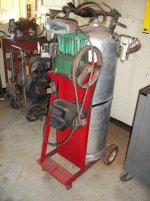
Found an add on craigs list for a home built air compressor. Would you buy this after reading this thread, NOT ME.
 

Attachments

  • 00F0F_agLJSYqGhyW_600x450 (337x450).jpg
    00F0F_agLJSYqGhyW_600x450 (337x450).jpg
    39.1 KB · Views: 205

boomer12831

Well-known member
Joined
Jan 6, 2013
Messages
526
Location
northern New York
I remember one of Richard Petty's crew members, I think it was his cousin or brother in law, was killed when a tank exploded during a race. I don't know if it was an air compressor or just a tank. I was in high school and had built my own compressor. My father was not to happy about my compressor and I think it disappeared soon after. This might come under the thread " Things my Father taught me" Ed.
 

djjsr

Well-known member
Joined
Sep 4, 2006
Messages
4,796
Location
In the cornfields
I don't get much water in my tank so I pop the relief valve for about 2 seconds once a month when I drain the tank. I've never seen one stuck closed but I have seen them leak. I don't think rust is an issue because they are brass. If yours is getting gunked up or rusty, you've got something wrong.
 

OccupantRJ

Well-known member
Joined
May 15, 2009
Messages
10,906
Location
Eastern North Carolina
Found an add on craigs list for a home built air compressor. Would you buy this after reading this thread, NOT ME.

I would not buy that particular one, but I would have no problem building my own, using a new tank, for several reasons. First, it is a helluva design space and portability wise.

A new LP tank is likely rated to 300 psi. The design gets the motor off the tank, and also the vibration, which from my experience, causes weld fractures at the motor plate/tank interface. I have two units at work that the tanks have failed from this, and have seen several more. The state allows me to remove all pipe attachments from the tanks, leaving open holes, then simply use the tanks as motor mounts.

Piping was run to new receiver tanks instead of replacing the existing tanks because they would also likely crack from the vibration. It also costs as much or more to do a certified repair on the tank than it does to buy a new one. A state certified weld repair would have been $850 on each tank.
 

Doozer75

Well-known member
Joined
Oct 24, 2009
Messages
260
Location
Buffalo NY
Since I can remember, maybe 5 or so years old,
my father's Sears air compressor had sheet metal
screws with rubber washers plugging holes in the
bottom of the tank. Later in life I learned how
dangerous this tank was. For at least 10 years
or more I told him how dangerous his compressor
tank was, like a bomb in waiting. He never took
me seriously. Well after 10 hears of telling him,
I bought another brand new 20 gallon tank for
him and switched the pump and motor over to
this new tank, seeing he would never listen to
me and get a new one himself.
Well I cut apart the old tank with a grinder.
Cut it clean in half right down the middle.
The bottom was as thick as a sheet of paper.
There were like 5 sheet metal screw plugs,
to the point where they had nothing left to
bite into. You could fold the metal of the tank
up with your hand easy as nothing. He was
very surprised, but it still did not phase him
as to the danger that was.
Good thing I bought him that tank.
Who knows I might have saved his life.
Also, the good parts of the tank were less
than 1/8" thick. Maybe 12 gauge, not sure.
The tank I bought was a full 1/4" thick steel
as has the Pressure Vessel Inspection Tag
on it, (don't remember the exact name for
this, maybe boiler code certified, I forget).
So it was the real deal. Not a cheap thin
consumer grade grenade. By the way,
those tire inflation tanks are thin azz steel,
and not to be trusted. Don't get any fancy
ideas about using them.

--Doozer
 

mmouse

Well-known member
Joined
Sep 4, 2010
Messages
92
Speaking seriously now, so don't send me to the corner. I've heard of lots of leaking tanks that don't explode. I'd be willing to bet that exploding compressors are the result of rusty tanks AND a safety device NOT doing it's job. But like the last poster said, his old thin tank did not explode. Now blow it up to enormous pressure, and you're going to have a problem.
 

brianpgriset

Well-known member
Joined
Sep 29, 2006
Messages
1,036
Location
Beaumont, TX
Respect the power that is stored in the compressed air, and maintain your compressor and lines.

fer instance:

1 hp = 746 watts = 550 ft-lb/sec

So if a little compressor with a little 1 hp motor ran for two minutes to fill up the tank before shutting off, then the motor ended up inputting

550 ft-lb/sec x 120 sec = 66,000 ft-lb of "work" done

Let's even throw in some efficiency factors of 80% for the electric motor and 80% for the air pump.

66,000 ft-lb x .8 (motor efficiency) x .8 (pump efficiency) = 42,240 ft-lbs of "work" or "energy" available.

So, thinking of it in another way, in those two minutes that the electric motor was running, it could have lifted 42,240 lbs one foot into the air (geared down or reduction pulleys or whatever).

Or 21,120 lbs lifted two feet into the air. Etc, etc, etc.

Jumping into SI units for a moment, where work=energy is measured in joules, we have (1 ft-lb = 1.4 J) 59,136 J.

Which is more energy than the muzzle energy of a 'elephant gun', about the energy contained in the combustion of 1 gram of gasoline, more than the energy contained in 1 gram of TNT, about the energy in a car moving about 25 mph, etc, etc, etc. But less than the energy contained in a 280 calorie candy bar. :D

http://en.wikipedia.org/wiki/Orders_of_magnitude_(energy)

Drop that weight suddenly and it can make a rather big smash/crash/boom.

That's a rough measure of how much "energy" has been input into the 'system' and is now stored in that compressed air in the tank.

And that's for our example 'little' 1 hp electric motor filling the tank in 2 minutes.

You have a bigger tank with a bigger motor that takes longer to fill up? Then even more energy is stored in that tank full of compressed air.

Which is 'good', because we can then use that energy from the compressed air to do some useful things, like turning it back into some sort of mechanical work like an impact wrench or a die grinder or whatever pneumatic tool you want to use at the moment.

But if that energy in that compressed air somehow is released 'instantly' and in an uncontrolled and unexpected manner (such as a tank or pipe suddenly bursting), then there can be various negative effects. Ranging from a need to change the shorts, to a need to clean up or repair broken items (damage to items), to a need for medical attention (injury), to a need for a mortician (fatality).

Respect the energy that is contained in compressed gases and maintain the equipment.

Most of the time, tank or metal pipe failures are on the more 'graceful' end of the failure spectrum. ie: a leak develops.

But not always. Sometimes, the item releases the compressed air rather suddenly and zips/peels/splits open rather forcefully and can launch or propel items (including the tank or other things in the vicinity) forcefully.

Respect and maintain.

For those well versed in pressure vessel code there is actually a calculation in ASME PCC2 that gives an equivalent weight of dynamite for pneumatic pressure tests. :beer:
 

brianpgriset

Well-known member
Joined
Sep 29, 2006
Messages
1,036
Location
Beaumont, TX
Metal fatigue is not quite that simple. The cyclic strain is one requirement of metal fatigue, but another is that the static and dynamic loads are above a threshold.
By designing a pressure vessel with rounded features to prevent stress risers, and using ample thickness steel, metal fatigue is not really an issue in air compressor cylinders.
Oh, and steel is much harder to fatigue than aluminum btw.

That threshold is known as the "endurance" limit.

And you are spot on about aluminum, I fact aluminum has NO endurance, meaning with enough cycles, even at minimal strain, it will fatigue, unlike steel.
 

jwith68

Well-known member
Joined
Jan 10, 2006
Messages
1,639
Location
EC Missouri
I would not buy that particular one, but I would have no problem building my own, using a new tank, for several reasons. First, it is a helluva design space and portability wise.

A new LP tank is likely rated to 300 psi. The design gets the motor off the tank, and also the vibration, which from my experience, causes weld fractures at the motor plate/tank interface. I have two units at work that the tanks have failed from this, and have seen several more. The state allows me to remove all pipe attachments from the tanks, leaving open holes, then simply use the tanks as motor mounts.

Piping was run to new receiver tanks instead of replacing the existing tanks because they would also likely crack from the vibration. It also costs as much or more to do a certified repair on the tank than it does to buy a new one. A state certified weld repair would have been $850 on each tank.

And how are you going to drain the condensate out of the LP tank? Have a state certified welder add a drain bung to it?
 

nehog

Well-known member
Joined
Jan 2, 2010
Messages
7,935
Location
Jaffrey, NH
If high pressure isn't an issue, why not get aluminum tanks to avoid the rust? Or do they rust anyway?

Aluminum will metal fatigue very quickly leading to exactly the situation you are trying to avoid.

Improved rust protection to the inside of the tank is a much better idea--hot water heater tanks are protected and there's no reason why not to do similar things to air-compressor storage tanks. The cost would probably be minimal.
 

OccupantRJ

Well-known member
Joined
May 15, 2009
Messages
10,906
Location
Eastern North Carolina
And how are you going to drain the condensate out of the LP tank? Have a state certified welder add a drain bung to it?

Simple. Mount the tank upside down on the modern guard ring and pipe it so the infeed also becomes the drain point. The pressure relief valve can be in the line feeding the tank.
 

DenisG

Well-known member
Joined
Jul 14, 2013
Messages
1,278
Location
Milwaukee
Here's a link to a study guide for an exam for qualifying NYC firemen to issue "Certificates of Fitness" for compressed air receivers: http://goo.gl/ICPSdr (shortened long link).

Or you can google the title of the document: "STUDY MATERIALS FOR THE
CERTIFICATE OF FITNESS EXAMINATION FOR
TESTING AIR RECEIVERS"

It discusses hydrostatic testing (among other things).
 
Last edited:

jwith68

Well-known member
Joined
Jan 10, 2006
Messages
1,639
Location
EC Missouri
Simple. Mount the tank upside down on the modern guard ring and pipe it so the infeed also becomes the drain point. The pressure relief valve can be in the line feeding the tank.

That will ensure that the tank never has any liquid moisture condensed in it. But that means that all the moisture (condensed or not) will be headed on out into the rest of the system. There's a reason why vertical air receivers are designed with the drain on the bottom and outlet on the side. Your receiver is the first line of defense against a wet air system and all the issues that brings.
 
To avoid these ads, REGISTER NOW!

Kev442

Well-known member
Joined
Jan 15, 2009
Messages
5,386
Location
Wi
I've often considered buying enough chain link fence to go around my older upright compressor 3 or 4 times. A mega tire cage so to speak, I'd feel better being around it at least.
 

texasOFT

Well-known member
Joined
Dec 1, 2009
Messages
158
Location
Texas Panhandle
Had an air tank (+/- 5 gallon) for the air brakes on a trailer rupture due to pop off failing. Tank came off the mount and wound up in 3 pieces - 2 end caps and the rolled section ended up a flat piece. Lucky it was up in the frame or it could have done some serious damage to something.
 

HotrodHR

Well-known member
Joined
Nov 22, 2009
Messages
445
Location
North Alabama
Interesting discussion...

I don't want to make light of the man's death, but there must be more to the story... Died after having leg amputated at the knee? Is this one of those health care horror stories we hear about?
 

icsamerica

Member
Joined
Oct 16, 2013
Messages
16
few thoughts, please chime in....

I have my compressor in my basement utility room which is near a family room just separated by a sheet rock wall and wood door. What would contain a rupture? Should I build a cement block wall on the utility room side?

Perhaps a length of PEX is a good fail safe. It is likely to split open under the high pressure that would occur if the safety blow off valve jams.

I have my compressor plumbed with a length of PEX until it reached the garage then it transitions to copper which I thought was a cop out but now seems like a good idea.
 
Last edited:

rlitman

Well-known member
Joined
Oct 18, 2010
Messages
24,576
Location
Long Island
Re: few thoughts, please chime in....

What would contain a rupture? Should I build a cement block wall on the utility room side?

Perhaps a length of PEX is a good fail safe. It is likely to split open under the high pressure that would occur if the safety blow off valve jams.

Contain a rupture? <laugh/sigh> Good luck with that one!

No, using PEX as a failsafe is just plain dumb.
There is a reason to have a safety valve. If you don't trust it, pull it off, stick in a tee, and screw in two safety valves. Or put a tee somewhere in your plumbing between the tank and the regulator and put in an extra safety valve there.
 
Last edited:

mellamoesrico

Well-known member
Joined
Aug 13, 2011
Messages
54
I've considered the possibility of adding a rupture disk in parallel with the pressure relief valve. With no moving parts to fail, it would make a great backup to the PSV. I imagine you could unscrew the PSV from the tank, screw in on leg of a TEE fitting where PSV used to reside. Then screw the PSV into second leg of the TEE, and add the rupture disk to the third leg of the TEE. Only problem would be finding a disk the right size and pressure rating.
 

6768rogues

Banned
Joined
Nov 28, 2007
Messages
4,524
Location
Western NY
My father had a tank that exploded. It was a vertical tank mounted in a loft and plumbed into the system. It was forgotten and never drained. The bottom weld joint gave way and the bottom blew out except about an inch, which made the bottom hinge open. My father was in the building but had just stepped out from under the area where the tank was located. The bottom of the tank blew a hole in the loft floor and flying debris ripped a sink off the wall and the door off its hinges. The tank went up and broke a roof truss and lifted the roof up a little off the building. A neighbor about 500 feet away in his house heard the explosion and came running. My father had some superficial scrapes from flying debris and was lucky he stepped away in time.
After he passed away I was cleaning up scrap metal around the farm and found that tank.
 

mryyc

Well-known member
Joined
Mar 30, 2012
Messages
72
Location
Calgary, AB
If you're looking to contain a rupture - good luck. I can tell you that this cinder block wall didn't do it very well though.

compressor.jpg
 

Vinman

New member
Joined
Apr 11, 2011
Messages
4
Location
Calgary, Alberta, Canada
Re: few thoughts, please chime in....

Contain a rupture? <laugh/sigh> Good luck with that one!

No, using PEX as a failsafe is just plain dumb.
There is a reason to have a safety valve. If you don't trust it, pull it off, stick in a tee, and screw in two safety valves. Or put a tee somewhere in your plumbing between the tank and the regulator and put in an extra safety valve there.

I just did some maintenance on my 60 gallon compressor and installed a Tee fitting along with a second PRV after reading about a compressor failure a while ago, cheap insurance.
 

RustFarmer

Well-known member
Joined
Mar 5, 2010
Messages
246
Location
The Rust Belt
July 23, 2005 - Orange Auto Handwash - California
A Car Wash Supervisor Died When an Air Tank Exploded in a Car Wash Equipment Room

"The test results of a failure analysis laboratory concluded there were products of combustion in the air tank that were most likely caused by the wrong viscosity of oil being used in the air compressor.

When OEM oil is not used, studies have shown that the oil may leak past the seals and gaskets and form carbon deposits in the supply line. As the diameter of the supply line decreases because of the carbon deposits, the compressed air, which is already at a high temperature, will increase even more, to the point where it might be possible to ignite the carbon deposits. If this should happen, and a piece of ignited carbon gets into the air tank, it could cause an internal explosion. This type of explosion would vary in intensity based on the amount of oil vapor within the tank. Air tank relief valves are not designed for this type of activity, and the air tank could explode, causing severe damage and injury.

The practical prevention measure to take to avoid such an incident is to maintain air compressor equipment in a safe operational condition and to use only the grade of oil recommended by the manufacturer."

https://www.osha.gov/pls/imis/accidentsearch.accident_detail?id=201146958

http://www.cdc.gov/niosh/face/stateface/ca/05ca010.html#investigation
 

MN4x4

Well-known member
Joined
Sep 5, 2010
Messages
1,443
Location
Minnesnowta
Re: few thoughts, please chime in....

I have my compressor in my basement utility room which is near a family room just separated by a sheet rock wall and wood door. What would contain a rupture? Should I build a cement block wall on the utility room side?

Perhaps a length of PEX is a good fail safe. It is likely to split open under the high pressure that would occur if the safety blow off valve jams.

I have my compressor plumbed with a length of PEX until it reached the garage then it transitions to copper which I thought was a cop out but now seems like a good idea.

Build your 'containment room' out of 3/4" plywood, then cover it and all seams with roll-on bedliner. Mythbusters did a segment on this and it made an amazingly effective blast curtain.

Just remember to leave an outlet for your pressure - someplace for it to dissipate if the tank blows. Usually people will allow it to blow 'UP' since that is least likely to injure anyone.
 
Last edited:

djjsr

Well-known member
Joined
Sep 4, 2006
Messages
4,796
Location
In the cornfields
Think about a "blow-out wall". It's common in industry where you have things like chemical storage. The enclosed structure (room) can be built very strong but should have one wall (or panel) that is substantially weaker that will blow out and direct the energy of an explosion.

I've seen it done with block construction where one wall has blocks that aren't staggered or reinforced, making it the weakest.
 

jwith68

Well-known member
Joined
Jan 10, 2006
Messages
1,639
Location
EC Missouri
I am a mechanical engineer and have worked with commercial refrigeration systems my entire career. These systems are typically more complex than an air system, have higher pressures, and have liquid in sections of them, so there are hydrostatic concerns as well. On the plus side, there is no water in these systems, so internal PV corrosion is not a concern.

There is a basic pressure safety protocol that is followed with most all of them, and it is effective - I have been in the industry almost 24 years and have never seen or heard of a burst pressure vessel on a system. The basic protocol is 3 levels of safety. First level is a high pressure limit built into the control system, typically read off a pressure transducer. Unfortunately, this is the component that is not in most air systems of the size we are talking about. The second level is an electromechanical safety, much like the pressure switch on most air compressors. It is set a bit above the control system's limit, usually by about 25 psi. The third and final level is a pressure relief valve, set about another 25 psi above the electromechanical switch. These are industrial valves, sized based on the volume of gas/liquid in the system they are protecting. You don't want to vent refrigerant to atmosphere, but that is preferable to a burst pressure vessel. This last level must still be below the maximum working pressure of the lowest pressure rated component in that section of the system. So, if there is an over pressure situation, the system controller should see it, and shut the system down. If it fails, the electromechanical switch will activate shortly thereafter and shut the system down. If both of those fail, the pressure relief valve will vent to prevent the system pressure from exceeding the MWP of the system.

As I see it, it would not be too difficult to implement the same type of control system on most 60 gallon or larger compressors, because the 2 higher levels are basically already there. Not too difficult, but not cost effective. It would be much more effective to maintain the safety's that are there, by:
1) Drain your tank! Regularly!
2) Check your CI/CO pressures once in a while. Is it cutting out at 120, or 135, or 175 psig like it's supposed to?
3) Check your PRV when you drain your tank. Does it vent robustly and reseal properly? If not, replace it - they are cheap.

The idea of putting a second PRV in parallel with the original via a "T" is also a good one. That is done regularly, often by code, on large refrigeration systems. That is a cheap, easy, and effective way to add safety redundancy.

Okay, enough of the engineer talk. Merry Christmas all!
 

xSoFx

Banned
Joined
Nov 30, 2013
Messages
32
I've considered the possibility of adding a rupture disk in parallel with the pressure relief valve. With no moving parts to fail, it would make a great backup to the PSV. I imagine you could unscrew the PSV from the tank, screw in on leg of a TEE fitting where PSV used to reside. Then screw the PSV into second leg of the TEE, and add the rupture disk to the third leg of the TEE. Only problem would be finding a disk the right size and pressure rating.

I couldn't tell you where to get them.. But we use them at work for all of our industrial equipment as failsafes.
 

xSoFx

Banned
Joined
Nov 30, 2013
Messages
32
For anyone that is interested, a quick search led me to this.

1 Atmosphere=14.695 PSI

So most household air compressors are about 150 PSI max.

150 PSI = 10.207 Atmosphere.

With that being said, the pressure inside your compressor tank is about the same pressure you would feel at ~305 feet beneath the ocean surface.

Although this may not be a direct calculation, it gives you a general idea.
 

rlitman

Well-known member
Joined
Oct 18, 2010
Messages
24,576
Location
Long Island
...The basic protocol is 3 levels of safety. First level is a high pressure limit built into the control system, typically read off a pressure transducer. Unfortunately, this is the component that is not in most air systems of the size we are talking about. The second level is an electromechanical safety, much like the pressure switch on most air compressors. It is set a bit above the control system's limit, usually by about 25 psi. The third and final level is a pressure relief valve, set about another 25 psi above the electromechanical switch. These are industrial valves, sized based on the volume of gas/liquid in the system they are protecting. You don't want to vent refrigerant to atmosphere, but that is preferable to a burst pressure vessel. This last level must still be below the maximum working pressure of the lowest pressure rated component in that section of the system...

The idea of putting a second PRV in parallel with the original via a "T" is also a good one. That is done regularly, often by code, on large refrigeration systems. That is a cheap, easy, and effective way to add safety redundancy.

As you said, on an air compressor, the electromechanical switch performs the first two functions, and doing it that way, you lose some safety redundancy.

The pressure relief valve must be rated not only to release before the system reaches dangerous pressures, but must also be able to vent air more quickly than a running pump can supply it. This is not really an issue on smaller systems though.

The reason that a typical pressure relief valve is mounted on the top of the tank, is so that it stays away from the rust and dirt inside that could clog it. A burst disc would in theory be more resilient, but shouldn't be necessary.
If a second PRV helps you sleep, then by all means, put one in. Just don't bypass the factory one, and if you keep the tank regularly drained, it is not likely to fail.

There is actually one more safety control you forgot about.
The motor should have a thermal cutout. That way, if the pressure release valve (or a burst disc) opens, the continuously running motor does not start a fire. This would also come into play if the plumbing between the pump and the check valve failed or burst. That part of the system is not protected by a PRV, and can reach burst pressures if the check valve gets stuck shut (although stuck open is the normal way it fails). In my case, an intercooler line broke due to vibration, and the motor was running continually until the thermal cutoff shut it.
 

Clik

Well-known member
Joined
Jan 1, 2011
Messages
430
Location
Highest Mountain in Western, MD
All this talk about water, rust and obssesive compulsive draining. Doesn't oxygen come into play here. Since the walls are wet and exposed to O2 wouldn't they be more prone to rust than the bottom that's holding water and exposed to less oxygen?
 

Davefr

Well-known member
Joined
Jan 7, 2010
Messages
11,815
Location
OR
I am a mechanical engineer and have worked with commercial refrigeration systems my entire career. These systems are typically more complex than an air system, have higher pressures, and have liquid in sections of them, so there are hydrostatic concerns as well. On the plus side, there is no water in these systems, so internal PV corrosion is not a concern.

There is a basic pressure safety protocol that is followed with most all of them, and it is effective - I have been in the industry almost 24 years and have never seen or heard of a burst pressure vessel on a system. The basic protocol is 3 levels of safety. First level is a high pressure limit built into the control system, typically read off a pressure transducer. Unfortunately, this is the component that is not in most air systems of the size we are talking about. The second level is an electromechanical safety, much like the pressure switch on most air compressors. It is set a bit above the control system's limit, usually by about 25 psi. The third and final level is a pressure relief valve, set about another 25 psi above the electromechanical switch. These are industrial valves, sized based on the volume of gas/liquid in the system they are protecting. You don't want to vent refrigerant to atmosphere, but that is preferable to a burst pressure vessel. This last level must still be below the maximum working pressure of the lowest pressure rated component in that section of the system. So, if there is an over pressure situation, the system controller should see it, and shut the system down. If it fails, the electromechanical switch will activate shortly thereafter and shut the system down. If both of those fail, the pressure relief valve will vent to prevent the system pressure from exceeding the MWP of the system.

As I see it, it would not be too difficult to implement the same type of control system on most 60 gallon or larger compressors, because the 2 higher levels are basically already there. Not too difficult, but not cost effective. It would be much more effective to maintain the safety's that are there, by:
1) Drain your tank! Regularly!
2) Check your CI/CO pressures once in a while. Is it cutting out at 120, or 135, or 175 psig like it's supposed to?
3) Check your PRV when you drain your tank. Does it vent robustly and reseal properly? If not, replace it - they are cheap.

The idea of putting a second PRV in parallel with the original via a "T" is also a good one. That is done regularly, often by code, on large refrigeration systems. That is a cheap, easy, and effective way to add safety redundancy.

Okay, enough of the engineer talk. Merry Christmas all!

Excellent post!!

However this assumes failure is a result of an overpressure situation. I wonder how many of these catastrophic failures occurred at std. operating pressures?

I would also think a large component to tank failure could be environmental. (ex: A pump sucking in cold humid salt air vs. warm dry desert air.) Draining the tank would help but I'd think salt or other corrosive deposits would cling to the walls of the tank.

The other interesting aspect was carbon deposits building up inside the tank and then catching fire and exploding.

Merry Christmas!!
 
To avoid these ads, REGISTER NOW!
Top Bottom