To avoid these ads, REGISTER NOW!

air compressor "plumbing" using air hose?

scottmlew

Well-known member
Joined
Nov 24, 2008
Messages
1,028
I've found many good threads about the recommended materials for air compressor plumbing (summary: no PVC, copper or black iron are good). One thing I haven't seen discussed is using air compressor hose, in lieu of piping. That seems like a relatively cheap and easy to work with material. Are there pitfalls to using air hose that I'm missing? I'm looking at installing 1, maybe 2, outlets, with a run length of 30-40 feet.

Thanks for any comments.
 
To avoid these ads, REGISTER NOW!

dps

Well-known member
Joined
Mar 13, 2007
Messages
610
I talk it up every thread that comes up. Works great. Goes up fast, impact resistant, few fittings to make up, great price. Though I've never had any problem, maybe because I can turn on an aftercooler, others suggest the lack of condensation by cooling in rubber could cause moisture troubles. I use decent traps and filters.

But get good hose/tubing, not the cheap stuff. I use 3/4" i.d. from Graco, Goodyear is also good and I'm sure there are others.
 

tdkkart

Well-known member
Joined
Jun 17, 2006
Messages
6,887
Location
Eastern Iowa
Probably 80% of home shops are "plumbed" with hose. 1 or 2 50 foot sections laid out across the floor. Easy, cheap, universal and easy to change as needed.........
 

jeepgod

Well-known member
Joined
Aug 15, 2005
Messages
184
Location
Wildomar, CA
yep.. i have a small copper section near my compressor.. then off that i ran hose around to the other side of the garage for an outlet...

i use the copper section for my filter/regulator hook up and for moisture.. just a simple upside down U... and i used hose for long run over to the work bench cause it was free..
 
Last edited:

buening

Well-known member
Joined
Dec 17, 2007
Messages
1,338
Location
Decatur, IL
The main concern is moisture. It will not condense in rubber, and we all know moisture is a big problem if you plan on painting. It will also damage your tools as well as spray water all over the part you are working on (extreme case with a small compressor tank). If you have the money to purchase a dryer (not cheap), then you have the money to plumb the shop correctly. Filters are minimal in moisture removal. I'm trying to picture using water traps with rubber hose and it's not working.

To test if you will have moisture problems, run the long hose from your compressor and use a fairly high CFM tool like a cutoff tool for a little while. I had a smaller 20gal 2-stage compressor with a 50' hose and using anything that kept the compressor running would result in the air tool spraying moisture everywhere out the exhaust. If this happens to you, then the same result will occur if you plumb your garage with rubber hose. Larger compressors will help due to the reserve capacity and the less times it needs to cycle (creates less moisture).
 

saywhat

Member
Joined
Oct 30, 2008
Messages
13
Wouldn't you see a lot of fluctuating pressure problems with a system plumbed entirely with rubber, because of the flexibility? Imagine a compressor tank made of rubber...
 

kbs2244

Well-known member
Joined
Nov 11, 2006
Messages
14,065
Some moisture worry, but mostly volume.
Hose isn't very big.
With long runs you get a lot of friction when atempting high volume.
It will work for tires and blowing dirt off stuff.
But do not try sandblasting.
 

saleen01

Member
Joined
Aug 22, 2008
Messages
10
subsciribing...
i was going to run copper throughout, but using rubbber air line would make life easy

maybe create a copper manifold at the compressor...and run flexible air line to all designated locations??
 

buening

Well-known member
Joined
Dec 17, 2007
Messages
1,338
Location
Decatur, IL
Some moisture worry, but mostly volume.
Hose isn't very big.
With long runs you get a lot of friction when atempting high volume.
It will work for tires and blowing dirt off stuff.
But do not try sandblasting.

You bring up a good point. The increase in friction will result in a fairly high pressure drop.
 

dps

Well-known member
Joined
Mar 13, 2007
Messages
610
Well, I'd agree on the pressure drop if you're talking about using the typical 3/8" i.d. hose for your permanent runs. Obviously the larger the pipe the less the pressure drop regardless of pipe/tube material. The same can be said for the fittings.

There isn't any pressure fluctuation; the rubber wall doesn't move. If you wanted to imagine a rubber compressor tank, just remember to give it the same cross section the hose has. You'd have walls somewhere around 12" thick for a 60 gallon tank :)

Now the moisture might be a problem for some. I'm in Denver, where the humidity is usually pretty low. My first drop is probably around 100' coming out a 60 gal. tank. I can attest that water does condense in rubber tube; it's a function of air temperature and humidity, not the composition of the tube. Rubber does not conduct heat or cold as quickly as metal, but my water traps are still catching the condensate. But I use my compressor primarily for painting high end finishes on furniture, and water hasn't been a problem.
 

buening

Well-known member
Joined
Dec 17, 2007
Messages
1,338
Location
Decatur, IL
I can attest that water does condense in rubber tube; it's a function of air temperature and humidity, not the composition of the tube. Rubber does not conduct heat or cold as quickly as metal, but my water traps are still catching the condensate.

Rubber is an insulator, whereas metal is a conductor. The function of air temperature and humidity affects the amount of moisture in the air that the compressor is sucking in, not so much the rate at which it condenses in the hose. The rate at which it condenses in the hose is more related to the thermal conductivity of the hose and the air temperature in the hose as well as the ambient air temperature outside the hose. You don't have moisture problem with your lines because the humidity is low in your area. You would not have success spraying oil based paint if you were located in Florida :p

Copper has the highest thermal conductivity rate of the material available for air distribution, then aluminum is next, then iron, and then rubber would be near the bottom. In the grand scheme of things, it will likely be minimal if you are only running 30' of pipe in a small garage.
 

rhandwor

Well-known member
Joined
Oct 10, 2008
Messages
1,366
I have trouble with air hose and bleed pressure when done. It gets rotten and is high maintenance.
 
OP
S

scottmlew

Well-known member
Joined
Nov 24, 2008
Messages
1,028
Thanks for the thoughts, everyone. I was wondering about the impact of longer runs and how much loss I'd experience due to friction. I think I'm going to try to do something with copper or iron since I was thinking it would be pretty nice to be able to, on occasion, run a hose from my piping out to the road, which would give a pretty long run...seems I'd better not risk having a run that long that's entirely tubing. I'll repeat KLars1's question: Does anyone have some links to where a 'proper setup' is discussed for hard lines? I don't want to get everything setup and then realize I've made a mistake!

p.s. I have seen the info about the RapidAir system, but thanks for pointing it out!
 

saleen01

Member
Joined
Aug 22, 2008
Messages
10
i'm thinking of using 1/2 copper around the garage 20X20....just for the use of air tools, ratchet, impact gun, drill....
is this ok, or should i really be running 3/4 pipe?
 
To avoid these ads, REGISTER NOW!

z28toz06

Well-known member
Joined
Nov 30, 2005
Messages
1,012
Location
Connecticut
If running the hose on walls and ceilings I would be concerned about all the bellys you would create in the hose. Each one would be a little pool of water eventually. If I did this and ran it along walls I would try my best to keep it at a downhill angle towrds the compressor and nail a strip of wood firring along the length of the wall and place the hose on top of that to keep it from bellying. My friend has this in his garage and has worked ok for years. A good high pressure hose should keep losses to a minimum.
 

Spridle

Member
Joined
May 24, 2007
Messages
11
Location
Somonauk, IL
Why not run DOT airline with push to connect fittings. It'll stop a semi, so it'll work for me. look at Suicidedoors.com for fitting and line pricing.

Copper is prone to stress fractures as it work hardens through the vibrations. If you're useing it, I strongly suggest some type of flex between compressor and the piping.

Black is nice but, anything in it causes it to degrade. Condensation = rust. I had a few setups with black pipe. Its easy to install, lasts, and takes some abuse.

PVC. well....

I also have thought about the aluminum stuff with the plastic fittings. i forget what its called right now though.
 
Last edited:

The Alchemist

Well-known member
Joined
Feb 16, 2006
Messages
142
Location
Doylestown, PA
buening, awesome links -- thanks so much! I skimmed them but will need to digest them in more detail later.

I think the schematic burl was referring to is this one:

http://www.tptools.com/pl/Images,3450-02_L,74,98_Water-Separator-and-Regulator-Piping-Kit.html

It is also very helpful, and the folks at tptools will apparently sell you that setup as a package, which could be convenient.

Thanks guys!

My only question with that setup that they show, is why is the inlet side a "T" and not just a 90* going to the compressor? :headscrat

I think I'm going to pick that up for the $119 that it's listed at, since it's easier than trying to match everything at a box store, and probably just as cheap.
 

buening

Well-known member
Joined
Dec 17, 2007
Messages
1,338
Location
Decatur, IL
That is intended as a drop from the pipe system. It tees into your distribution pipe that runs along the wall. Having the valves and drops is pretty useless for water removal if your entire system is composed of just what is shown in the picture. The distribution line needs to be a decent length to condense the moisture to water, which it would then fall straight down into the drain valve pipe. If you were to attach that kit directly to your compressor then you would get a very small amount of condensate in the drain pipe.

If you just want a single outlet at your compressor, go to your local farm supply store and buy a 3' or 4' hydraulic hose sized to your outlet of your compressor. Then buy a standard ball valve and a few NPT short pipe sections of the same size as your hydraulic hose from your hardware store. The pipe sections (and may need a male-to-female fitting) are used to connect your hydraulic hose to the ball valve as well as connecting the ball valve to a regulator. Then, if you are on a budget, look on ebay for surplus combination regulator/filter units that have the same inlet as your hydraulic hose and ball valve. You can use reducers if the outlet is not the same size as your regular 50' (or whatever length) reel hose is. You can attach these to your wall by using pipe straps and make sure the regulator/filter is mounted higher than the outlet of the air compressor tank. Granted, this is for a simple system that is wall mounted with one outlet. You could always attach the filter/regulator to the outlet of the tank and then attach your rubber 50' air hose to the that, if you like to simplify it even more.

The hydraulic hose and ball valve should be no more than $10 each, and you can get a combo regulator/filter for $20-30 shipped. Here is an example of a 3-pack. You can disconnect the oiler and just install the regulator/filter, as most prefer to not use oilers.
 
Last edited:

sberry

Banned
Joined
Jun 18, 2005
Messages
35,747
Location
Brethren, Michigan
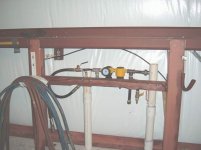
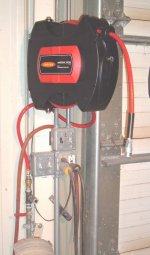
Yup, Menards also has those kits. What I like about them is they are 1/2 npt ports and like you I toss the oiler. This setup is the air supply to my storage building. I like these reels from for occasional use places, saves a big hose mess, comes with 50 ft and about 60$.
 

Attachments

  • air plastic 1.JPG
    air plastic 1.JPG
    44.1 KB · Views: 219
  • air manifold.JPG
    air manifold.JPG
    36.4 KB · Views: 151
  • air ret reel.JPG
    air ret reel.JPG
    40.1 KB · Views: 141

buening

Well-known member
Joined
Dec 17, 2007
Messages
1,338
Location
Decatur, IL
You may or may not have moisture build-up problems with the way your hydraulic hose is. It creates a low spot for water to sit in. The only solution I can think of is to move the 45° fitting further down towards the floor, which would eliminate that trap. Do you have pipes running inside the PVC?

The Menard's combo units work great but make sure your compressor doesn't put out more than what the combo is rated. My compressor puts out 175psi from the factory (I could reduce it though) and most residential units have a max of 150psi. I chose to use Norgren brand units off Ebay (I bought 6 combo units for $80 shipped), since some of their units are commercial grade with a max rating of 175psi. The higher the psi you allow you compressor to store, essentially the more volume of air you will have in reserve. Obviously don't go higher than what the factory recommends.
 

sberry

Banned
Joined
Jun 18, 2005
Messages
35,747
Location
Brethren, Michigan
Yes, there is about 150 ft of plastic pipe feeding that building, water is separated before it ever hits that line. Normally PVC is a no-no but this line is buried 36 inches and is transitioned to steel anywhere its exposed, the 2 inch is a shield. Once it hits that first valve it turns to steel and that hose feeds back into another underground. This isn't a working shop, its a storage, the air is for general service, to feed tire machine, blow a tire or blow off, no real tools running from it and it gets turned off when not in use.
 

Wandering

Active member
Joined
Nov 28, 2008
Messages
26
Location
Western ND
I've found many good threads about the recommended materials for air compressor plumbing (summary: no PVC, copper or black iron are good). One thing I haven't seen discussed is using air compressor hose, in lieu of piping. That seems like a relatively cheap and easy to work with material. Are there pitfalls to using air hose that I'm missing? I'm looking at installing 1, maybe 2, outlets, with a run length of 30-40 feet.

Thanks for any comments.

As I am building my shop I needed to run air hose from my compressor in the kitchen to the far side of the shop location 125 feet away to run a framing nail gun. 125 of ¼ inch trubber hose is incapable of driving a framing nail, The same scenario with Polyurethane ¼ inch hose and the gun hand to be adjusted because it was driving the nails too deep.

The moral of the story follows:

Long runs of flexible hose will take the “edge” off of impact tools, the hose works like shock absorber, stealing energy from the tool. It is also important to remember that the entire system will absorb that shock. If you put 125 feet of hose in your system it can be like using 125 foot hose for everything in regards using tools that require impact. This is not about using expensive hose over less expensive hose, it is to display the impact of using non rigid materials in your air system and its impact on your tools. The high end hose will do the same thing it will just take more hose length to be noticeable.

A second consideration is volume requirements it goes with saying that a bigger hose moves more air, however a short hose will move more air than a long hose even if the impact is academic it is true. However do not expect to use ¼ Inch hose to feed two ¼ inch hoses and et good performance from two tools at the end being operated at the same time no matter what monster compressor you have.


All that said 30 foot of hose plus a 12 foot coil hose is still just 42 foot of hose weather you hang it on the wall or leave it coiled around your feet.

Don't hang it in the sun continus expusure to UV will do your hose no good.
 

The Alchemist

Well-known member
Joined
Feb 16, 2006
Messages
142
Location
Doylestown, PA
Sorry, I wasn't looking to go cheap, this is an investment to me that I will have for a long time, so I want to do it right.

I'm just looking for easy and simple. I've got two kids under the age of two, so I don't have time to re-invent the wheel and figure all this out, so that's why I liked the setup from tptools, it's already measured and put together. I planned on putting that at the end of about 25-30 feet of black pipe as my compressor is going to be in the basement, and I'm running the lines up and into the garage. That should be sufficient time to cool and condense a good amount of the water vapor. I don't paint cars, so it's not an issue if I get a little bit of moisture in the line as I always oil my tools when I'm done using them.
 

buening

Well-known member
Joined
Dec 17, 2007
Messages
1,338
Location
Decatur, IL
That will work perfect :) Just replace the Tee with an elbow. I left a few tees (with a plug) in my system in case I decide to expand in the future, but for a small system you could add a tee at a later date.

Just keep in mind that, with the exception of the filter/regulator, there probably isn't but $30 worth of fittings, pipes, and ball valves. Printing that picture and going to your local Menards/Lowes may save you some money assuming you can find a good deal on a filter/regulator combo. Either way you are going to have to assemble the pipes, so you can either get the same materials from the local box store or it will arrive in the same unassembled condition from TPtools.
 
Last edited:

The Alchemist

Well-known member
Joined
Feb 16, 2006
Messages
142
Location
Doylestown, PA
That was going to be my next step is to see actually how much is included in the 'kit' they offer. It at least give's me a good reference point and a shopping list.
 

jeepgod

Well-known member
Joined
Aug 15, 2005
Messages
184
Location
Wildomar, CA
my hose run is only about 35 feet.. and it works great... it's sloped back towards the copper section.. that i have with the water drops.. you guys get waaay to involved in this.. i guess if you were a shop or painting things.. it's great to go all out.. but for us garage dorks that work in there every other weekend tops.. hose works great.. no need to break the budget just because every one says this is the best way.. well that might be true for some folks.. but not for all.. my time is money to me.. and i weigh the cost of it to what i intend to do.. and see what fits MY application.. unless something is just truely unsafe.. then how can you say, don't do this, do it this way, because it was what you wanted doesnt mean it's what i want.. hose is not unsafe if installed correctly and with safety in mind.. it was far cheaper than copper and way faster to install.. for what i use my drops for..
 

PoorOwner

Well-known member
Joined
Feb 10, 2007
Messages
5,032
Location
CA
I see it this way, it took me a couple days to put together 3/4" copper lines based on TP diagram. I have absolutely no moisture out of when using die grinders for long periods of time, the tool gets cold but no moisture.

My air tools cost $100 on average each so I consider that a little investment / insurance to setup a pipe system to get the best life and performance out of the tools. In case you don't know.. moisture shorten the life of air tools.

attachment.php


attachment.php
 

buening

Well-known member
Joined
Dec 17, 2007
Messages
1,338
Location
Decatur, IL
I concur. If you are using cheap air tools and only plan on using your compressor to air up a tire or maybe use an impact wrench a few times a year, then plumbing a system is definitely overdoing it. If this is the plan, then just attach a regulator to the outlet of the air compressor and hook a hose reel directly to that (or use a mini-regulator at the tool). A 50' hose reel at the compressor should reach all areas of a standard garage. I sandblast and use high CFM tools that create a ton of moisture, and need the 30 or 40' of pipe with water traps to remove as much moisture as possible. If your use is simple, then go the simple route. You can always add the plumbing at a later date if you decide to begin painting or sandblasting.
 
To avoid these ads, REGISTER NOW!
Top Bottom