To avoid these ads, REGISTER NOW!

Air lines layout recommendations

thammel

Well-known member
Joined
Oct 3, 2005
Messages
2,259
Location
Maryland
I just got a nice compressor in my 28x 32 garage with 12' ceilings. I want to use copper air lines to feed, at least, a sandblast booth, an overhead pull down air line reel and at least one other spot for air feed. In addition to the sandblast booth, I'll be using air tools primarily. I may do some painting, but this is lower priority. I'll be running lines on the ceiling.

My questions:
1) Best spot for the pull down line from a reel in the middle?
2) Any reel recommendations?
3) Put one regulator/filter/trap at the compressor outlet? Any others anywhere else?
4) Recommendations for valve brand and same for regulator/filter/trap?
5) Recommendations for quick connect fittings? Milton?
6) Exact configuration at each valve recommendation? Drip leg with valve on it?
7) Where and what brand of flex lines have you bought to connect compressor to fixed air lines (and to blast booth, for example)

I figured many of you have been through this and I learn a TON from all your experience.
Thanks!
 
To avoid these ads, REGISTER NOW!

cvairwerks

Well-known member
Joined
Aug 12, 2016
Messages
7,300
Location
Within hearing distance of Texas Motor Speedway
TP Tools, in their Tech Tip section, has a decent layout diagram with the basics. You can adapt it to your particular setup without much effort.

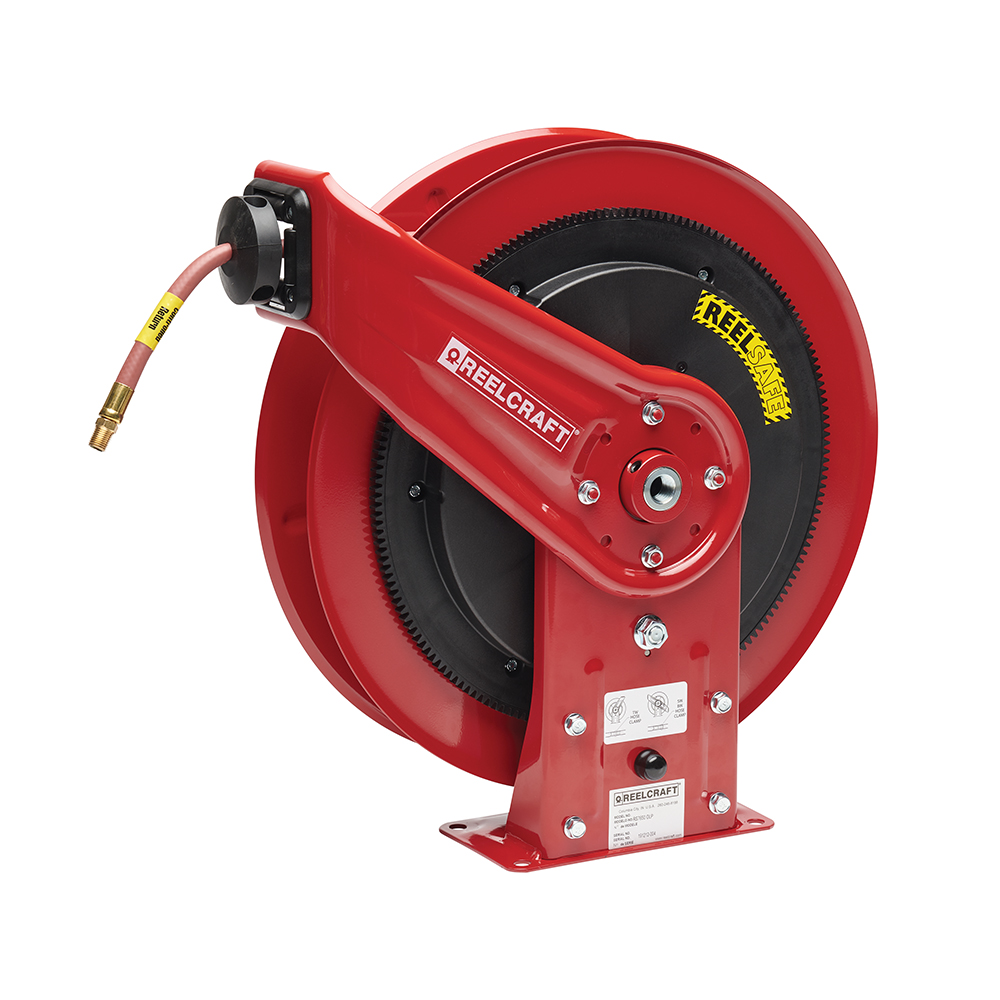
Reels.... Personally, I detest spring loaded reels due to having my self or guys on my crew hurt or equipment damaged when they let go. Just had one of the crew go out on medical due to a cord reel lock failing and the cord whipped around his legs and jerked his feet out from under him. He may end up having to have surgery to repair his shoulder from this. I got hit in the head by the stop ball on an air hose where the lock failed. Wasn't fun. We don't have the cheap stuff in our hangars, it's all top of the line heavy duty models. All of our hose reels are Reelcraft and the cord reels are KH's if I remember right.
 

nadogail

Well-known member
Joined
Jan 23, 2009
Messages
32,228
Location
Coronado, CA
1. Do not mention PVC air lines, that subject has been hopefully beaten to death.
2. Gravity is pretty much a constant; slope all air lines to avoid the buildup of unwanted moisture.
3. Compressed air has moisture in it, plan on removing it someplace other than through the tool you are using.
4. Air Lines run in a loop around the perimeter of a shop, rather than like a tree or fish skeleton; will in my opinion gave you a more uniform distribution throughout you system.
5. No matter how you build your Compressed Air Delivery System; somebody will tell you that you didn't do it correctly.
6. All advice you get from a forum on the internet is Guaranteed to be worth exactly what you paid for it.
 

DocsMachine

Well-known member
Joined
Sep 16, 2006
Messages
1,931
5. No matter how you build your Compressed Air Delivery System; somebody will tell you that you didn't do it correctly.

-This. Right here. Every freakin' time. :D

My tips: Don't worry too much about the location of the drop- you're going to plug an air hose into it anyway, so it's not like it needs to be right next to the place it'll be used.

On the same note, don't "hide" them- intentionally or otherwise, behind anything. Having to shift a machine out of the way, or move stacked parts to get to the air hose starts to get annoying.

Also, new QDs are not expensive. Start with new, and preferably name-brand. I know too many guys that cheaped out with used fittings or Chinese ****, and are thus always dealing with leaks.

And the big one I found out- if possible, put the compressor somewhere semi-remote, and look into something like that "egg crate" foam to at least partially surround it. I wound up putting mine in a sort of side shed, and two of the walls around it are just vapor-barriered insulation. I can barely hear it in the next room.

Doc.
 

matt_i

Well-known member
Joined
Mar 14, 2008
Messages
10,797
Location
SE Michigan
I put my compressor in the attic where its quieter.

I have this "tree" which basically forces air to climb vertically. I subscribe to the larger diameter "trunk line" theory, you can also put in a double-fed loop. Then tee off with smaller branches. Main thing is to use full-port ball valves for isolation and preservation of your compressed air! The Apollo Conbraco seem to do well, I used to prefer Nibco, but I regard that as poor quality now. Avoid the white-handled "potable water" ball valves as they are made to a low residential price point.

50430895742_628ff5ae47_b.jpg

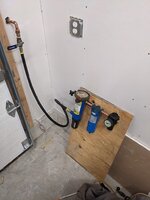
Typical cyclonic and coalescing filters in this part. I ordered a 1" ID hose from McMaster Carr, getting Goodyear UltraGrip with push-on fittings and backed up with Oetiker metal crimp-clamps. That hose is 100% under pressure so must be a quality offering.

50534164593_4c547c7d3e_b.jpg

I temp'd in this dessicant for painting outdoors.

50534482661_88bc27f9b0_b.jpg

I have been using Foster Mfg (www.couplers.com) quick connects. I bought a Tekton hose reel while they were offered (believe they have been discontinued) and it seems like its doing the job but of course lightly used.

Future plans are compressor monitoring and interlock functions using PLC controls...I've worked in heavy industry/plant engineering/plant maintenance for 23 years now and picked up various things along the way that influence the components and design. I'd rather have a good-used industrial component than something I got from Amazone.
 
OP
T

thammel

Well-known member
Joined
Oct 3, 2005
Messages
2,259
Location
Maryland
Thanks for all your replies! They help a lot!

Now a question pm the quick disconnects...I will go with Milton. Looking at Milton, I see a ton of different options. I will have 1/2" copper pipe and I would probably terminate with a male or female 1/2" pipe thread. What specific Milton QD have you connected and how did you connect it to your pipe?
 

BillK

Well-known member
Joined
Aug 24, 2006
Messages
9,422
Location
Beautiful Southern Maryland
All of the major Air Compressor manufacturers have information on their web sites.

I ran across this website a while back and bookmarked it. Plenty of good info:

A filter/trap right at the compressor outlet is pretty much useless. The air has to cool down some for the water to come out of suspension. I have them at every drop in my shop.
 

pcmeiners

Well-known member
Joined
Aug 13, 2009
Messages
8,056
Location
In the only town in Pennsylvania, Bloomsburg.
Use long radius Elbows through out,

Ream all pipe cuts, or un-reamed pipe causes turbulence resulting in friction
rough pipe/cast fittings causes extra friction.

Use high flow ball valves, many "standard valves" have really small flow path. Seen 1 " ball valves with 1/2" paths through the valve body, very restrictive, poor engineering but more profitable.

Use over sized filters/regulators adapted down to your pipe size. Regulators and filters are very restrictive, larger quality regulators/filters have less friction loss. Only use quality devices not the of shore brand **** if possible.

Use swing check valves or other properly designed check valve. Most check valves are restrictive, like the "in tank check valves". Again better to use a larger valve and adapt down.

I put a trap/filter after the tank, it catches oil and water, but I also have a large after-cooler before any filtering. Even so a filter will catch oil/particles which you do not want in the supply piping.
These might be handy.....


Controlled retraction speed reels....


Great little friction loss calculator.....

 
Last edited:

fj5gtx

Well-known member
Joined
Oct 26, 2009
Messages
50
I just got a nice compressor in my 28x 32 garage with 12' ceilings. I want to use copper air lines to feed, at least, a sandblast booth, an overhead pull down air line reel and at least one other spot for air feed. In addition to the sandblast booth, I'll be using air tools primarily. I may do some painting, but this is lower priority. I'll be running lines on the ceiling.

My questions:
1) Best spot for the pull down line from a reel in the middle?
2) Any reel recommendations?
3) Put one regulator/filter/trap at the compressor outlet? Any others anywhere else?
4) Recommendations for valve brand and same for regulator/filter/trap?
5) Recommendations for quick connect fittings? Milton?
6) Exact configuration at each valve recommendation? Drip leg with valve on it?
7) Where and what brand of flex lines have you bought to connect compressor to fixed air lines (and to blast booth, for example)

I figured many of you have been through this and I learn a TON from all your experience.
Thanks!

1. Install it close to where you want to use it, maybe you want more than one.
2. I have the hf 50ft reel, it works pretty good - I replaced the hose with a flexzilla one.
3. Nah, put it well down line for where the temp drops off.
4. I have a sharpe 880A air handler for painting I bought a couple decades ago. I also bought three wilkerson units for the drop I use for my sandblasting cab, as well as my pressure sand blaster. The 5 micron filter I'm using is a F18-04-SK00B model, followed by a coalescing unit, then a regulator. That is after about 50 ft of 3/4 black pipe with the appropriate downslope and take offs. Modeled as sharpe depicts here: http://www.sharpe1.com/sharpe/sharpe.nsf/Page/Air+Piping+Layout
5. I just swapped out to high output quick connects. Milton is a great brand to use. I bought a kit at AdvanceAutoParts (with 25% off coupon) because I was painting over 100ft away with a HVLP gun and had an incredible pressure drop.. the HO quick connects solved that issue immediately. I am in process of slowly replacing all my fittings with the HO ones.
6. See that air pipe layout. I used 3/4 ballcock plumbing valves w/o any issues for decades.
7. I think I bought my 3/4" flex line from TPTools in Ohio, to isolate the compressor from the hard lines.
 
To avoid these ads, REGISTER NOW!
OP
T

thammel

Well-known member
Joined
Oct 3, 2005
Messages
2,259
Location
Maryland
1. Install it close to where you want to use it, maybe you want more than one.
2. I have the hf 50ft reel, it works pretty good - I replaced the hose with a flexzilla one.
3. Nah, put it well down line for where the temp drops off.
4. I have a sharpe 880A air handler for painting I bought a couple decades ago. I also bought three wilkerson units for the drop I use for my sandblasting cab, as well as my pressure sand blaster. The 5 micron filter I'm using is a F18-04-SK00B model, followed by a coalescing unit, then a regulator. That is after about 50 ft of 3/4 black pipe with the appropriate downslope and take offs. Modeled as sharpe depicts here: http://www.sharpe1.com/sharpe/sharpe.nsf/Page/Air+Piping+Layout
5. I just swapped out to high output quick connects. Milton is a great brand to use. I bought a kit at AdvanceAutoParts (with 25% off coupon) because I was painting over 100ft away with a HVLP gun and had an incredible pressure drop.. the HO quick connects solved that issue immediately. I am in process of slowly replacing all my fittings with the HO ones.
6. See that air pipe layout. I used 3/4 ballcock plumbing valves w/o any issues for decades.
7. I think I bought my 3/4" flex line from TPTools in Ohio, to isolate the compressor from the hard lines.
Thanks! On 5), I also like Milton quick connects....but here's a question. We go to lengths to minimize pressure drops and get good flow, then at the very end, most of these quick connects use 1/4" pip thread to connect to our system. Doesn't that introduce unwanted pressure drop right there?
 

fj5gtx

Well-known member
Joined
Oct 26, 2009
Messages
50
Thanks! On 5), I also like Milton quick connects....but here's a question. We go to lengths to minimize pressure drops and get good flow, then at the very end, most of these quick connects use 1/4" pip thread to connect to our system. Doesn't that introduce unwanted pressure drop right there?
What happened was I would have to raise the standing psi really high so that the flow, after opening the trigger on the paint gun, would be appropriate. So its really a flow constriction, and I wasn't really bothered much by it until I used two 50' 3/8 hoses to get to the area I was painting. Likely you could just install all HO couplers until the last quick connect (the spray gun), since the pressure at that fitting wouldn't experience the pressure delay. But if you want to daisy chain your hoses, its best to just match the quick connects.
 

Neggy

Well-known member
Joined
May 30, 2021
Messages
754
as others have said slope the lines so water runs to an end point where you can install a drain valve in a drop, well below the point of your last take off fitting.... let the additional length collect the water and garbage.... drain frequently

Also put your take offs at the top of the pipe, as the condensation that makes it into the system will be running down the sloped pipe along the bottom... take offs at the bottom just let the **** run into the pipe below

Lots of drain points are your friends.....
 

rayra

Well-known member
Joined
Dec 1, 2014
Messages
4,724
Location
Escaped from Los Angeles
Air out the top of the storage tank and find a way to rig the tank bottom drain valve so it actually gets used frequently. if tha tmeans plumbing a line to it, where a ball valve can be readily reached, do so.
 

ZRX61

Well-known member
Joined
Aug 15, 2006
Messages
28,716
Location
Solar Blight Valley, SoCal
The general rule for blasting cabinets is 50ft of line to allow the air to cool & then a regulator/water separator just before the blaster. I used Sharpe products & the air was drier than a popcorn fart (altho I live in the Mojave Desert).
Ball valve shut-off at the tank outlet to isolate the entire system.
Running the lines along the walls instead of the ceiling will allow them to be sloped easier (lowest end away from the tank) & will also eliminate 90deg elbow at every drop... altho with that said, the better method has the drops plumbed to the top of the line & 2x 90deg elbows to feed the drop... plus you can solder up the 90's & the drop with the fittings etc on the bench then just have to solder the one joint to the feed line in situ.
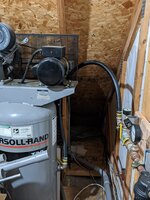
As for the flex line from the tank to the copper pipe, I used this stuff & only needed to check the hose clamps were tight maybe once every couple of years. 20+ years without issue:
hose1ab.jpg
 
Last edited:

pcmeiners

Well-known member
Joined
Aug 13, 2009
Messages
8,056
Location
In the only town in Pennsylvania, Bloomsburg.
What nadogail says is correct. Figure out a way to remove moisture from the air. At least get an aftercooler, but a Craigslist refrigerated air dryer is better.
You are in Maryland, you definitely should take engineer2's advice. I have used a compressor with an aftercooler in NYC and it drops out water constantly for 3 seasons of the year, your state is as humid if not more than NYC. You will be able to paint during a couple winter months, but not most of the year without an aftercooler or a refrig air dryer.
 
OP
T

thammel

Well-known member
Joined
Oct 3, 2005
Messages
2,259
Location
Maryland
You are in Maryland, you definitely should take engineer2's advice. I have used a compressor with an aftercooler in NYC and it drops out water constantly for 3 seasons of the year, your state is as humid if not more than NYC. You will be able to paint during a couple winter months, but not most of the year without an aftercooler or a refrig air dryer.
My compressor has an aftercooler and an auto water drain, so this is a good start. Thanks for the advice!!
 

rayra

Well-known member
Joined
Dec 1, 2014
Messages
4,724
Location
Escaped from Los Angeles
The general rule for blasting cabinets is 50ft of line to allow the air to cool & then a regulator/water separator just before the blaster. I used Sharpe products & the air was drier than a popcorn fart (altho I live in the Mojave Desert).
Ball valve shut-off at the tank outlet to isolate the entire system.
Running the lines along the walls instead of the ceiling will allow them to be sloped easier (lowest end away from the tank) & will also eliminate 90deg elbow at every drop... altho with that said, the better method has the drops plumbed to the top of the line & 2x 90deg elbows to feed the drop... plus you can solder up the 90's & the drop with the fittings etc on the bench then just have to solder the one joint to the feed line in situ.
As for the flex line from the tank to the copper pipe, I used this stuff & only needed to check the hose clamps were tight maybe once every couple of years. 20+ years without issue:
hose1ab.jpg
not as big a deal with air as it is with water, but every 90deg fitting you put in there is a reduction in flow rate.

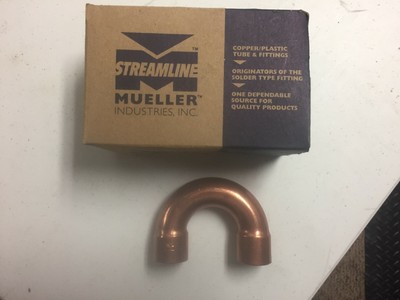
And heck, if you are going to put a clear PVC flex line in the run, you might as well make it a drop loop and you'll SEE any moisture accumulation.

Drain your tank often. Compressing the air into puts the moisture in the tank. The air line out the top of the tank will provide air drier than your ambient humidity. Put a moisture trap on the tank outlet and you don't have to worry about the rest of the run(s)
 
To avoid these ads, REGISTER NOW!
Top Bottom