PhantomEB
Well-known member
I had Copper but then I went SS……


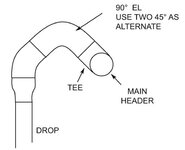
AL, might be a dumb question, but how did you get more than 90 degrees out of those elbows to keep all of the horizontal runs sloped on the wall? Any issues with leaks where the copper runs don't enter the fittings straight? Also, what is the function of the couplings on the short vertical sections?One advantage of copper over pex is that copper is an excellent heat conductor so will cool the air down better. If you use pex to save money I would consider making a copper "radiator" before entering the pex lines.
I have a smaller set up, where I got the copper used and assembled. I just put screws in the wall and stretched it out horizontally so that all the runs go downhill. The 90s are still 90*AL, might be a dumb question, but how did you get more than 90 degrees out of those elbows to keep all of the horizontal runs sloped on the wall? Any issues with leaks where the copper runs don't enter the fittings straight? Also, what is the function of the couplings on the short vertical sections?
Why the change ?I had Copper but then I went SS……
I honestly don't remember why there are couplings on the vertical sections. It may have something to do with having to put that up by myself in sections. I agree in hindsight it doesn't make sense.AL, might be a dumb question, but how did you get more than 90 degrees out of those elbows to keep all of the horizontal runs sloped on the wall? Any issues with leaks where the copper runs don't enter the fittings straight? Also, what is the function of the couplings on the short vertical sections?


I rarely see water either. I have some sticks of 1/2". I wonder if it would be best to use 3/4 for everything or if o could get by with 3/4 for the perimeter runs and then change to 1/2 for the drops. Seems like 1/2 would be easier to adapt fittings to. And being as I'm told the lines don't add to tank volume and pressure is what will matter I wonder what advantage the actual line size has.I did 3/4" & 1/2" L copper since there there was existing from a long abandoned solar hot water system to be repurposed.
Comp is in the corner of my 20'x20' near the main door. Regulator on the wall next to the door. Ran 3/4" the copper up the wall to the peak of the roof where it reduces to 1/2". Then drops for my hose reel in the center, and one at the bench. Drains at each low point.
First time sweating copper, and no leaks. Yet to get any moisture out of the drops.
Guess I'll have to compare the prices when I go. Looking online and it appears $6 more for 1/2 and $10 more for 3/4.I used L in mine , but that was in 2016 or so, the price on copper wasn't that bad. I also silver soldered most of the joints
Type M is ok for compressed air, not sure on the max PSI

 ipexna.com
Until I purchase, nothing is decided and it might be 6hrs or 6months before I get to it. I just have to have a pretty solid plan in my head so I can think abut it while out there and figure out what might be best. I was pretty solid on the threaded pipe before I built the garage and even until fairly recently. After seeing the install posted, I do think it would look really good with the aged cedar fence. AND, as someone else just posted it is super easy to work with. Considering I'll have a lot of pipe 12' up in the air, I could lay out the copper, sweat a bulk of the connections on the ground, then lift into place. With threaded, weight becomes a big issue to contend with during install.Looks like you have decided on copper but for others reading the thread I will ad something my brother and I learned in our 40-50 business shop way back in the 70s. If you use threaded pipe, put in a lot of those couplers that allow you to take it apart w/o spinning the pipe. We didn't know about them until near the end of the install. Got to where we needed to spin pipe for some reason and of course it would have tightened one end but loosened the other. We need to make a 90deg turn at the corner of the shop. Screwed the 90joint onto the pipe and had a choice. It needed to be about 45deg over tightened or 315deg loose. We also found later that we had a layout that was almost impossible to change or ad a drop to.
That stuff is interesting. I tried glancing at their site, but don't have time right now to delve heavily into it. Looks like some of the fittings aren't necessarily fixed in place and can be moved?I ran a Teseo air system down the one side of the shop 10 years ago. It’s been great. Nice leak free fittings, aluminum piping (no rust). Easily expandable while assembled. From what I remember the 12’ lengths of piping weren’t expensive but the fittings were……I highly recommend it.
Aluminium piping for compressed air and fluids distribution. | Teseo
Teseo is the worldwide leader in the production of aluminium modular systems for fluid distribution. Contact us now and ask for a free project design.www.teseoair.com
Is 50/50 cheaper than silver or whatever one would buy for potable water? I always just buy from box store, whatever is rated for that. No clue if I still have any or not, been a few years since I've had to sweat a pipe, but rarely have an issue.To the very best of my knowledge 50/50 Solder is acceptable for Compressed Air Pipes.
It is prohibited for Potable Water lines.
I buy my Acid Flux and 50-50 Solder from an Industrial Hardware supply store.
Big Box Stores around here don’t sell 50-50 Solder, everything is that Lead Free stuff.Is 50/50 cheaper than silver or whatever one would buy for potable water? I always just buy from box store, whatever is rated for that. No clue if I still have any or not, been a few years since I've had to sweat a pipe, but rarely have an issue.
That's why I ask. It's it cheaper or better for this?Big Box Stores around here don’t sell 50-50 Solder, everything is that Lead Free stuff.
How does the proce compare to copper or aluminum? That stuff looks great.Duraplus! Easy to put in, doesn't rust or corrode.
Industrial Compressed Air Piping - Compressed Air Distribution System | IPEX USA LLC
Duraplus™ ABS Air-Line is designed and engineered for industrial compressed air applications
They can be moved and reused else where but you would have to get buy a plug for the hole you left behind. You can tap into the piping at any point with a drill bit and and a fitting.That stuff is interesting. I tried glancing at their site, but don't have time right now to delve heavily into it. Looks like some of the fittings aren't necessarily fixed in place and can be moved?
I actually really like that idea! Of course, EMT is nearly as expensive as copper unless you have a good source of salvaged stuff. You'd have to use sweeps for all corners and Ts would be a PITA.I like the look of emt on the walls. Would be cool to have 1/2 pex in 3/4 emt.
I hate M copper for water lines due to pin holing from acidic water but for air lines I would be perfectly fine with it. I personally don't because I have Tee pullers and expanders to eliminate Tees and couplings, which work much better with L than M but if I was buying those fittings I would use M for airlines.Is it really better to go L copper over M for the air lines?