To avoid these ads, REGISTER NOW!

Aircraft tools

To avoid these ads, REGISTER NOW!

FlyingLow

Well-known member
Joined
Mar 10, 2014
Messages
127
Location
Vancouver Island
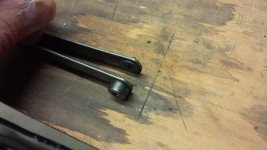
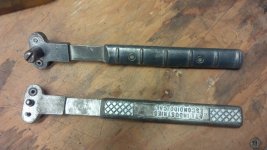
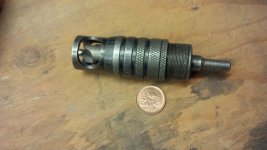
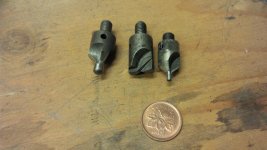
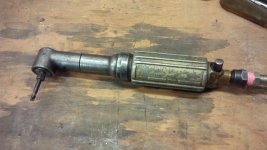
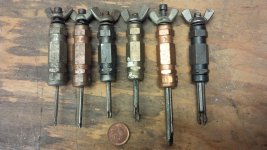
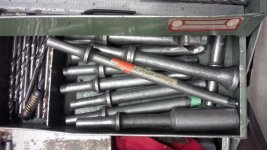
Just some random things I think are a little different than most tools you find in a shop. In order of the pictures.

Safety wire twisters.

Hole finder for drilling a hole in a new skin to match the hole behind it.

Nutplate tools.

Deburring tool, spring loaded cutter so it shaves the outside on the way in and inside on the way back.
 

Attachments

  • IMG_20140414_221348.jpg
    IMG_20140414_221348.jpg
    146 KB · Views: 128
  • IMG_20140414_222040.jpg
    IMG_20140414_222040.jpg
    145 KB · Views: 179
  • IMG_20140414_222055.jpg
    IMG_20140414_222055.jpg
    142.7 KB · Views: 151
  • IMG_20140414_222122.jpg
    IMG_20140414_222122.jpg
    147.9 KB · Views: 159
  • IMG_20140414_222137.jpg
    IMG_20140414_222137.jpg
    145.8 KB · Views: 154

Provincial

Well-known member
Joined
Sep 21, 2011
Messages
6,855
Location
Near Salem, OR
This sounds like a story we need to hear...

I'm guessing crib it up, let the air out of the tires and pump like a madman.

To do a gear retract test on a DC-3 with only one jack, and the jack won't pump up, first fully inflate the struts with a nitrogen bottle, then use the lock ring on the jack ram to pull the ram up into contact with the jack pad on one side. Deflate the struts on that side and use cable pullers to retract the struts enough to clear as the gear retracts. Pull the safety lock pin on only the deflated side and pump up the gear with the hand pump. Observe the function of the gear mechanism and related systems, including warning lights.

Lower that gear and ensure that it locks down properly and with proper indications. Reinflate the struts fully and move the jack to the other side. Repeat. After testing both sides, adjust the nitrogen charge in both sides to the proper extension. :beer:

Next up, how to change a R-985 engine on a Grumman Goose in a tundra pond with no facilities and only 72 hours from the time of failure until the pond gets too shallow from evaporation to fly the repaired airplane out!
 

FlyingLow

Well-known member
Joined
Mar 10, 2014
Messages
127
Location
Vancouver Island
To do a gear retract test on a DC-3 with only one jack, and the jack won't pump up, first fully inflate the struts with a nitrogen bottle, then use the lock ring on the jack ram to pull the ram up into contact with the jack pad on one side. Deflate the struts on that side and use cable pullers to retract the struts enough to clear as the gear retracts. Pull the safety lock pin on only the deflated side and pump up the gear with the hand pump. Observe the function of the gear mechanism and related systems, including warning lights.

Lower that gear and ensure that it locks down properly and with proper indications. Reinflate the struts fully and move the jack to the other side. Repeat. After testing both sides, adjust the nitrogen charge in both sides to the proper extension. :beer:

Next up, how to change a R-985 engine on a Grumman Goose in a tundra pond with no facilities and only 72 hours from the time of failure until the pond gets too shallow from evaporation to fly the repaired airplane out!

It's called a boot strap
 

Hootbro

Well-known member
Joined
Dec 8, 2011
Messages
1,465
Location
Delaware
When I first got into aviation repair, "El Brutus" Johnson Bar was the first thing one would get if they expected to do wing fuel panel removals.

mkQXER2yyrTtTI6Fo_W1-zw.jpg
 

Jolomite

Well-known member
Joined
Oct 6, 2011
Messages
163
Location
Detroit, Michigan
Awesome stuff, all! Thanks for sharing- this aviation/ warbird buff is learning a couple things.

FlyingLow- In all seriousness, what is the nutplate tool used for? The holefinder and deburring tools seem mighty handy.
 

Kracin

Well-known member
Joined
Mar 25, 2013
Messages
1,666
Location
Omaha, NE
If your messing with foreign warbirds...

The plierwrench and I become my besties.
And a nice pair of scissors for fabric is always good to have around.


i love those things! i want all 4 sizes they offer and the huge ones.. the 10 inch ones i have are great for what i use them for. random size nuts and bolts when you aren't anywhere near a tool box. and the fact that i work around a lot of sheetmetal makes them awesome. you can just bend the metal back into shape and send it through the die instead of having to cut off a whole section... they are great for sheetmetal work!
 

ecotec

Well-known member
Joined
Oct 5, 2010
Messages
5,405
I love the pliers wrench. I have the 10 inch ones. They have replaced the Crescent wrench in my work tools.
 

A_Pmech

Well-known member
Joined
May 8, 2007
Messages
8,002
Location
IL
Well that's inventive!

To do a gear retract test on a DC-3 with only one jack, and the jack won't pump up, first fully inflate the struts with a nitrogen bottle, then use the lock ring on the jack ram to pull the ram up into contact with the jack pad on one side. Deflate the struts on that side and use cable pullers to retract the struts enough to clear as the gear retracts. Pull the safety lock pin on only the deflated side and pump up the gear with the hand pump.
 

UncleDirty

Well-known member
Joined
Mar 19, 2006
Messages
103
Location
Riverside Ca
Pliers wrench, cobra pliers, and a flip-flop screwdriver - the basics of every line mechanic.

Very true, I've been carrying my Snap On flip flop and 6" adjustable for almost 30 years. Really ***** they stopped making both of them. :dunno:
But the most important tool of a line mechanic is the pen.;)
 

Charles (in GA)

Well-known member
Joined
Jan 11, 2006
Messages
12,489
Location
50 mi south of Atlanta
When I first got into aviation repair, "El Brutus" Johnson Bar was the first thing one would get if they expected to do wing fuel panel removals.

mkQXER2yyrTtTI6Fo_W1-zw.jpg

Crazy expensive, but for a line mechanic somewhere away from compressed air (to run the rivet gun/screwknocker) it is a lifesaver. One guy at work used to have one. I searched for several years and could not locate a source for them, found them at Brown Aviation Tool Supply, $339 and $379 depending on whether you want 1/4 or 3/8 square drive for the bit holder and ratchet.

Charles
 
Last edited:

unionmechanic

New member
Joined
Mar 16, 2014
Messages
4
Very true, I've been carrying my Snap On flip flop and 6" adjustable for almost 30 years. Really ***** they stopped making both of them. :dunno:
But the most important tool of a line mechanic is the pen.;)

Yeah, I forgot the pen- the most important tool!
 
To avoid these ads, REGISTER NOW!

FlyingLow

Well-known member
Joined
Mar 10, 2014
Messages
127
Location
Vancouver Island
Awesome stuff, all! Thanks for sharing- this aviation/ warbird buff is learning a couple things.

FlyingLow- In all seriousness, what is the nutplate tool used for? The holefinder and deburring tools seem mighty handy.

You drill your screw hole first and then the bullet part goes into the hole and you drill the first rivet hole, flip it over and the second bullet fits in the rivet hole and the pilot hole lets you drill the second rivet hole. Rivets need to be much more precise than bolts and screws. There's no second chances.
 

FlyingLow

Well-known member
Joined
Mar 10, 2014
Messages
127
Location
Vancouver Island
Adjustable microstop for repetitive countersinking and shaving, with a couple countersinks and a shaver for flush rivets
 

Attachments

  • IMG_20140414_222221.jpg
    IMG_20140414_222221.jpg
    143.6 KB · Views: 83
  • IMG_20140414_222423.jpg
    IMG_20140414_222423.jpg
    146.1 KB · Views: 89

FlyingLow

Well-known member
Joined
Mar 10, 2014
Messages
127
Location
Vancouver Island
First 2 pictures are rivet sets.

Third picture is draw clecos, medium length. Sizes 3/32, 1/8, 5/32, 3/16, 1/4 and 5/16. I want to add 3/8 for my garage projects. They are used for pulling multiple layers of sheetmetal together especially with sealant.

Forth picture is an angle drill, an old one at that and it has a bigger head than newer ones.
 

Attachments

  • IMG_20140414_222318.jpg
    IMG_20140414_222318.jpg
    145 KB · Views: 96
  • IMG_20140414_233253.jpg
    IMG_20140414_233253.jpg
    150 KB · Views: 119
  • IMG_20140414_222642.jpg
    IMG_20140414_222642.jpg
    145.7 KB · Views: 86
  • IMG_20140414_222632.jpg
    IMG_20140414_222632.jpg
    148 KB · Views: 98

Provincial

Well-known member
Joined
Sep 21, 2011
Messages
6,855
Location
Near Salem, OR

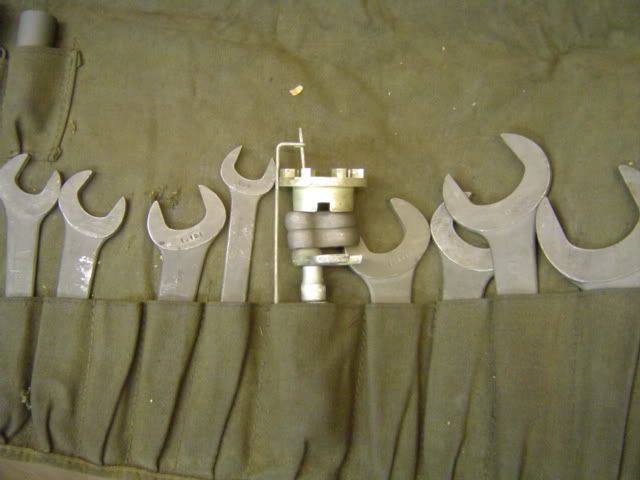
Snapmom, the hard ones to find are the goosenecks that snap into the square drives to convert them into torque adapters.

There was a later series of Pratt & Whitney base nut wrenches with male square drives on short shanks that used a female drive torque adapter gooseneck. The wrenches show up but one almost never sees the gooseneck.
 

Hootbro

Well-known member
Joined
Dec 8, 2011
Messages
1,465
Location
Delaware
Crazy expensive, but for a line mechanic somewhere away from compressed air (to run the rivet gun/screwknocker) it is a lifesaver. One guy at work used to have one. I searched for several years and could not locate a source for them, found them at Brown Aviation Tool Supply, $339 and $379 depending on whether you want 1/4 or 3/8 square drive for the bit holder and ratchet.

Charles

Used a Rivet Gun/Screw Knocker combo for many years until I got onto some contracts and platforms that specifically prohibit them as they stress the nutplate and surrounding structure.
 

FlyingLow

Well-known member
Joined
Mar 10, 2014
Messages
127
Location
Vancouver Island
There's always the *hush-hush double flush* ;)

Oh ya, and snowmen are ok as long as you can't see them right? ;)

Snapmom, the hard ones to find are the goosenecks that snap into the square drives to convert them into torque adapters.

There was a later series of Pratt & Whitney base nut wrenches with male square drives on short shanks that used a female drive torque adapter gooseneck. The wrenches show up but one almost never sees the gooseneck.

I don't work on recips but those are cool and i'd never pass them up if i came across a set.

Used a Rivet Gun/Screw Knocker combo for many years until I got onto some contracts and platforms that specifically prohibit them as they stress the nutplate and surrounding structure.

They certainly have a time and place, pressurised structure not so much. I find a good speed handle is the next best thing. I could put one to good use in my garage now and then, might have to make one some day.
 

ZRX61

Well-known member
Joined
Aug 15, 2006
Messages
28,716
Location
Solar Blight Valley, SoCal
There was a later series of Pratt & Whitney base nut wrenches with male square drives on short shanks that used a female drive torque adapter gooseneck. The wrenches show up but one almost never sees the gooseneck.
I've got a set someplace, plus ones for the intake tubes from the blower & the ones for the pushrod tube nuts... P&W & Wright versions :)
 

Provincial

Well-known member
Joined
Sep 21, 2011
Messages
6,855
Location
Near Salem, OR

Attachments

  • F6F Box Front Resized.JPG
    F6F Box Front Resized.JPG
    29.8 KB · Views: 50
  • F6F Box Side Resized.JPG
    F6F Box Side Resized.JPG
    22.8 KB · Views: 50
  • F6F Box Inside Lid Resized.JPG
    F6F Box Inside Lid Resized.JPG
    22 KB · Views: 56
  • F6F Tool List Resized.JPG
    F6F Tool List Resized.JPG
    26.6 KB · Views: 58

James_B

Well-known member
Joined
Jun 24, 2013
Messages
674
Location
Nova Scotia, Canada (started in Brisbane, Australi
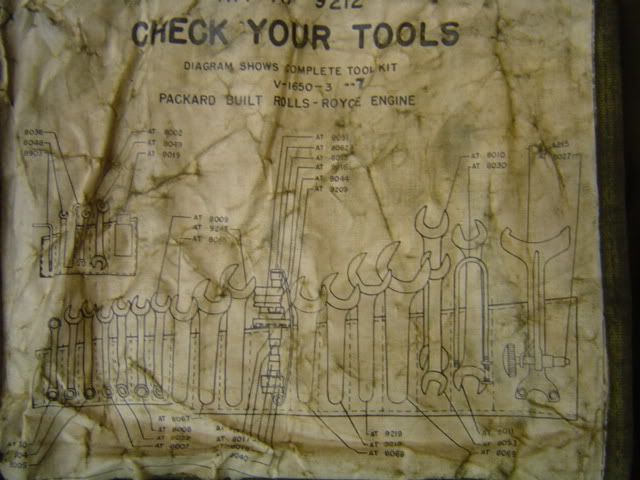
How about these... (Merlin engine)

8-8-09004.jpg


8-8-09002.jpg
Those bring back memories.

In my father's tool box are an interesting collection of odd tools that he acquired either during WW2 or soon afterwards. A few of them looked like they could be out of that kit or one very much like it. A lot of Merlin engine tool kits like the ones pictured above were dumped into the ocean off Brisbane after the war, and I remember him telling me that there were some tools from a RR Merlin engine kit in his tool box.

My father's family lived on the banks of Breakfast Creek in Brisbane, Australia (they had 5 or 6 side by side house allotments on which stood 4 houses and the family run paint factory). During WW2, General Motors set up a workshop to repair and overhaul Allison V-1710 aircraft engines on the other side of Breakfast Creek (You can see his parent's house and factory in the aerial photographs of the GM Workshops). The workshop buildings were still there in the late 60s, and they were close enough to hit from his old back yard with a well thrown rock. I suspect that some of the other odd tools in his tool kit may have made their way across the creek from that workshop.
 

Dave455

Well-known member
Joined
Mar 19, 2013
Messages
5,796
Location
Sussex, England
The original RR Merlins were all Whitworth, or to be more precise BSF (British Standard Fine) for the most part, with a few BSW and of course BA threads chucked in as well!

As far as I can recall, the licence built Packard Merlins used exactly the same fasteners, in order to retain interchangeability in the field! The difference, of course, was that Packard, like Rolls, bought in many of the ancillary parts, thus a Rolls engine would have BS fasteners, as would it's SU carb. A Packard would have the same, but it's U.S. carb would have American National Fasteners, probably from the numbered series as well, and so on for all the other bits!

To be honest, this is the reason the British government suggested we all adopt the 'Unified' system, but it also explains why many British aero engineers, especially the old blokes, have a VAST collection of wrenches!

Incidentally, my Dad flew Merlin powered aircraft right up till the mid 60's! Although the engine is revered now, Dad reckoned it was fine for powering a bomber that would probably be lost after a couple of hundred hours, but no good for airline use! The main problem was the cooling system - quote "about fifty dodgy old rubber hoses, held together with a hundred jubilee clips, any one of which could fail and give you a shutdown"!
 
Last edited:

James_B

Well-known member
Joined
Jun 24, 2013
Messages
674
Location
Nova Scotia, Canada (started in Brisbane, Australi
From what I understand, only the Packard Merlins had a dedicated tool kit, and one came with each engine. The RR Merlins just used off the shelf, standard issue, black finished, British mechanic's tools. Royal Australian Air Force mechanics did their best to get their hands on the Packard Merlin tool kits.
 

Dave455

Well-known member
Joined
Mar 19, 2013
Messages
5,796
Location
Sussex, England
Yep! Dead right!

In British service tools are issued either to an individual (for small stuff) or to his Squadron (for the bigger stuff)! Generally these were of quite good quality! Although Chrome plating was omitted during the war, the tools were still made of good steel and lasted well!

When the first U.S. equipment arrived in the U.K. under Lend -Lease it all had American fasteners and there were no tools to maintain it!

From then on every U.S. bit of equipment came supplied with a full tool kit!

Thank you America!

I still have, handed down from my Grandfather, some of those original tools! Socket wrenches by Williams, wrenches by Armstrong, Bonney and the like! Good honest tools!

I suppose Packard didn't really need to supply British Standard tools, but it was nice that they did!

Snap On still offer some very nice combination wrenches in BS sizes!
 
Last edited:

James_B

Well-known member
Joined
Jun 24, 2013
Messages
674
Location
Nova Scotia, Canada (started in Brisbane, Australi
From then on every U.S. bit of equipment came supplied with a full tool kit!
It still happens.

I have friends that used to maintain the Omega VLF Navigational Aid station in Australia (Station G, near Woodside, Victoria, Australia).

Every time there was a modification to be done on the US made equipment, the modification kit would include every single tool you'd need to do the job. If a hole had to be drilled, the modification kit would have the drill bit, and the power drill to go with it.
 
To avoid these ads, REGISTER NOW!
Top Bottom