pedrodagr8
Well-known member
- Joined
- Aug 25, 2013
- Messages
- 613
Everything you wanted to know about multimeters but were afraid to ask!
After writing a recent post about the fuses found in Fluke multimeters, I realized that there is a lot of FUD about multimeters. I have seen a lot of threads where there have been huge debates on multimeters. Often times, the people debating have little to no clue about what they are talking about. For example, it’s not uncommon to see a well-intended question about a multimeter devolve into a debate between “You need a Fluke to test AAA batteries or you will DIE!” versus “My HF freebie is all you need to test the transformer on the pole outside”. With all of the meters out there, it’s understandable that there is a lot of confusion about what to select and what is needed. Add in the fanboi’s and it can be difficult. My goal is to hopefully shed some light on this topic and dispel a bit of the FUD that is prevalent. I have broken this discussion into various categories to help give some organization to the range of topics that must be discussed.
Analog versus Digital

This is one of the first topics that has to be discussed. As with most things, digital has mostly supplanted analog but there are still certain situations where an analog meter is preferred. The biggest one is when trying to spot rapid fluctuations on top of a voltage. Most digital meters have a refresh rate of between 2 and 5Hz, analog meters have a technically infinite “refresh rate”. In reality, the “refresh rate” is limited by the motion speed of the meter. The biggest thing with the analog meter is you can watch the twitching of the needle to see the overlaid fluctuations. To be honest, this is about the ONLY situations where analog meters are preferable other than nostalgia. Analog meters are more fragile, they have abysmal input protection at best, their accuracy is often measured in percents (digital meters are usually measured in fractions of a percent or less).
Resolution versus accuracy
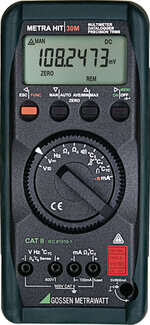
This is one area that often confuses people. Resolution deals with the number of digits a meter has, while accuracy deals with how close to the real value a meter is. While many times these two values are linked, they do NOT have to be linked. Resolution is typically measured in counts and is a measure of the maximum value a meter can display in a given range. So a 20,000 count meter can display a maximum of 20.000V in the 20V range; while a 2000 count meter would only display 20.00V. Depending on how the meter is made, these two different count meters could have identical accuracy specs (not likely but possible). Even if this is the case, there are situations where the higher resolution is very valuable. For example, monitoring a slowly draining battery in a car; with the extra resolution you could watch the voltage slowly drop due to parasitic losses. You don’t care if the voltage is exactly 12.455V, as the meter reads, or 11.121V, just that you can watch it change over time. There are other times, where you are really interested in the exact value and want to ensure that it is within a tight range. Because of this, you often need to decide which is more important for your usage scenario. For most non-electronic uses, the accuracy of most meters (<1%) is sufficient, same with the number of counts. As I mentioned before, there are situations where higher resolution or higher accuracy is more important so choose according to your needs.
Mutlimter Safety Ratings
One of the most confusing things and the areas of highest FUD are the safety ratings. Many people incorrectly assume that the CAT category is based upon the voltages encountered. This is not the case, instead, they are based upon the current that the device under test can source. This is because a device which can provide 10kV but only 1mA isn't nearly as dangerous as something which can provide 100V at 1kA.
The safety ratings are as follows:
When considering the CAT rating of the meter, never blindly trust the rating on the front of the meter. Look for a meter which has been rated by a third-party such as TUV, UL, etc. The highest CAT rating possible at this time is CAT IV 1kV. Also, recent changes to the CAT regulations mean that ALL inputs MUST have the same rating, so a meter will be rated based on the input with the lowest rating. So if a meter can achieve Cat IV 1kV on the voltage and ohm input but only Cat II 300V on the current inputs. The meter is rated as Cat II 300V. This used to not be the case, so it isn't uncommon to see meters with multiple CAT ratings on the inputs. Though if it is being sold as new, it is required to comply with the new regulations.
There are a variety of things that go into achieving a high CAT rating. This includes HRC fuses, PTCs, polyfuses, MOVs, keeping tracks spaced far enough apart insde the meter so that there is no arcing between traces, etc. This is why high CAT rating meters are so much more expensive, the parts that go into them are NOT cheap but they CAN save your life. Cheaper multimeters often leave out these parts, in particular the HRC fuses.
The following image from wikipedia shows the input protection on Fluke 28
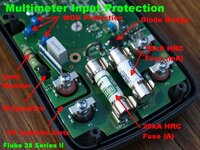
All of these parts are essential for the CAT rating the meter has achieved.
There is a common myth that the CAT ratings is related to the ability of a meter to survive a particular voltage. This is not the case at all, in fact a meter could die completely at a voltage lower than the CAT rating. Instead, it ensures that the meter, even when dead, will fail properly up to the rated voltage. The CAT ratings is strictly to make sure that YOU don't die (or are injured) when your meter is exposed to that voltage.
HRC Fuses

Earlier, I mentioned HRC fuses and I feel that these are important enough to discuss in detail. Much of this is copy/paste/edit from a post I made in another thread.
The large fuses that you see in a high CAT-rating multimeter are called high rupture current(HRC) or high breakage current (HBC) fuses. As the name implies, they are designed for breaking large currents and high voltages reliably. What many people don't realize is that fuses have both a minimum and maximum value. The minimum value is the rating on the side of that fuse. We will choose a 10A fuse as an example. This min value is the 10A rating. There is a second rating, the maximum current that it can break. Above this current the vaporized metal from the filament can actually flash into a plasma. Plasma is an excellent conductor offering very little resistance. Basically, you just created an metal arc light bulb. Once an arc is established it takes very little to keep it going, rendering the fuse useless. At this point, you now have more or less a dead short across the fuse. This is a potentially fatal situation.
See this datasheet for a common 250V 10A glass fuse. If you look under the maximum value section, you can see the AC interrupt ratings. These are the maximum currents this fuse can break. Notice, the interrupt rating at 125V is a very respectable 10kA. Meaning a surge at 125V is going to be stopped by the fuse no matter how strong it is. The thing to notice is look how that value plummets by the time it reaches the 250V rating. It has dropped to a measly 200A. Now imagine what that is at 300V, likely around an amp or less. This fuse would be completely useless for measurement protection, even at its rated 250V. At a higher voltage, it would be outright dangerous. The 10A fuses in your fluke are rated at ~20kA at 1000VAC and the 44/100 fuse is rated at 10kA at 1000VAC. These are orders and orders of magnitude in difference.
If you have a 10A rating, you want the fuse to break and break safely at ALL of the voltages your meter is rated for. Automotive and glass fuses would not do this and structurally are not CAPABLE of doing this. In a glass fuse and auto fuse, the metal wire is surrounded by air. In the fluke fuse, the metal fuse wire surrounded by an energy absorbing matrix, typically sand, which prevents or extinguishes an arc before it starts. Which is the reason for the ridiculously high current rating. This is one reason these expensive fuses are essential for the CAT rating of the meter.
This is not the only difference, auto and glass fuses are typically normal speed or fast acting fuses. Fast acting fuses have a break time measured on the order of seconds or tenths of a second at their rated current. The fluke fuses are guaranteed to be on the order of milliseconds (2.2ms for 44/100 and 10ms for the 10A fuse). Once again these are orders of magnitude difference. The fluke fuse will blow and blow quickly saving your health. Stopping high currents from running through your test leads; vaporizing them in the process.
Lastly, many glass fuses can pop when tripped. These have reinforced ceramic bodies to help prevent that from happening. Typically, in a meter, the MOVs will absorb the energy and blow long before the fuse explodes. Also, these fuses are designed to be able to handle 100% of their rated current indefinitely, no accidental tripping.
After writing a recent post about the fuses found in Fluke multimeters, I realized that there is a lot of FUD about multimeters. I have seen a lot of threads where there have been huge debates on multimeters. Often times, the people debating have little to no clue about what they are talking about. For example, it’s not uncommon to see a well-intended question about a multimeter devolve into a debate between “You need a Fluke to test AAA batteries or you will DIE!” versus “My HF freebie is all you need to test the transformer on the pole outside”. With all of the meters out there, it’s understandable that there is a lot of confusion about what to select and what is needed. Add in the fanboi’s and it can be difficult. My goal is to hopefully shed some light on this topic and dispel a bit of the FUD that is prevalent. I have broken this discussion into various categories to help give some organization to the range of topics that must be discussed.
Analog versus Digital
This is one of the first topics that has to be discussed. As with most things, digital has mostly supplanted analog but there are still certain situations where an analog meter is preferred. The biggest one is when trying to spot rapid fluctuations on top of a voltage. Most digital meters have a refresh rate of between 2 and 5Hz, analog meters have a technically infinite “refresh rate”. In reality, the “refresh rate” is limited by the motion speed of the meter. The biggest thing with the analog meter is you can watch the twitching of the needle to see the overlaid fluctuations. To be honest, this is about the ONLY situations where analog meters are preferable other than nostalgia. Analog meters are more fragile, they have abysmal input protection at best, their accuracy is often measured in percents (digital meters are usually measured in fractions of a percent or less).
Resolution versus accuracy
This is one area that often confuses people. Resolution deals with the number of digits a meter has, while accuracy deals with how close to the real value a meter is. While many times these two values are linked, they do NOT have to be linked. Resolution is typically measured in counts and is a measure of the maximum value a meter can display in a given range. So a 20,000 count meter can display a maximum of 20.000V in the 20V range; while a 2000 count meter would only display 20.00V. Depending on how the meter is made, these two different count meters could have identical accuracy specs (not likely but possible). Even if this is the case, there are situations where the higher resolution is very valuable. For example, monitoring a slowly draining battery in a car; with the extra resolution you could watch the voltage slowly drop due to parasitic losses. You don’t care if the voltage is exactly 12.455V, as the meter reads, or 11.121V, just that you can watch it change over time. There are other times, where you are really interested in the exact value and want to ensure that it is within a tight range. Because of this, you often need to decide which is more important for your usage scenario. For most non-electronic uses, the accuracy of most meters (<1%) is sufficient, same with the number of counts. As I mentioned before, there are situations where higher resolution or higher accuracy is more important so choose according to your needs.
Mutlimter Safety Ratings
One of the most confusing things and the areas of highest FUD are the safety ratings. Many people incorrectly assume that the CAT category is based upon the voltages encountered. This is not the case, instead, they are based upon the current that the device under test can source. This is because a device which can provide 10kV but only 1mA isn't nearly as dangerous as something which can provide 100V at 1kA.
The safety ratings are as follows:
- CAT I – Low voltage, low current situations.
- CAT II – local level electrical situations. Such as your wall outlet.
- CAT III – Higher level installations such as distribution panels, circuit breakers, etc.
- CAT IV – Origin level installations (such as before the distribution panel).
When considering the CAT rating of the meter, never blindly trust the rating on the front of the meter. Look for a meter which has been rated by a third-party such as TUV, UL, etc. The highest CAT rating possible at this time is CAT IV 1kV. Also, recent changes to the CAT regulations mean that ALL inputs MUST have the same rating, so a meter will be rated based on the input with the lowest rating. So if a meter can achieve Cat IV 1kV on the voltage and ohm input but only Cat II 300V on the current inputs. The meter is rated as Cat II 300V. This used to not be the case, so it isn't uncommon to see meters with multiple CAT ratings on the inputs. Though if it is being sold as new, it is required to comply with the new regulations.
There are a variety of things that go into achieving a high CAT rating. This includes HRC fuses, PTCs, polyfuses, MOVs, keeping tracks spaced far enough apart insde the meter so that there is no arcing between traces, etc. This is why high CAT rating meters are so much more expensive, the parts that go into them are NOT cheap but they CAN save your life.
Cheaper multimeters often leave out these parts, in particular the HRC fuses.The following image from wikipedia shows the input protection on Fluke 28
All of these parts are essential for the CAT rating the meter has achieved.
There is a common myth that the CAT ratings is related to the ability of a meter to survive a particular voltage. This is not the case at all, in fact a meter could die completely at a voltage lower than the CAT rating. Instead, it ensures that the meter, even when dead, will fail properly up to the rated voltage. The CAT ratings is strictly to make sure that YOU don't die (or are injured) when your meter is exposed to that voltage.
HRC Fuses
Earlier, I mentioned HRC fuses and I feel that these are important enough to discuss in detail. Much of this is copy/paste/edit from a post I made in another thread.
The large fuses that you see in a high CAT-rating multimeter are called high rupture current(HRC) or high breakage current (HBC) fuses. As the name implies, they are designed for breaking large currents and high voltages reliably. What many people don't realize is that fuses have both a minimum and maximum value. The minimum value is the rating on the side of that fuse. We will choose a 10A fuse as an example. This min value is the 10A rating. There is a second rating, the maximum current that it can break. Above this current the vaporized metal from the filament can actually flash into a plasma. Plasma is an excellent conductor offering very little resistance. Basically, you just created an metal arc light bulb. Once an arc is established it takes very little to keep it going, rendering the fuse useless. At this point, you now have more or less a dead short across the fuse. This is a potentially fatal situation.
See this datasheet for a common 250V 10A glass fuse. If you look under the maximum value section, you can see the AC interrupt ratings. These are the maximum currents this fuse can break. Notice, the interrupt rating at 125V is a very respectable 10kA. Meaning a surge at 125V is going to be stopped by the fuse no matter how strong it is. The thing to notice is look how that value plummets by the time it reaches the 250V rating. It has dropped to a measly 200A. Now imagine what that is at 300V, likely around an amp or less. This fuse would be completely useless for measurement protection, even at its rated 250V. At a higher voltage, it would be outright dangerous. The 10A fuses in your fluke are rated at ~20kA at 1000VAC and the 44/100 fuse is rated at 10kA at 1000VAC. These are orders and orders of magnitude in difference.
If you have a 10A rating, you want the fuse to break and break safely at ALL of the voltages your meter is rated for. Automotive and glass fuses would not do this and structurally are not CAPABLE of doing this. In a glass fuse and auto fuse, the metal wire is surrounded by air. In the fluke fuse, the metal fuse wire surrounded by an energy absorbing matrix, typically sand, which prevents or extinguishes an arc before it starts. Which is the reason for the ridiculously high current rating. This is one reason these expensive fuses are essential for the CAT rating of the meter.
This is not the only difference, auto and glass fuses are typically normal speed or fast acting fuses. Fast acting fuses have a break time measured on the order of seconds or tenths of a second at their rated current. The fluke fuses are guaranteed to be on the order of milliseconds (2.2ms for 44/100 and 10ms for the 10A fuse). Once again these are orders of magnitude difference. The fluke fuse will blow and blow quickly saving your health. Stopping high currents from running through your test leads; vaporizing them in the process.
Lastly, many glass fuses can pop when tripped. These have reinforced ceramic bodies to help prevent that from happening. Typically, in a meter, the MOVs will absorb the energy and blow long before the fuse explodes. Also, these fuses are designed to be able to handle 100% of their rated current indefinitely, no accidental tripping.
Last edited: