MScott.
Let us assume that it is a PMG, ie the rotating field is from a magnet that spins.
It is then quite simple. If it worked before but not now it MAY be that somehow it was connected to the battery with reversed polarity. This will in fractions of a second burn out the diodes.
If you have access to a basic DVM with a diode test function ( often shown as a diode on the face of the dvm) it is very simple to test. ( Also possible to use a 9 V battery and a 12 V 2W lamp)
There are two sets of each three diodes. The heatsink going to the positive output have normal polarity screw in diodes, ie the cathode in the casing,
The other three are reverse polarity, with the anode in the housing.
Do like this :
Unscrew all 6 wire connections , they seem to be fastened with a screw, washer and nut.
Bend the wires a bit to the side so they do not touch.
Attach one of the test leads from the DVM to the heatsink the diodes are screwed in to. Put the DVM in diode test position. Touch each terminal ( where the wire was ) with the other test lead. The readings shall be either open circuit or about 0,56 , which is the forward drop voltage of a typical diode. Reverse the test leads and you will have either open circuit or 0,56.
If both polarities are open circuit or close to zero that diode is damaged.
Repeat for the other three diodes, same result but different polarity.
If a diode, or several are damaged ( most overcurrent faults in diodeds lead to open circuit) the generator voltage under load will drop a lot.
In your generator , replacing a diode is easy. Unscrew, read the type ( typically 1N and 4 more digits) Get new , attach and you are OK.
But, better pictures showing rotor, sliprings, voltage reg is a must if it is not a PMG
Ola


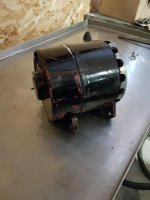


 Good idea.


 The thinner belt was still on it when the pictures were taken.


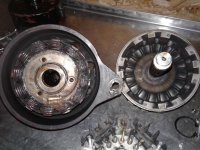
 I wonder if the Diodes are big Zeners?