To avoid these ads, REGISTER NOW!

Annual energy consumption guesstimate

ericm

Well-known member
Joined
Apr 17, 2016
Messages
1,963
Location
Southern Oregon
I'm trying to guesstimate the annual kwh usage for the house and shop I'm getting built in Southern Oregon. 2300sq ft house, 800 sq ft apartment, 2240 sq ft heated and cooled side of the shop. It'll all be mini splits (seven air handlers!). It's all electric, planning for heat pump water heaters and induction cook tops but a regular electric clothes dryer. There's a well and a whole house R/O system. Everything except the apartment is new construction, well sealed and well insulated. It gets into the 20s in the winter and 110 a few days in summer but 90s is more common. We don't over heat or cool our spaces- 68 is enough in winter and mid 70s in summer. The shop will be a few degrees cooler/warmer than that.


The reason I'm looking for a guess is to size the solar array. It's likely the federal rebate will go away soon so my plan of erring on the small side and adding later would get more expensive for the adding later part.Oregon has 1:1 net metering but they don't cut you a check for any overage, it gets donated. I'd like to get close to the consumption of the house apartment and shop. If I go over I can use the credits to offset the pump for the irrigation system but that's on an ag meter which gets billed less than residential so I don't need to try to offset it all. The power company told me that the previous owners used about 10k kwh per year just on the pump. At the rates they charge for ag, solar for that will take a long time to pay off.

My previous guess just for the house, based on our existing house which is very different and 400 miles away was on the order of 10-12k kwh/year. I was going with a 12kw array but it looks like the building we were going to put them on is not suitable so it's probably going to be a ground mount. This is also giving me the opportunity to change the size.

In this thread: https://www.garagejournal.com/forum...plit-heated-and-cooled-home-and-garage.546723 he used about 8700 kwh/yr for a 1200sq ft house and 800 sq ft garage. In an area that's got colder winters and cooler summers so very roughly a wash climate wise. Scaling that to our house + apt I'd get 13500 kwh/yr. I have no clue what the shop would take with R21 walls and R45 ceiling and pole construction.

Congrats to anyone who read all this. Proably the answer is to put in all the panels I can up to the 25kw limit. I just don't want to write that check!
 
To avoid these ads, REGISTER NOW!

pcmeiners

Well-known member
Joined
Aug 13, 2009
Messages
7,938
Location
In the only town in Pennsylvania, Bloomsburg.
What is your all inclusive KW cost ?

My 1080 sft shop, 1250 sft home. total 2330 sft
As to your size shop and home, it also a wash compared to mine.

"I have no clue what the shop would take with R21 walls and R45 ceiling"
Very little, I have R13 in the walls, some siding insulation and R18 in the shop ceiling, and (2) new 10x8 roll-ups, couple windows and a regular door, insulated slab.
As to the heating and cooling cost, with the amount of insulation you plan and air sealing I would not be surprised if it cost $10-15 a month, that is if the roll-ups are not opened often, or left open most of the time, and if you get efficient heat pumps.

As to your solar array size, have not dealt with solar so far, houses in NYC generally have a 10kw panel, which is far more capacity then generally used. I do not see 25KW use at any point, even with welding and battery storage.

As to irrigation you have a choice of running the pump[(s) during the high output times of the array, so you could do with less battery backup, supplementing the array with utility power at times when the array produces less power, basically using the utility as a "backup" battery, if you want to cut back on panels/batteries.
 
OP
E

ericm

Well-known member
Joined
Apr 17, 2016
Messages
1,963
Location
Southern Oregon
All in residential rate is about $0.15. The ag rate per kwh is about $0.07 but the rate schedule has a lot of potential charges I don't understand, and some have appeared on bills. But unless I get socked with a lot of them the total rate will still be pretty low and not worth offsetting with solar.

A Manual J was done for the house and I have the results. I can use loadcalc.net to generate them for the other buildings. I can probably get degree days from a near by weather station. A quick search showed a thread on greenbuildingadvisor that linked to a NREL document that's missing now and had a lot of posts saying it's easy, but not showing how to do it. Any pointers would be appreciated!

The build spec calls for some decent Daikin units for the house and apartment. At this point I'm reluctant to change that.
The shop mini splits are up to me but they will be DIY install units.
 

Daedalus

Well-known member
Joined
Sep 28, 2009
Messages
6,039
I have 2500 sq ft, very mild weather, gas water heater, dryer and cooking, triple pane windows, and I use about 700 kw-h / month on average. I think 13500 kw-h seems a bit optimistic, unless you keep the thermostat set low in the winter and high in the summer. Just a gut feel. Even with mild weather, the HVAC for me is a killer, especially in the winter. I use 50% more energy in the coldest month vs. the mildest month (900 vs 600). I do like it "just right" in the house though. Right around 68 in the winter and 72* in the summer. I have a 5 ton heat pump unit.

Is your net metering on an annual basis? Are you allowed to change your "true up" date? If so, make sure you do that as soon as you can to change it to reset right before the 1st month with guaranteed over-generation (around March-May for most people).

A 25kw-h system would be huge. What's the estimated annual generation of a system that size where you are?
 
Last edited:
OP
E

ericm

Well-known member
Joined
Apr 17, 2016
Messages
1,963
Location
Southern Oregon
Oregon has annual net metering. The annual billing cycle ends Mar 31 and it looks like we can change it only with the utility's approval. We probably won't get PTO until fall so we won't have a bank of credits built up for the first winter.

The estimated annual generation depends on the orientation of the panels but the 12kw array we had planned would generate about 13kwh according to the solar company. That had some north-ish facing panels due to space limitations. A ground mount array should do a bit better.
 

Sumboodie

Well-known member
Joined
Mar 20, 2021
Messages
10,706
Location
AK
Golly. I must be a unicorn or something. Use around 3500-4000 kwhr a year.
 

Daedalus

Well-known member
Joined
Sep 28, 2009
Messages
6,039
Golly. I must be a unicorn or something. Use around 3500-4000 kwhr a year.
~10 kw-h/day on average? In Alaska? Do you have electric heat, or rely on gas? Single? Family of 4? Live in a studio or a mansion? When my wife and I lived in a tiny house with gas heat and no AC we were down around 400 kw-h per month. This was before LED lighting and LCD TVs, and the dryer was electric, which was a pretty good chunk of our usage then, with 6 loads of laundry per week.
Today my 1 fridge ***** up about 3 kw-h/day. Granted, it's not efficient by any means. My home office, with 3 computers (2 for WFH for wife and me, plus my PC) ***** up 2 kw-h/day. Then there's everything else. EV charging, TVs, lights at night for people in 3 different rooms, fans, garage stuff, laundry, etc. Fairly easy for us to get to 20 kw-h/day before we turn the HVAC on, and that consumes 6kw. It would be low-hanging fruit to cut down on the infinite parasitics around here, but since our solar over-generates by a good margin, I haven't had much incentive to, other than the ~1 cent/kw-h the state will pay me for my extra juice :rolleyes:.
 

Sumboodie

Well-known member
Joined
Mar 20, 2021
Messages
10,706
Location
AK
~10 kw-h/day on average? In Alaska? Do you have electric heat, or rely on gas? Single? Family of 4? Live in a studio or a mansion? When my wife and I lived in a tiny house with gas heat and no AC we were down around 400 kw-h per month. This was before LED lighting and LCD TVs, and the dryer was electric, which was a pretty good chunk of our usage then, with 6 loads of laundry per week.
Today my 1 fridge ***** up about 3 kw-h/day. Granted, it's not efficient by any means. My home office, with 3 computers (2 for WFH for wife and me, plus my PC) ***** up 2 kw-h/day. Then there's everything else. EV charging, TVs, lights at night for people in 3 different rooms, fans, garage stuff, laundry, etc. Fairly easy for us to get to 20 kw-h/day before we turn the HVAC on, and that consumes 6kw. It would be low-hanging fruit to cut down on the infinite parasitics around here, but since our solar over-generates by a good margin, I haven't had much incentive to, other than the ~1 cent/kw-h the state will pay me for my extra juice :rolleyes:.
Just electric for lights, shop equipment, kitchen, dryer, etc.... actually hot plate is propane.
Do maybe 5-6 loads of wash a month between 2 people.

Haven't used a TV for years, though those aren't power hogs these days.

Have a fridge and seperate deep freeze. Both from the 90s. No idea what they draw.

Have heated floor that is off a gas boiler, used oil boiler in the works too.

Probably biggest power use is winter if I plug in a block heater. That's ~1000 watts for 8-10+ hours.
 
Last edited:

Daedalus

Well-known member
Joined
Sep 28, 2009
Messages
6,039
I put in an Emporia Vue 3 home energy monitor system. I recommend looking into one; for the low cost, it gives minute by minute usage of up to 16 circuits, is compatible with solar charging systems and EV charging. I put mine in about 3 months ago, and immediately identified places we were wasting energy..
I've had one of those on my main panel for about a year and a half. I agree, very informative, but the 16 circuits limit is the downside, plus I have 2 subpanels I never bothered moving it to. All I know is my unmonitored balance is 56% of my total usage. That includes the HVAC (probably most of it), garage, the master bedroom and most of downstairs.
 

scooterbum46

Well-known member
Joined
Jan 29, 2014
Messages
871
Location
South Central Michigan / ex Gulf Coast Florida
I've had one of those on my main panel for about a year and a half. I agree, very informative, but the 16 circuits limit is the downside, plus I have 2 subpanels I never bothered moving it to. All I know is my unmonitored balance is 56% of my total usage. That includes the HVAC (probably most of it), garage, the master bedroom and most of downstairs.
I was able to cover all but 3 circuits in my 200 amp main panel. I thought I was sunk on the 16 circuit limit until I learned that 240 volt circuits only needed one amp probe per circuit . I can account for about 96% of my total usage. Additional Vue 3's can be added, data merged.
 
To avoid these ads, REGISTER NOW!

ipgenie

Well-known member
Joined
Jan 29, 2020
Messages
562
Location
Idaho
The hard part is that two different families can live in the same house and each can have radically different power usage. Some run AC/heat at much lower/higher temps, every light is left on or religiously turned off when not needed, server racks of network/sound/computer equipment or just a phone and maybe a laptop,cooks a lot or mostly eats out, EV vehicles, etc.

I put a 25kw array on my shop 5 years ago. That was the largest residential system allowed by the utility. It was way oversized for our usage, but I had several years worth of data and I started adding up power for things we didn't do yet like adding some minisplits for heat and AC, an EV and a plug in hybrid, adding electric heat to the boiler system for our homes in floor heating, etc.

Last year we used about the same amount we had produced so the system size is pretty close for our family. The first few years we over produced and the utility allows that to stay on our account as a credit so we have a nice sized buffer for the future.

That is probably not a lot of help, but I guess my point is that your system needs are largely based on your family size and energy use habits.
 

dcg9381

Well-known member
Joined
Jun 20, 2018
Messages
11,799
Location
Austin, TX
The reason I'm looking for a guess is to size the solar array. It's likely the federal rebate will go away soon so my plan of erring on the small side and adding later would get more expensive for the adding later part.Oregon has 1:1 net metering but they don't cut you a check for any overage, it gets donated. I'd like to get close to the consumption of the house apartment and shop. If I go over I can use the credits to offset the pump for the irrigation system but that's on an ag meter which gets billed less than residential so I don't need to try to offset it all. The power company told me that the previous owners used about 10k kwh per year just on the pump. At the rates they charge for ag, solar for that will take a long time to pay off.
In my experience your best bet is to design for it now (so you can easily set it up) and wait until you're living in the home to see your energy use. Given the exact same home, energy costs can swing 100% just by "lifestyle" choices.

Alternately, if you want to set an array now, set one that you know will "undersize" but make sure that it's expandable. Generally multi-inverter setups need to "communicate" with each other in the case where you have 2+ possible arrays.

A big part of this will be how "optimal" your array is. Most are fixed tilt, you need south facing, the tilt alone (typically due to roof slope) and decrease the production of a given array if it's not optimal.

Is your "net meter" monthly? Some have annual which is one hell of a deal as my energy costs go way up in the winter.

If it's the state that has 1:1 net meter, I'd buy into that. Our local PoCo pulled the rug out from under us and stopped net meter about 5 years into production, so that can happen too.
 

ipgenie

Well-known member
Joined
Jan 29, 2020
Messages
562
Location
Idaho
One thing you might consider is to use larger string inverters to leave room for expansion.

For example, my inverters each have connections for three strings of solar panels. I could install enough panels to fill two of the string connections and then later when the tax credit has expired, if needed I can expand the system by adding more panels to the third string connection and it will cost less because I'm not purchasing more inverters, just panels and associated mounts, wiring, etc.

A DIY system will save a lot of money if you are able to do that. If not, some planning during the install should make adding to the system much easier and maybe that can be DIY to help with the no tax credit cost.
 

u3b3rg33k

Well-known member
Joined
Dec 18, 2017
Messages
4,048
I'm trying to guesstimate the annual kwh usage for the house and shop I'm getting built in Southern Oregon. 2300sq ft house, 800 sq ft apartment, 2240 sq ft heated and cooled side of the shop. It'll all be mini splits (seven air handlers!). It's all electric, planning for heat pump water heaters and induction cook tops but a regular electric clothes dryer. There's a well and a whole house R/O system. Everything except the apartment is new construction, well sealed and well insulated. It gets into the 20s in the winter and 110 a few days in summer but 90s is more common. We don't over heat or cool our spaces- 68 is enough in winter and mid 70s in summer. The shop will be a few degrees cooler/warmer than that.


The reason I'm looking for a guess is to size the solar array. It's likely the federal rebate will go away soon so my plan of erring on the small side and adding later would get more expensive for the adding later part.Oregon has 1:1 net metering but they don't cut you a check for any overage, it gets donated. I'd like to get close to the consumption of the house apartment and shop. If I go over I can use the credits to offset the pump for the irrigation system but that's on an ag meter which gets billed less than residential so I don't need to try to offset it all. The power company told me that the previous owners used about 10k kwh per year just on the pump. At the rates they charge for ag, solar for that will take a long time to pay off.

My previous guess just for the house, based on our existing house which is very different and 400 miles away was on the order of 10-12k kwh/year. I was going with a 12kw array but it looks like the building we were going to put them on is not suitable so it's probably going to be a ground mount. This is also giving me the opportunity to change the size.

In this thread: https://www.garagejournal.com/forum...plit-heated-and-cooled-home-and-garage.546723 he used about 8700 kwh/yr for a 1200sq ft house and 800 sq ft garage. In an area that's got colder winters and cooler summers so very roughly a wash climate wise. Scaling that to our house + apt I'd get 13500 kwh/yr. I have no clue what the shop would take with R21 walls and R45 ceiling and pole construction.

Congrats to anyone who read all this. Proably the answer is to put in all the panels I can up to the 25kw limit. I just don't want to write that check!
my total of 12kW in the midwest generates 13.3 MWh/yr, including time wasted with snow on the panels. if I was going electric, I'd want a bigger roof (I want a bigger one now, for more panels!).
All in residential rate is about $0.15. The ag rate per kwh is about $0.07 but the rate schedule has a lot of potential charges I don't understand, and some have appeared on bills. But unless I get socked with a lot of them the total rate will still be pretty low and not worth offsetting with solar.

A Manual J was done for the house and I have the results. I can use loadcalc.net to generate them for the other buildings. I can probably get degree days from a near by weather station. A quick search showed a thread on greenbuildingadvisor that linked to a NREL document that's missing now and had a lot of posts saying it's easy, but not showing how to do it. Any pointers would be appreciated!

The build spec calls for some decent Daikin units for the house and apartment. At this point I'm reluctant to change that.
The shop mini splits are up to me but they will be DIY install units.
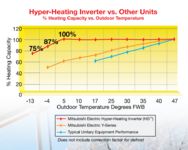
if it was me, I'd be speccing mitsubishi hyperheats and either their medium static air handlers (furnace style) or the low static hidden units, since both can take real pleated filters.
I've already picked out my "oh $h*t replacment for my 90s R-22 AC unit. Hyper-heat does nameplate output down to like 5F, and they run a like 10-15F colder minimum temp than a lot of the other brands, so if you want to avoid needing to run aux heat, they're worth a serious look.

for comparison, i have an "american" system (inverter board says LG) installed somewhere, and it functionally cuts out at 4F (it'll keep running to -4F if the call for heat is uninterrupted). mitsubishi is just getting warmed up at that point.

1748453388142.png

Oregon has annual net metering. The annual billing cycle ends Mar 31 and it looks like we can change it only with the utility's approval. We probably won't get PTO until fall so we won't have a bank of credits built up for the first winter.

The estimated annual generation depends on the orientation of the panels but the 12kw array we had planned would generate about 13kwh according to the solar company. That had some north-ish facing panels due to space limitations. A ground mount array should do a bit better.
i'd kill for annual net metering. mine is monthly, and any overage is "sold" to the power company at wholesale prices. so I buy at TOU ($0.29/.10, flat rate is now $.17), and sell at $0.03. pretty much a donation. on my house, I generated 7.5MWh last year and used 18MWh. I'm pretty happy to functionally buy power at a 70% discount for most of the year and functionally ignore the retail/peak pricing structure.

I have two separate systems, 6.5kW on the house and 5.5kW on the garage (garage got it's own 200A service instead of upgrading the house and trenching).
 
OP
E

ericm

Well-known member
Joined
Apr 17, 2016
Messages
1,963
Location
Southern Oregon
The house design doesn't have room for a central HVAC unit's duct work. Most of the rooms have cathedral ceilings. The builder/designer only uses mini splits these days. I did insist on a carbon filter in the HRV system because the area sometimes gets wildfire smoke.

Pretty much any mini split sold these days works well at temps lower than we'll see in this location. I haven't even seen one for sale with aux heat though I'm sure they still are sold somewhere.

Net metering is why we're doing solar. We can also assign extra credits to other meters in priority order, so I can offset the shop meter with the house's solar and vice versa. But since we want the house to have backup batteries and the batteries to get charged by solar, the panels have to feed the house. Otherwise I'd just put them all on the shop.
 
Last edited:

u3b3rg33k

Well-known member
Joined
Dec 18, 2017
Messages
4,048
The house design doesn't have room for a central HVAC unit's duct work. Most of the rooms have cathedral ceilings. The builder/designer only uses mini splits these days. I did insist on a carbon filter in the HRV system because the area sometimes gets wildfire smoke.

Pretty much any mini split sold these days works well at temps lower than we'll see in this location. I haven't even seen one for sale with aux heat though I'm sure they still are sold somewhere.

Net metering is why we're doing solar. We can also assign extra credits to other meters in priority order, so I can offset the shop meter with the house's solar and vice versa. But since we want the house to have backup batteries and the batteries to get charged by solar, the panels have to feed the house. Otherwise I'd just put them all on the shop.
I wish I could assign my excess from the garage to the house! A few free MWh would be nice!

My experience (and others here) with H/ERV and smoke is that you need more than a polishing filter to handle smoke. Functionally you need a merv13+ filter for particulate matter and then a significant charcoal filter to handle the remaining odor.

Ie the big box store carbon filter will leave you wanting

here's denwood's work:
 
Last edited:

aquinob

Well-known member
Joined
Oct 7, 2014
Messages
238
Location
Portsmouth, VA
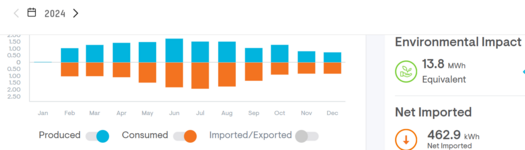
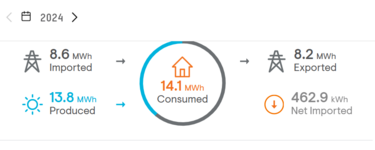
Not sure if this will help, but I'll throw out some numbers for my home. We installed 39 panels beginning of last year, nominal rating of 15.6kw. 2200 sq ft house, no outbuildings. I'm in SE VA, so climate wise it may not be that far off your location in Oregon. Summers get in the 90's, winters are moderate, down in the 30's to 40s but some days colder or warmer. We cool with electric but heat with gas as well as hot water and the stove and dryer. For the 2024 year (11 months, system installed in Feb) this is what we got:


1748463861523.png

1748464132460.png

So we are pretty balanced on the electrical side. We use most gas during the cold months which is not reflected here. VA is a 1:1 net metering state and any excess is credited to future billing cycles where you may fall short. Don't forget to factor in SREC's as part of the payback cycle, though that varies quite a bit by state. I get about 40 a credit, my brother in NJ gets around 100.

Since you are dealing with larger areas and all heat/cooling electric, you would probably want to scale accordingly. One thing I don't have visibility on is how much sun your roof/property gets. If you have an ideal southern exposure, then your results will be better.
 

scooterbum46

Well-known member
Joined
Jan 29, 2014
Messages
871
Location
South Central Michigan / ex Gulf Coast Florida
That might be useful once the house is completed and we're living in it. But it won't do anything for predicting the consumption now when I'm sizing the solar array.
Well, there is that.... Three little words "I'm getting built" are sooo easy to miss when I'm half asleep. Sorry.
If you're building in the Bend area, say hello to Casey LaDelle (Cascade Heavy Rescue on YT).
Good luck on the load estimating, BTDT for a large computer center, easier than a household ;)
 
OP
E

ericm

Well-known member
Joined
Apr 17, 2016
Messages
1,963
Location
Southern Oregon
Not sure if this will help, but I'll throw out some numbers for my home.
Thanks!


No SRECs in Oregon so we don't have to worry about that.

Since you are dealing with larger areas and all heat/cooling electric, you would probably want to scale accordingly. One thing I don't have visibility on is how much sun your roof/property gets. If you have an ideal southern exposure, then your results will be better.

It'd be better if the land sloped to the south but I think we can work something out. It might not point directly south but it will be pretty close. According to the PVwatts model it will be only a few percent less than true south.

The solar companys' going to work up a proposal for a ground mount next to the building we were going to use. Also they told me that they mount panels at 30 degrees instead of 40 that would be normal for that lattitude. Said it's not quite as good in the winter but significantly better in the summer so the total is higher. The PVwatts model says that's an annual 20k kwh off a 15kw array.
 

u3b3rg33k

Well-known member
Joined
Dec 18, 2017
Messages
4,048
Thanks!


No SRECs in Oregon so we don't have to worry about that.


It'd be better if the land sloped to the south but I think we can work something out. It might not point directly south but it will be pretty close. According to the PVwatts model it will be only a few percent less than true south.

The solar companys' going to work up a proposal for a ground mount next to the building we were going to use. Also they told me that they mount panels at 30 degrees instead of 40 that would be normal for that lattitude. Said it's not quite as good in the winter but significantly better in the summer so the total is higher. The PVwatts model says that's an annual 20k kwh off a 15kw array.
if I could wave a magic wand, I've noticed that the steeper roofs/tall ground mounts shed snow MUCH better than my relatively flat roof that catches the snow as it tries to fall off.

makes a big difference in feb/march.
 

pcmeiners

Well-known member
Joined
Aug 13, 2009
Messages
7,938
Location
In the only town in Pennsylvania, Bloomsburg.
My experience (and others here) with H/ERV and smoke is that you need more than a polishing filter to handle smoke. Functionally you need a merv13+ filter for particulate matter and then a significant charcoal filter to handle the remaining odor.

Ie the big box store carbon filter will leave you wanting
Agreed, unless you literally have a ton of activated charcoal in your filter system charcoal will do little to remove smoke or odors in the long term. It is a scam as it works for a very short time for a day to a few days unless a miracle occurs .
 
Last edited:

Sumboodie

Well-known member
Joined
Mar 20, 2021
Messages
10,706
Location
AK
I had a 3.6 kw array at my old place. It covered 100% power usage from May to September, plus enough excess to cover into November. Just had a full bill December to February
 
To avoid these ads, REGISTER NOW!
Top Bottom