7th Kahuna
Well-known member
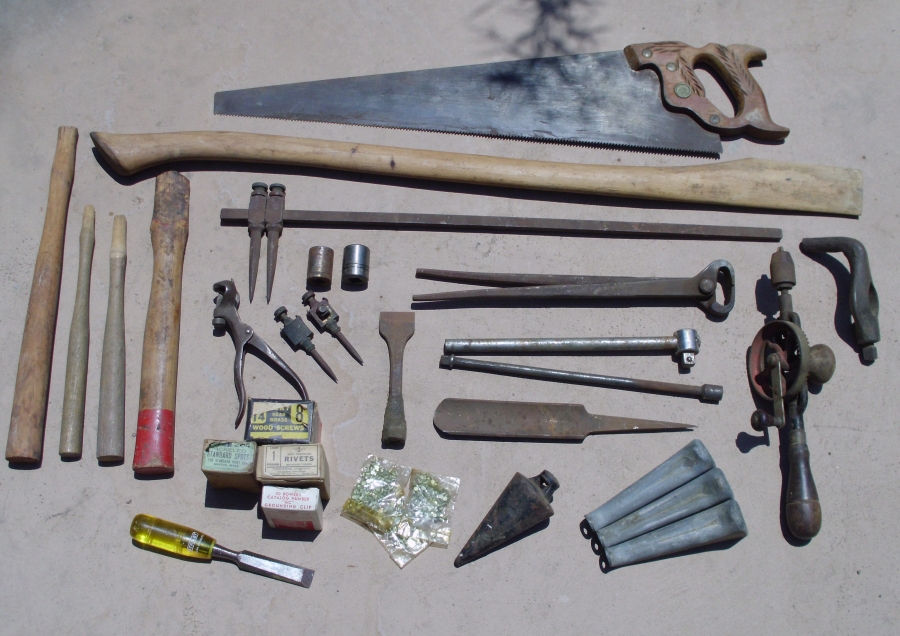
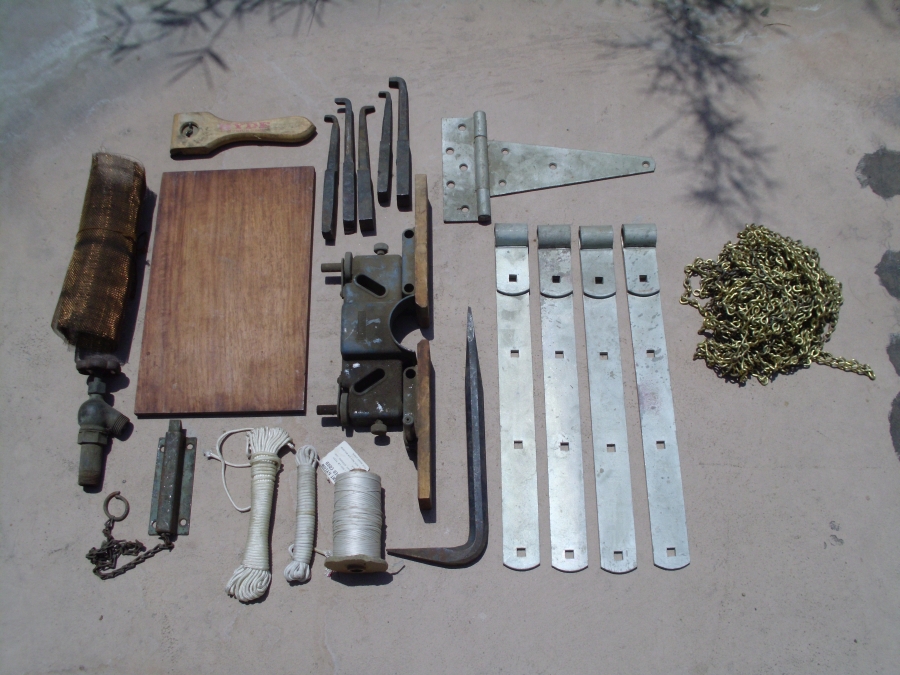
Attended my first barn sale. You know we don't get many of those here in the city. Unfortunately they didn't actually let us into the barn. The owner, who appeared to be in either his late 70's or early 80's said his family had just been stuffing stuff into it since his grandfather built it oh so many years ago. I have to say I believe it. (Kitchen sink, check; Victorian piano, check; harvest boxes, check; Model 'A' parts, check; buck board, check) Though it was well picked over before I got there, there was still a lot of interesting stuff. I mostly picked up odds and ends however; brass screws, brass chain, brass pipe fittings, stuff that costs you an-arm-and-a-leg at the box store, assuming you can find it at the box store. I wish I could have seen it before it all got drug out into the yard and mixed up. Anyhow here are a few items that came home with me.
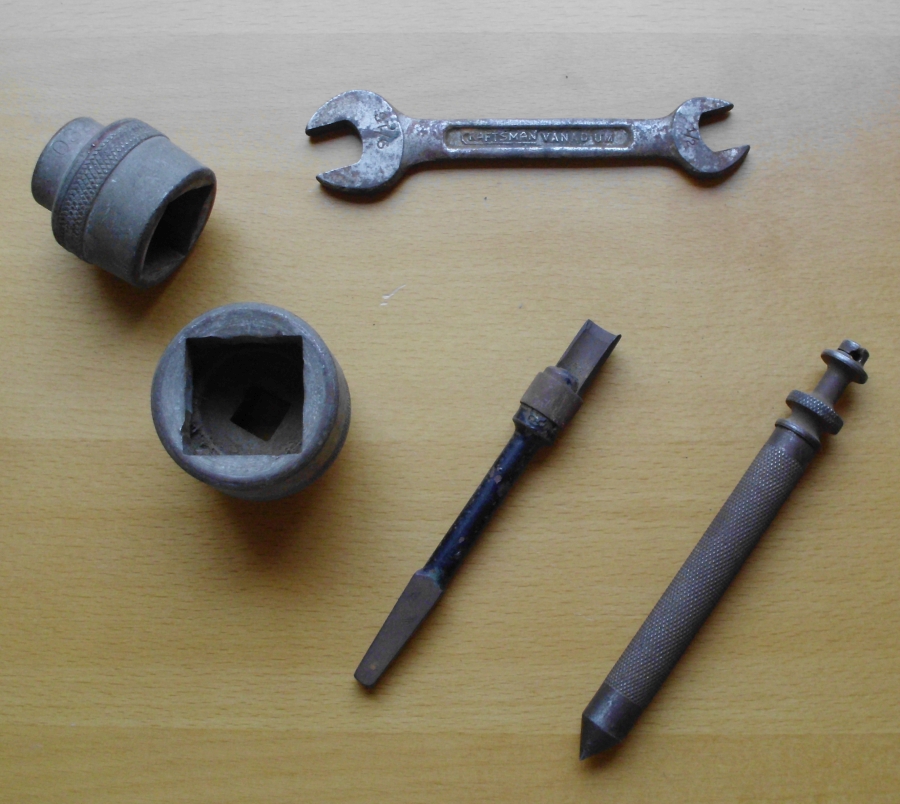
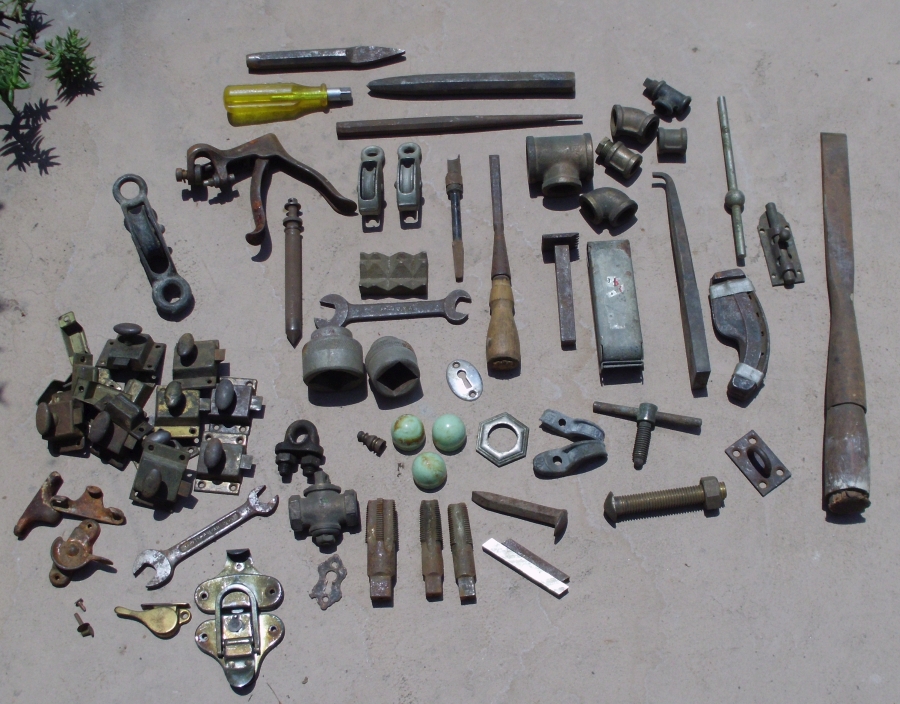
First are the two Blackhawk Sockets. I found a reference to these in the 1928 catalog. I have never seen sockets for square nuts before. I remember seeing large square nuts on various old equipment as a kid. Is that the sort of thing these were for or did they have another more common use? These are for 1" and 1.25". They almost look galvanized. Perhaps a heavily oxidized cadmium coating?
The Craftsman wrench was of interest. I have not seen one like it before. Pre WWII I'd guess. 1/2" and 9/16".
The item with the navy blue shaft appears that it would work with a standard brace (i.e. brace and bit). The only marking on it says 1/2". The curved sheet metal portion has a taper ground on the inside of the curve. It appears to be new, but I can't imagine what it was intended for unless it was for winding something. Anyone?
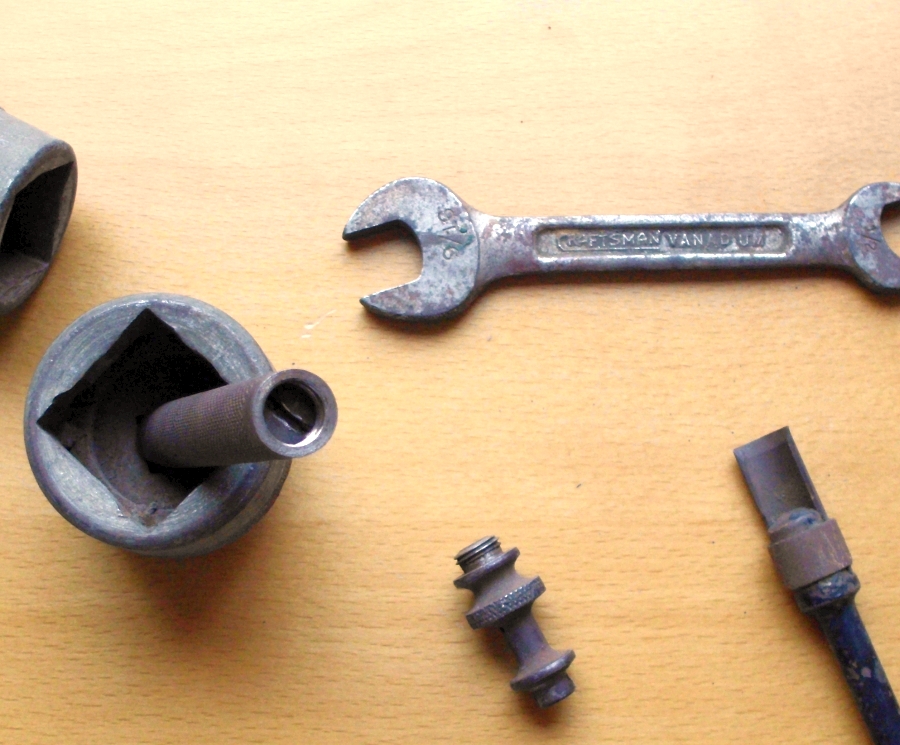
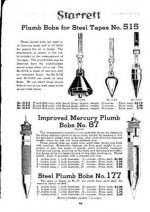
The final item in this photo appears to be a plumb bob but there are things going on that I don't understand. First, the form is odd, long and thin, and knurled. Then, as you might have noted in the photo below, the top screws off. Inside the body, note the threaded plug. I can't budge the plug and I am not sure I want to. There is something behind it. I am wondering if it might be filled with mercury. Something moves around inside when I shake it. It feels neither like a spring nor like water. Mercury would help to settle it, if it is a plumb bob, but the long narrow body seems like it would defeat any advantage such a dampener might have provided. Then the knurling would suggest there is a reason to want to open it. If it were a plumb bob, especially a mercury filled plumb bob, there's no reason. It would be like having a removable door on the side of a shot filled dead blow hammer. So what is it?
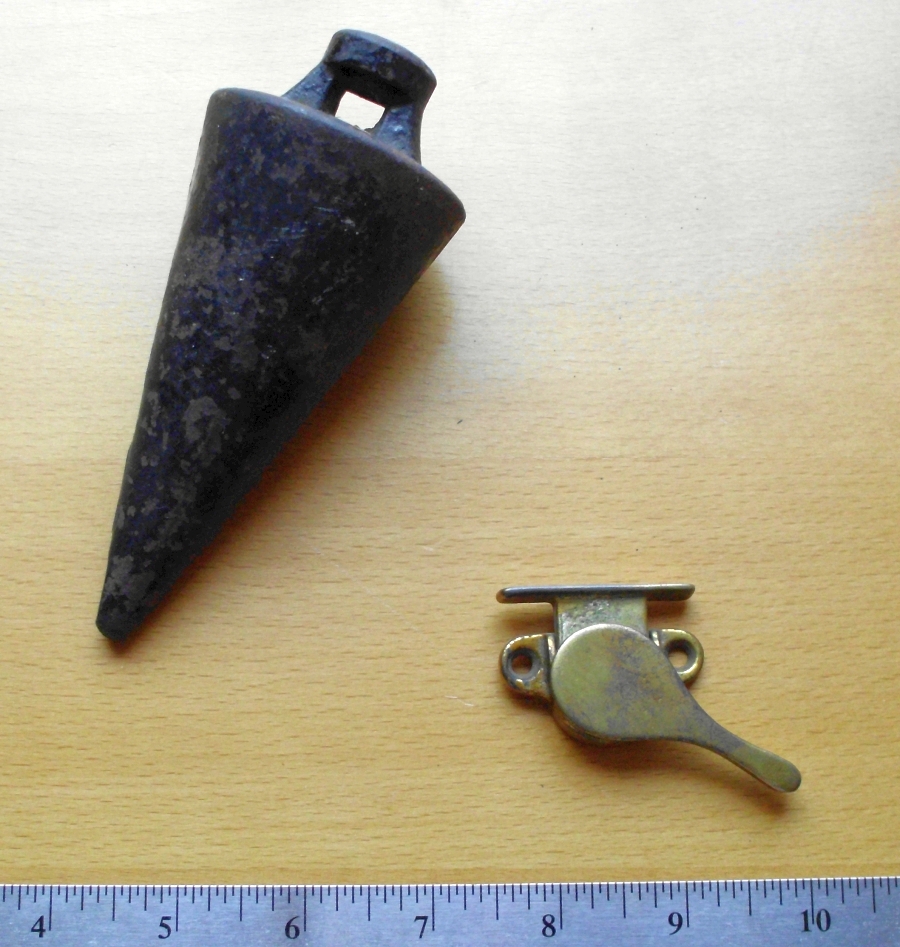
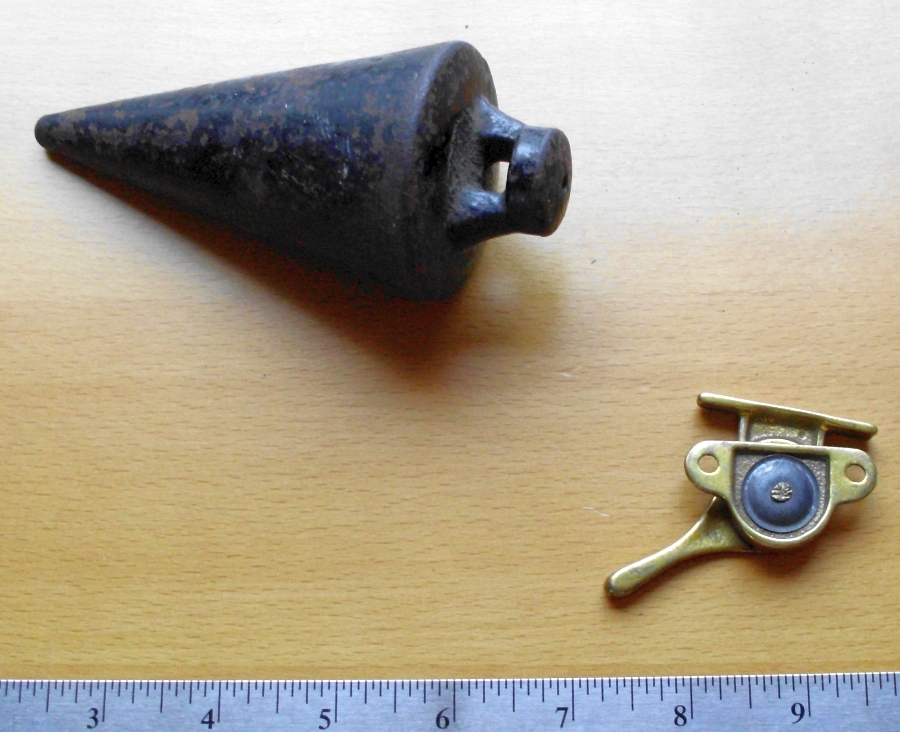
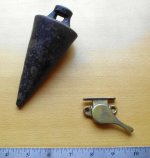
Now I'm pretty sure this one is a plumb bob, but it is the size of a small avocado and weights two pounds. There is a hole in the middle of the top cap but it doesn't go through. I have been experimenting with ways to tie it through the large side opening and still have it fall straight. You would think given the weight it would fall straight no matter what, but that isn't necessarily true. In any case, it will work as a plumb bob for longer drops. I'd just like to know if that was the original intent.
The little brass catch is a curiosity. I expected when I pushed the arm from one side to the other that a catch would be released (like a window lock). When I got it home, I realized that all it does is extend or retract the 'T' shaped portion on a cam. In the photo it is in its extended position. It came out of a box of old carriage and car parts but my guess is that it isn't more than 40 years old. Thoughts?
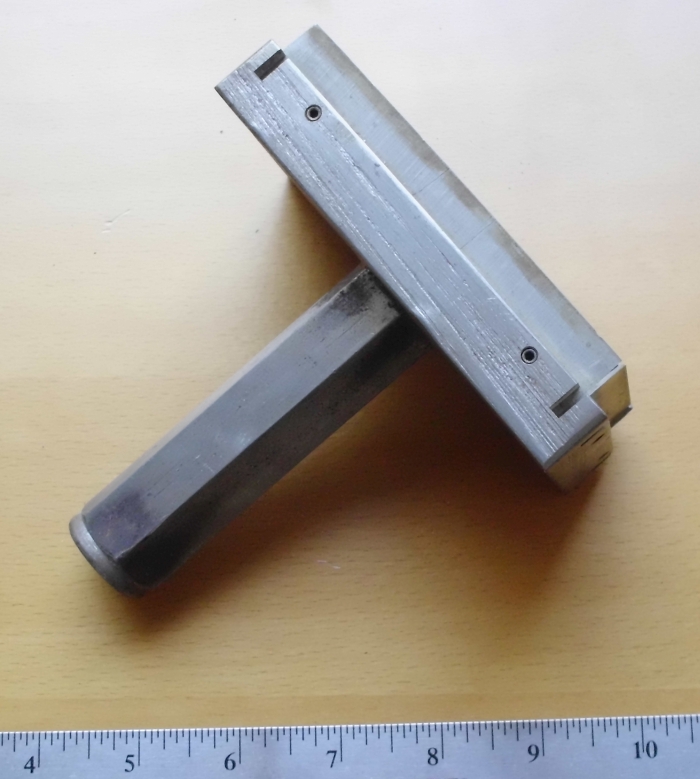
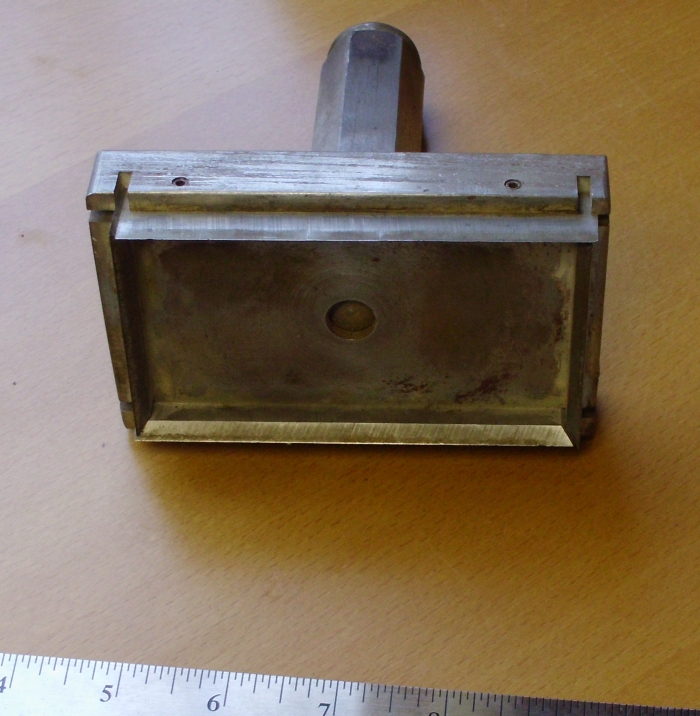
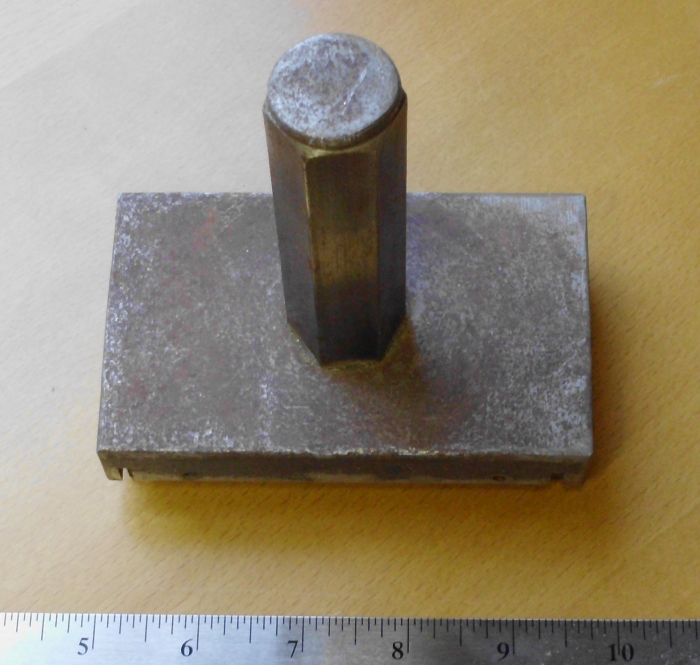
This last item came out of box of maintenance items from UC San Diego. It looks to have been shop made. My guess is that it is for chiseling (embossing) boxes into wood for small signs or something similar. I'm just not sure how effective it would be unless you hit it really hard or the wood was really soft. This leads me to ask if maybe it was for some other purpose. (It seems to have gypsum dust on it?) I know it's a long shot but maybe someone has seen something like it. Maybe someone here is retired from UCSD's maintenance department. Whoever made it did a nice job.
More stuff for those who are curious. There are a few gems in there but mostly just stuff. As I joked with the guy, 'From your barn to my garage.'
That gouge, which doesn't appear to have ever been used, was made in Sheffield England by King George's official 'x' maker. I'm not sure what 'x' was but I'm guessing it had something to do with blades.
In the whole place I saw four sockets and I went through a lot of boxes to find those. There were of course the two Blackhawks mentioned earlier and the two 12 point sockets you see here, a Plomb and a New Britian. The first I found was the 1/2" drive, 12 pt, 7/8", war finish Plomb socket. Several years back I picked up a set of 1/2" drive, 12 pt, mostly war finish, mostly Plomb sockets. I say mostly Plomb because the 7/8" socket was a Proto. Funny how these things work out. I didn't realize my luck until I got home.
Those boring bars, I assume they are boring bars, look to be hand forged. The body of each is a unique size. The blunt ends look to have been torn from the original stock. They don't look like much, but I think they could break our little Logan metal lathe.
First are the two Blackhawk Sockets. I found a reference to these in the 1928 catalog. I have never seen sockets for square nuts before. I remember seeing large square nuts on various old equipment as a kid. Is that the sort of thing these were for or did they have another more common use? These are for 1" and 1.25". They almost look galvanized. Perhaps a heavily oxidized cadmium coating?
The Craftsman wrench was of interest. I have not seen one like it before. Pre WWII I'd guess. 1/2" and 9/16".
The item with the navy blue shaft appears that it would work with a standard brace (i.e. brace and bit). The only marking on it says 1/2". The curved sheet metal portion has a taper ground on the inside of the curve. It appears to be new, but I can't imagine what it was intended for unless it was for winding something. Anyone?
The final item in this photo appears to be a plumb bob but there are things going on that I don't understand. First, the form is odd, long and thin, and knurled. Then, as you might have noted in the photo below, the top screws off. Inside the body, note the threaded plug. I can't budge the plug and I am not sure I want to. There is something behind it. I am wondering if it might be filled with mercury. Something moves around inside when I shake it. It feels neither like a spring nor like water. Mercury would help to settle it, if it is a plumb bob, but the long narrow body seems like it would defeat any advantage such a dampener might have provided. Then the knurling would suggest there is a reason to want to open it. If it were a plumb bob, especially a mercury filled plumb bob, there's no reason. It would be like having a removable door on the side of a shot filled dead blow hammer. So what is it?
Now I'm pretty sure this one is a plumb bob, but it is the size of a small avocado and weights two pounds. There is a hole in the middle of the top cap but it doesn't go through. I have been experimenting with ways to tie it through the large side opening and still have it fall straight. You would think given the weight it would fall straight no matter what, but that isn't necessarily true. In any case, it will work as a plumb bob for longer drops. I'd just like to know if that was the original intent.
The little brass catch is a curiosity. I expected when I pushed the arm from one side to the other that a catch would be released (like a window lock). When I got it home, I realized that all it does is extend or retract the 'T' shaped portion on a cam. In the photo it is in its extended position. It came out of a box of old carriage and car parts but my guess is that it isn't more than 40 years old. Thoughts?
This last item came out of box of maintenance items from UC San Diego. It looks to have been shop made. My guess is that it is for chiseling (embossing) boxes into wood for small signs or something similar. I'm just not sure how effective it would be unless you hit it really hard or the wood was really soft. This leads me to ask if maybe it was for some other purpose. (It seems to have gypsum dust on it?) I know it's a long shot but maybe someone has seen something like it. Maybe someone here is retired from UCSD's maintenance department. Whoever made it did a nice job.
More stuff for those who are curious. There are a few gems in there but mostly just stuff. As I joked with the guy, 'From your barn to my garage.'
That gouge, which doesn't appear to have ever been used, was made in Sheffield England by King George's official 'x' maker. I'm not sure what 'x' was but I'm guessing it had something to do with blades.
In the whole place I saw four sockets and I went through a lot of boxes to find those. There were of course the two Blackhawks mentioned earlier and the two 12 point sockets you see here, a Plomb and a New Britian. The first I found was the 1/2" drive, 12 pt, 7/8", war finish Plomb socket. Several years back I picked up a set of 1/2" drive, 12 pt, mostly war finish, mostly Plomb sockets. I say mostly Plomb because the 7/8" socket was a Proto. Funny how these things work out. I didn't realize my luck until I got home.
Those boring bars, I assume they are boring bars, look to be hand forged. The body of each is a unique size. The blunt ends look to have been torn from the original stock. They don't look like much, but I think they could break our little Logan metal lathe.
Last edited:

 My other concern is one of age. If this plumb bob predated nylon, you'd be contemplating hanging a two pound pointy object from a fairly fine cotton or linen thread, fished through a hole with potentially sharp edges. Now if it predates nylon, I'd suggest it predates OSHA, but just the same, a larger hole would have made better sense than what we see there. Maybe that hole was just to start the drill.

 Could it be that it was the precursor and model for the raft of cheap, occasionally functional tools, that would begin to arrive from Asia 30 or 50 years later. That too might explain why a search for vintage plug cutter turns up nothing that looks like it. They all got tossed long ago.