To avoid these ads, REGISTER NOW!

Anti-seize opinions.

Tunar

Well-known member
Joined
Oct 7, 2017
Messages
115
Location
Woodstock VA
When I started wrenching on FJ40's many years ago, I learned to use anti-seize on just about everything (automotive that is). Just a little extra insurance that parts would come off easy in the future. I'm guessing it's graphite suspended in a oil therefore lubricating and preventing components from rusting where they meet.

The only place I've seen a downside is in the lugnuts on my truck. The anti-seize has kind of become a thick paste that almost takes more effort to overcome. I'm guessing that's from attracting dirt and a thourgh cleaning would correct that.

My brother recently had to take some training on torque techniques and learned that no modifiers should be applied to the wheel studs or hub. I know critical engine components should be torqued dry except fasteners with factory specified additives. I'll acknowledge that lugnuts would fall under critical fasteners. I was just wondering what opinions or knowledge is on GJ in reference to anti-seize.
 
To avoid these ads, REGISTER NOW!

Jay H 237

Well-known member
Joined
Apr 24, 2005
Messages
1,994
Location
Torrington, CT
I do put a little bit on the lugs, but I'm also in a rust belt area. I do other fastners sometimes too.

I think for most of us it comes down to personal preference and the location where we live.
 

nadogail

Well-known member
Joined
Jan 23, 2009
Messages
31,957
Location
Coronado, CA
The answer is "It Depends".

Manifold studs need anti-sieze on the brass nuts securing exhaust pipe flanges to the manifold.

Anti-Seize works great on many marine applications.

It also gets allover your tools and hands.
 

sberry

Banned
Joined
Jun 18, 2005
Messages
35,747
Location
Brethren, Michigan
A little, sparingly. Whoever came up with dry torque needs an examination. Snap-on torque wrench manual of old says,, all values for clean lightly lubed threads, about like modern penetrating oil which is what we put on nearly everything threaded and lots of 8nterferance parts we want 5o come apart.
 

NUTTSGT

Super Moderator
Staff member
Joined
Sep 14, 2009
Messages
50,954
Location
Northern Central Ohio
The answer is "It Depends".

Manifold studs need anti-sieze on the brass nuts securing exhaust pipe flanges to the manifold.

Anti-Seize works great on many marine applications.

It also gets allover your tools and hands.


That's why it makes a great anti-theft device too. Anybody that has used it, knows how it makes a mess and they will avoid touching anything with anti-seize on it.
 

exmaxima1

Well-known member
Joined
Jun 25, 2011
Messages
6,341
Location
Midwest
I put it on the wheel studs and the faces of the hubs/rotors so they come back off easily.

+1
Without Never-Sieze I typically need my dead blow sledge to release the wheels on my BMW. I would hate to be in a situation on the road where I couldn't change a flat.
 

plinker

Well-known member
Joined
Feb 28, 2007
Messages
4,286
Location
Northern Wi
Any flange type surface that will rust together and around the center hole on rotors always gets anti-siezed so it will actually come apart again. Sleeved bushing bolts such as shock bolts & control arm bolts also get a coating on the shoulder of the bolt.

I find the copper better then the regular, Nickle better yet, both are more expensive.
 

unslow1

Well-known member
Joined
Mar 3, 2012
Messages
7,880
Location
Illinois
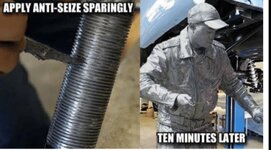
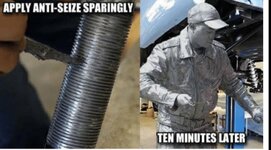
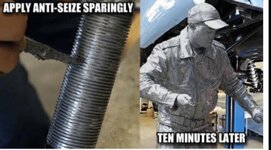
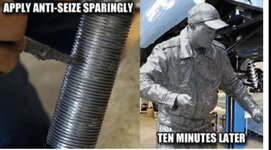
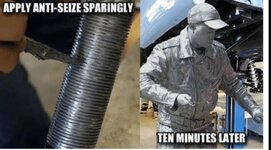
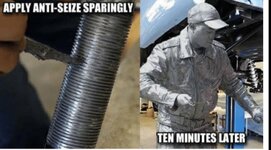
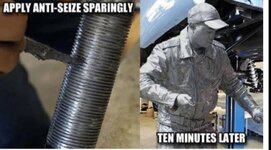
This sums up anti seize from my experience 040a97f1b16045f90e498a9e10474d9d.jpg

Sent from my SM-N960U using Tapatalk

One of the guys at work today asked a girl to hand him the anti-seize. I told her to be careful with that or she would end up looking like the tin man. She had no clue what I was talking about.
 

Attachments

  • 040a97f1b16045f90e498a9e10474d9d.jpg
    040a97f1b16045f90e498a9e10474d9d.jpg
    66 KB · Views: 3

unslow1

Well-known member
Joined
Mar 3, 2012
Messages
7,880
Location
Illinois
+1
Without Never-Sieze I typically need my dead blow sledge to release the wheels on my BMW. I would hate to be in a situation on the road where I couldn't change a flat.

Without anti-seize I have to use a torch on every wheel of my Toyota.
 

unslow1

Well-known member
Joined
Mar 3, 2012
Messages
7,880
Location
Illinois
Use a lady slipper pry bar between rim and hub for stuck Toyota rims (Alloy ones). Ones that wouldn't come off with heat and a sledge hammer come right off. It amazed me when I finally figured that out.

I'll keep that in mind but mine are steel. I've been curious if Fluid Film would work.
 

Legion Prime

Well-known member
Joined
Sep 5, 2018
Messages
740
Location
Leelenau County MI
My brother recently had to take some training on torque techniques and learned that no modifiers should be applied to the wheel studs or hub.

That depends on what's speced for the fastener. Some are speced to go on hard and dry while some are speced to go on with oil, assembly lube etc. Some manufacturers have gone to hybrid torque specs ie torque to say 80ft/lbs and then turn another 120 degrees. It's not as accurate as using a micrometer to measure fastener stretch but it's not as labor intensive and time consuming either. By using a lower torque spec and then degrees of rotation there is less variance from clean vs dirty vs lubed vs dry threads.
Me personally I'd use it for jackin if it weren't so thick. If I'm putting together something with threads and it doesn't spec loctite it's getting antisieze period end of story. I've worked on so many cars with a combination of rust, dirt, corrosion, ugga dugga torque specs etc that I just put it on EVERYTHING, it really does make a difference down the road when you need to take something apart again be it lug nuts or tie rods. Even if it does get caked a bit a wipe with an oily rag (there's one somewhere in your shop right?) usually cleans that right up.
 

Tonyuk

Well-known member
Joined
Jun 9, 2017
Messages
1,539
Location
Scotland
Use common sense.

The torque values are for clean and new fasteners, so over time, with a bit of wear and corrosion, its going to change no matter what.

VAG spec optimol paste to the threaded portion of their wheel bolts, its essentially a ceramic based antiseize.

Porsche spec the same stuff to the threads on their centrelock wheel nut.

I've always used a small amount of it, and never had an issue. If anything the reduced friction should increase the stretch of the bolt, and therefore the clamping force, when it reaches the specced torque. Wheel bolts have a large margin when it comes to overtorquing before they get damaged so i wouldn't worry.
 

PCMusicGuy

Well-known member
Joined
Feb 15, 2009
Messages
851
Location
Houston, TX
I've never used any antisieze on wheels or brakes or anything before and have never had any issues removing lugs or bolts. I guess South Louisiana and Texas doesn't really have weather where it makes a difference?
 

NUTTSGT

Super Moderator
Staff member
Joined
Sep 14, 2009
Messages
50,954
Location
Northern Central Ohio
I've never used any antisieze on wheels or brakes or anything before and have never had any issues removing lugs or bolts. I guess South Louisiana and Texas doesn't really have weather where it makes a difference?

If you lived in the rust belt where they use salt or brine, you'd see the difference.
 

lilredex

Well-known member
Joined
Apr 29, 2006
Messages
5,956
Location
Toronto
I put it on the wheel studs and the faces of the hubs/rotors so they come back off easily.

Same here, otherwise hammer action will be necessary. One place I do no use it is on auto brake adjusters, it cakes up and seizes the auto action.....brake grease here.
 
To avoid these ads, REGISTER NOW!

Jlbc212

Well-known member
Joined
Dec 7, 2013
Messages
1,530
Location
Northeast MA
Living in the rust belt I use it generously. There are a few exceptions where I don't use it. I've never had an issue because I did use it, except for getting it off my clothes. Where others have commented about "caking", like on lug nuts or brake adjusters, it's never failed for what it is intended to do which is to prevent metal parts from seizing together.
 

SGKent

Banned
Joined
Feb 12, 2010
Messages
1,959
Location
Citrus Heights CA
... except for getting it off my clothes.

that is why it is referred to as that silver (or copper) stuff that gets all over everything if you look at it.

Oh - I see that has already been addressed several times...

This sums up anti seize from my experience 040a97f1b16045f90e498a9e10474d9d.jpg

Sent from my SM-N960U using Tapatalk
 

Attachments

  • 040a97f1b16045f90e498a9e10474d9d.jpg
    040a97f1b16045f90e498a9e10474d9d.jpg
    66 KB · Views: 3
Last edited:
OP
T

Tunar

Well-known member
Joined
Oct 7, 2017
Messages
115
Location
Woodstock VA
Great info, thank you. It's always been helpful in removing fasteners at a later date with no negative issues so I'll continue to use it. We use plenty of salt here in VA in the winter. Most of my automotive education has just been from other car guys so I'd figure I'd ask. Thank you.
 

sberry

Banned
Joined
Jun 18, 2005
Messages
35,747
Location
Brethren, Michigan
I use more spray cans of pen oil installing than removing. It has about ended our seizure issues, its fast and simple and quite clean. We spray rotor hubs, wheel hubs, spring shackle bolts thru sleeves and almost all nuts bolts we install and its about the perfect juice for lug nuts, just to keep them from dry seizure and it repels the first wave of water.
 

ransil

Well-known member
Joined
Jul 22, 2018
Messages
313
Location
pa
I put that **** on everything

Sent from my SM-G920V using Tapatalk
 

MBfreak

MEMBER EMERITUS
Joined
Dec 10, 2010
Messages
2,301
Location
Linkoping , Sweden
This answer is restricted to MB engines from the sixties.
4 and 6 cyl, cast iron block, aluminium head and lots of different metals in the cooling circuit.
The exhaust( and intake) manifold sat on M10 and M8 studs in the aluminium head.
The manifold nuts were heavily copperplated. I have removed many manifolds that had not been removed until I did so after 20-30 years. The nuts came off with no problems and the studs stayed in the cylinder head.
Another not so happy situation was to replace the thermostat that sat in an aluminium external casting. The cover was secured with 4 off M6* 30 mm galvanized screws. After having broken a number that were hopelessly seized I learned to drill them out before even trying to screw out. Cleaned up the thread and used teflon tape over the threads when putting back. The teflon taped screws came out easy even after many years.

Ola
 

QwikKotaTx

Well-known member
Joined
Aug 10, 2013
Messages
967
Location
Seabrook, TX
I've never used any antisieze on wheels or brakes or anything before and have never had any issues removing lugs or bolts. I guess South Louisiana and Texas doesn't really have weather where it makes a difference?
I dunno. I am only a half mile or so from the water and I've seen plenty of things that anti-seize would have helped on. As long as you use it sparingly and take into account the torque change any issues are being blown out of proportion. A 120 ft-lb lug nut is not going to magically come loose just by adding a little lubricant.

Sent from my SM-G900V using Tapatalk
 

RKA

Well-known member
Joined
Jun 9, 2010
Messages
1,744
Location
NJ
I dunno. I am only a half mile or so from the water and I've seen plenty of things that anti-seize would have helped on. As long as you use it sparingly and take into account the torque change any issues are being blown out of proportion. A 120 ft-lb lug nut is not going to magically come loose just by adding a little lubricant.

Sent from my SM-G900V using Tapatalk

Having a fastener come loose because it's been lubricated is a bit of a misconception (as long as the seat of the fastener is clean). It's over torquing the fastener that becomes a problem down the road. If you use a fastener within it's designed torque range, it can be reused many times. If you exceed that, you'll find the threads stretched to the point where it will hold the first time, but each subsequent use it won't properly hold when torqued to spec and it will back out on it's own. Many suspension/drivetrain/engine fasteners are designed to be used in this way and are specified as one time use for this reason. If your lugnuts ever reach that point, replace them. The lubrication on the threads causes you to stretch that bolt more to reach the desired torque spec. In many cases it's fine, but if you later find the bolts or nuts backing out, it's not because of the antiseize in the threads, it's because you stretched them too far.

And if you ever encounter a situation where you need to put a 3-4 ft lever on a breaker bar or wrench to remove a lug nut/bolt installed by a shop, at a minimum, mark that bolt and check the torque every week for a few weeks to make sure it's not backing out. Or better still, just replace it. The nuts/bolts are usually softer than the hub flange or studs, so *usually* you'll be in good shape just replacing the lug nuts/bolts. But keep an eye on those new bolts just in case the flange or stud was damaged too.
 
Last edited:

FakeNewsRealHP

Well-known member
Joined
Oct 27, 2018
Messages
83
Location
Midwest
Many mfg make a spray can of anti seize now, it is much less of a mess besides overspray! I commonly use LONG stainless hardware with a nylon lock nut to fasten a part at work, without anti seize the two gall up instantly before it gets tight and you have to break the fastener.


Sent from my iPhone using Garage Journal
 

Falcon67

Well-known member
Joined
Jun 11, 2009
Messages
18,371
Location
Merkel, TX
I use what the mfg says on engine fasteners. Everything I use in critical areas on the race cars comes from ARP and has specific torque specs when using their lube and usually with engine oil. Wheel studs usually get a shot of WD-40 and torque to spec. 80 ft/lbs on 1/2" studs, 100 ft/lbs on 5/8". The only anti-sieze I use is on things going into aluminum heads and manifolds. Spark plugs, bolts, etc. And on stainless anything into aluminum anything.
 

zmotorsports

ALLIANCE MEMBER
Joined
Oct 20, 2009
Messages
21,400
Location
Northern Utah
The technical answer is that anything that is put onto the bolts and nuts changes the amount of bolt tension produced by a given torque applied to the nut. So, the torque value isn't valid if anti-sieze is applied and changes the force.

In the real world, you need the anti-sieze for anything to be taken apart again that is subject to corrosion. So, it's a necessary evil, and the fact that it changes the torque probably is of lesser concern than the corrosion is.

In general, I think anti-sieze lowers the force needed to torque a bolt to a specific tension. So, you end up overtightening the bolt.

^^Agreed.

I uses Permatex's Anti-seize on most all suspension fasteners up to an including wheel studs but a little goes a long ways. I cringe when I watch people slather that stuff on fasteners and then when they run them down with an impact to snug the stuff gets thrown everywhere. I use the brush to lightly coat the threads on the studs then torque properly knowing that they will end up being very slightly over torqued but they will at least all be uniform. Many times I back off a few lb/ft but generally to spec.

I also insist on using it on all suspension components especially those with steel sleeves which not only aids in removal but also prolongs the life of the components.

Another product that I use in similar situations on suspension components is Fluid Film for many of the same reasons.
 

QwikKotaTx

Well-known member
Joined
Aug 10, 2013
Messages
967
Location
Seabrook, TX
Having a fastener come loose because it's been lubricated is a bit of a misconception (as long as the seat of the fastener is clean). It's over torquing the fastener that becomes a problem down the road. If you use a fastener within it's designed torque range, it can be reused many times. If you exceed that, you'll find the threads stretched to the point where it will hold the first time, but each subsequent use it won't properly hold when torqued to spec and it will back out on it's own. Many suspension/drivetrain/engine fasteners are designed to be used in this way and are specified as one time use for this reason. If your lugnuts ever reach that point, replace them. The lubrication on the threads causes you to stretch that bolt more to reach the desired torque spec. In many cases it's fine, but if you later find the bolts or nuts backing out, it's not because of the antiseize in the threads, it's because you stretched them too far.

And if you ever encounter a situation where you need to put a 3-4 ft lever on a breaker bar or wrench to remove a lug nut/bolt installed by a shop, at a minimum, mark that bolt and check the torque every week for a few weeks to make sure it's not backing out. Or better still, just replace it. The nuts/bolts are usually softer than the hub flange or studs, so *usually* you'll be in good shape just replacing the lug nuts/bolts. But keep an eye on those new bolts just in case the flange or stud was damaged too.
I hear what you are saying but I highly doubt 130 ft-lbs and anti-seize is going to yield a wheel lug. And if it does need to be replaced how are you going to replace it? Most people pull them in with a washer and lug nut which I guarantee you requires more than 130 ft-lbs to seat. That is most likely the worst case for the lug stud, bringing you back to square one.

Anti-seize increases the torque about 10 to 15%. Reduce torque wrench setting accordingly. Not that anyone uses them...

Sent from my SM-G900V using Tapatalk
 

RKA

Well-known member
Joined
Jun 9, 2010
Messages
1,744
Location
NJ
I hear what you are saying but I highly doubt 130 ft-lbs and anti-seize is going to yield a wheel lug. And if it does need to be replaced how are you going to replace it? Most people pull them in with a washer and lug nut which I guarantee you requires more than 130 ft-lbs to seat. That is most likely the worst case for the lug stud, bringing you back to square one.

Anti-seize increases the torque about 10 to 15%. Reduce torque wrench setting accordingly. Not that anyone uses them...

Sent from my SM-G900V using Tapatalk

I'm not saying it will or won't, just adding a little clarity on the issue of nuts backing out and why they might. It's fine if it doesn't cause an issue, but at least know the signs that it did cause an issue so you can address it.
 

Lucky13driver

Well-known member
Joined
Feb 15, 2014
Messages
317
Location
Corpus Christi Texas
I use Permatex on any thing that doesn't have to do with an engine. I have had it go dry and firm up. A quick hit with a torch and the nuts and bolts come apart easily.
 

Fix Until Broke

Well-known member
Joined
Feb 21, 2016
Messages
794
Location
SE Wisconsin
Many mfg make a spray can of anti seize now, it is much less of a mess besides overspray! I commonly use LONG stainless hardware with a nylon lock nut to fasten a part at work, without anti seize the two gall up instantly before it gets tight and you have to break the fastener.


Sent from my iPhone using Garage Journal

Do you have any links to spray anti-seize?

I've been using this for years as "spray anti-seize" - Krylon 1402 High Heat Aluminum specifically. Nice and thin so it does not gum up threads and such, dries fast, not messy like most pastes, everything comes off without issue after a few years in the salt, you can weld right through it, use it on exhaust, etc. It can be a bit hard to find, but works well and inexpensive.

images


I hear what you are saying but I highly doubt 130 ft-lbs and anti-seize is going to yield a wheel lug. And if it does need to be replaced how are you going to replace it? Most people pull them in with a washer and lug nut which I guarantee you requires more than 130 ft-lbs to seat. That is most likely the worst case for the lug stud, bringing you back to square one.

Anti-seize increases the torque about 10 to 15%. Reduce torque wrench setting accordingly. Not that anyone uses them...

Sent from my SM-G900V using Tapatalk

Be careful with your 10-15% assumption - friction is the largest component of the torque you apply to a fastener. A 5% change in friction can change the tension in the fastener by 50%. On a lug nut, that may not be too big of a deal, but other applications it is the difference between success and someone's life. As Legion Prime mentioned earlier, a low assembly torque and then an angle is the best method for any remotely critical fasteners in my opinion. This procedure reduces variation a LOT, is relatively easy to execute and very robust. A torque wrench is likely one of the most inconsistent methods of insuring a properly installed fastener - it inspires confidence in inexperienced hands.
 
To avoid these ads, REGISTER NOW!
Top Bottom