To avoid these ads, REGISTER NOW!

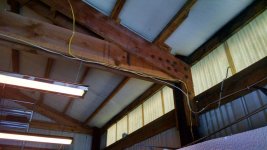
Any engineer or builders know what this truss will support?

cthulu

Well-known member
Joined
Aug 20, 2014
Messages
246
Location
Western Washington
I have a 24x30 pole barn with a double truss running down the middle that is 30ft long as seen in the pictures. I want to insulate the ceiling and have the estimated weight at 900lbs. (4.5 inches of 30psi poly iso and 2x4's running top to bottom) I bought the building used and the manufacturer isn't around anymore.

I have studded in the sidewalls and insulated so if need be I could run something between those new points. I'd rather not unless I have to though.

Does anyone know what this truss is rated for?
 

Attachments

  • IMG_20170103_102908919[1].jpg
    IMG_20170103_102908919[1].jpg
    148 KB · Views: 572
  • IMG_20170103_102900046[1].jpg
    IMG_20170103_102900046[1].jpg
    147.7 KB · Views: 389
  • IMG_20170103_102851481_HDR[1].jpg
    IMG_20170103_102851481_HDR[1].jpg
    145.1 KB · Views: 401
  • IMG_20170103_102843228_HDR[1].jpg
    IMG_20170103_102843228_HDR[1].jpg
    145.3 KB · Views: 373
  • IMG_20170103_102834996_HDR[1].jpg
    IMG_20170103_102834996_HDR[1].jpg
    147 KB · Views: 339
To avoid these ads, REGISTER NOW!

BFBOB

Well-known member
Joined
Sep 20, 2011
Messages
5,073
I have no idea, but to get a shot at a meaningful answer you'll need to post detailed dimensions, and grades of lumber if they're marked- then, one of the engineers among us may be able to help you. A scale drawing would be most helpful.
 

Sharpest

Well-known member
Joined
Feb 11, 2013
Messages
169
Location
South Texas
Since normal roof trusses are usually 2x4s, I'm gonna say that one is rated for a metric sh*t-ton. Where do I send my bill?:beer:
 
OP
C

cthulu

Well-known member
Joined
Aug 20, 2014
Messages
246
Location
Western Washington
Mainly looking to see if everyone thinks this will support 900lbs nailed to the roof. It has roughly 10 feet till the back and the front of the pole barn.

Main beam is 2x12 on either side and is 30ft long.

Top beams are 2x12 and are roughly 12 feet long.

Support beams in the middle of the truss are 2x4 nailed together, everything is bolted together with 3/4ish diameter bolts.

Total truss height is 4 feet.
 

73RR

Blank Email
Joined
Dec 13, 2016
Messages
300
Location
Central Ory-Gun
As said, you will need to find someone with a truss design programme that can reverse-engineer the truss to determine load capabilities....guessing is not a good idea.
 

-Brent-

Well-known member
Joined
Dec 23, 2009
Messages
4,709
Location
Utah
Trusses aren't usually something I'd call beautiful, but that one pretty dang attention grabbing!

The issue (or, that is, what needs to be accounted for, as well) I see isn't just the truss, it's the purlins. What's their size, length and distance apart?
 
OP
C

cthulu

Well-known member
Joined
Aug 20, 2014
Messages
246
Location
Western Washington
The issue (or, that is, what needs to be accounted for, as well) I see isn't just the truss, it's the purlins. What's their size, length and distance apart?

Purlins are 2x6, building is 24ft deep on the outside and they over lap in the middle of the truss by two feet or so so guessing they are 13-15ft long.
 

sberry

Banned
Joined
Jun 18, 2005
Messages
35,747
Location
Brethren, Michigan
What climate? List your location. All 900# of it wont be applied to the truss and only a some of it to the middle. Its less than a pound a foot spread out over near 100 sq ft, much of it bearing on the walls. Its nothing.
 
OP
C

cthulu

Well-known member
Joined
Aug 20, 2014
Messages
246
Location
Western Washington
What climate? List your location. All 900# of it wont be applied to the truss and only a some of it to the middle. Its less than a pound a foot spread out over near 100 sq ft, much of it bearing on the walls. Its nothing.

Good point there, Seattle WA. We don't get much snow climate is geneally 35-75 but a decent amount of humidity. Recently we got 4in of snow and everyone talked about how it was a big deal and hasn't happened in a long time.
 

-Brent-

Well-known member
Joined
Dec 23, 2009
Messages
4,709
Location
Utah
I wouldn't do it and I don't think you even need to compute purlin and truss loads calcs (or any other supporting forces), here's why: Those purlins are 2x6 and run 12' 6", minimum, to that centered truss and appear to be 24" on center. That's very minimal. They're there to to do the job they do, and that's about it.

That building wasn't built for how you'd like to finish it out.

If they were 2x8s, at that span and spacing, I think it would be worth looking into. At 2x6, I wouldn't.
 
Last edited:

ishiboo

Well-known member
Joined
Oct 27, 2010
Messages
9,481
Location
Oshkosh, WI
That truss won't be touched at 900lbs, as long as it's in good shape. Make sure all the connections are solid and there are no issues, since it's the main supporting member.
 

ssdave

Banned
Joined
Apr 11, 2015
Messages
2,913
Location
Eastern Oregon
http://www.wclib.org/pdfs/simpspantbls.pdf is the link to span tables that detail what roof rafters can support. You can guess at what the grade of 2x6's are that you have, and then look up what they are rated for span.

I'd guess based on that reference, that the 2x6's are marginal for your application. I won't guess at the truss, that would take some analysis to rate it. You are not adding a lot of weight with your proposal, but are adding some. Whether it is significant or not depends on whether you are currently deficient. Your 4 inches of wet Seattle snow is probably equivalent to about 5 psf of snow load. Your garage door mounts and lights and insulation are adding something to that, not sure how much that would amount to. The purlins themselves and the roofing add some more. You may already be exceeding the safe capacity of the roof, it's hard to tell without a detailed analysis.
 

lakeroadster

Well-known member
Joined
Jan 19, 2015
Messages
5,166
Location
Central Colorado
IMO the weakest link would be how it's bolted together.


Agreed. and the truss looks home made to me, FWIW.

For those saying it's massive and super strong... it has to be robust due to the span between trusses. If the trusses on either side of it are 10 feet away it's doing the work of 10 std. 24" o/c trusses.
 

John in OH

Well-known member
Joined
Jun 2, 2007
Messages
2,444
Location
SE Ohio & Eastern Virginia
What climate? List your location. All 900# of it wont be applied to the truss and only a some of it to the middle. Its less than a pound a foot spread out over near 100 sq ft, much of it bearing on the walls. Its nothing.

I'm with sberry on this one. 900 lb is like six average guys standing on the roof. Nothing. But that's just my opinion.

Since I'm passing out free opinions .... I'll offer another one, as a retired electric utility engineer, I think you need to hire a new electrician.
 

The Tool Tyrant

ALLIANCE MEMBER
Joined
Dec 19, 2011
Messages
2,182
Location
Bonita, Ca. (San Diego)
What climate? List your location. All 900# of it wont be applied to the truss and only a some of it to the middle. Its less than a pound a foot spread out over near 100 sq ft, much of it bearing on the walls. Its nothing.

I concur...if the truss is centered between the front and rear bearing walls, it's only carrying 50% of the total load, with the bearing walls each carrying 25%.
No sweat, just do it!
 

Jake40

Well-known member
Joined
Dec 10, 2016
Messages
80
Location
Green Springs, Ohio
When you insulate you will want to do it between the perlings that are already there and use an unfaceded fiberglass insulation. If you build it down with 2x4's going top to bottom you will end up with an air gap between the new and the existing insulation causing moisture issues. If you plan to finish it off after its insulated I recommend shop liner, you can run it one piece from the exterior wall to the ridge.
 
To avoid these ads, REGISTER NOW!

tthornto

Well-known member
Joined
Mar 11, 2011
Messages
743
That roofs weak point is likely wind/shear loading. If you add either diagonal bracing or sheathing on the bottom of those purlins it will be a lot stronger.
 
OP
C

cthulu

Well-known member
Joined
Aug 20, 2014
Messages
246
Location
Western Washington
I recommend shop liner

I've seen some installs with dura-panel type roofing material for walls, they look good and are tough but I'm not sure where to find them locally on the cheap. No Menards out here in Seattle, was going to put up firecode 5/8 drywall but if I could get my hands on some panels I'd rather do that.
 

Woodman920

Active member
Joined
Jan 17, 2016
Messages
26
If you are in snow country, then 900 lbs is negligible at roughly 1.2 lbs per square foot.

Dan, from my phone
 
OP
C

cthulu

Well-known member
Joined
Aug 20, 2014
Messages
246
Location
Western Washington
I'll offer another one, as a retired electric utility engineer, I think you need to hire a new electrician.

I've been meaning to **** can myself, haven't got around to it yet though. (I know, they should be in conduit those lights are just temporary until I finish the interior/roof..or were supposed to be anyway)
 

Strouty

Well-known member
Joined
Mar 21, 2010
Messages
38,213
Location
Southern Maine
When you insulate you will want to do it between the perlings that are already there and use an unfaceded fiberglass insulation. If you build it down with 2x4's going top to bottom you will end up with an air gap between the new and the existing insulation causing moisture issues. If you plan to finish it off after its insulated I recommend shop liner, you can run it one piece from the exterior wall to the ridge.

What is shop liner?
 

-Brent-

Well-known member
Joined
Dec 23, 2009
Messages
4,709
Location
Utah
While it very well could be home built, bolts aren't all that uncommon in some regions.

Usually you'll see flitch plates (used with beams) or truss plates on either side.

Guys saying the truss will handle it and run with it haven't ever walked on a 2x6 that spans 12-15' without any support. It's not the truss that's going to deflect it's the purlins. For example, as a joist, the maximum span is 8'8" for hem-fir. Extending that 4-7 more feet and you're in territory where the load bearing potential is much less.

Could it handle 900 lb over the whole roof? Sure, 900# isn't all that much but I'll stand pretty firm in the opinion that you're asking those purlins to do more than they're designed for.
 
Last edited:

kbs2244

Well-known member
Joined
Nov 11, 2006
Messages
14,065
Do I understand you are putting the insulation on the top side of the existing roof.
If so. I don't think your worry is the trusses themselves, but the supports between them.

That said, I think spreading your 900 lb total weight out over the whole building will be carried O K .
A 13 foot 2x6 can carry a pretty good load.
 

ishiboo

Well-known member
Joined
Oct 27, 2010
Messages
9,481
Location
Oshkosh, WI
It could be home-made as in DIY, or it could be site-built to engineered plans, or it could have been purchased from somewhere as part of an engineered kit. Hard to tell just by guessing. Either way, it looks well done.
 

Matt The Hammer

Well-known member
Joined
Sep 6, 2013
Messages
79
Location
South Jersey
This is why people are scared of us engineers. You ask us a simple question and you get 88 questions back and so many opinions... we rule.
 

lakeroadster

Well-known member
Joined
Jan 19, 2015
Messages
5,166
Location
Central Colorado
So, what's your takes you two smarty pants? :spit:

73RR is already on record here...

As said, you will need to find someone with a truss design programme that can reverse-engineer the truss to determine load capabilities....guessing is not a good idea.

:thumbup:

The folks that are saying "900 lbs, that's nothing, that's just a couple guys standing up there"

Yep, a few guys, in addition to the live loads, in addition to the dead loads and the additional environmental loads (wind, snow, etc.).

It's not pick and choose, it's everything all at once, worst case scenario. If it's not analyzed that way the OP will make his changes and may think he has won the battle. Then a winter storm hits, with record snow fall and record winds.... that's when he may find out the hard way that he did indeed win the first battle, but that he now has lost the war.

No good answer is available without a site visit. Wind loading is based on site conditions. What grade lumber is used for the trusses - purlins - etc. How is this truss assembled, what type of fasteners are used, etc.
 
Last edited:
OP
C

cthulu

Well-known member
Joined
Aug 20, 2014
Messages
246
Location
Western Washington
The cost of an engineer to tell me if this is **** or not and the time to find one exceeds the cost for me to put two new trusses up in between the existing truss and the walls. Last time I got an engineer for something he disappeared and took 2k with him so little gun shy on trying to find one again.

Instead I'm going to mirror the existing design and scale it down a bit then put the new trusses on top of the 2x4 stick wall I have built along the sides of the pole barn. I plan on using an adjustable screw jack to to add just a bit of tension on each truss before bolting it together like the existing one. Once the two trusses are done I'll run 2x4's front to back between them and put the insulation on those then drywall on the bottom of everything.

Thanks for the advice guys.
 

ssdave

Banned
Joined
Apr 11, 2015
Messages
2,913
Location
Eastern Oregon
The cost of an engineer to tell me if this is **** or not and the time to find one exceeds the cost for me to put two new trusses up in between the existing truss and the walls. Last time I got an engineer for something he disappeared and took 2k with him so little gun shy on trying to find one again.

Instead I'm going to mirror the existing design and scale it down a bit then put the new trusses on top of the 2x4 stick wall I have built along the sides of the pole barn. I plan on using an adjustable screw jack to to add just a bit of tension on each truss before bolting it together like the existing one. Once the two trusses are done I'll run 2x4's front to back between them and put the insulation on those then drywall on the bottom of everything.

Thanks for the advice guys.

I wouldn't bother with making a truss like you have there, I'd just put rafters in to support the 2x6 purlins that are there. Use a collar tie at the 1/3 point of the rafter height. Or, if you were willing to put up with the bottom chord of a truss anyway, put in a ceiling joist at the bottom of the rafters.

The right solution? Not really. But, it will add strength beyond what you have now, so it is definitely bettering the situation. It will also be a lot easier to add rafters than make a truss and install it.

The truss really only is useful in that it is bolted to the moment resisting posts of the pole barn construction. Making a similar truss that sits on a 2x4 wall would be overkill for what the wall could support.

What this solution does is assume that the existing structure is currently adequate, particularly in keeping the outside walls from spreading apart under roof load. The additional rafters will just take some of the load from between the truss and ends, and spread it to your 2x4 walls. If they start to deflect, the load will be picked up by the 2x6 purlins and transferred to the truss, just like it was originally. But, any load that is carried by the rafters will not be going to the truss, so it will be less loading than before modification. So, your roof safety increases.
 

lakeroadster

Well-known member
Joined
Jan 19, 2015
Messages
5,166
Location
Central Colorado
I wouldn't bother with making a truss like you have there, I'd just put rafters in to support the 2x6 purlins that are there.

How will the new rafter support the purlins, there is nothing structural to attach the lower end of the rafter to? See op's photo below.

And if he builds stud walls attached to the girts, and sets the rafter on the wall, now the girts are seeing loads they were never intended for.

Unless the stud walls go all the way to the slab, which on a pole barn isn't recommended since there is no perimeter foundation supporting the slab.
 

Attachments

  • Truss o matic.jpg
    Truss o matic.jpg
    137.6 KB · Views: 32

ssdave

Banned
Joined
Apr 11, 2015
Messages
2,913
Location
Eastern Oregon
John,

He said that he has built stud walls along the sides. Support for the rafters is the same problem he would have of support for more trusses. Recognizing that they don't have a foundation, they'll still support quite a bit of load, and the original roof structure is still there to hold up what it is holding now. To attach to the 2x6's, I'd use the small kite shaped joist hangers that are made just for this. I do that a lot with gable bracing and such in attics. Like I said in my post, not the right solution, but it would improve the load capacity of the roof. There's really not an elegant way to improve this roof without removing all the original construction and doing it right. But, presuming it's been in place for some time without failure, there should be no harm in beefing it up a bit more to give extra insurance.
 
To avoid these ads, REGISTER NOW!
Top Bottom