To avoid these ads, REGISTER NOW!

Anyone done a DIY wheel alignment?

OX1

Well-known member
Joined
Aug 6, 2012
Messages
157
Location
Jackson, NJ
The strings are the toe/thrust measurement device, not camber/caster. Your question seems to be about lifts. If the car is on a 4-post lift, obviously adjustments are easier than on the ground. This is the same for strings, toe plates, a $1000 used system from Canada, or a $25,000 computer alignment system.

The practical answer is that if you have to jack the car up to make adjustments, you restring it afterward. With my setup this takes about 30 seconds a side, so one minute total.

For mine, I use slip plates under all four wheels and can make many of the adjustments on the ground.
On Fords IRS (my 17 Fusion Sport and 21 GT500 anyway), as soon as you loosen camber bolt, weight of vehicle wants to send bolt straight to inner end of camber adjustment slot built into rear subframe.


Due to this, you sometimes need a long pry bar to hold camber bolt in slot where you want it, while also trying to use dual "breaker bars" to really tighten down camber bolt (since it only relies on bolt torque/friction for actual placement). IMO, especially important on my Shelby that has seen well over a G in corners (on track). This (for me anyway), necessitates a leveled 4 post that allows me to jack car high enough I can walk under and use long pry/breaker bars.

All that prying occasional shifts the entire rear of car on the rear slip plates. With a "real time" alignment system, I can be watching screen while all this is going on, and immediately know if this happened, as front toe will show it moved.

Could I do all that with strings. Probably, but I'd need 4 step ladders (or at least two for the front??) to get at string measurements every time I wanted new measurements, as tires/body are at eye level or higher. I also don't believe pulling rear of car back over on slip plates, would be timely with strings (timely is like ugly, different for everyone I realize :)). Watching screen, it is easy doing things real time.

That said, I would eventually like to have a quickjack setup and string method available that I can use at the track. Someday, maybe....
 
To avoid these ads, REGISTER NOW!

OX1

Well-known member
Joined
Aug 6, 2012
Messages
157
Location
Jackson, NJ
PS, if also recall fixing one of my DSP200 heads on my previous machine...
I forget what was wrong with it at the time... but these arent too bad to work on if you know electronics.

20220710_194857.jpg
20220710_205533.jpg

20220711_150101.jpg

20220711_151329.jpg20220711_150812.jpg


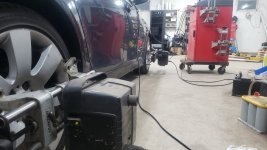
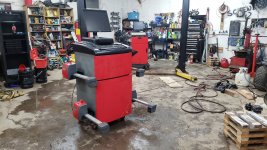
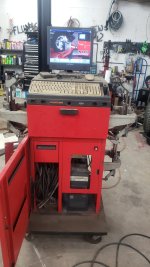
Old machine in the back (Hunter P211 with DSP200 heads, cira 1995 but with updated data to 2003), newer one in the front ("KJC 3000 Bluetooth CCD Wheel Aligner" - Branded for "TreadPlus". It's a Chinese clone of the Ranger CRT380) :

20230118_171730.jpg
Is there some significance to the "treadplus" :p

I'm pretty handy, but with 11 vehicles, I don't always have the time to dig into the electronics on my "tools" (which being a mech engineer, is not my strong suit). But I retire in 5 months, so may have more time.

I would like to dig up that old thread on the software. My main unit/computer is a P611, think it is updated through 2015ish (spec-wise, not that that really matters). I'd like to have the software either way, just in case this Win95 computer ever takes a ****.

Would love to have a newer system that does not use "heads", but mounting the "cross" in a permanent spot would be tough with the amount of **** I have hanging on walls and/or just general junk where it would have to go.
 

djbmw

Well-known member
Joined
Jun 20, 2013
Messages
1,122
Location
Ottawa, Ontario, Canada
Is there some significance to the "treadplus" :p

I'm pretty handy, but with 11 vehicles, I don't always have the time to dig into the electronics on my "tools" (which being a mech engineer, is not my strong suit). But I retire in 5 months, so may have more time.

I would like to dig up that old thread on the software. My main unit/computer is a P611, think it is updated through 2015ish (spec-wise, not that that really matters). I'd like to have the software either way, just in case this Win95 computer ever takes a ****.

Would love to have a newer system that does not use "heads", but mounting the "cross" in a permanent spot would be tough with the amount of **** I have hanging on walls and/or just general junk where it would have to go.
TreadPlus was/is a Canadian automotive equipment company that re-sold the KJC 3000 machine locally and provided support.

I personally love the wireless heads (as opppsed to my old string heads) - no more messing around with wires all over the place, and no more bad connections. The heads also draw a full box around the vehicle (i guess thats why they call it a "3d aligner"), unlike the DSP200 heads that drew a partial box, with the rear being "open". Also, its using newer software that is much more intuitive, faster, more legible, etc.

Like you, i dont really have the room to mount a camera system - nor do I want to be restricted to one single area when doing an alignment. Thats why Im a fan of the 3ccd units, even though a camera and target system would be so much faster/easier.
 
  • Like
Reactions: OX1

gregs

Well-known member
Joined
Mar 16, 2007
Messages
1,589
FWIW. After getting the burb aligned yesterday I went and dug up the paperwork of when it was aligned at the chain store for the PO. The before and after sheet was a joke. All they aligned was the toe, and it was out of spec. Looking at the sheets it really doesnt look like it was even setup correctly to the machine. This was after they replaced ball joints and strut assemblies.

The guy that did it yesterday really took the most time of anybody I had been to before. After some adjustments he would roll it back off the slip plates and back on again I am guessing to make sure the "new" adjustments registered. He realigned the steering wheel lock again during the process. And he re-registered the machine a few times as he would turn it lock to lock and back to center. I am guessing this was to verify the adjustments he made where correct and stayed in there location. Also maybe he had to move things a lot due to the prior work? I cant say that this is the right way, but he truly seems to understand alignment and what to adjust to make it work the way he/me wants it to be.
 

ToolFanGeoff

Well-known member
Joined
Jul 19, 2017
Messages
47
Location
So Cal
For Christmas, my 16 Y.O. son got a 2 ½” lift kit front and rear for his 2023 Ram 1500 Hemi.

He installed the kit (Icon out of Riverside, CA.) with just a little assistance from me.

The kit had front and rear springs, front struts, rear shocks, and aluminum billet front upper control arms. The install went smoothly. We then checked the camber, then caster using a hub mounted bubble gauge and greased turn plates. Once we had that very close, we then used a toe check tool. A bar with a leg on one side to hold the bar at height above the ground, and an arm to touch the tire. The other side of the bar has an adjustable head with a needle. Checking the front side of the tire, setting the needle to zero, then the rear side of the tire. The needle showed us we were off about 1/10 of an inch. His tires are 35” tall, so we figured the angle would be small, and we did not do more adjustment. The truck drove very straight with the steering wheel centered.

The next week we took the truck to a trusted alignment shop. Camber was right on. Caster was in spec. Toe was off on the left side by less than 2/10 of a degree.


For reference: my son and I got toe to .1” difference front to rear on 35” diameter tires. I did the math, and .1” over 35” length is 0.16 degrees.


Maybe we just got lucky… I am not saying I could repeat this, but the results for a DIY alignment this time were pretty decent, and validated by a “pro” using a professional digital alignment system.

I will admit that I had no way of knowing that the left front was the one that needed further adjustment when we were doing our work.

Bottom line: Can you get “close” with a DIY alignment? With attention to detail, my experience is yes.
 

djbmw

Well-known member
Joined
Jun 20, 2013
Messages
1,122
Location
Ottawa, Ontario, Canada
For Christmas, my 16 Y.O. son got a 2 ½” lift kit front and rear for his 2023 Ram 1500 Hemi.

He installed the kit (Icon out of Riverside, CA.) with just a little assistance from me.

The kit had front and rear springs, front struts, rear shocks, and aluminum billet front upper control arms. The install went smoothly. We then checked the camber, then caster using a hub mounted bubble gauge and greased turn plates. Once we had that very close, we then used a toe check tool. A bar with a leg on one side to hold the bar at height above the ground, and an arm to touch the tire. The other side of the bar has an adjustable head with a needle. Checking the front side of the tire, setting the needle to zero, then the rear side of the tire. The needle showed us we were off about 1/10 of an inch. His tires are 35” tall, so we figured the angle would be small, and we did not do more adjustment. The truck drove very straight with the steering wheel centered.

The next week we took the truck to a trusted alignment shop. Camber was right on. Caster was in spec. Toe was off on the left side by less than 2/10 of a degree.


For reference: my son and I got toe to .1” difference front to rear on 35” diameter tires. I did the math, and .1” over 35” length is 0.16 degrees.


Maybe we just got lucky… I am not saying I could repeat this, but the results for a DIY alignment this time were pretty decent, and validated by a “pro” using a professional digital alignment system.

I will admit that I had no way of knowing that the left front was the one that needed further adjustment when we were doing our work.

Bottom line: Can you get “close” with a DIY alignment? With attention to detail, my experience is yes.
The larger the diameter of the wheel assembly, the easier a "backyard alignment" will be. It also helps that it increases ground clearance, allowing for adjustments. Im happy to hear that you were able to get it close.

In my experience, the time spent to mess around with making slip plates, getting everything level, setting up a string box, marking the tires, using bubble gauges, measuring 4,767 times, laying on your back on a cold floor .. to get "close", isnt worth it. This becomes even truer if your vehicle has smaller wheels, or is a higher performance vehicle doing highway speeds (or greater).

If DIYing it, buy a used machine and do your alignments in 30 to 60 minutes without the headaches mentioned above. Otherwise, eye-ball it and bring it to a trusted alignment shop.
 

CV428

Well-known member
Joined
Dec 12, 2019
Messages
156
I have. It's never as good as the shop with a laser system.

I fabricated a set of measuring rods for vehicles and motorcycles- basically just extends the axis of the spindle/axle so it amplifies misalignment out 3-4 feet. I used a metric tape measure with 1/2mm graduation (~0.020") and adjusted until I was as close as possible. This worked decently on a motorcycle, but was marginal at best on a vehicle.

Just my opinion here, I feel like someone who is trained to do alignments could use the rudimentary tools to a decent result, but for those of us who are not trained in alignment it's going to be a daunting task with a gamble on results. It's also dependent on the vehicle.
 

CraigStu

Well-known member
Joined
May 22, 2014
Messages
4,013
Location
Blacksburg, Va
Guys this just isn't that hard. Camber +- 1/3degree, caster +- 1/2degree are fine. Caster needs to be equal side to side but even there if you have trouble getting them dead nuts equal go w/ a little more + on the right side. This will help counter balance road crown trying to make the car head towards the side of the road. Toein needs to be more accurate. Camber being off would have the tire leaning a little off of vertical in reference to the road. Yes it will wear either side a little faster than the other so, at 30,000 miles, you might see that wear as slightly thinner tread. OTOH toein being off has the tire sliding sideways while it is rolling and that will grind rubber away. So get it as dialed in as you can. The good thing is that toein is usually the easiest of all to measure and adjust.
 

djbmw

Well-known member
Joined
Jun 20, 2013
Messages
1,122
Location
Ottawa, Ontario, Canada
Guys this just isn't that hard. Camber +- 1/3degree, caster +- 1/2degree are fine. Caster needs to be equal side to side but even there if you have trouble getting them dead nuts equal go w/ a little more + on the right side. This will help counter balance road crown trying to make the car head towards the side of the road. Toein needs to be more accurate. Camber being off would have the tire leaning a little off of vertical in reference to the road. Yes it will wear either side a little faster than the other so, at 30,000 miles, you might see that wear as slightly thinner tread. OTOH toein being off has the tire sliding sideways while it is rolling and that will grind rubber away. So get it as dialed in as you can. The good thing is that toein is usually the easiest of all to measure and adjust.
Toe is not "easy" to dial in without proper equipment. Most people dont even pre-load the vehicle before trying to set toe!

Even with my alignment machine, turn plates/slip mats, etc etc it still takes an hour to properly set toe and double check that the steering wheel didnt go out of whack and everything tracks well before calling it "done".
 

Jack_K

Well-known member
Joined
Aug 7, 2021
Messages
331
Location
Australia
I have an old portable light based aligner. It does the job but because I want everything perfect, it takes me a long time. The most annoying thing is getting the platforms level. I need to make some platforms for the turnplates with adjustable feet and small ramps. I'd like to find a proper alignment ramp but I don't really have the space.

I like the idea of a computerised aligner BUT I don't really want to deal with software issues or even calibration. I don't mind electronic issues. I was still tempted by a $50 "working" hunter machine but it was a little too far for me to bother. I know a light based system will always turn on and work. With a light based system it is easy to calibrate or work out why a measurement is wrong.

One trick to verify calibration is to switch the heads to the other side. The readings should then be the same value but opposite. If it is out of calibration, it will read differently.

The guy that did it yesterday really took the most time of anybody I had been to before. After some adjustments he would roll it back off the slip plates and back on again I am guessing to make sure the "new" adjustments registered. He realigned the steering wheel lock again during the process. And he re-registered the machine a few times as he would turn it lock to lock and back to center. I am guessing this was to verify the adjustments he made where correct and stayed in there location. Also maybe he had to move things a lot due to the prior work? I cant say that this is the right way, but he truly seems to understand alignment and what to adjust to make it work the way he/me wants it to be.
It is too difficult for me to explain but the way the modern machines work, "recomping" would definitely help. I watch Lucore Automotive on YouTube and he always re compensates the heads before doing the final adjustment.

It's a simple thing to do but no tyre monkey is going to do it.
 

yhprum

Well-known member
Joined
Jul 27, 2006
Messages
1,381
Location
Brisbane Australia
I really think these fancy alignment machines fall into two categories; marketing or ease of use.
If you look at tolerances for suspension mounting points (huge), needing such high accuracy to a tenth of a degree is a moot point to me.
It might be a little work to do in your garage, but far from impossible with some basic tools.
 
To avoid these ads, REGISTER NOW!

djbmw

Well-known member
Joined
Jun 20, 2013
Messages
1,122
Location
Ottawa, Ontario, Canada
I really think these fancy alignment machines fall into two categories; marketing or ease of use.
If you look at tolerances for suspension mounting points (huge), needing such high accuracy to a tenth of a degree is a moot point to me.
It might be a little work to do in your garage, but far from impossible with some basic tools.
Its not moot and the smallest of changes make a huge impact to a properly maintained vehicle. Yes, its Less noticable in vehicles with poor feedback,... but on a sedan or sports car where everything is running well, you can certainly feel small alignment changes.

The car will pull you, or push you, or wander, or will be super responsive,.. with only a quarter twist of a tie rod end, for example.
 

theastronaut

Well-known member
Joined
Oct 7, 2015
Messages
55
I do my own, caster isn't adjustable on my car so that makes it easier, although I do have an old Ammco magnetic camber/caster gauge that fits the hubs perfectly for when I install adjustable camber/caster plates. I use an angle app on my phone for camber and toe plates/tape measure for toe. I put ballast in the driver seat to match my weight when aligning my car since it has very light springs (125lb F/105lb R).

I set my car to -4 front, -3.5 rear, zero to 1/16" toe-in up front, and zero toe in the rear for dual purpose street/autocross use. Tires usually last a bit over 20k driving it aggressively. I did a 5,700 mile road trip in it from SC to AZ and back and there was no noticeable wear, but it was all just highway miles with no corners to throw it into, so it would go much more than 20k if I drove it more nicely even with a lot of camber. Toe is what wears tires.

My '66 C10 is at 1/16" toe in, -1.5 camber, and it has roughly 6* caster iirc. Has close to 25k on the current set of tires, they're about 2/3 worn with even wear front to rear.

The main road I drive 20 miles on every day is very rough chip seal/tar and gravel which seems to be causing tires to wear quicker than when it was normal pavement. The car stops noticeably harder and shorter on that surface, so I'm guessing it bites into the tires better which is great for avoiding deer at 60 mph, but not good for tire life.
 

scooperman

Member
Joined
Mar 3, 2025
Messages
19
In the 70s I raced a Mini in SCCA, no crew just amateur racing. Car had a poor man's lsd, a "broken locker" diff where they weld a couple of spider teeth, then break the welds, so on corner turn-in you had a moment of diff action before the spiders rotated around to the welded teeth and it locked again, but its fwd so to keep the car turning you had to overcome the slicks with power, had to be back on the gas or else it would plow straight ahead. Front bodywork did not come off, car severely lowered so impossible to make adjustments until the car was up on stands. I would get the toe kinda sorta close to correct at home shop and then go to the track. Track had a flat setup pad, get in line and wait my turn. Push forward, do not steer as I push, straight only until on to the pad. Use a machinists square, make a chalk mark on the back of the front tires at axle height, line up the square on the ground behind the tire to the tire mark and then mark the concrete directly below. Push the car forward slowly until the tire marks come around to the front at axle height, use the square to mark the concrete. Push the car away, use tape measure to find the track distance between the left and right chalk mark pairs, difference between the front and back track length measurements is twice the toe. Back in my pit, jack up the car. I knew the thread pitch on the steering rack tie rod ends, easy adjust. Go race.
 
Last edited:

Ike Carlson

Well-known member
Joined
Jun 14, 2019
Messages
168
Location
Wisconsin
We do our own alignments all the time with string and a tape. We do em on the car, trucks, and even semi’s. It’s not hard, and once you have done a few, it becomes the preferred method.

Those jokers at the alignment shop can’t get it right. I have had people call me and ask for an alignment after taking it to a shop 3x and it gets worse every time. They leave with a smile on their face every time. Tires wear evenly and last a long time.

I did an alignment for a guy once after he got tires, and he called a few days later and said he took it to a shop to have them ‘check my work’. Of course they told him it was all wrong and did a full alignment. He called a few months later looking for tires…..I told him to go to the shop that ‘fixed my mistake’.

Always fix any worn components before doing an alignment, unless it is a quick and dirty temp job.
 

ronr80

Well-known member
Joined
Feb 13, 2013
Messages
504
Location
ontario
Using the string around the tire will get you in the ball park with toe in or out , camber is a little trickier , I bought one of these Camber tools , and it will also get you some what close . Some cars camber is not adjustable like the F series from Lexus , you have to replace the arms with adjustable ones.
 

Attachments

  • camber gage.JPG
    camber gage.JPG
    600.8 KB · Views: 16

tlc1976

Active member
Joined
Apr 3, 2017
Messages
27
Location
Michigan
My vehicles make it simple, as in they have a solid rear axle.

First thing I do is the camber. I cut a board with parallel sides, so it sits squarely on the wheel weight ledge. For a convex wheel I cut out an area in the middle for clearance. Check for plumb on both front wheels, noting how much each is out, that's how much angle it has to change. Then after jacking it up and getting the wheel off, I put a couple nuts to hold the brake rotor tight, and check the angle of the rotor. Then make my adjustments at the strut nuts or whatever so the change in rotor angle is the same as the wheel was out of plumb. Before I had an angle gauge, I'd just use a little trig. Meanwhile I'll get the toe adjustment broke loose.

Then with the car back down and run back and forth a few times to settle everything and center the steering wheel, I'll adjust the toe. I seem to have a really good eye for this, so I just crouch down some distance from the car and do it visually. If the wheel track is the same front and back, then I just turn it until the front and back tires are totally in line, and you can't see any hint of the face of either. If the wheel tracks are different, then I compare the shapes of the visible wheel ovals and turn it until they match. I also do this for additional assurance on same track width vehicles. Once all is good, I'll jack it up if needed and tighten the toe adjustment. My first time I tried a long board, string, drawing lines on the floor, measuring between tire treads, etc. What a pain, things would move, get kicked over... It was quicker and more accurate to just do it by eye.

As with just about anything else, I started doing this myself after losing faith in shops when I was young. Like a brake shop that didn't seat my pads and I got into an accident shortly after. One that cut my wheel cylinder seals. One that charged $750 for a brake line across the rear axle, and didn't even do a good job, they had crossthreaded one fitting so it slowly leaked. An alignment shop that said nothing about a loose failing ball joint, and realigned it anyway. Afterwards the car would shoot me toward the centerline in corners, and another shop found the bad balljoint, but were going to charge a fortune to change it.

I also live in Michigan, where beat up roads are the norm. Not just potholes, but just shoddy construction, like expansion joints that are like speed bumps. I'd go broke paying alignment shops all the time. To me there's really no sense in computerized perfection. I've never had any handling or tire wear problems by aligning something by eye. I've also easily spotted when a car is out of alignment, and been able to put it back to within reason so it drives properly. I could do the camber by eye easily, but by taking measurements I can do it in one shot.
 

pbon

Well-known member
Joined
May 14, 2017
Messages
3,498
Within the last 2 weeks, I read a review of an app that uses your phone to measure the alignment specs. You do haven’t hold the phone steady against the top of the wheel. Testing showed the results were about equal to a shop alignment rack. Unfortunately, I forget the name of the app. I do not recall whether it does each end separately or can do a 4 wheel or thrust alignment.
 

racecougar

Well-known member
Joined
Jan 26, 2021
Messages
4,981
Location
Missouri
Within the last 2 weeks, I read a review of an app that uses your phone to measure the alignment specs. You do haven’t hold the phone steady against the top of the wheel. Testing showed the results were about equal to a shop alignment rack. Unfortunately, I forget the name of the app. I do not recall whether it does each end separately or can do a 4 wheel or thrust alignment.
Gyraline. I mentioned it in post #24.
 

Glemon

Well-known member
Joined
Aug 29, 2020
Messages
2,159
Location
NE
Not the one around here......
Or here either, they were a block away from where I used to work so I went a couple times. Don't remember the specifics, but decided I would take my business elsewhere after a couple visits.
 

ctandc72

Well-known member
Joined
Sep 19, 2020
Messages
1,086
Location
VA
Depends on the vehicle - meaning what's actually adjustable. Solid rear axle cars for example. You want to make sure the rear axle is axle straight etc. For my two SN95 Mustangs the only real adjustment w/o adding aftermarket caster / camber plates or cutting slots in shock tower is toe. I set that myself. The factory adjustment 'range' is pretty wide. In my lowly opinion, for my cars, the toe is a mix of how you drive it, what type of roads, personal preference and tire wear.

If you find a GOOD alignment shop - you are lucky. I spent months restoring a '95 Bronco - lifted w/ 35" tires. TTB front suspension. I replaced all suspension components and TTB bushings. Finding a shop that had a clue about this truck for alignment was quite an adventure. I used to know a guy who ran a frame and alignment shop. He was great. Then he retired.
 

gregs

Well-known member
Joined
Mar 16, 2007
Messages
1,589
After looking back thru the thread it brought back a memory of my dad who was a mechanic most of his life. I remembered "helping" him when I was young to set the toe on various vehicles and tractors. His toe stick was a 1x2 with finish nails in each end. You would scratch a mark on each tire then roll it backwards, line up one nail on the mark and see how much difference there was from the other mark.
 
To avoid these ads, REGISTER NOW!
Top Bottom