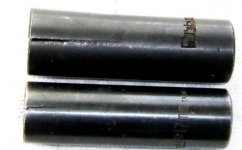
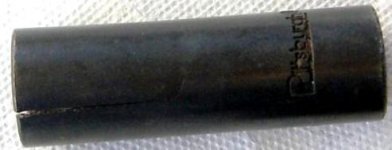
Does 14mm count as a smaller socket? Even the good old USA-made chrome 3/8" sockets can cause problems on small, highly torqued fasteners. As an example, I recently had a 30-year old Cman-USA 3/8" drive 14mm socket fit kind of loose on an automotive fastener. It kept slipping off when using a ratcheting handle. A brand new Cman-China 1/2" drive 14mm impact socket on a ratcheting handle fit nice and tight and took the bolt out with no problems. Not sure if it was a size differential or the impact socket just had a better grip than the chromed socket.
Breaking tools is the wrong measure of the suitability of tools. The devil is in the details.
14mm is the JIS size for an M10. It can be torqued at the factory at 55ftlbs. Generally, I think any bolt can easily get stuck requiring double its std torque (due to high static friction caused by corrosion etc). So you could be putting 100ftlbs thru that 14mm socket. Japanese car makers use bolts with smaller heads than everyone else. That makes them generally harder to remove.
The inside profile of a wrench or socket is a complicated shape. You can't simply make a hex slightly larger than the greatest size bolt head. In use, the socket will bear against the fastener's corners and round them over. If you simply relieve the corner (like an impact socket for example), you will contact the bolt head at an infintessimal line until either to the socket or the bolt yields. So manufacturers have all developed special curved shapes inside their sockets to allow a range of fastsner head sizes to contact the socket in the right place with area contact.
If you don't have a very well formed profile inside the socket, the contact patches between the socket and the bolt head could be tiny (line contact). Since stress = load/area, you don't need tons of load to yield (round) a screw head when the area is small (loose fitting socket). That, in a nut shell, is how stuff gets rounded.
The problem with cheap tools is twofold:
1) The shapes of them may not be ideal. Sockets are made by a cold forging/broaching proccess. In use, the broaching tool (forging die) wears. It has to be inspected regularly and replaced. My guess is, Chinese companies don't/can't do this. They are more likely check the sockets, replacing the expensive die only when the sockets get really bad. So you will likely see fairly significant dimensional changes in the inner profiles of cheap sockets. Some people here will have good experiences, especially those who were the early adopters who got the new model of sockets when the dies were fresh. Same is true of wrenches, etc.
2) Good materials are NOT easily had outside first world nations. You guys who haven't lived there or worked with foreign suppliers just don't understand. These are countries that don't have clean water. Clean steel is literally too much to ask. The Chinese build apartmemnt buildings that collapse due to poor quality steel. So despite the manufacturers' best efforts, they never realy know what steel is coming in the door. (to heat treat steel effectively, you must know it's exact make up).
America is not a perfect society. We hold people legally responsible for stuff, which many of us complain about. The threat of lawsuits is a constant concern for business owners. Consequently, we are pretty sure about what we make, even our trash has to consist of what we say it consists of. We also take great pride in our work, which honestly isn't true everywhere. Many people making our clothes, shoes and maybe even tools in the third world are in survival conditions, doing what they must to survive and feed their children. Consequently, **** happens and bad products get shipped. That's just the way our world is at present.
When the product is a hammer, none of this matters. And steel is pretty dog-gone strong, even if it is dirty or mishandled in heat treat. You just have to look out for items where a tiny bit of tool wear (forging dies) will make a significant percent difference in the finished product. And then it is only an issue when you are trying to remove something stuck.
Unfortunatley for me, nearly every automotive job I do includes something stuck. I typically don't work on cars that are covered by factory warranties (like many dealer mechanics do). I work on cars when they are older and out of warranty when stuff is good and corroded. And since my time is precious to me, I am happy to spend an extra $100 on a set of tools that wont let me down. So that's why I make the recommendations I do. But if you are in plant maintenance or are fixing lawn mowers maybe none of this matters.
Hopefully, this explains why some guys prefer certain tools, regardless of whether it breaks less than another brand. More to tools than how often they break.