
You are using an out of date browser. It may not display this or other websites correctly.
You should upgrade or use an alternative browser.
You should upgrade or use an alternative browser.
Anyone know anything about JO-Line torque wrenches?
- Thread starter Packard V8
- Start date
I borrowed this Jo Line torque wrench from a friend and then found this terrific
thread of the history of Jo Mfg.
This an air force issued Model 1202, Size 5, 1" drive, torque range 300-2000 ft./lbs.
There are 2 approx. 4ft. long bars that interlock to make an 8ft. long handle!
The broken alu. cast part attaches to the socket end of the head to add a bar out the opposite end.
I assume this is for a 2 man operation.
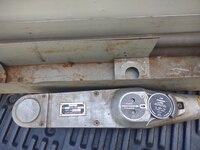
thread of the history of Jo Mfg.
This an air force issued Model 1202, Size 5, 1" drive, torque range 300-2000 ft./lbs.
There are 2 approx. 4ft. long bars that interlock to make an 8ft. long handle!
The broken alu. cast part attaches to the socket end of the head to add a bar out the opposite end.
I assume this is for a 2 man operation.
Attachments


Grayspoked
Well-known member
NK:My wife came back from the in-laws house with more tools from my father-in-law. I found another JOTRU 10A!!!. This one has a ratcheting head and breaks at 75 inch pounds. It also has an interesting hand etched series of numbers on the shank: "527A04007-13". What say you, Grayspoked?
First, my apologies for this delayed response. Life has been busy of late!
I expect that this is another of the Van Belknap specials. Those are tools that Dad's Detroit salesman (before he founded his own company, that still exists), Van Belknap, ordered up to try to convince the automotive industry to buy Jo-Line torque tools. I have no idea now, over 60 years later, what Van had in mind with a 75 inch-pounder. My experience was that the automotive industry bought lots of the 30-250 ft-lb "Size 3" wrenches, with inch pounders being a distinct afterthought. Maybe that's why Van was unsuccessful in selling more of these like yours.....
Anyway, back to the tool at hand.
It has the two patent numbers, 2743638 and 3016773. That places it on the earlier end of things. Later tools had three patent numbers on them. The "SERIES A" marking does the same. Jo-Line got up to SERIES D before Dad sold the Company to KD in late 1979.
The notation on the spring tube that it was manufactured in South Gate ought to put an end date to the inquiry. Jo-Line moved to Anaheim in the fall of 1968. Thus, I don't think it possible that your tool was manufactured after 1968. Of course, it's possible that Les Trimble grabbed a South Gate spring tube out of the tool crib in 1969-1970 because yours was a one-off and the place of manufacture was therefore meaningless. I don't give that theory much credence, though. I started working at Jo-Line in June 1969, and I never saw a South Gate-marked spring tube, ever.
The name stamped on the spring tube, "Jo-Line" dates your tool to the time after the company changed its name from J O to Jo-Line. Dad told me that this change occurred in the 1962-1963 time frame.
The finish on your spring tube is what we called a "satin" finish. It wasn't terribly popular (not putting down your tool - it's just that Jo-Line put me through school on its chrome-plated models, not the satins like yours) overall, and more of them were seen earlier in Jo-Line's lifetime than later in my experience.
The ratcheted JOTRUs had any number of different ratchets on them. Dad didn't begin making Jo-Line ratchets based on the Facom design until the early 1970's. Yours looks like one of the New Britain ratchets, of which I saw a lot in the 1969-1972 (or so) era.
Unfortunately, the etched number on the spring tube was placed there by an owner of your tool, and not by Jo-Line. Had I received your tool for a refit while I was working in the repair room. I'd have swapped out the engraved spring tube for a clean and unmarked one.
So, time for bottom lines. I think your JOTRU 10A is a one-off Van Belknap special manufactured between 1962 and 1968, and probably closer to the 1962 end of that range. Why it was built - for what purpose - I cannot now tell you. Good to hear that it has maintained its setting after all these years. The tools I got in the repair room had pretty much stayed calibrated, but I never had the chance to see a 60 year old tool while I was working at Jo-Line.
I have fielded a number of other inquiries in this thread regarding JOTRU 10s - see Posts Numbered 23, 25, 28, 48, and 75. I also discussed your patent numbers at Post 43.
Enjoy your tool! I suspect that there are not many like it out there.
Bill
Grayspoked
Well-known member
RJ:I borrowed this Jo Line torque wrench from a friend and then found this terrific
thread of the history of Jo Mfg.
This an air force issued Model 1202, Size 5, 1" drive, torque range 300-2000 ft./lbs.
There are 2 approx. 4ft. long bars that interlock to make an 8ft. long handle!
The broken alu. cast part attaches to the socket end of the head to add a bar out the opposite end.
I assume this is for a 2 man operation.
Oh my. You have one of the monsters.
We called these "1202s" You can see that labelling in the "Model No." box on your tool. I am not sure why we called them that, but that's what we did. No other Jo-Line (or J O ) product was numbered like that. Maybe it was a military thing.
My recall is that the military and shipbuilding firms were the primary customers for these beasts. I never shipped any of them, so I can't now tell you who else other than the Air Force (which makes perfect sense to me) might have bought these. Even then, 1202s were only occasionally seen. I can't even tell you how many men were needed to use one of these monsters. Your guess of two makes sense to me. I do recall seeing them being tested and calibrated. One (large) guy did the testing, which involved putting the tool on a big scale and making sure it "broke" at the set torque value. My recall is that the testers put loooooong extensions (your two 4' bars would be those extensions) on the, well, "handholds" of these 1202s, and then pulled. Hard.
I mentioned in my response to NK a moment ago that the name of the company changed from J O to Jo-LIne in the 1962-1963 period. That puts the date of manufacture of yours to 1962 or earlier. Yes, yours has JO/LINE on it, but my understanding is that this was considered an occasionally used branding item when it was first used. The name of the company itself changed from J O to Jo-Line in 1962-1963, and the name "J O" never appeared after that. However, the JO/LINE branding may mean that your tool was manufactured in the period late 1950's to 1962-1963.
I'd be really interested in what you and/or your buddy want to use this monster for. I've always wondered about that. The 1202 always struck me as a largely useless tool.... until you had that one job for which only a 1202 would do.
Bill
Bill,NK:
First, my apologies for this delayed response. Life has been busy of late!
I expect that this is another of the Van Belknap specials. Those are tools that Dad's Detroit salesman (before he founded his own company, that still exists), Van Belknap, ordered up to try to convince the automotive industry to buy Jo-Line torque tools. I have no idea now, over 60 years later, what Van had in mind with a 75 inch-pounder. My experience was that the automotive industry bought lots of the 30-250 ft-lb "Size 3" wrenches, with inch pounders being a distinct afterthought. Maybe that's why Van was unsuccessful in selling more of these like yours.....
Anyway, back to the tool at hand.
It has the two patent numbers, 2743638 and 3016773. That places it on the earlier end of things. Later tools had three patent numbers on them. The "SERIES A" marking does the same. Jo-Line got up to SERIES D before Dad sold the Company to KD in late 1979.
The notation on the spring tube that it was manufactured in South Gate ought to put an end date to the inquiry. Jo-Line moved to Anaheim in the fall of 1968. Thus, I don't think it possible that your tool was manufactured after 1968. Of course, it's possible that Les Trimble grabbed a South Gate spring tube out of the tool crib in 1969-1970 because yours was a one-off and the place of manufacture was therefore meaningless. I don't give that theory much credence, though. I started working at Jo-Line in June 1969, and I never saw a South Gate-marked spring tube, ever.
The name stamped on the spring tube, "Jo-Line" dates your tool to the time after the company changed its name from J O to Jo-Line. Dad told me that this change occurred in the 1962-1963 time frame.
The finish on your spring tube is what we called a "satin" finish. It wasn't terribly popular (not putting down your tool - it's just that Jo-Line put me through school on its chrome-plated models, not the satins like yours) overall, and more of them were seen earlier in Jo-Line's lifetime than later in my experience.
The ratcheted JOTRUs had any number of different ratchets on them. Dad didn't begin making Jo-Line ratchets based on the Facom design until the early 1970's. Yours looks like one of the New Britain ratchets, of which I saw a lot in the 1969-1972 (or so) era.
Unfortunately, the etched number on the spring tube was placed there by an owner of your tool, and not by Jo-Line. Had I received your tool for a refit while I was working in the repair room. I'd have swapped out the engraved spring tube for a clean and unmarked one.
So, time for bottom lines. I think your JOTRU 10A is a one-off Van Belknap special manufactured between 1962 and 1968, and probably closer to the 1962 end of that range. Why it was built - for what purpose - I cannot now tell you. Good to hear that it has maintained its setting after all these years. The tools I got in the repair room had pretty much stayed calibrated, but I never had the chance to see a 60 year old tool while I was working at Jo-Line.
I have fielded a number of other inquiries in this thread regarding JOTRU 10s - see Posts Numbered 23, 25, 28, 48, and 75. I also discussed your patent numbers at Post 43.
Enjoy your tool! I suspect that there are not many like it out there.
Bill
Thank you so much for the reply. I appreciate your comments on my recently-passed father-in-laws mystery tools. Though you indicated previously that his two Jo-Tru's were not a military gear, I was actually able to narrow down his years of service in Viet Nam. (Somewhat more poignant since today is Veterans Day). He was drafted at 19 in 1968 and served two years as a helicopter mechanic in country. He recently passed, just shy of his 77th birthday in September 2025). I have successfully assembled half-a-dozen tool kits for his grandchildren from all his tools and toolboxes. So his mechanical legacy lives on. Even found some of his hammers that had his fingerprints still on them from years of working around the house and getting paint splatters on them. (I did keep the Jo-Tru's for my personal tool box). Thank you again, for your amazing info!
Bill, my buddy has bought and sold military and industrial equipment all his life. I am designing/building a very large spring winding machine for a customer and need to know the torque required to bend 5/8" to 1" steel around different diameter mandrels so I can select the power train....
I'd be really interested in what you and/or your buddy want to use this monster for. I've always wondered about that. The 1202 always struck me as a largely useless tool.... until you had that one job for which only a 1202 would do.
Bill
When he said he had a large torque wrench....I had no idea it would be this big!
Thanks for your reply.
Bob
Last edited:
M J Peters
Active member
I’ve read through this thread and have found it extremely interesting. Reading Grayspoked’s posts has been incredible - getting that level of insight is amazing.
I ran across this thread while trying to research’s couple of wrenches I acquired recently. The seller indicated they were his grandfather’s - who was an aviation mechanic.
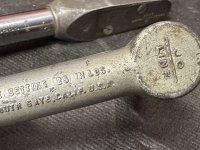
I have a question about the JOMi 150 that I am hoping someone can answer for me.
Is the anvil supposed to ratchet? Or does it just click at the setting? The smaller 25 inch pound pound ratchet pictured ratchets, as well as clicking when it reaches 25 in pounds.
The JOMI 150 clicks when it reaches the setting, but it does to ratchet. If it is supposed to ratchet, are these fairly straight forward to open up and work on? Nice rebuilt many a standard ratchet, but I’ve never tried to open up a torque wrench.
Thank you for any help you might provide.

I ran across this thread while trying to research’s couple of wrenches I acquired recently. The seller indicated they were his grandfather’s - who was an aviation mechanic.
I have a question about the JOMi 150 that I am hoping someone can answer for me.
Is the anvil supposed to ratchet? Or does it just click at the setting? The smaller 25 inch pound pound ratchet pictured ratchets, as well as clicking when it reaches 25 in pounds.
The JOMI 150 clicks when it reaches the setting, but it does to ratchet. If it is supposed to ratchet, are these fairly straight forward to open up and work on? Nice rebuilt many a standard ratchet, but I’ve never tried to open up a torque wrench.
Thank you for any help you might provide.
Attachments


Outlawmws
Well-known member
If you don't see a reversing switch, I'd assume them to be non-ratchetng.
Cruzan80
Well-known member
It wouldn't surprise me to know these were single-direction on anything ratcheting. If you were determined (and super careful), I might try removing the screws in the head (probably inside a plastic ziplock, in case anything moves on you). I know the little 1/4" torque wrench I have doesnt ratchet, but it also looks like an anvil pinned straight thru (visually doesnt look like it would).
Mintgrun
Well-known member
They're non-ratcheting.
You could use a ratchet-adaptor.

You could use a ratchet-adaptor.
M J Peters
Active member
They're non-ratcheting.
You could use a ratchet-adaptor.
Thanks.
Grayspoked
Well-known member
MJ:
It looks like I'm a little late to the party. I have plans to post some history of Jo-Line (and J O) that will tell everyone about the guys who invented and manufactured these tools, but life has been a bit chaotic, so my plans remain that - plans.
As you may have noticed in the thread, I no longer have Dad to guide me in responding to questions. I can no longer go back to the source.
However, I have a Jomi 100 and a Jomi 750 in my collection, both of which are of a bit more recent vintage than yours. Their heads are a bit different than yours (although yours certainly brings back memories of ancient examples I dug out of the Jo-Line tool crib in my dissolute youth), but neither one ratchets. Further, I have an ad that Grandfather placed in the late 1940's touting Jomis. Consistent with Mintgrun's observation a couple of posts above, the ad refers to adaptors to get the head where you wanted it. The ad notes the lock ring that is at the top of the handhold on your tool, but says nothing about a ratchet feature. Later promotional materials made the difference between "plain heads" (Grandfather and Dad figured out how to do away with the whole assembly at the top of your tool by the mid-1960's, and probably earlier) and ratcheting models.
I'll also note that you have some real antiques there! I saw some of those 25 inch pound ratchets at the factory, and they were really old in 1969-1970. The Jomi 150 looks to be second generation - mid 1950's? The first generation is the somewhat more rounded head that appears in the ad I noted above. I have seen head assemblies like yours among the company's antiques, but the design was still used into 1979 on the "1202"s that have popped up in this thread from time to time. Your tool is another example of how this head design was used in smaller sized wrenches in the early days. Later, Grandfather and Dad figured out how to make plain heads that are just square drives on the hinge, rather than the more elaborate version you have, and more modern ratchets (first, purchased from sadly departed New Britain and then manufactured at Jo-Line from a design pioneered by French manufacturer Facom.
A little bit o' history you have there, MJ!
Bill
It looks like I'm a little late to the party. I have plans to post some history of Jo-Line (and J O) that will tell everyone about the guys who invented and manufactured these tools, but life has been a bit chaotic, so my plans remain that - plans.
As you may have noticed in the thread, I no longer have Dad to guide me in responding to questions. I can no longer go back to the source.
However, I have a Jomi 100 and a Jomi 750 in my collection, both of which are of a bit more recent vintage than yours. Their heads are a bit different than yours (although yours certainly brings back memories of ancient examples I dug out of the Jo-Line tool crib in my dissolute youth), but neither one ratchets. Further, I have an ad that Grandfather placed in the late 1940's touting Jomis. Consistent with Mintgrun's observation a couple of posts above, the ad refers to adaptors to get the head where you wanted it. The ad notes the lock ring that is at the top of the handhold on your tool, but says nothing about a ratchet feature. Later promotional materials made the difference between "plain heads" (Grandfather and Dad figured out how to do away with the whole assembly at the top of your tool by the mid-1960's, and probably earlier) and ratcheting models.
I'll also note that you have some real antiques there! I saw some of those 25 inch pound ratchets at the factory, and they were really old in 1969-1970. The Jomi 150 looks to be second generation - mid 1950's? The first generation is the somewhat more rounded head that appears in the ad I noted above. I have seen head assemblies like yours among the company's antiques, but the design was still used into 1979 on the "1202"s that have popped up in this thread from time to time. Your tool is another example of how this head design was used in smaller sized wrenches in the early days. Later, Grandfather and Dad figured out how to make plain heads that are just square drives on the hinge, rather than the more elaborate version you have, and more modern ratchets (first, purchased from sadly departed New Britain and then manufactured at Jo-Line from a design pioneered by French manufacturer Facom.
A little bit o' history you have there, MJ!
Bill