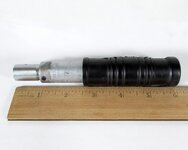
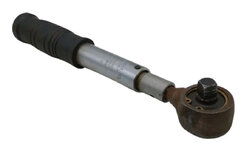
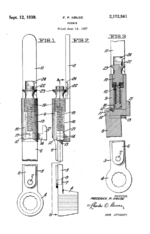
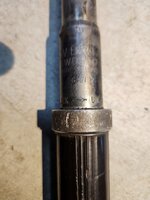
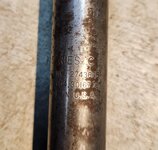
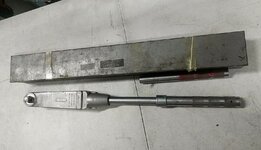
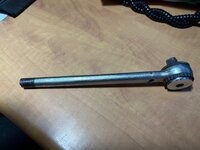
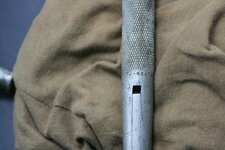
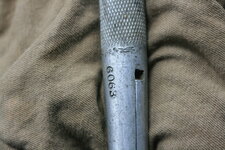
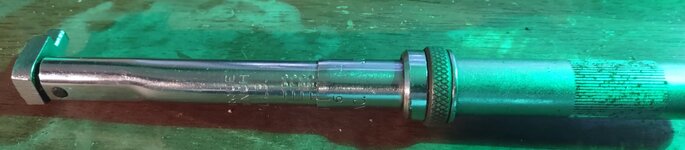
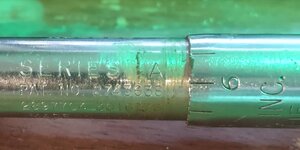
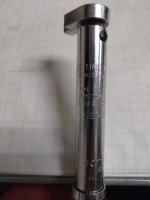
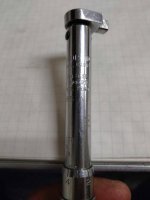
Mine is slightly different. mine's got a lock ring and different knurling
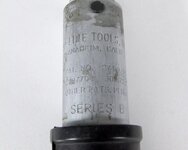
I see series A but no model. Date of 3-71
Fish:
I recognize your tool. In fact, I may have helped manufacture and ship it.
Jo-Line's model number for your tool is 2002 AI. Here's where that number comes from (other than the company catalog dated August 1977, from which I pulled this).
The "200" that starts the model number refers to the top number on the tool's calibration scale. You mentioned that your tool tops out at 200 inch pounds. That's where the "200" comes from on this occasion. How am I so confident about that? Well, the "I" in "AI" refers to "inch," as in "inch pounds."
The "2" that ends the "2002" in the model number refers to the size of the drive. Jo-Line measured the size of the drives on its tools in increments of eighths of an inch. You reported that your tool has a 1/4 inch drive on it. 1/4 inch is two eighths of an inch. Jo-Line would count that as a "2" in the model number.
The "A" in "AI" refers to "adjustable." This "A" distinguishes your tool from, say, a JOTE (the little T-shaped jobs that I believe have been discussed earlier in this thread - but I didn't slow down to check). A JOTE was pre-set at the factory. You can set yours at 30 inch pounds at the low end to 200 inch pounds at the high end.
There is no "R" in this model number. Jo-Line used an "R" in its model numbers when a wrench had a "r"atchet. Yours doesn't have a ratchet, so no "R."
Many Jo-Line model numbers had an "M" at the end (e.g., "AI
M"), because they had a metric calibration scale on the other side of the wrench from the imperial scale shown in your photos. However, the vast majority of wrenches manufactured by Jo-Line didn't have an "M" in their model numbers, because American customers didn't give a wet petunia about the metric system back in the day.
Your tool should be about 8 3/4 inches long, tail to tip, when rolled down to the 30 inch pound setting. It should be about 3/4" across the top, excluding the drive. It should be about 1/2-5/8" across the base (the measurements in my catalog are based on a 5/8"-wide rubber handhold, which was wider than the steel one you have. The head should be about 5/8" wide. It should weigh about 12 ounces.
Now, why do I say that I recognize it? I mentioned in another post earlier today that Jo-Line (actually, my Dad) figured out that private label was the way to go. I mean, which would you take, a tool made by some unknown outfit somewhere in the wilds of Southern California or a tool offered by Snap-On or Mac Tools? Three guesses about which tool most buyers would take -- and the first two guesses don't count. Jo-Line made a few - emphasis on
few - wrenches branded with its own name. I saw maybe one or two shipments of Jo-Line branded tools over the nine years (weekends, holidays, and summers only - I was a student otherwise) I worked at Jo-Line
There was one Jo-Line customer that didn't give a hoot about brand names -- the military. The military (we called this customer simply "the government," although it's difficult thinking about what the State Department or the IRS would do with one of these) put out a Request For Proposal ("RFP"), to which manufacturers would respond with bids. The low bidder who met the specifications in the RFP tended to get the contract. Dad hated the government contracts. What was great for the government and the taxpayers was awful for the manufacturers. It was real hard to make an honest buck doing business with the government. Further, the specifications almost always had some screwy term that made government tools more difficult and expensive to make (more on that below). Dad only bid on government work with reluctance and only at a price he'd be willing to take if he happened to land the contract.
However, products that Jo-Line sold to the government were proudly branded "Jo-Line." Government wrenches were just about the only ones that carried that branding after about 1961-1962, when my Dad rose high enough in the Jo-Line hierarchy to tell HIS Dad (my Grandfather) how to sell torque wrenches.
There was little demand for inch pound wrenches like yours during my tenure at Jo-Line (1969-1978). Further, there was little demand for what we called "square drive" (as opposed to "ratcheting") wrenches during this period. Finally, my 1977 Jo-Line catalog does not even list a 2002 AI (no "M") for sale to private (non-government) customers. You couldn't even buy a wrench like yours from Jo-Line unless you entered into a specific contract to make wrenches
without the metric calibration scale on it. No one but the government did that.
Your lock ring dating gave this one away to me. Of course, "3-71" means that your tool was manufactured in March, 1971. That dating corresponds in time just about right with a strong memory I have of one of the more obstinate orders I ever saw at Jo-Line. It was an order of a few hundred government 2002 AIs. The contract specifications required that each wrench be placed in a little metal box, much like the much larger one depicted in post 172, above. Each box had affixed to it a sticker like the one depicted at post 172, proclaiming the box's contents as being a "wrench, torque" (love the military!), along with all that other information shown there that
no one ever read. Jo-Line subcontracted out the manufacture of these boxes. The boxes for this order arrived at Jo-Line as the 2002 AIs were being assembled - "Just In Time" manufacturing, before that became a buzz-word! Unfortunately, the boxes got screwed up somewhere along the way. The boxes were about 3/4" shorter than they were supposed to be. Our policy was that we packed our adjustable wrenches for shipment set at their lowest calibration, 30 inch pounds in your case. Doing this minimized stress on the spring located in the middle of the tool and essential to its accurate operation. The government 2002 AIs wouldn't fit in the required boxes if we set them the way we typically did. Remember my saying above that there was always
something out of the ordinary with a government order? Well, here it was, big time. We couldn't get new boxes and meet the delivery time requirements specified in the contract. We didn't want to roll up the tools so that they would fit in the little metal boxes (setting them at somewhere around 100 inch pounds, as I recall) when we shipped them, given our spring stress concerns.
I remember a meeting with the plant manager (everybody knew he was an important guy because he wore a tie to work and had a desk next to the Jo-Line V.P, and across the hall from my Dad's office), the lead man from the assembly department, and me representing the shipping room. What to do? The answer was simple. Roll the tools up to 100 inch pounds. Not optimal, but hey, it was a government order. Anything else and we'd blow the delivery deadline while simultaneously having to re-do the boxes which would **** all the profit out of the contract.
Well, all these hundreds of little wrenches had been rolled down to 30 inch pounds after they had been tested and calibrated - standard operating procedure, right?? That meant that somebody had to roll each and every one of them up to 100 inch pounds so that they were short enough to fit in the %$*&^!!! metal boxes. Then, somebody would have to actually get the wrenches into those %$*&^!!! metal boxes. The edges of the box bottoms and lids themselves were sharp, and only permitted themselves to be opened and closed with great reluctance and only after much pleading and wrestling. Further, you couldn't stack the metal boxes very high because they were really slick (with rounded edges) so they'd slide off the shipping room table and bang onto the concrete floor if all you did was look at them funny, denting the boxes along the way. I didn't duck fast enough when a call for volunteers to perform these tasks was made. I strongly recall standing at an assembly department table rolling 2002 AI wrenches up to 100 inch pounds, and then carting to the shipping room metal boxes with a wrench in each one a few at a time. From there, we got them on a Yellow Freight truck (may Yellow Freight rest in peace!) in time to meet the specifications in the RFP. There were four or five of us who spent two-three hours doing these stupid tasks. Sheesh.
Sorry for the long-winded tale. Actually, the
very long-winded tale. It's just that this small disaster has stuck in my mind for over 50 years now. Your photos brought me back perilously close to PTSD.
Enjoy your wrench, Fish. I hope it's still accurate.
Bill