To avoid these ads, REGISTER NOW!

Anyone know what this screwdriver was made for?

Oregon Dave

Well-known member
Joined
Sep 16, 2023
Messages
298
They've been making screw holding screwdrivers since at least the 1880's.
The only place I came across the 1880 date was in the A.I. blurb that shows up at the beginning of a lot of Google searches; but could only find Mann’s “Holdfast”, which could never drop a screw, but is more of a club than a screwdriver and certainly, in my opinion, not a very suitable option for “an issue in commercial work”. If you know of any other specific tools and verifiable dates, please share them.

At this point, I am aware of only two others; the first was the spring type, Rudolph J. Velepec of Rochester NY was granted patent 1,641,307, in 1927, but it didn’t go into any serious production until much later, ultimately by Upson Brothers, Incorporated, also of Rochester. The other is the Quick-Wedge type which came out twenty years later.

That’s the extent of what I have; again please share your what you have - one of the great things about G.J. is that we all get incremental increases in tool knowledge!!!
 
Last edited:
To avoid these ads, REGISTER NOW!

Private Lugnutz

Well-known member
Joined
Mar 30, 2012
Messages
30,877
Location
The Authentic Jersey Shore
Is it possible the one that started this query is a smaller size of the Type A than most people have, and that's why it looks different, bigger central point to wing ratio?
I concur, saving me some typing in my very late arrival to this party. Think about it in a patent context. 'Just like the Clutch Head A in shape, but smaller' would be a tough sell to patent inspectors with uniqueness as their number one criterium. Or even in the context of a design shop pitching it to the front office trying to figure out how to present, market, and sell it commercially. Has anyone looked at any Clutch Head literature? Seems perfectly reasonable to expect that Type A came in a similar range of sizes as Type B (or whatever they designated the "butterfly" type). I'm shaving with Occam's Razor on this one for now.

// BREAK //

On the screw holding tangent...
They've been making screw holding screwdrivers since at least the 1880's.
I could only find Mann’s “Holdfast”, ...[ ]... If you know of any other specific tools and verifiable dates, please share them.
The oldest verifiable produced that I know of is Crawford's, PAT 274912 (Apr 3, 1883), DATAMP page linked here.

The oldest in my personal collection, and what I think is still the oldest we have here on our GJ thread on this particular topic, is from my former fellow NJ native, John D. Campbell, PAT 703638 (Jul 1, 1902), shown in league with Philly's North Bros, linked here. The DATAMP page for that one is linked here. (Lest you think I am taking credit for someone else's antique screw holding driver, that is also mine shown in Patent Pic 2 and 3, and the "Brian Kirk" of the photo credit is @four.cycle, who submitted the photo! :))
At this point, I am aware of only two others;...[ ]...That’s the extent of what I know; again please share your what you have - one of the great things about G.J. is that we all get incremental increases in tool knowledge!!!
One of the next greatest things about GJ is that we may, if we choose to do so, access topics on which we have all gotten incremental increases in tool knowledge in a method more deliberate than as they appear in the tangents of random Whatzit threads on page 1 of a very fast moving forum, by visiting the A-Z Index of Threads in the READ B4 POSTING! Sticky at the top of the page. :)

See the 'Screw starters/holders' thread for much more information, examples, and history.

1755692200880.png

 
Last edited:

RTM

Well-known member
Joined
May 13, 2019
Messages
13,357
Location
SF Bay Area
At this point, I am aware of only two others; the first was the spring type, Rudolph J. Velepec of Rochester NY was granted patent 1,641,307, in 1927, but it didn’t go into any serious production until much later, ultimately by Upson Brothers, Incorporated, also of Rochester. The other is the Quick-Wedge type which came out twenty years later.
Oh my, have we got news for you. Don’t know about 1880s, but a few different ones in here. My earliest might be a 1909.


Damn, guess I skimmed Lugz’ post a bit too fast. 😞
 
Last edited:

Private Lugnutz

Well-known member
Joined
Mar 30, 2012
Messages
30,877
Location
The Authentic Jersey Shore
Please let me know if you come up with a pic or a catalog listing (I'm looking too.)
Reply Part I

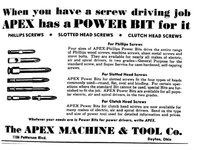
Google Books searches on "Clutch Head Screws Type A":

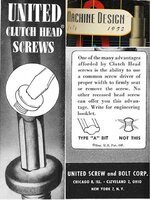
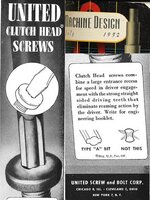
United Screw and Bolt Corp advertising in The Tool Engineer (1941)
They are relentless on the virtues of Type A. (Those are not redundant ads below, but three different text boxes)

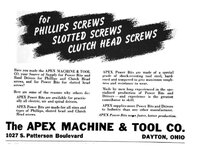
Apex Machine and Tool Co advertising in Machine Design (1952)
They don't distinguish types and not enough definition in the illo to discern if it's Type A or B

Select excerpts...
 

Attachments

  • Clutch Head Type A 1952.jpg
    Clutch Head Type A 1952.jpg
    182.7 KB · Views: 11
  • Clutch Head Type A 1952 (2).jpg
    Clutch Head Type A 1952 (2).jpg
    183.2 KB · Views: 7
  • Clutch Head Type A 1952 (3).jpg
    Clutch Head Type A 1952 (3).jpg
    180.8 KB · Views: 6
  • Apex Clutch Head 1941.jpg
    Apex Clutch Head 1941.jpg
    133.9 KB · Views: 6
  • Apex Clutch Head 1941 3.jpg
    Apex Clutch Head 1941 3.jpg
    124.7 KB · Views: 4
  • Apex Clutch Head 1941 2.jpg
    Apex Clutch Head 1941 2.jpg
    142 KB · Views: 4
Last edited:

Leviton

Well-known member
Joined
Feb 25, 2019
Messages
947
Location
Oregon
The only place I came across the 1880 date was in the A.I. blurb that shows up at the beginning of a lot of Google searches; but could only find Mann’s “Holdfast”, which could never drop a screw, but is more of a club than a screwdriver and certainly, in my opinion, ..

At this point, I am aware of only two others; the first was the spring type, Rudolph J. Velepec of Rochester NY was granted patent 1,641,307, in 1927, ... The other is the Quick-Wedge type which came out twenty years later.

That’s the extent of what I have; again please share your what you have - one of the great things about G.J. is that we all get incremental increases in tool knowledge!!!
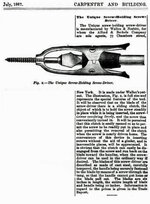
Here is an example from 1887:.

Screw Holding Screwdriver - July 1887.jpg
 

Oregon Dave

Well-known member
Joined
Sep 16, 2023
Messages
298
I concur, saving me some typing in my very late arrival to this party. Think about it in a patent context. 'Just like the Clutch Head A in shape, but smaller' would be a tough sell to patent inspectors with uniqueness as their number one criterium. Or even in the context of a design shop pitching it to the front office trying to figure out how to present, market, and sell it commercially. Has anyone looked at any Clutch Head literature? Seems perfectly reasonable to expect that Type A came in a similar range of sizes as Type B (or whatever they designated the "butterfly" type). I'm shaving with Occam's Razor on this one for now.

// BREAK //

On the screw holding tangent...


The oldest verifiable produced that I know of is Crawford's, PAT 274912 (Apr 3, 1883), DATAMP page linked here.

The oldest in my personal collection, and what I think is still the oldest we have here on our GJ thread on this particular topic, is from my former fellow NJ native, John D. Campbell, PAT 703638 (Jul 1, 1902), shown in league with Philly's North Bros, linked here. The DATAMP page for that one is linked here. (Lest you think I am taking credit for someone else's antique screw holding driver, that is also mine shown in Patent Pic 2 and 3, and the "Brian Kirk" of the photo credit is @four.cycle, who submitted the photo! :))

One of the next greatest things about GJ is that we may, if we choose to do so, access topics on which we have all gotten incremental increases in tool knowledge in a method more deliberate than as they appear in the tangents of random Whatzit threads on page 1 of a very fast moving forum, by visiting the A-Z Index of Threads in the READ B4 POSTING! Sticky at the top of the page. :)

See the 'Screw starters/holders' thread for much more information, examples, and history.

1755692200880.png

Thanks Private Lugnutz for the incredible additional information on early screwholding screwdriver; I have tried your suggestion for Google books - was easy to get there; frustrating for me to get a relevant document displayed; have grandkids as a back-up - will smooth out with usage & experience. Thank you and RTM for the link at the beginning of this thread; I had forgotten about it and how much valuable information is included and how much time can be saved getting to a specific subject material.

For clarity, I am confounded with an association with the O.P. tool and the clutch-head fastener system; Type A or any other (please see my post #78 above). I believe I own all the clutch-head driver sizes created in either handled tools or ¼” hex drive tips (not all brands); NONE have the extended center post OR the “flat-tip screwdriver” wings of the O.P.’s tool - none of the clutch-head images in this thread do either, but are offered, clearly showing no extended post and with bat/bowtie/butterfly wings; none of the images I have located with regular Google searching do either - beyond that why would they; wouldn’t it require a clutch-head fastener to have a ⅛” dia. center hole for the wings to seat & purchase. In addition measure the tip of your large US made screwdrivers; all mine are the same as the O.P. posted from his tool.

None of the screw-holding screwdrivers, even the recent submissions, really lend themselves to “an issue in commercial work”; i.e. automotive production lines etc. - they are more intended for holding a fastener on the tip for reaching into confined spaces; have a substantial use in electronics. I don’t mean to imply the O.P.’s tool was used automotively (although that industry could create the demand for the production of such a tool), seems more tools and/or fasteners would around if so. Wood was used, I know, in early autos; we have restored a Model T & A, but I did not pay attention to the wood screw heads; will query members of our Model A club. I am still of the opinion that who ever made the O.P. this tool, with a common sized center post, did so as a screw-hold assist - here it is, buy it if you wish; you’ll have to drill center holes in your own screwheads.

Gangly, had the same thought up-thread, EXC uses a square extended center post and is of a much more recent vintage and this tool failed an O.P. fit test above, in a modern electric switch terminal. Additionally I envisioned, having to install all the switches and outlets in early 20th century skyscrapers & tract house - the reliable American ingenuity kicks in and the tool is a precursor to EXC; but have a few old 2-wire outlets and they use a straight slot head.
 
Last edited:

Private Lugnutz

Well-known member
Joined
Mar 30, 2012
Messages
30,877
Location
The Authentic Jersey Shore
...was easy to get there; frustrating for me to get a relevant document displayed...
When you enter the search terms in the search bar, you should get something that looks like this.

1755707337756.png

You just click on each hyperlinked title to retrieve the book.

If you get one that says "Snippet view", you will only get a very small excerpt, because the entire book is still copyright protected and cannot be digitized by the Google Books team.
...no extended post...[ ]..wouldn’t it require a clutch-head fastener to have a ⅛” dia. center hole for the wings to seat & purchase.
I can see what you mean about the OP's having a sizable amount of the center tip that is not flush with the wings. And I can see it creating similar difficulties as those experienced when mistakenly trying to use a Reed & Prince (Frearson) driver on a Phillips screw, or vice versa, if the entire cruciform recess in the fastener was not deep enough.
 

Private Lugnutz

Well-known member
Joined
Mar 30, 2012
Messages
30,877
Location
The Authentic Jersey Shore
Please let me know if you come up with a pic or a catalog listing (I'm looking too.)
Reply Part II.

I don't think this helps much, I just thought it was interesting seeing the graphic show the second (but named Type "A") type Clutch Head in the inset, but showing the named Type "B" (so-called Butterfly) as the primary.

Pop Mech 1953.jpg
 

Oregon Dave

Well-known member
Joined
Sep 16, 2023
Messages
298
Here is an example from 1887:.

Screw Holding Screwdriver - July 1887.jpg

Reply Part II.

I don't think this helps much, I just thought it was interesting seeing the graphic show the second (but named Type "A") type Clutch Head in the inset, but showing the named Type "B" (so-called Butterfly) as the primary.

Pop Mech 1953.jpg
The superscript clutch-head image is very interesting and a 'good find'; it does not show an extended post, but may be the tip Beerhippie was referring to up-thread.

We need to petition Private Lugnutz to teach a 'puter research class, as if he has the time. LesserSon provided a great dissertation on taking photos in the How many pliers is too many thread.
 
Last edited:

RTM

Well-known member
Joined
May 13, 2019
Messages
13,357
Location
SF Bay Area
When you enter the search terms in the search bar, you should get something that looks like this.

1755707337756.png
@Oregon Dave You can go a couple of steps further with this search too.

Put things in quotes, forces it to find the word "clutch" and "head" together as a phrase and similarly w Type A. (of course, until AI tries to bypass what you want it to do)
1755710702074.png

Second, restrict your time range, here I have selected 1915 to 1955, thus removing modern catalogs who refer to a security bit as a clutch head. This gives you contemporaneous results, not some modern interpretation of it.

1755710777605.png

Sometimes the search result, as Lugz shows above, can give you more information than clicking thru to the resuls.

¢¢
 
OP
N

nz44tool

ALLIANCE MEMBER
Joined
Nov 5, 2024
Messages
350
Location
New Britain CT
Reply Part II.

I don't think this helps much, I just thought it was interesting seeing the graphic show the second (but named Type "A") type Clutch Head in the inset, but showing the named Type "B" (so-called Butterfly) as the primary.

Pop Mech 1953.jpg
Thanks, this is interesting - the clutch head driver picture is the closest yet to what I have, except for the protruding center pin.
I suppose my example could have been modified, but it doesn't appear to be, and I can't imagine a purpose for doing so.
 
To avoid these ads, REGISTER NOW!

Oregon Dave

Well-known member
Joined
Sep 16, 2023
Messages
298
Thanks, this is interesting - the clutch head driver picture is the closest yet to what I have, except for the protruding center pin.
I suppose my example could have been modified, but it doesn't appear to be, and I can't imagine a purpose for doing so.
To the O.P., not to pick on you, but more to smooth out/streamline future requests for tool identification assistance; initially providing the dimensions you eventually did after several requests would have been very helpful. Look how many rabbit holes have been created; clutch-head, carb jets, screwholders - on balance it did create much insight and information sharing & we learned.

However, once you did provide the dimensions, it is clearly a large flat-tip screwdriver with a ⅛” dia center post - most likely formed by feeding a ⅜” round stock through a drop/stamp forge; pressing the tip profile at intervals, two tips worth at a time, end to end, cutting mid-line and filing/grinding the wings back - setting up two grind wheels shimmed apart would make it faster. Doesn’t the tools wing tip ends in the original images (far right one), in post #1 show tool marks?

Not to be grumpy, but folks asking for help - maybe reflect on being more helpful up-front.

Also re: . . . "I suppose my example could have been modified, but it doesn't appear to be," . . . the wing tip ends appear to have tool marks in your original images; not with your eyes on the tool itself??? They almost appear concentric like ground with a spinning stone with ⅛” dia. hole; any clues on the O.D. of post?
 
Last edited:

Oregon Dave

Well-known member
Joined
Sep 16, 2023
Messages
298
Here is an example from 1887:.

Screw Holding Screwdriver - July 1887.jpg
Thank-You for sharing the above information; are you using something other than regular Google that may be helpful for others to know about?

You clipped "certainly, in my opinion, not a very suitable option for “an issue in commercial work””. I should have been more specific, I meant a faster paced usage than that any of the screwholders seen so far. For me screwholders are for use in confined spaces that won’t accommodate the use of another hand to hold the fastener; pre magnetic tip era - was a missle radar, fire control tech in the service - handy for electronic work in the mid 1960’s.
 
OP
N

nz44tool

ALLIANCE MEMBER
Joined
Nov 5, 2024
Messages
350
Location
New Britain CT
To the O.P., not to pick on you, but more to smooth out/streamline future requests for tool identification assistance; initially providing the dimensions you eventually did after several requests would have been very helpful. Look how many rabbit holes have been created; clutch-head, carb jets, screwholders - on balance it did create much insight and information sharing & we learned.

However, once you did provide the dimensions, it is clearly a large flat-tip screwdriver with a ⅛” dia center post - most likely formed by feeding a ⅜” round stock through a drop/stamp forge; pressing the tip profile at intervals, two tips worth at a time, end to end, cutting mid-line and filing/grinding the wings back - setting up two grind wheels shimmed apart would make it faster. Doesn’t the tools wing tip ends in the original images (far right one), in post #1 show tool marks?

Not to be grumpy, but folks asking for help - maybe reflect on being more helpful up-front.

Also re: . . . "I suppose my example could have been modified, but it doesn't appear to be," . . . the wing tip ends appear to have tool marks in your original images; not with your eyes on the tool itself??? They almost appear concentric like ground with a spinning stone with ⅛” dia. hole; any clues on the O.D. of post?
Point taken, Oregon Dave - I'm an old geezer, kinda new at this digital forum thing, so my social skills leave much to be desired. All of you folks know WAY more than I do about any of this - it's a little intimidating.
I didn't provide more info initially because, frankly, I was pretty sure that someone would hit it with the first or second shot. Post and learn, as they say.
Re possible modification - nothing in the tool marks looks newer than anything else to my not-so-great eyes. I suppose someone with some skills could have modded it, but why would they?
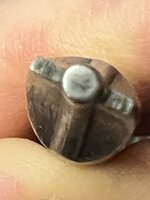
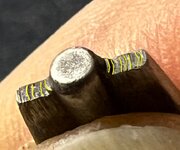
Here are a few more pics, maybe they'll help.
Thanks to all the GJ people who've chimed in on this.
 

Attachments

  • IMG_8154.jpeg
    IMG_8154.jpeg
    213.8 KB · Views: 5
  • IMG_8157.jpeg
    IMG_8157.jpeg
    323.8 KB · Views: 4
  • IMG_8158.jpeg
    IMG_8158.jpeg
    303.8 KB · Views: 5

Private Lugnutz

Well-known member
Joined
Mar 30, 2012
Messages
30,877
Location
The Authentic Jersey Shore
^ He's referring to the machining and chatter marks on the "wings". See pics. If factory, those would've been finished and buffed smooth. I'm leaning more toward modified Clutch Head Type A than ever. Your question "Why?" is a good one, though. As Dave mentioned, the fastener would have to have a serious bore in the center. Maybe something that was seized was drilled and slotted for removal. Just spit ballin'.
 

Attachments

  • Chatter marks.jpg
    Chatter marks.jpg
    74.7 KB · Views: 4
  • Chatter marks 2.jpg
    Chatter marks 2.jpg
    85.6 KB · Views: 7
OP
N

nz44tool

ALLIANCE MEMBER
Joined
Nov 5, 2024
Messages
350
Location
New Britain CT
^ He's referring to the machining and chatter marks on the "wings". See pics. If factory, those would've been finished and buffed smooth. I'm leaning more toward modified Clutch Head Type A than ever. Your question "Why?" is a good one, though. As Dave mentioned, the fastener would have to have a serious bore in the center. Maybe something that was seized was drilled and slotted for removal. Just spit ballin'.
I see your point, although I notice that the center pin has been inserted enough times to be worn to a slightly tapered shape at the tip, which seems unlikely for what would probably be a one-off modification. Also spit ballin'.
 

Oregon Dave

Well-known member
Joined
Sep 16, 2023
Messages
298
Point taken, Oregon Dave - I'm an old geezer, kinda new at this digital forum thing, so my social skills leave much to be desired. All of you folks know WAY more than I do about any of this - it's a little intimidating.
I didn't provide more info initially because, frankly, I was pretty sure that someone would hit it with the first or second shot. Post and learn, as they say.
Re possible modification - nothing in the tool marks looks newer than anything else to my not-so-great eyes. I suppose someone with some skills could have modded it, but why would they?
Here are a few more pics, maybe they'll help.
Thanks to all the GJ people who've chimed in on this.
Please, like I mentioned, not picking on you, more of an attempt to smooth out/streamline future requests; appreciate your response though; more so that you posted such a puzzler to begin with - hell, I least you posted some decent pictures, with a ruler to boot; better than the coke can Old Tool Guy mentioned.

The new additional images; the tip appears dressed, not in Austria, Switzerland or Germany. If done by hand to a tool with Private Lugnutz’s superscript clutch-head tool and he drilled his own screws; would certainly explain the apparent rarity of both.

Old Geezer; looking forward to your experience and knowledge in the future - still hope’n this one keeps getting moving on.
Point taken, Oregon Dave - I'm an old geezer, kinda new at this digital forum thing, so my social skills leave much to be desired. All of you folks know WAY more than I do about any of this - it's a little intimidating.
I didn't provide more info initially because, frankly, I was pretty sure that someone would hit it with the first or second shot. Post and learn, as they say.
Re possible modification - nothing in the tool marks looks newer than anything else to my not-so-great eyes. I suppose someone with some skills could have modded it, but why would they?
Here are a few more pics, maybe they'll help.
Thanks to all the GJ people who've chimed in on this.
 
Last edited:
OP
N

nz44tool

ALLIANCE MEMBER
Joined
Nov 5, 2024
Messages
350
Location
New Britain CT
That chamfering also could've been from machining the wings down, though. Hard to say.
Agreed.
Two points:
a. No one has come up with a closely corresponding fastener or another example of the tool.
b. The tool does look a lot like the one in the Popular Mechanics ad.

Considering these points, I'm starting to think that modification is the likeliest explanation so far.
 
OP
N

nz44tool

ALLIANCE MEMBER
Joined
Nov 5, 2024
Messages
350
Location
New Britain CT
Please, like I mentioned, not picking on you, more of an attempt to smooth out/streamline future requests; appreciate your response though; more so that you posted such a puzzler to begin with - hell, I least you posted some decent pictures, with a ruler to boot; better than the coke can Old Tool Guy mentioned.

The new additional images; the tip appears dressed, not in Austria, Switzerland or Germany. If done by hand to a tool with Private Lugnutz’s superscript clutch-head tool and he drilled his own screws; would certainly explain the apparent rarity of both.

Old Geezer; looking forward to your experience and knowledge in the future - still hope’n this one keeps getting moving on.
Not to worry, I don't feel picked on - just awed by how deeply some of you have dived into the ocean of tools.
I'm a surface-feeder - I love finding the tools from my youth and earlier, cleaning them up, and getting them into the hands of people who use and appreciate them (via eBay, of course). It's a terrific history lesson as well - the story of the Industrial Revolution, told by the tools that made it happen.
One question - how did Austria, Switzerland and Germany get into the discussion - I'm missing the reference.:unsure:
 

Oregon Dave

Well-known member
Joined
Sep 16, 2023
Messages
298
Agreed.
Two points:
a. No one has come up with a closely corresponding fastener or another example of the tool.
b. The tool does look a lot like the one in the Popular Mechanics ad.

Considering these points, I'm starting to think that modification is the likeliest explanation so far.
Are three of us heading to the same conclusion? User modified tool; one off job; left the tool laying around so we could ponder it.
 

Oregon Dave

Well-known member
Joined
Sep 16, 2023
Messages
298
Not to worry, I don't feel picked on - just awed by how deeply some of you have dived into the ocean of tools.
I'm a surface-feeder - I love finding the tools from my youth and earlier, cleaning them up, and getting them into the hands of people who use and appreciate them (via eBay, of course). It's a terrific history lesson as well - the story of the Industrial Revolution, told by the tools that made it happen.
One question - how did Austria, Switzerland and Germany get into the discussion - I'm missing the reference.:unsure:
Craftsmen in those countries, among others, would have never left the tip surface so rough; neither would American craftsmen before boardrooms.
 

Oregon Dave

Well-known member
Joined
Sep 16, 2023
Messages
298
I just picked this up at a junk store. It's a nicely-made tool, looks like 1920s or '30s to me.
But I don't recognize the tip.
Anyone out there know what it's for?
I'm betting someone does.
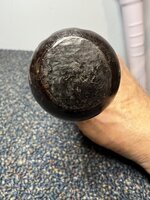
Definitely Maybe that is a user modified clutch-head driver; blew up the right image in post #98 - does it for me; not wear taper, just the state of the workmanship used, likely got user’s job done . It was originally the 5/16”/Cross Blade Size No. 3 for size 10, 12 or 14 screws; shown in the image Private Lugnutz provided in post #92 from an issue of Popular Mechanics dated March, 1953. Icing on the cake would be if a mechanical drawing of that tip’s cross-section could be sleuthed-up and showed the wings to be 0.055” thick.

O.P. Other than previously postulated purposes, does the end of handle show signs of being struck; use of a soft hammer would tough to detect - probably going for an unnecessary stretch. If we wanted to see another tool like yours; likely we have to make it; makes it not medium or well-done - RARE!

Put’n this one in the can; leaving the lid slightly ajar.
 
Last edited:
OP
N

nz44tool

ALLIANCE MEMBER
Joined
Nov 5, 2024
Messages
350
Location
New Britain CT
Definitely Maybe that is a user modified clutch-head driver; blew up the right image in post #98 - does it for me; not wear taper, just the state of the workmanship used, likely got user’s job done . It was originally the 5/16”/Cross Blade Size No. 3 for size 10, 12 or 14 screws; shown in the image Private Lugnutz provided in post #92 from an issue of Popular Mechanics dated March, 1953. Icing on the cake would be if a mechanical drawing of that tip’s cross-section could be sleuthed-up and showed the wings to be 0.055” thick.

O.P. Other than previously postulated purposes, does the end of handle show signs of being struck; use of a soft hammer would tough to detect - probably going for an unnecessary stretch. If we wanted to see another tool like yours; likely we have to make it; makes it not medium or well-done - RARE!

Put’n this one in the can; leaving the lid slightly ajar.
Agreed - seems like the best we can do for now. I'd also like that hypothetical mechanical drawing to show the diameter of the center post, and the dimension from where the shank becomes the tip to the end of the tip.
To me the handle doesn't look struck; it's not perfectly flat but doesn't look hammered. Hard to tell from the pic.
Glad you're leaving the lid ajar - ya never know when those unicorns will show up.:)
 

Attachments

  • IMG_8230.jpeg
    IMG_8230.jpeg
    615.6 KB · Views: 5
To avoid these ads, REGISTER NOW!
Top Bottom