To avoid these ads, REGISTER NOW!

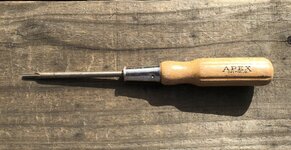
Anyone know what this screwdriver was made for?

Oregon Dave

Well-known member
Joined
Sep 16, 2023
Messages
298
Here is a jet tool with a nub in the middle.
1754964599061.png
Thanks Mintgrun, it fits the profile, but not the period; O.P.'s driver is 1930ish. Have worked on Model A, Zenith and Tillotson Carburetors; no special tools needed - other makes; don't know, but have a decent mystery going here - every clue helps - hope we solve it.
 
Last edited:
To avoid these ads, REGISTER NOW!

driftpin

Well-known member
Joined
Dec 22, 2016
Messages
11,387
Location
Miami-Dade/Broward Co. Florida
Several clutch head screwdrivers of different sizes. I bought this set to work on a tri-five Chevy. Locations where I found these to be useful were the left rear tail light which swings open to access the fuel filler cap, and the front hood bracing. I think there was also a need for it when working on the dashboard and pieces underneath it.

None of these butterfly types are the same as the clutch head in question. Pictures are for comparison only. I believe when I was searching for a selection of these style clutch head 'drivers, I saw some of the other type.

Years ago, in a selection of screwdriver tips from a Craftsman set, I found clutch heads in two different sizes. The set was a round, red indexing storage holder, w/a clear plastic top. You 'dialed' to the tip you wanted, and there were a couple of round holes in the clear plastic lid, where the tip you wanted, could fall-out if you inverted the entire holder. I don't recall seeing the type of clutch head tip shown by the O.P. in the Craftsman tip set.

20250812_080916.jpg
You can enlarge the tip pictures if you wish to see them in more detail


20250812_080948.jpg
 
Last edited:

Oregon Dave

Well-known member
Joined
Sep 16, 2023
Messages
298
Based on what? This is a 1964 Stanley catalog page. It doesn't show that tip, but has tools with a similar grip.

1754999367213.png

(taken from the Internet Archive site)
Tom
This got way too lengthy -

Based on what? Based on the images of O.P.’s driver; appears to be a well-made tool with NO maker’s identification; the 60’s Stanley Tools catalog page - can't make out all the items for now, but identification is at least semi-prevalent. Wood handled tools are currently being made.

Carriage and wagon makers supplied a ‘tool kit’ they often made themselves; Henry Ford, and others, built a ‘horseless’ carriage and continued the ‘established practice'. I personally believe, initially, they had no idea of the demand and that they would sell millions of vehicles & need as many tool-kits. Tool kit problem wasn’t ducked; rather contracted out - millions of painted wooden handled screwdrivers were made in that era with NO maker’s identity. Even Ford’s other tools, while displaying the script Ford or flying F, have no direct maker’s identification; other markings do lead to the contract producer - never seen any such marks on the screwdrivers; notwithstanding, have not seen them all. This, and other instances, speak to Henry’s vanity; but resulted in millions of unmarked, wooden handle screwdrivers in the ‘30’s.

nz44tool’s fit test points away from electrical use (hopefully nz doesn’t stand for New Zealand and you’re on the metric system). d42jeep’s Apex type A screwdriver is interesting. Beerhippie is that possibly the one you were referring to? It has parallel wings, rather than the bat/butterfly style, but lacks the extended center post of the O.P.’s driver.

The new info has triggered another thought; overhead work in the automobile industry - if you HAD to install the smaller Type A clutch-head fasteners overhead, possibly prior to magnetic tips, the addition of the center post; requiring a recessed hole in the fastener, would hold the fastener better - would be a way to speed things up.

Continues to be an interesting mystery to me; history is a moving picture.
 
Last edited:

RTM

Well-known member
Joined
May 13, 2019
Messages
13,364
Location
SF Bay Area
Here is my Apex type A screwdriver.

IMG_8315.jpeg
-Don
If you go digging into the link Don supplied here, it links to a Sizes.com website, which in the Clutch screwdriver section, where they showed only the bowtie type, the following sizes are listed.

The size is the maximum diameter in inches of the bit point: 1⁄8″, 5⁄32″, 3⁄16″, 1⁄4″, 5⁄16″.

Is it possible the one that started this query is a smaller size of the Type A than most people have, and that's why it looks different, bigger central point to wing ratio?

Dunno, never owned any, drop them like they are very hot when I realize they aren't screw starters.
 

Mintgrun

Well-known member
Joined
Oct 7, 2015
Messages
2,170
Location
Kingston, Wa.
The new info has triggered another thought; overhead work in the automobile industry - if you HAD to install the smaller Type A clutch-head fasteners overhead, possibly prior to magnetic tips, the addition of the center post; requiring a recessed hole in the fastener, would hold the fastener better - would be a way to speed things up.

The same would be true for carb jets. They have hollow centers to accept the protruding pin section. I'm not aware of any fasteners that do. Clutch drive tips are flat across the end.

I use screw-holding screwdrivers on jets, for removal and installation. It's a bit of a pain with a plain slotted screwdriver, having to reach down inside to get at them. It's also important to get them going in straight and the pin would help with that too.
 

Oregon Dave

Well-known member
Joined
Sep 16, 2023
Messages
298
If you go digging into the link Don supplied here, it links to a Sizes.com website, which in the Clutch screwdriver section, where they showed only the bowtie type, the following sizes are listed.

The size is the maximum diameter in inches of the bit point: 1⁄8″, 5⁄32″, 3⁄16″, 1⁄4″, 5⁄16″.

Is it possible the one that started this query is a smaller size of the Type A than most people have, and that's why it looks different, bigger central point to wing ratio?

Dunno, never owned any, drop them like they are very hot when I realize they aren't screw starters.

The same would be true for carb jets. They have hollow centers to accept the protruding pin section. I'm not aware of any fasteners that do. Clutch drive tips are flat across the end.

I use screw-holding screwdrivers on jets, for removal and installation. It's a bit of a pain with a plain slotted screwdriver, having to reach down inside to get at them. It's also important to get them going in straight and the pin would help with that too.
All good points; hopefully the O.P. will provide some tip dimensions; per the images he supplied, it is a fairly large tip ~3/8". Can you think of larger jets like for burners or furnaces; am still in the 1930's at this point also.
 

Oregon Dave

Well-known member
Joined
Sep 16, 2023
Messages
298
If you go digging into the link Don supplied here, it links to a Sizes.com website, which in the Clutch screwdriver section, where they showed only the bowtie type, the following sizes are listed.

The size is the maximum diameter in inches of the bit point: 1⁄8″, 5⁄32″, 3⁄16″, 1⁄4″, 5⁄16″.

Is it possible the one that started this query is a smaller size of the Type A than most people have, and that's why it looks different, bigger central point to wing ratio?

Dunno, never owned any, drop them like they are very hot when I realize they aren't screw starters.
If your bit point measurements are outside edge to outside edge of the 'bowtie'; note the O.P.'s images and the statement he posted, later “The shank is very stout - .375" (which I just now re-read & discredits my small fastener/overhead work scenario, but does leave overhead work with a more common sized fastener) - side to side tip dimensions of the O.P. driver appear near the shank diameter - near or larger than your 5⁄16″ measurement; at least, more toward the large end of the tool sizes.

nz44tool, interesting measurements from your tool tip would be the center post diameter (appears >1/16” from the image with the ruler), and how far it protrudes beyond the wings, and the side to side & wing thickness measurement; have a caliper/micrometer handy? Someone skilled in photo analysis might be able to extract them.

The puzzlement is that the tool clearly exists, which means there was a need/use for some maker to put it into production; yet it seems, as yet, so rare.
 

Mintgrun

Well-known member
Joined
Oct 7, 2015
Messages
2,170
Location
Kingston, Wa.
Here's a Holley jet-driver. I have one just like it.
1755200476398.png

The pin in the middle is way too big for Weber or Solex jets. I don't recall the size of the Rochester jets in my Suburban's carb.

The center hole in the jets I have is deeper than the slot, so the OP's driver would work even better.

I'm not buying the screwdriver identification until I see a screw that would accept it.
My money's still on it being a jetdriver.

I want one.
 

Cruzan80

Well-known member
Joined
Jul 22, 2015
Messages
4,414
Location
Denver, CO
Speaking of, anyone know what used 5/16 hex bits, besides hand-impacts? Have a few of various ends floating around, and never could figure out what they originally attached to.

And I can't imagine a clutch-head screw needing a hand-impact to loosen...
 

Cruzan80

Well-known member
Joined
Jul 22, 2015
Messages
4,414
Location
Denver, CO
Yes. Was thinking maybe it was for assembly line work, or something else that wouldn't be seen in a home shop. Just curious if anyone knew.

Wouldn't surprise me to learn that using a different size was so people would stop stealing them for home use...
 
To avoid these ads, REGISTER NOW!
OP
N

nz44tool

ALLIANCE MEMBER
Joined
Nov 5, 2024
Messages
353
Location
New Britain CT
Thanks Mintgrun, it fits the profile, but not the period; O.P.'s driver is 1930ish. Have worked on Model A, Zenith and Tillotson Carburetors; no special tools needed - other makes; don't know, but have a decent mystery going here - every clue helps - hope we solve it.

Here is a jet tool with a nub in the middle.
1754964599061.png
Here is a jet tool with a nub in the middle
Here is a jet tool with a nub in the middle.
1754964599061.png
Thanks, Mintgrun - my screwdriver might work in that jet, but I don't think it was designed for that use. The proportions look too different.
 

Oregon Dave

Well-known member
Joined
Sep 16, 2023
Messages
298
Would mind providing the dimensions of the tool, requested up-thread. We are trying to help with your request for identification; help us to understand the proportions we're dealing with.
 

Sumboodie

Well-known member
Joined
Mar 20, 2021
Messages
10,881
Location
AK
Thanks Mintgrun, it fits the profile, but not the period; O.P.'s driver is 1930ish. Have worked on Model A, Zenith and Tillotson Carburetors; no special tools needed - other makes; don't know, but have a decent mystery going here - every clue helps - hope we solve it.
I had no idea there was a tool! I've always used a screwdriver and prayers.
 
OP
N

nz44tool

ALLIANCE MEMBER
Joined
Nov 5, 2024
Messages
353
Location
New Britain CT
Would mind providing the dimensions of the tool, requested up-thread. We are trying to help with your request for identification; help us to understand the proportions we're dealing with.
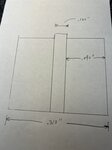
Sorry, apologies to all; should have done that early on. Please excuse the crudeness - my graphic skills are non-existent.
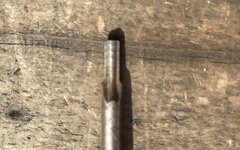
In case the drawings are not decipherable - the total tip width is .310", each "wing" is .090" wide and .058" thick, and the center "post" is .120" diameter.
 

Attachments

  • IMG_8023.jpeg
    IMG_8023.jpeg
    486.7 KB · Views: 11
  • IMG_8024.jpeg
    IMG_8024.jpeg
    477.9 KB · Views: 13

Oregon Dave

Well-known member
Joined
Sep 16, 2023
Messages
298
Sorry, should have done that early on. Please excuse the crudeness - my graphic skills are non-existent.
In case the drawings are not decipherable - the total tip width is .310", each "wing" is .090" wide and .058" thick, and the center "post" is .120" diameter.
Thanks; how far does the center "post" extend beyond the wings?
 

Old Man Roger

Well-known member
Joined
Apr 6, 2017
Messages
18,093
Location
Palm Coast Florida
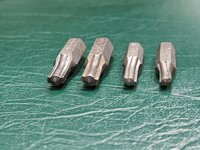
I was sorting through a box of odds and ends from a sale a couple of weeks ago and found some Apex clutch head screwdriver tips. The smaller ones are 1/4" hex drive and the bigger ones are 5/16" hex.

20250812_115042.jpg20250812_115103.jpg
I couldn’t find these on their website. Not even on the chart they have of all the types of bits. Most of the bit part numbers started in the 400 range.
 

Oregon Dave

Well-known member
Joined
Sep 16, 2023
Messages
298
Holding an item next to a coke can is the best we usually get.lol
Coke can huh Old Tool Guy. The O.P’s original post, to begin this tread, has a full-length image of the tool lying along side a ruler; for me that is a level of scale at least a notch above coke cans & quarters - although they are more for perspective. Now that the O.P. has provided actual tip dimensions: beerhippie & other clutch-head proponents; do they help point you a specific tool and/fastener, Mintgrun; any carb jets or carb jet range coming to mind?

Old Tool Guy, I am an “Old Tool Guy” also and have never seen this tool before or a fastener to use it on; but there it is, had to be produced for a purpose, seems that necessitates the production of plenty of fasteners - notwithstanding some very limited, as yet, unknown application. If us two don’t recognize it; may take older Old Tool Guys - take the images to the local VFW/American Legion etc., some WWII survivor may know it. The closest modern tool is the EXC tools for electricians; technology only 15 or so year old though, and uses a protruding square center post - and the fasteners are in the > billions; somewhat annoyingly so.

From the unrecognizability, I’m presently going to pursue the very old/certainly not modern; lot of GJ members have gained access to very old catalogs, and as yet, no identification - means obviously very rare also.
 
Last edited:

Beerhippie

Well-known member
Joined
Oct 13, 2023
Messages
10,231
Location
Far NE Oregon
Coke can huh Old Tool Guy. The O.P’s original post, to begin this tread, has a full-length image of the tool lying along side a ruler; for me that is a level of scale at least a notch above coke cans & quarters - although they are more for perspective. Now that the O.P. has provided actual tip dimensions: beerhippie & other clutch-head proponents; do they help point you a specific tool and/fastener, Mintgrun; any carb jets or carb jet range coming to mind?

Old Tool Guy, I am an “Old Tool Guy” also and have never seen this tool before or a fastener to use it on; but there it is, had to be produced for a purpose, seems that necessitates the production of plenty of fasteners - notwithstanding some very limited, as yet, unknown application. If us two don’t recognize it; may take older Old Tool Guys - take the images to the local VFW/American Legion etc., some WWII survivor may know it. The closest modern tool is the EXC tools for electricians; technology only 15 or so year old though, and uses a protruding square center post - and the fasteners are in the > billions; somewhat annoyingly so.

From the unrecognizability, I’m presently going to pursue the very old/certainly not modern; lot of GJ members have gained access to very old catalogs, and as yet, no identification - means obviously very rare also.
It sure looks like others have posted two sets of photos of the same kind of driver above.
 

Oregon Dave

Well-known member
Joined
Sep 16, 2023
Messages
298
It sure looks like others have posted two sets of photos of the same kind of driver above.
Please clarify: is “the same kind of driver above” the original image in post #1; clearly showing the tip with parallel side webs and a protruding round center post, that we now have been informed is ~⅛” dia. and extends beyond the wings, 0.052”, per the O.P. and is ~0.310” side to side/5/16”.

By “others have posted two sets of photos” are you referring to driftpin’s in post post #43 clearly show a CTA set with batwing/bowtie/butterfly-style web profile and no center extended post and WisJim’s Apex set in post #56 that show a different wing profile; but definitely no extended center post; further, in the Apex catalog at:

[chrome-extension://efaidnbmnnnibpcajpcglclefindmkaj/https://www.farnell.com/datasheets/1673891.pdf],
I could not find a reference to WisJim’s 305- series, but all of the 190- series show a batwing/bowtie/butterfly-style web and no center post.

At this stage, for me, the O.P.’s tool with parallel web/wings and the extended round center post and it’s large size is distinct and not related to the clutch-head system at this point of the investigation; hopefully clarification is ahead, but for now, in my opinion only, the O.P. has a very rare tool.
 
OP
N

nz44tool

ALLIANCE MEMBER
Joined
Nov 5, 2024
Messages
353
Location
New Britain CT
Too late to this party, but my guess would have been an old time security screw driver.
Hmmm... the center post could prevent you from using the tool to turn a slot-head screw, but the corresponding fastener (hope we see one sometime!) could still be turned by any ordinary straight-blade screwdriver. So the security would be on the wrong side of the equation, wouldn't it?
I miss the Pontiacs too, but I miss the Oldsmobiles more.;)
 

Oregon Dave

Well-known member
Joined
Sep 16, 2023
Messages
298
It is very likely a screw hold modification; a standard screwdriver blade with a ⅛”ø center post.

From the parallel sided wings/webs in the original pics & after the O.P. provided his driver’s web thickness as 0.055” a light came on; measured my large screwdrivers (a lot, am old) - most 0.055” thick; rest within 0.002” even the large Bell Sytems/old.

So, hypothetically, if you had in a situation where dropping large slot-tip screws off the tip of your screwdriver was an issue in commercial work; i.e. working 90° off a ladder/long reach overhead work, you could buy this tool and set up a jig and drill, or have an apprentice/helper drill a common ⅛”ø center hole in regular slotted screws - should hold the screw more secure & helps to explain the rarity of the fasteners.

As far the rarity of the tool; the era was during the development of the screw holding screwdriver (indicating a further recognition of ‘the dropped screw issue’; needing a better mousetrap), but prior to the development of the magnetic tip, in the early 1950’s; making both obsolete.

Not as comfortable as I would be seeing the tool in an ad/catalog/patent application; but getting there.
 
Last edited:
OP
N

nz44tool

ALLIANCE MEMBER
Joined
Nov 5, 2024
Messages
353
Location
New Britain CT
It is very likely a screw hold modification.

From the parallel sided wings/webs in the original pics & after the O.P. provided his driver’s web thickness as 0.055” a light came on; measured my large screwdrivers (a lot, am old) - most 0.055” thick; rest within 0.002” even the large Bell Sytems/old.

So, hypothetically, if you had in a situation where dropping large slot-tip screws off the tip of your screwdriver was an issue in commercial work; i.e. working 90° off a ladder/long reach overhead work, you could buy this tool and set up a jig and drill, or have an apprentice/helper drill a common ⅛”ø center hole in regular slotted screws - should hold the screw more secure & helps to explain the rarity of the fasteners.

As far the rarity of the tool; the era was during the development of the screw holding screwdriver (indicating a further recognition of ‘the dropped screw issue’; needing a better mousetrap), but prior to the development of the magnetic tip, in the early 1950’s; making both obsolete.

Not as comfortable as I would be seeing the tool in an ad/catalog/patent application; but getting there.
That's a plausible theory. Like you, I'd want to see a matching fastener or a catalog listing, or some other confirmation.
 

Leviton

Well-known member
Joined
Feb 25, 2019
Messages
947
Location
Oregon
As far the rarity of the tool; the era was during the development of the screw holding screwdriver (indicating a further recognition of ‘the dropped screw issue’; needing a better mousetrap), but prior to the development of the magnetic tip, in the early 1950’s; making both obsolete.
They've been making screw holding screwdrivers since at least the 1880's.
 
To avoid these ads, REGISTER NOW!
Top Bottom