To avoid these ads, REGISTER NOW!

Anyone use hand reamers?

T45

Well-known member
Joined
Nov 20, 2014
Messages
3,250
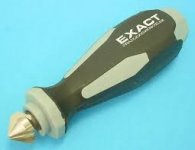
I recently had a couple of holes in soft metal that needed a de-burr ing. Curious to see if people here have different techniques of tools for this. Ive seen a variety of tools that might be useful, and tried a handful more. But ingeneral I'd like something simple to keep in my box to clean up burred edges or messed up thread holes to avoid cross threading and other problems.

Looking for any real world feedback. or Tips/tricks.
 

Attachments

  • Hand Countersink.jpg
    Hand Countersink.jpg
    10.8 KB · Views: 49
Last edited:
To avoid these ads, REGISTER NOW!

KMScott

Well-known member
Joined
Feb 14, 2012
Messages
4,637
Location
Daufuskie Island, South Carolina
I think you are talking about countersinks. Not reamers. Reamers are used for sizing hole diameters, these countersinks in this e-bay listing is what I use in my 18V hand drill or just use my fingers and spin it slowly to remove burrs. Remember 90 degree Countersinks are for Metric flat head cap screws and 82 degree countersinks are for English flat heads. Might mention that the 100 degree sinks are for aircraft rivets. OOPS, you snuck in a picture, yes that setup will work fine.

http://www.ebay.com/itm/7-Ford-Coun...818?pt=LH_DefaultDomain_0&hash=item2eda0e40e2
 
Last edited:

Alan Douglas

Well-known member
Joined
Jun 4, 2011
Messages
295
Location
Cape Cod, Mass.
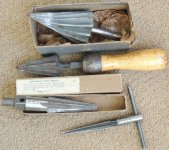
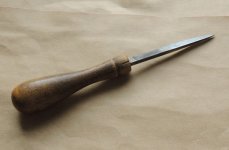
There are tapered pipe reamers but the one I have is fairly large (second one down in the photo). Besides countersinks, I use a machinist's scraper made from a triangular file.
 

Attachments

  • taper reamers.jpg
    taper reamers.jpg
    124.6 KB · Views: 49
  • scraper.JPG
    scraper.JPG
    25.9 KB · Views: 37
Last edited:

justme-

Well-known member
Joined
May 24, 2014
Messages
787
Location
Boston suburbs
Are you talking about deburring an edge or counter sinking? The tool you pictured is a countersink.
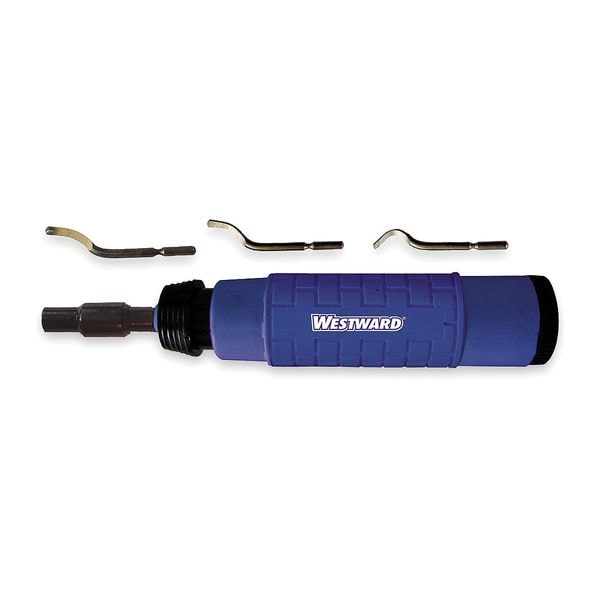
Assuming you mean deburring : I don't need to do that too often, but if it's possible I'll just use a larger side drill but gently. Also the tang of a file will work, and I have one of these by another company (in red)
4KTV1_AS01.JPG
 

OkRider

Well-known member
Joined
Apr 26, 2014
Messages
593
Location
Oklahoma
To be versitle, get a good counter sink, an edge deburring tool, triangular scraper, and some needle files, all with handles. Should cover 99.9% of the burr issues.
 
Last edited:

ihatelaramie

Well-known member
Joined
Oct 19, 2012
Messages
399
Location
Bay City, Tx
Are you talking about deburring an edge or counter sinking? The tool you pictured is a countersink.
Assuming you mean deburring : I don't need to do that too often, but if it's possible I'll just use a larger side drill but gently. Also the tang of a file will work, and I have one of these by another company (in red)
4KTV1_AS01.JPG

Shaviv, I believe, is the company that makes the red ones, that's what we have at work. Don't really work well in a threaded hole, but otherwise great for deburring sharp edges.
 

zkling

Well-known member
Joined
Jan 23, 2007
Messages
16,939
Standard practice for me is to drill, spot with a counter sink and then tap for the cleanest threads, especially if it has to fit flush with a mating part on that face.

A hand deburring tool and counter sink tool like you posted will do most anything. Even a utility knife will go pretty far in a pinch.
 
OP
T

T45

Well-known member
Joined
Nov 20, 2014
Messages
3,250
Standard practice for me is to drill, spot with a counter sink and then tap for the cleanest threads

:thumbup: In soft metal like aluminum the tap wants to walk all over. A little clean up can save the day.
 
OP
T

T45

Well-known member
Joined
Nov 20, 2014
Messages
3,250
One issue with countersinks is that many countersinks are designed for wood. The flute patterns/shape is not the best for metal. It seems most reamers are designed for metal, and so have a diferent flute design (notwithsatnding basic geometry differences).
 

epossum

Active member
Joined
Mar 18, 2014
Messages
36
Location
Hampton Roads, Virginia
4KTV1_AS01.JPG


Speaking from several decades of experience as an inside machinist (meaning I worked in a machine shop and set up, operated, and programmed machine tools, thereby making thousands of machined parts) the above-pictured tool or any of similar type is the best choice for deburring holes. It will also work on edges, but a file is usually a better choice for that type of deburring.
Note that the above tool takes a bit of getting used to. The blades are a bit fragile and will snap off if you aren't careful. A sharp blade and a light touch will usually do the job.

As for tapped holes the correct procedure is to centerdrill/spotdrill the hole to give the drill a place to start cutting. Next is to drill the hole. Then countersink the hole. That will also remove the burr around the hole if the countersink is sharp. Lastly, tap the hole. All this is usually best done on a drill press (or other machine tool) but it is possible to do it with a powered drill. The tap should be driven with a T-handle tap wrench if possible to minimize side deflection that will likely break the tap, etc.


As an item of miscellaneous info kerosene is the lubricant of choice when drilling/tapping aluminum if available. There are specialized cutting fluids available as well. In the end I usually just give the tool and/or workpiece a shot of WD-40. Works on steel and just about everything else.
 
OP
T

T45

Well-known member
Joined
Nov 20, 2014
Messages
3,250
epossum,

Thanks for that post. how do you use one of those tools?

+1 on WD-40 and using a press whenever possible.

My most recent interest in this subject came after needing to do a freehand job.
 
To avoid these ads, REGISTER NOW!

Kracin

Well-known member
Joined
Mar 25, 2013
Messages
1,666
Location
Omaha, NE
epossum,

Thanks for that post. how do you use one of those tools?

+1 on WD-40 and using a press whenever possible.

My most recent interest in this subject came after needing to do a freehand job.

you just swirl it around the opening. the blade is free and swivels, as you go around it will take off the edge.

i use those mostly for copper piping. when i do black pipe the machine does all the work deburring with the tools attached. and conduit i use a manual hand cup. although id rather have a drill attachment.
 

MotoDave

Well-known member
Joined
Jul 1, 2009
Messages
505
Location
Ventura, CA
A friend gave me the idea to make a simple handle (mine's aluminum turned on the lathe) and loctite a countersink bit in a hole in the end, extremely handy and fast for breaking the sharp edge on a drilled hole without having to change bits in the drill press or mill.
 
OP
T

T45

Well-known member
Joined
Nov 20, 2014
Messages
3,250
Wants to walk all over? Can't say I've ever had that problem. :headscrat:

Basically, the tap threads grab in some areas and this means that the the tap spins off-axis as force is applied (rotational + downward).

The odds of this seem to go up if there are burrs, sharp-hole edges (no countersink), or no proper cutting fluid.
 
Last edited:

zkling

Well-known member
Joined
Jan 23, 2007
Messages
16,939
Basically, the tap threads grab in some areas and this means that the the tap spins off-axis as force is applied (rotational + downward).

The odds of this seem to go up if there are burrs, sharp-hole edges (no countersink), or no proper cutting fluid.

Are you trying to do it all by hand? It really helps to use a machine, even just to get it started.
 

hackwelder

Well-known member
Joined
Jul 12, 2014
Messages
224
I use a tapered reamer for sheet metal projects, drill the hole slightly undersize and then ream it to remove burrs and make a rounder hole, works great (FWIW this is specifically for electronics projects that need holes for pots, switches, jacks, etc.)

704px-Taper_reamer_K-442.jpg
 
OP
T

T45

Well-known member
Joined
Nov 20, 2014
Messages
3,250
Are you trying to do it all by hand? It really helps to use a machine, even just to get it started.

Sometimes this is not always possible, but absolutely agree it's the way to go.
 

Kracin

Well-known member
Joined
Mar 25, 2013
Messages
1,666
Location
Omaha, NE
Are you talking about deburring an edge or counter sinking? The tool you pictured is a countersink.
Assuming you mean deburring : I don't need to do that too often, but if it's possible I'll just use a larger side drill but gently. Also the tang of a file will work, and I have one of these by another company (in red)
4KTV1_AS01.JPG

speaking of which. i went to the pawn shop to go look for secret santa steals. found a vargus twist a burr with 2 carbide burrs in perfect shape in it. i wasn't gonna pay much for it considering they are 15 new. 1 dollar for a good deburr tool as a backup to the pen one i have. not bad. worth the money spent if you buy new, even better when one dollar.
 

geojag

Well-known member
Joined
Oct 11, 2012
Messages
359
Location
Little Rock, AR
I have an Xcelite tapered reamer, I have used it a few times on sheetmetal and it works pretty well. I usually just use a carbide counter sink really lightly, takes the burrs off very quickly.
 

PelicanPines

ALLIANCE MEMBER
Joined
Apr 30, 2014
Messages
38,107
Location
New Jersey, USA, Earth, My own reality
Are you talking about deburring an edge or counter sinking? The tool you pictured is a countersink.
Assuming you mean deburring : I don't need to do that too often, but if it's possible I'll just use a larger side drill but gently. Also the tang of a file will work, and I have one of these by another company (in red)
4KTV1_AS01.JPG

^^^ I use one of these. Shocked as to how well it works. :pimpflash
 
To avoid these ads, REGISTER NOW!
Top Bottom