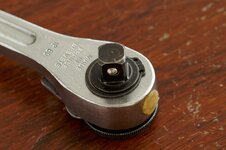
Why is that?
Is it just so the lubricant stays put for more than ten minutes?
I ask because those large flat surfaces in a ratchet mechanism see low pressures by bearing standards. On the other hand, I suppose replenishment might pose more problems than in a ball bearing, say, that neatly replenishes its own lubricant.
Yes. Obviously the relative motion inside the head happens only during ratcheting. The weight of the handle produces a moment such that the edge of the gear rubs against the top and bottom surfaces of the head. I feel as tho most ratchets are designed with clearance to the sides to prevent the gears from rubbing on the side walls. Sometimes you will see finish worn off in a ring inside the head. It often doesn’t contact as a wide flat surface, tho that’s the goal.
So, we want lubrication between the gear and the head to reduce friction, stop potential scoring or galling, as well as to prevent corrosion.
If there was a tiny oil pump inside our ratchets, we’d use the lightest weight oil we could. But we don’t. So we need a form of lubrication that holds its shape and stays in place.
Lubrication is complicated and not my speciality. But I know tack or stickiness is another attribute, besides thickness or viscosity, that engineers use to ensure the best possible performance.