To avoid these ads, REGISTER NOW!

Appropriate safety harness for this roof

MattH

Member
Joined
Mar 10, 2023
Messages
19
I'd like to install a GNSS antenna on my roof and would appreciate advice on the safest way to do this, as I've never worked on a roof before. I've attached two pictures showing the roof and the easiest access point to it. The best location for the antenna in terms of signal quality is the flat portion at the top (the edge of this is visible in the 2nd photo). The easiest point to get up onto the roof is the closest, lower section in the first image. The pitch of the lower section is 13deg from the horizontal and really doesn't seem all that steep. I haven't measured the pitch of the upper, steeper section. In addition to the installation and eventual uninstallation, I may need to perform occasional maintenance, like swapping one antenna for another.

There are roof anchors, such as this that I could nail into a joist on the top of the roof. However, I'm not sure how useful that is if I have to get up and down from the top portion without it since once I'm on the top I expect the chance of falling is pretty low: I would only go out in perfect conditions, no wind, rain, etc. and none of the equipment I need is particularly heavy or large. I imagine the most dangerous part is getting to and from that top section. One possible solution that occurred to me would be to use an adjustable-length lanyard that I could leave outside. Then, I'd only be unprotected on the first ascent during initial installation and otherwise secured. Of course, this would be attached to a body harness that I wear. However, I'm not sure if something like this exists that I can leave outside. Does it?

I suppose 2nd best option would be to have the same solution as the previous one, but not leave it outside. Then, each time I need to go up I make a first, unprotected trip with just the harness and lanyard to get locked in, then go back for needed items and perform maintenance, etc.

Are there better options? Any other thoughts? Product recommendations?

I'll hire a professional to do this if I need to. But, I'd prefer to avoid that (a) because I'd like to learn how to do this sort of thing and (b) this is not a one time installation - I will need to perform some (probably) infrequent maintenance.

By the way, I have looked up appropriate lightning safety measures and understand how to do this correctly. This question is really about how to safely walk on my roof.
 

Attachments

  • IMG_2624.small.JPG
    IMG_2624.small.JPG
    259.9 KB · Views: 183
  • IMG_2626.small.JPG
    IMG_2626.small.JPG
    291.6 KB · Views: 180
To avoid these ads, REGISTER NOW!

Jeff Ivers

Well-known member
Joined
Apr 9, 2010
Messages
2,556
Location
Oklahoma
What does a GNSS antenna look like? How much does it weigh? How awkward is it to carry (dimensions)?

Most roof pitches are expressed in inches of rise per foot of horizontal measurement. 1/12 is about 5 degrees (if I recall correctly) and is the pitch used for handicap ramps. 12/12 is 45 degrees and is very hard for most to walk on without serious safety devices. From your pictures, it is really hard to guess what your steepest pitch is.

I recently had my house reroofed and the steepest pitch I believe is 8/12. The roofers used no safety devices.

Ultimately, many jobs come down to your comfort level and confidence in doing something.
 
OP
M

MattH

Member
Joined
Mar 10, 2023
Messages
19
Hi Jeff,

I've attached pictures of both antennas I currently plan to use. Any other antennas I use would almost certainly be smaller than this.

The dimensions of the first antenna are: 343mm diameter, 93mm height, 1.3kg. For the 2nd antenna: 185mm diameter, 69mm height, 0.5kg. I'll need to carry about 30m of wound coax too and small mounting poles. The mounting poles are small (half a foot or so) and light (aluminum). And, I don't need to carry everything up in one trip.

Using that measure, 13deg is a little less than 3/12. I don't know what the pitch is of the steeper section, but I can measure it from the less steep section when I get up there. For what it's worth, the angle of the picture I took makes the roof look steeper than it is.

Yeah I've seen many roof workers use no safety precautions. I suppose I could do this, but it makes me nervous. I'm young and in good shape and I'm not particularly scared of heights, but still. The roof is high enough that if I fall I would almost certainly die.
 

Attachments

  • Antenna_Choke_Ring.jpg
    Antenna_Choke_Ring.jpg
    27.5 KB · Views: 147
  • novatel_antenna.png
    novatel_antenna.png
    66.2 KB · Views: 132

Zeke

Well-known member
Joined
Aug 13, 2009
Messages
17,176
Location
Long Beach CA, the sewer by the sea.
It has been said here that the first person up on the roof is not tied off. I would not leave any gear on the roof for an extended time.
The hazard is tripping on materials and tools. The busier the job is the more the danger. You could do well to install the anchor and go up there and tie off with as as long a tether as needed to work.

Want to be safe? Crawl. And for sure secure your ladder. Getting on and off the ladder is probably your most dangerous move. Put your materials up there from the ladder, do not carry them in one arm and climb onto the roof. And wear good shoes, not some soft sneakers. Keep your feet in line with the pitch as much as possible. You don't want to turn an ankle.
 

WisJim

Well-known member
Joined
Dec 20, 2010
Messages
2,277
Location
Menomonie, WI
Soft soled shoes with good grippy soles are my choice for climbing around on a roof. And I have 2 sets of good tower climbing harness that I got when doing work on small wind turbines and they work well for roof work too. Have someone else on the ground when you are on the roof.
 

LXCam

ALLIANCE MEMBER
Joined
Apr 23, 2013
Messages
19,121
Location
AZ
I’m only going to add one piece of advice after decades of working at elevation. If you’re scared of heights, extremely nervous or just flat out uncomfortable don’t do it, those are the guys that either get hurt or get someone hurt.
 

Firebrick43

Well-known member
Joined
May 12, 2015
Messages
14,032
Location
West central Indiana
"I'd like to install a GNSS antenna on my roof"

Are you expecting your house to move? Help me understand why one would put an a receiver antenna on the roof of their house?


When we did old barn roofing repairs we ran a very large and long rope up and over the building tied to a truck on the other side to have as a safety line until you could attach a safety point on the roof itself. Many small repairs that is all we did. The pitch and height(80') of the gamrel roofs was such that there was no other way unless you brought in a very large man lift.
 
Last edited:

ycgoat

Well-known member
Joined
Mar 28, 2020
Messages
971
Location
S.E. Va
You can get harness kit at Lowes or Homedepot that has most all you need. You want a tie off point higher than you are working if possible, but on a finished roof there is no where to tie to with out damaging the roof. If I was trying to tie off for this I Would run a rope from something extremely sturdy on the ground opposite the side of the house I am working on over the top of the roof to the work location. The kit will have a rope grab to hook the harness to the mail rope. The best way to use this as fall prevention where you set it so that the line prevents you from reaching the edge

 
OP
M

MattH

Member
Joined
Mar 10, 2023
Messages
19
Are you expecting your house to move? Help me understand why one would put an a receiver antenna on the roof of their house?

Positioning is just one of the applications of GNSS; timing is another and that's what I use it for. You can discipline a clock to the very precise atomic clocks onboard the GNSS satellites. If you're curious, you can read about this here.
 

Firebrick43

Well-known member
Joined
May 12, 2015
Messages
14,032
Location
West central Indiana
Positioning is just one of the applications of GNSS; timing is another and that's what I use it for. You can discipline a clock to the very precise atomic clocks onboard the GNSS satellites. If you're curious, you can read about this here.
What are you doing that need that precision with time?
 

manwithtools

ALLIANCE MEMBER
Joined
Aug 24, 2015
Messages
13,815
Location
Lebanon, TN
If you tie off to a vehicle parked on the opposite side, be sure you have all the keys and fobs in your control. There are old tales of farmers wife getting in the truck and driving away while they were tied to them while working on barn roofs. The end result would not be pleasant.
 

65ranchero

Well-known member
Joined
Dec 16, 2020
Messages
5,083
Location
Danville, VT left NJ forever
If you tie off to a vehicle parked on the opposite side, be sure you have all the keys and fobs in your control. There are old tales of farmers wife getting in the truck and driving away while they were tied to them while working on barn roofs. The end result would not be pleasant.
I was just going to state something very similar
 

billconner

Well-known member
Joined
Jul 20, 2021
Messages
6,964
Location
Thousand Islands NYS
My first roof as 30 squares, 8:12 pitch, hip roof. It was a little scary at first but I got very cc comfortable quickly. I did have scaffolding at edge - tall 2 story - but no other safety gear. Several years later I had to get back on it. Scared again.

I found hooking a ladder over ridge was helpful. A duck board - a wide board with 1x3 or similar cleats nailed to it and hooked over ridge would also work and protect roofing. Store on ground and install when you need it. Even put wheels on it to make it easier to push up roof.
 
OP
M

MattH

Member
Joined
Mar 10, 2023
Messages
19
What are you doing that need that precision with time?

It's more a hobby and interest than anything else. I'm an electrical engineer and like working with and developing precise frequency references and ways to measure these frequency sources. The accuracy of some of the equipment I use for other stuff (like radar development, which is what I do professionally) does benefit from stable and accurate frequency sources, but if truth be told the precision you get from a good GPSDO is still a bit overkill for most radars.
 

cvairwerks

Well-known member
Joined
Aug 12, 2016
Messages
7,210
Location
Within hearing distance of Texas Motor Speedway
Matt: I'd mount them on a crossbar on a pushup pole rather than on the roof. Much easier to set up and you don't have to mess around with anything more than a small step ladder. We run our GPS repeaters just laying on a 4 wheel cart and push them out the back of the hangar if we need to have more than 4 satellites on the receiver...whole lot easier than tugging the airplane out.
 

Leaflessshadetree

Well-known member
Joined
Aug 1, 2013
Messages
7,154
Location
Don't ask.
"I'd like to install a GNSS antenna on my roof"

Are you expecting your house to move? Help me understand why one would put an a receiver antenna on the roof of their house?


When we did old barn roofing repairs we ran a very large and long rope up and over the building tied to a truck on the other side to have as a safety line until you could attach a safety point on the roof itself. Many small repairs that is all we did. The pitch and height(80') of the gamrel roofs was such that there was no other way unless you brought in a very large man lift.
A lot of applications use fix "base stations" to improve precision/accuracy of mobile units.
 

Firebrick43

Well-known member
Joined
May 12, 2015
Messages
14,032
Location
West central Indiana
A lot of applications use fix "base stations" to improve precision/accuracy of mobile units.
Yes, I am quite aware of that, especially WAAS and RTK. I have worked for Cat and Case/IH which use these systems on their equipment to achieve sub inch accuracy. But no one builds their own base stations, nor are they placed on top of a house, they are placed on tall towers.

That is why I asked, it didn't fit with anything in the industry that I had ever seen before.

And he answered that he was an EE and it was a hobby, which satisfies my curiosity
 

P0234

Well-known member
Joined
Aug 6, 2012
Messages
3,241
Location
NoVA
I use the tie to the car method at times, it works well, but as mentioned you have to disable the car from driving off. Current roof is 3/12 and it’s almost good enough to roller skate on.
 
To avoid these ads, REGISTER NOW!

Monza Harry

Well-known member
Joined
Dec 29, 2018
Messages
1,433
Location
Windsor ON
Vehicular tie off's aren't legal in Ontario [Maybe all of Canada] If I remember correctly. If you had an purely vintage vehicle pulling the whole coil would be about as safe as one could hope for with a vehicle anchor, but it needs to be around 3600#'s for a 200# climber! So if you and your load is over 200#'s you need a truck with wheel chocks as you adding a 4G snap will lift the back of the vehicle enough to let the rear wheels slide while you go for the scariest ride of your life. @Strouty would be your man for more in depth as he is Straight Up Crazy for his at height adventures and he at least has recent American law knowledge which I Do Not [and my Canadian info is 20+ years old! I would also tie off the bottom of the ladder to prevent/reduce the likelihood of the bottom shooting out. Been There Done That! NOT FUN! Almost finished recuperating from the surgery to repair that FIASCO. Be Safe Sir! Harry
 

Chance

Well-known member
Joined
Dec 4, 2022
Messages
720
Location
New England
How I do it.
  1. extend your ladder such that you can step, not crawl, from the top of the ladder onto the roof.
  2. tie the ladder to the gutters.
  3. I installed an eye just at the edge of the flashing, that has a separate piece of flashing over it that gets bent back, that I clip my rope into with a caribiner.
  4. There's a g-absorbing lanyard leading off my harness that is webbing with stitches that sequentially break.
  5. The lanyard attaches to the rope with a clamp -- can't think of its name in the moment -- that allows me to take up slack or let out the rope. This is key. Keeping the slack down to 3 feet means you can't really get in trouble.
  6. going up to clip in is not risky. Its using tools or otherwise reaching when working that is the the real danger. You're moving your gear from one place to another, and you reach just a tad too far and start slipping.
  7. if your roof is very steep, you can make a chicken-ladder thing from a board that you hang from the peak to give you some cleats to brace your feet against.
If you get nervous about heights, you might try a few climbing lessons at a place with an indoor climbing wall.
 

428PI

Well-known member
Joined
Jul 14, 2018
Messages
1,976
Location
Peabody, KS
I was worried about working on my shed roof replacing some panels without a harness so hired it done. The roofers didn't use any harness. I've been up there numerous times trying to fix small leaks when my wife helps me.
 

gizardlizard

Well-known member
Joined
Aug 29, 2019
Messages
726
Location
Madison, WI
Not trying to be condescending but if you’re worried about walking a 3/12 pitch roof, you probably shouldn’t be up there. Like others said, it comes with experience. I can comfortably walk an 8/12 pitch but my roofing buddy walks 10/12 where I would have to be tied off. 3/12 is very flat to me.
 

Chance

Well-known member
Joined
Dec 4, 2022
Messages
720
Location
New England
I was worried about working on my shed roof replacing some panels without a harness so hired it done. The roofers didn't use any harness. I've been up there numerous times trying to fix small leaks when my wife helps me.
I know roofers don't use harnesses. On the other hand when I was about 17 I was walking my dog past a house where the guys were roofing and was looking at how they were doing it. When suddenly this one guy slips, rolls off the eave head-first, and manages somehow to grab the edge of the gutter as his arm goes by it, jerking him around and swinging his body sideways and he lands partially on his feet and partially on a bush on his back. He broke his leg (or foot?) even at that. After seeing that, I decided I would alway use safety gear of many kinds.
 
Last edited:

Tostal

Well-known member
Joined
Feb 1, 2020
Messages
893
Location
The Emerald Isle
OP, you could get an attachment to convert a regular ladder into a roof ladder, the wheeled side is pushed up the roof surface without causing any damage, then the ladder is flipped over so that the hooked section locates behind the ridge preventing any risk of slippage.
Quick and easy to position, reposition as needed and then remove.
For extra safety, you could tie yourself off to the ladder.
The advantages of using a roof ladder is that you are not relying solely on your footwear being able to grip a sloping surface for balance, (so degree of slope doesn't really matter) and you always have something to hold onto (the ladder rungs).

extendable-roof-ladder-july2021-1-551x551.jpg
T~
 

nadogail

Well-known member
Joined
Jan 23, 2009
Messages
31,948
Location
Coronado, CA
I call a Professional Roofer, they have a ton of insurance and are very aware of the best ways to stay alive,
 

428PI

Well-known member
Joined
Jul 14, 2018
Messages
1,976
Location
Peabody, KS
If you're worried about climbing on your rooftop, just remember that falls are the #1 killer at work in North America.
I grew up in an area where the youth groups in church did lots of volunteer work at camps, etc. and many times they would do roof work. I don't think that's a wise decision at all. I was even concerned about having my own kids on my own roof. I don't think I could live with myself if something happened.
 

duneslider

Well-known member
Joined
Jan 20, 2013
Messages
2,261
Location
Riverton, Utah
It is completely normal to tie off to a car or other solidly secure something. The roofer that did my house (14/12) in the winter, tied off to his truck and threw the rope over and then climbed up and attached some tie off points and dropped ropes down. Then they unhooked from the truck.

Nothing wrong with tying off to something secure for a one time roof climb and it may not make sense to put in a permanent roof anchor if you may not ever go up there again.
 

Kpaige

Well-known member
Joined
Aug 12, 2015
Messages
751
Location
Big Lake Minnesota
Well looks like a pretty easy pitch but yes for most not comfortable
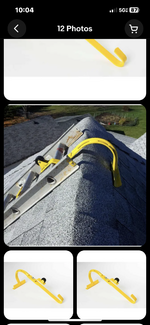
Get one of these for your ladder
Roof hook, hook ladder, etc

IMG_3638.png
 

captaindiode

Well-known member
Joined
Jul 8, 2013
Messages
371
Location
NC
What does a GNSS antenna look like? How much does it weigh? How awkward is it to carry (dimensions)?

Most roof pitches are expressed in inches of rise per foot of horizontal measurement. 1/12 is about 5 degrees (if I recall correctly) and is the pitch used for handicap ramps. 12/12 is 45 degrees and is very hard for most to walk on without serious safety devices. From your pictures, it is really hard to guess what your steepest pitch is.

I recently had my house reroofed and the steepest pitch I believe is 8/12. The roofers used no safety devices.

Ultimately, many jobs come down to your comfort level and confidence in doing something.
 

Stelzer

Well-known member
Joined
Mar 14, 2022
Messages
448
Location
Portland, OR
I make my living on roofs, painting, roof cleaning & gutter cleaning, then Christmas Light Installations during the winter. I'll try my best to give you the safest way possible.

Make sure to have a capable ladder and get some ladder standoffs for it, then place it to where you climb directly to the roof. Most accidents are caused in transition to & from ladders/roofs, and setting a ladder up on a gutter is a recipe for disaster. I've known painters who've had very serious accidents relying on gutters to stabilize the ladder, so I'd avoid it if I were you.

You're not climbing on the roof yet; merely positioning the ladder and climbing up it so it'll be an easy transition. If you have an extra 32' ladder, split it in half and use the half with the feet, along with a roof hook attached to that ladder, to roll it up to the peak, then flip it over so the wheel is up and the hook straddles the peak. This plan only works if you have 16' or less from the ladder to the peak. If you have more than that, my solution would depend upon how much you want to spend and how comfortable you are at heights.

90% of Christmas Light installs are done from roofs, in the pouring rain, on high houses with steep pitches, so we've tried all the goodies. I'll give you suggestions and you can take it from there.

If you have the funds, you can invest in some Cougar Paws, which are roofing shoes that give you traction better than any shoe can offer. If not, invest in some Merrell shoes or something similar with Vibram soles. They are the next best thing, but are still a far cry from Cougar Paws.

If your distance is more than the span of your ladder, the 2 safest choices would be to either get some Pitch Hoppers or the Goat steep assist.

Once you're at the peak, you'll be able to installs some roof anchors in targeted areas. This will allow you to to have a solid system after you buy a harness, shock absorbing lanyard, rope, and rope grab. HD's in my area sell them in a 5 gal bucket like this.

The biggest snag in this entire thing will be that unless you buy the Goat Steep Assist, there will always be the initial ascent and final descent where you aren't rigged in, which is why I suggested the ladder hooks as well as the Pitch Hoppers. Pitch Hoppers are magical little time savers, but they still come with the risk of not being properly tied into a system.

After some rough math, you'll likely notice that the initial investment, (ultimately depending upon your choices), will cost anywhere from $900-$2,k+. How many times could you pay someone to do this for you before you saw a return on your investment? Only you can answer that. I applaud your drive and willingness to learn though. I've spent the last decade learning how to safely climb 80-90' up the trees on my property to prune them and remove dangerous limbs.

Go slow, be safe, triple check everything, have someone with you, and go no higher than you're comfortable with. No shame in changing your mind halfway up. Good luck.
 

Kpaige

Well-known member
Joined
Aug 12, 2015
Messages
751
Location
Big Lake Minnesota
I make my living on roofs, painting, roof cleaning & gutter cleaning, then Christmas Light Installations during the winter. I'll try my best to give you the safest way possible.

Make sure to have a capable ladder and get some ladder standoffs for it, then place it to where you climb directly to the roof. Most accidents are caused in transition to & from ladders/roofs, and setting a ladder up on a gutter is a recipe for disaster. I've known painters who've had very serious accidents relying on gutters to stabilize the ladder, so I'd avoid it if I were you.

You're not climbing on the roof yet; merely positioning the ladder and climbing up it so it'll be an easy transition. If you have an extra 32' ladder, split it in half and use the half with the feet, along with a roof hook attached to that ladder, to roll it up to the peak, then flip it over so the wheel is up and the hook straddles the peak. This plan only works if you have 16' or less from the ladder to the peak. If you have more than that, my solution would depend upon how much you want to spend and how comfortable you are at heights.

90% of Christmas Light installs are done from roofs, in the pouring rain, on high houses with steep pitches, so we've tried all the goodies. I'll give you suggestions and you can take it from there.

If you have the funds, you can invest in some Cougar Paws, which are roofing shoes that give you traction better than any shoe can offer. If not, invest in some Merrell shoes or something similar with Vibram soles. They are the next best thing, but are still a far cry from Cougar Paws.

If your distance is more than the span of your ladder, the 2 safest choices would be to either get some Pitch Hoppers or the Goat steep assist.

Once you're at the peak, you'll be able to installs some roof anchors in targeted areas. This will allow you to to have a solid system after you buy a harness, shock absorbing lanyard, rope, and rope grab. HD's in my area sell them in a 5 gal bucket like this.

The biggest snag in this entire thing will be that unless you buy the Goat Steep Assist, there will always be the initial ascent and final descent where you aren't rigged in, which is why I suggested the ladder hooks as well as the Pitch Hoppers. Pitch Hoppers are magical little time savers, but they still come with the risk of not being properly tied into a system.

After some rough math, you'll likely notice that the initial investment, (ultimately depending upon your choices), will cost anywhere from $900-$2,k+. How many times could you pay someone to do this for you before you saw a return on your investment? Only you can answer that. I applaud your drive and willingness to learn though. I've spent the last decade learning how to safely climb 80-90' up the trees on my property to prune them and remove dangerous limbs.

Go slow, be safe, triple check everything, have someone with you, and go no higher than you're comfortable with. No shame in changing your mind halfway up. Good luck.
Lol cougar paws…. I was one of the original prototype testers of those. My crew had about 10 pairs each all with different sole material. Even spikes for running up and down old cedar. Awesome roof shoes.
 

Stelzer

Well-known member
Joined
Mar 14, 2022
Messages
448
Location
Portland, OR
Lol cougar paws…. I was one of the original prototype testers of those. My crew had about 10 pairs each all with different sole material. Even spikes for running up and down old cedar. Awesome roof shoes.
I've been using them since they came out, at least around here, (mid-to-late 90's). Remember the magnetic ones? Great for metal roofs. Can't find em anymore though.
 

Kpaige

Well-known member
Joined
Aug 12, 2015
Messages
751
Location
Big Lake Minnesota
Never had the magnet ones would not have worked well on the copper we installed lol. Yes mid 90,s is when they came out. We tested sole materials for what worked best on different slopes, different materials and how well they held up.
 

mike93lx

ALLIANCE MEMBER
Joined
Dec 9, 2013
Messages
37,501
Location
Richmond, VA
Once you're at the peak, you'll be able to installs some roof anchors in targeted areas. This will allow you to to have a solid system after you buy a harness, shock absorbing lanyard, rope, and rope grab. HD's in my area sell them in a 5 gal bucket like this.
Anyone getting a harness should understand the risk of suspension trauma and have a ******** their rig to prevent it.
 
To avoid these ads, REGISTER NOW!
Top Bottom