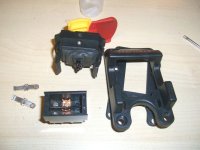
I do believe switches on large loads arcs especially on motors that deal with magnetic fields and flux and inductions, arcs and breaks down.... I think there are techniques that suppress these arcing....
You are right -- an induction motor looks like, well, an inductor to the power source. A key property of an inductor is that it tends to oppose changes in current flowing through it. So when you open a switch and cut the supply of current to the motor, the inductance of the motor winding tries to keep the current flowing anyway by inducing a high voltage across the now-open switch.
(The voltage comes from the collapsing magnetic field in the windings, which induces a voltage that tends to oppose the change in field. See
https://en.wikipedia.org/wiki/Lenz%27s_law for a description of Lenz's law, which is what applies here.)
The result is that once the switch opens, it sees a very large voltage across it from the inductive "kick back". Absent any protective measures, this can create a plasma arc across the opening contacts, which does them no good at all.

One counter measure is to use an MOV to absorb the induced voltage and limit it to a level that will not cause an arc.
Another method is to use a series resistor-capacitor network, called a "snubber", across the switch terminals. The capacitor acts to keep the current flowing at the instant the switch is opened. This eliminates the mechanism that caused the inductive voltage spike. But the price for this is that the inductor and the capacitor then form a resonant circuit that "rings". So you need to add a resistor to absorb the energy and stop the ringing. (See
https://en.wikipedia.org/wiki/Snubber for a brief discussion of snubbers.)
Of course, you don't see MOVs or RC snubbers in tablesaws. Those components add cost and can fail (in some cases spectacularly!), so the manufacturer just specifies a fairly beefy switch and figures that at the end of the day the switch is a consumable that will get replaced when it wears out.