To avoid these ads, REGISTER NOW!

arcing inside a tablesaw switch

dogdog

Well-known member
Joined
Nov 15, 2011
Messages
12,711
.....arcing inside a tablesaw switch

anyone knows any good way of preventing this?

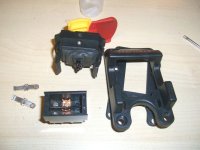
the Craftman 10" table saw I have won't turn off... so I disassemble the switch (DPST) found one of the rocker contacts fused with each other... both contacts are pretty blacken with arc soot and pitted.

Any good recommendation or just those greese noalox compound ?...
 
To avoid these ads, REGISTER NOW!

gregtwojeeps

Well-known member
Joined
Jul 30, 2013
Messages
5,096
Location
Ky
Bad switches on power tools should kept in good order for safety reasons, just replace it for probably $20.00. I have old Makita, Dewalt's, Hitachi tools and I ordered their replacement triggers at Toolpartsdirect ... Just need the brand name of the tool and model # .... or go to Craftsman Direct parts would be my first choice.

http://www.searspartsdirect.com/partsdirect/brands/Craftsman-Parts


http://www.toolpartsdirect.com/?utm_source=bing&utm_term=toolpartsdirect%20com&utm_campaign=TPD-Brand&utm_medium=cpc&utm_content=55kedX4y_pcrid_7871623192_pkw_toolpartsdirect%20com_pmt_be_pdv_c
 
Last edited:

zmaxmotorsports

Well-known member
Joined
Jan 11, 2013
Messages
11,948
Location
South of omaha
OP
D

dogdog

Well-known member
Joined
Nov 15, 2011
Messages
12,711
..... trying to understand what is causing the arcing...
 

abk241

Well-known member
Joined
Aug 22, 2014
Messages
310
Location
SF Bay Area, California
.....arcing inside a tablesaw switch

anyone knows any good way of preventing this?
When you replace the switch the arcing should go away.
As for preventing this from happening again....you could take some current readings on the motor and see if it isn't drawing too much for the switch to safely handle.
 

gregtwojeeps

Well-known member
Joined
Jul 30, 2013
Messages
5,096
Location
Ky
..... trying to understand what is causing the arcing...


th


As you can see in the pic there are metal "arms" that have the actual contacts on them. Over time these arms will lose tension from normal wear and tear which means the contact will not engage to the other contact fast enough or apply enough pressure..to prevent some arcing when it closes. The more engagements, the more arcs = more heat = faster degrading of the switch parts.

Unless your saw motor ( assuming it is 240 V. ? ) has a bad motor ( or too high of current draw) and is locked up (locked rotor condition) , then I think the switch that controls your saw's power, just gave up the ghost. JMO
 

Norcal

Well-known member
Joined
Mar 16, 2008
Messages
13,752
Craftsman power tools are just consumer products built to a price point, the switches are just good enough to get by, so some will last the life of the tool & some wont, this also applies to other tool brands as well, I don't want to turn this into a Sears bashing thread.

To the OP, just replace the switch & you should be good to go.
 
OP
D

dogdog

Well-known member
Joined
Nov 15, 2011
Messages
12,711
What kind of switch? I've seen too many household switches on power tools. Why DPST? Is this a 240v motor?

Yea weird dunno why it's DPST but it is. Pic on bottom... have to look up the circuit diagram first... just the garage always seems so far away when you are lazy.


When you replace the switch the arcing should go away.
As for preventing this from happening again....you could take some current readings on the motor and see if it isn't drawing too much for the switch to safely handle.

Yup for $7 probably + $20 s&h I will probably order one for stand by or something....but more interested about the arcing... I know the switch was defective as soon as I find one of the rocker contacts stick onto the poles. the plug is on an fused 13AMP retractable extension, never tripped the fuse at the retractable extension cords. but I never measure the amps it draws at start/stop or running. I am suspecting the arcing is probably either during start or stopping The switch have a rating of 120 / 240 20AMP.


Craftsman power tools are just consumer products built to a price point, the switches are just good enough to get by, so some will last the life of the tool & some wont, this also applies to other tool brands as well, I don't want to turn this into a Sears bashing thread.

To the OP, just replace the switch & you should be good to go.


No this was not originally intended bash sears, this is a pretty nice saw... I can cut down to with 1/10" accuracy, only complain is that it being a contractor saw from earlier models it doesn't have a slide so I can't build a sled for it....... the switch is not that expensive, but still, I would like to know if it is a known cause of arcing on contact on these type of switches for motors.


http://www.searspartsdirect.com/par...SUP6yXF-Lct1nNRUDNe_DtESoko0Hz2A36hoCAS3w_wcB
 

Attachments

  • Assembly 1.jpg
    Assembly 1.jpg
    91 KB · Views: 45
  • Assembly 2.jpg
    Assembly 2.jpg
    49.4 KB · Views: 36
OP
D

dogdog

Well-known member
Joined
Nov 15, 2011
Messages
12,711
the pics of the switch are after it's cleaned up as much as possible in the ultrasonic cleaner and soft brass brush... that is why it looked cleaned. before this was burn marks and dried greases of sort.
 
OP
D

dogdog

Well-known member
Joined
Nov 15, 2011
Messages
12,711
th


As you can see in the pic there are metal "arms" that have the actual contacts on them. Over time these arms will lose tension from normal wear and tear which means the contact will not engage to the other contact fast enough or apply enough pressure..to prevent some arcing when it closes. The more engagements, the more arcs = more heat = faster degrading of the switch parts.

Unless your saw motor ( assuming it is 240 V. ? ) has a bad motor ( or too high of current draw) and is locked up (locked rotor condition) , then I think the switch that controls your saw's power, just gave up the ghost. JMO

Thanks
Not too sure if motor is bad, it spins and screams....
 

nadogail

Well-known member
Joined
Jan 23, 2009
Messages
31,907
Location
Coronado, CA
Contacts opened and closed under load all arc, that is thier nature.

Sometimes they will last for years, other times not so much.

IMHO, just replace the switch and move on to your next problem.
 

ishiboo

Well-known member
Joined
Oct 27, 2010
Messages
9,481
Location
Oshkosh, WI
Yeah... basically all mechanical switches arc as they make/break. Used in explosive environments, switches/relays/fuses/etc. have to be specifically sealed - "explosion proof" in industrial environments, "ignition protected" for marine stuff, etc.

Used in the wrong application, as the springs and contacts themselves wear, etc... the arcing gets worse which erodes the contacts and makes the arcing even worse.
 

chops101

Well-known member
Joined
Jul 15, 2013
Messages
554
Location
S. FL
..... trying to understand what is causing the arcing...

As contacts make and break, carbon residue builds up over time.
The more carbon buildup, the more resistance, the more heat generated.
Over time, it will fail.

Carbon can be cleaned off with a pencil eraser if the contacts are not heat distorted. Sometimes contacts are flashed with gold - the ultimate conductor. If you sand the contact, you remove the gold flash and ultimately decrease the life cycle of the contact.
 
To avoid these ads, REGISTER NOW!

gregtwojeeps

Well-known member
Joined
Jul 30, 2013
Messages
5,096
Location
Ky
Thanks
Not too sure if motor is bad, it spins and screams....

Screams ???? Could be failing shaft bearings/bushings or something rubbing or loose somewhere. Check it out guy, big table saws make serious weapons when they fly apart while running wide open...

Do an amp draw on the saw while it is running to see if it is in the amp draw range, that is (maybe) stamped on the motor's nameplate. jmo

Here is my gizmo I made many years ago to check appliances/equipment amp draw while they are running easier. Make or use one of my gizmo's at your own risk. .
 
Last edited:
OP
D

dogdog

Well-known member
Joined
Nov 15, 2011
Messages
12,711
going to order a back up set... thx all.


in the mean time... that switch was cleaned, noalox, seems to be working better now... the motor is more smooth turning on, going to open it up later on after few use and see if that noalox helps...... Also going to check out the MOV suggestions... but that box is a little tight might not have room for MOVs...
 

sberry

Banned
Joined
Jun 18, 2005
Messages
35,747
Location
Brethren, Michigan
Switch contacts cannot be repaired. You need to replace the switch. I suspect the wrong type or rating on the switch was the cause.

we figure it worked for decades,, came from the factory with the wrong part? It fuggin broke, likely doesn't need to be re engineered.
 

nehog

Well-known member
Joined
Jan 2, 2010
Messages
7,935
Location
Jaffrey, NH
we figure it worked for decades,, came from the factory with the wrong part? It fuggin broke, likely doesn't need to be re engineered.

Well, if it worked for decades, then the original might well be OK. But I'm of the school that it should have worked forever! :thumbup:
 
OP
D

dogdog

Well-known member
Joined
Nov 15, 2011
Messages
12,711
Well, if it worked for decades, then the original might well be OK. But I'm of the school that it should have worked forever! :thumbup:

I do believe switches on large loads arcs especially on motors that deal with magnetic fields and flux and inductions, arcs and breaks down.... I think there are techniques that suppress these arcing.... I just don't remember them after 30 years since I learned them.... something with condensers / diodes or resistors. Was hoping for a EE scientist that happens to like tools on this forum might be able to explain... the closest I get is the MOV... link which is good start.. in the mean time I'll get a spare switch. But the point of this post is not really about it broke where to find replacements.... more of wanted to know why are these arcing , what techniques out there that are uses to suppress these arcing
 

iron block

Well-known member
Joined
Jun 22, 2015
Messages
261
Location
Bay Area, CA
I do believe switches on large loads arcs especially on motors that deal with magnetic fields and flux and inductions, arcs and breaks down.... I think there are techniques that suppress these arcing....

You are right -- an induction motor looks like, well, an inductor to the power source. A key property of an inductor is that it tends to oppose changes in current flowing through it. So when you open a switch and cut the supply of current to the motor, the inductance of the motor winding tries to keep the current flowing anyway by inducing a high voltage across the now-open switch.

(The voltage comes from the collapsing magnetic field in the windings, which induces a voltage that tends to oppose the change in field. See https://en.wikipedia.org/wiki/Lenz%27s_law for a description of Lenz's law, which is what applies here.)

The result is that once the switch opens, it sees a very large voltage across it from the inductive "kick back". Absent any protective measures, this can create a plasma arc across the opening contacts, which does them no good at all. :(

One counter measure is to use an MOV to absorb the induced voltage and limit it to a level that will not cause an arc.

Another method is to use a series resistor-capacitor network, called a "snubber", across the switch terminals. The capacitor acts to keep the current flowing at the instant the switch is opened. This eliminates the mechanism that caused the inductive voltage spike. But the price for this is that the inductor and the capacitor then form a resonant circuit that "rings". So you need to add a resistor to absorb the energy and stop the ringing. (See https://en.wikipedia.org/wiki/Snubber for a brief discussion of snubbers.)

Of course, you don't see MOVs or RC snubbers in tablesaws. Those components add cost and can fail (in some cases spectacularly!), so the manufacturer just specifies a fairly beefy switch and figures that at the end of the day the switch is a consumable that will get replaced when it wears out. :dunno:
 

theoldwizard1

Well-known member
Joined
Feb 22, 2011
Messages
43,077
Location
SE MI
..... trying to understand what is causing the arcing...

Contacts opened and closed under load all arc, that is thier nature.

IMHO, just replace the switch and move on to your next problem.

Yeah... basically all mechanical switches arc as they make/break. Used in explosive environments, switches/relays/fuses/etc. have to be specifically sealed - "explosion proof" in industrial environments, "ignition protected" for marine stuff, etc.
The reason they arc is that electricity "jumps" the gap between the contacts, especially on high current item, when going from Off to On. The electricity just wants to "keep flowing". (Electricity is moving electrons. Electrons have mass. Once an item that has mass is in motion, it wants to stay in motion.)

Even on very low current switches, the contacts "bounce" (make and break dozens of times before "settling down" to either Off or On).

I'm not sure how they make "explosion proof" or "ignition proof" switch, but if you put a gob of dielectric grease between the contacts it will greatly reduce the arcing.
 
Last edited:

sberry

Banned
Joined
Jun 18, 2005
Messages
35,747
Location
Brethren, Michigan
The duty cycle is now low, a common switch works and I have been switching my paint fan of 1 hp for years on a 49 cent switch. Its on a recept. Doesn't bother me so much with a cord and plug appliance.
 

Radix2

Well-known member
Joined
May 28, 2014
Messages
1,853
Location
the thumb!, MI
Eventually the plating on the contacts is eroded by the arcing and the switch wears out - you can clean the contacts, but usually the underlying metal will pit and fail much sooner.
 
To avoid these ads, REGISTER NOW!
Top Bottom