CAT isn’t a tool manufacturer that is bidding government contracts. They are an equipment manufacturer bidding government contracts. They do their own fleecing with different products.Customers (including large corporate and dare I say government) are pretty savvy about that stuff and company's usually don't last long with those practices


You are using an out of date browser. It may not display this or other websites correctly.
You should upgrade or use an alternative browser.
You should upgrade or use an alternative browser.
Are CAT sockets still Snap On/Williams?
- Thread starter 11thfinger
- Start date
For anyone unsure about this, I have both CAT and Snap On in a variety of tools: sockets, Torx bit sockets, hex bit sockets, etc. They are identical in function, they are identical in any measurement or tolerance I can measure.
Where the CAT and Snap On tools differ is in the chrome finish. The Snap On is a higher polish chrome, which surely costs more to do in and of itself.
The Williams sockets are different from the CAT / Snap On. Many of the other tools in the CAT line - screwdrivers, combination wrenches, etc are Williams variants. There is a whole CAT thread about this, which I think this discussion should be merged into.
 www.garagejournal.com
Where the CAT and Snap On tools differ is in the chrome finish. The Snap On is a higher polish chrome, which surely costs more to do in and of itself.
The Williams sockets are different from the CAT / Snap On. Many of the other tools in the CAT line - screwdrivers, combination wrenches, etc are Williams variants. There is a whole CAT thread about this, which I think this discussion should be merged into.
CAT tools
the Inspection Mirror came in Lisle packaging and was marked as Made in China good grief. American-made 2-1/4" diameter inspection mirror mounted on hexagonal shaft so it won't get knocked out of position when you bump it into the exhaust pipe $6.00 from Cripe Distributing. Be sure to "sign...
www.garagejournal.com
alinc100
Well-known member
Might represent the cost , but not the value. If you spend an hour swapping out a broken socket at the CAT dealer ,you've lost an hour of production working. Some of Snap On's value is them catering to a professional with regular visits/service.I'm not. It just goes to show how much margin Snap-On has in their pricing. The Cat pricing reflects the true value of the sockets.
JerseyBoatBuilder
Well-known member
That thread is actually resourceful and useful. Please do not merge this thread with that one, It will only screw it up with a bunch of dribble assumptions, some that have been addressed 10+ years a go.For anyone unsure about this, I have both CAT and Snap On in a variety of tools: sockets, Torx bit sockets, hex bit sockets, etc. They are identical in function, they are identical in any measurement or tolerance I can measure.
Where the CAT and Snap On tools differ is in the chrome finish. The Snap On is a higher polish chrome, which surely costs more to do in and of itself.
The Williams sockets are different from the CAT / Snap On. Many of the other tools in the CAT line - screwdrivers, combination wrenches, etc are Williams variants. There is a whole CAT thread about this, which I think this discussion should be merged into.
CAT tools
the Inspection Mirror came in Lisle packaging and was marked as Made in China good grief. American-made 2-1/4" diameter inspection mirror mounted on hexagonal shaft so it won't get knocked out of position when you bump it into the exhaust pipe $6.00 from Cripe Distributing. Be sure to "sign...
51dueller
Well-known member
Snap On has buy one get one free monthly deals on their sockets. They can give away a whole socket set and still make money on the set you buy.
They sell them to students at 50% (same price as BOGO) so of course they make money at that price. They have no need to give them away.Snap On has buy one get one free monthly deals on their sockets. They can give away a whole socket set and still make money on the set you buy.
Occam's Razor... Cat and Snap-On have a contract for Snap-On to manufacture tools with Cat rollmarks from the Snap-On family of brands. To think Snap-On would have Williams manufacture Cat sockets and then go to the extra expense of having special tooling to make the Cat branded sockets look identical to the Snap-On, minus the Cat rollmark, is ludicrous.
For some reason, you seem obsessed with the thought that Cat sockets must be anything other than genuine Snap-On, minus the Cat rollmark. It's been stated by numerous Snap-On dealers that the sockets are genuine Snap-On. Also, why would the dealers be raising so much hell about the price of the Cat sockets, if they weren't genuine Snap-On?
This is just more evidence of Snap-On's grossly inflated pricing for their labeled tools. The Cat price is comparable to other premium brand sockets.
For some reason you seem obsessed with the thought that Cat sockets must be genuine Snapon, minus the Snapon roll mark.
Nobody is saying that Snapon has special tooling made for the CAT sockets, just that they are each made to different levels of quality. Occam’s razor: CAT sockets cost less because their manufacturing process is less costly. Pretty simple, really.
Also - you keep citing these nebulous sources to support your point:
It's been stated by numerous Snap-On dealers that the sockets are genuine Snap-On. Also, why would the dealers be raising so much hell about the price of the Cat sockets, if they weren't genuine Snap-On?
Who are these Snapon dealers that say CAT sockets are the same? Who are these dealers that are raising hell about these sockets? It’s a little odd that a dealer would tell a potential customer “These sockets? you can get these exact same sockets for a fraction of the price at your local Cat dealer. I’m mad as hell about it, because it’s such a good deal and I can’t compete with their prices”. Doesn’t seem like good business practice to tell your customers they can get the products you’re selling for much less money.
Earlier you referred to several articles that talked about Snapon pricing:
I've read numerous articles from Snap-On insiders claiming that their retail pricing reflects what they charge the US Government and therefore, they have to keep retail prices similar to avoid government scrutiny.
I asked you to cite one of these articles, which should be a simple thing to do, but you ignored my request. Maybe this time you’ll back up your claims with some of the evidence you claim to have seen.
I have no stake in this - I don’t own any Snapon sockets and I plan on ordering some Cat sockets, in fact. I just don’t think they are made to the same specs. I’d love to settle this debate one way or another, but the fact remains — none of us know for sure. We’re all just making the best guess we can.
ihateminimumwage
Well-known member
- Joined
- Jan 26, 2012
- Messages
- 3,962
Call it 20 years ago. 10 years back this exact discussion was still on this site, with the same silly justifications on why Snap-on branded sockets are magically different.No one ten years ago was cross-shopping these brands and no one was having ten thousand freaking page discussions on their similarities and origins.
My 1/4" deep Williams socket set included a Snap-on socket on the rail like 14 years ago. Posted it on here and obviously nothing has changed anyone's silly opinions since.
Ohio Andy
Well-known member
I have wondered about that thanks. I expected what you said to be true as well. And I do not expect her to attempt to become a mechanic. Although one of our members here is a paramedic and a mechanic and he maintains the vehicles if I remember correctly. But that would not be my daughter. She finished her EMS training now and tends to finish her paramedic training. And after that I don't know if she will go for fireman training. Doubt if she will go for mechanic as well.No. Automotive or trade school students. And I don’t think taking one automotive class in your community college qualifies you. Pretty sure you need to be seeking some sort of certification.
CHI_Tool&Die
Well-known member
Outside of the fact that machine shops do have different machines for different capabilities everything you have just said is completely incorrect.I’m shocked that you of all people don’t get this. They probably run the Williams stuff on older machines, or as the tools wear.
We know Williams aren’t as hard or dimensionally identical to snap on. We’ve seen Williams screwdrivers with slightly crooked handles. Whatever machine does that is probably just past its prime. Snap on switched to instinct handles but kept the old hard handle line for Williams.
Every machine shop I’ve ever been in had a range of machines with different capabilities.
Why on earth would Snap on offer their tools at deep discounts under other brand names? That would be like thinking you can buy a VW and really get a 911. No one would ever buy a Porsche again.
I feel like I’m telling a kid there is no Santa. Hey, if you have Williams and think you’ve got Snap on, bless your heart. I’m going to get into my POS dodge Durango which is really a Mercedes GL450. Exact same vehicle.
You remind me a lot of the junior engineers I interact with. You know, the ones that washout of the industry because they were too high off their own supply and crash into a wall of reality midway through their first project.
Sockets aren’t manufactured in sets. They are manufactured as single items and sorted into sets possibly by hand. Williams mixed in with snap on sets only proves both are made in the same factory, and we already know that.Call it 20 years ago. 10 years back this exact discussion was still on this site, with the same silly justifications on why Snap-on branded sockets are magically different.
My 1/4" deep Williams socket set included a Snap-on socket on the rail like 14 years ago. Posted it on here and obviously nothing has changed anyone's silly opinions since.
I’m not trying to rain on anyone’s parade. I think Williams sockets are great and should be the GJ default. I think you guys are right that smoking gun evidence is scant.
Sooner or later, someone will measure ODs with a mic to 3 decimal places and we will see while snap on and Williams get initially shaped on the same machines, subsequent polishing steps are different. Snap on sockets will be smaller. Remember, the surface finish of a torsional member matters. Smoother is stronger. We’ve seen this data, but then people argue its manufacturing variation. So we’d need to see more than one or 2 sets measured.
Hardness testing will be next, followed by strength testing. Lastly, Id like to see someone measure the broach. Could be as easy as measuring the rotation of a hex inside the socket. I suspect the difference will be tiny to non-existent, but consistent.
As I’ve said all along, factories can control quality of items they produce.
Here’s the better case to make- instead of endlessly arguing whether or not they are good because they are identical to Snap, ask instead if they are good enough. How do Williams compare to other sockets in their price range? They cost more than Icon, but are otherwise similar in form factor.
Just because I support american (including Canada) manufacturing whenever possible, I would choose Williams over Icon every day all day. If I was looking for high perfomance, I’d try to get Snap on off eBay. Failing that, I’d go for Koken or Hazet.
CAT could be identical to Williams and that would be my assumption. There’s absolutely no reason why Snap on would sell their best products under another brand name for less. That just doesn’t pass the sniff test.
Any reference to me being young I take as a compliment!You remind me a lot of the junior engineers I interact with. You know, the ones that washout of the industry because they were too high off their own supply and crash into a wall of reality midway through their first project.
Sorry if rubbed you the wrong way.
rust in the eye
Well-known member
I disagree and here's why; Actual manufacturers that manage to sell at retail have tremendous profit margins. What does it really cost Snap-on to make a socket? More than others certainly given US labor and better materials but still pennies. Rolling a private label on your usual product for bulk orders would seem a simple and still profitable choice. This discussion proves plausible deniability of the facts if so.Cat sockets, in fact. I just don’t think they are made to the same specs. I’d love to settle this debate one way or another, but the fact remains — none of us know for sure. We’re all just making the best guess we can.
Does it make sense to have a separate line or to interrupt production for these short(comparatively)runs? Using a less expensive steel doesn't seem to make sense either as they no doubt have very good pricing for their "usual", buying small quantities of another may cost as much or more. Corners could be cut with heat treating, etc. but again that would seem an interuption in the workflow of a well oiled machine.
All my thoughts, of course, are nothing more than conjecture but make sense to this guy.
I had a friend, now passed, that had very close connections to Snappy who no doubt could have gotten us the answer but alas..
I disagree and here's why; Actual manufacturers that manage to sell at retail have tremendous profit margins. What does it really cost Snap-on to make a socket? More than others certainly given US labor and better materials but still pennies. Rolling a private label on your usual product for bulk orders would seem a simple and still profitable choice. This discussion proves plausible deniability of the facts if so.
Does it make sense to have a separate line or to interrupt production for these short(comparatively)runs? Using a less expensive steel doesn't seem to make sense either as they no doubt have very good pricing for their "usual", buying small quantities of another may cost as much or more. Corners could be cut with heat treating, etc. but again that would seem an interuption in the workflow of a well oiled machine.
All my thoughts, of course, are nothing more than conjecture but make sense to this guy.
I had a friend, now passed, that had very close connections to Snappy who no doubt could have gotten us the answer but alas..
Very sensible response. To be clear, I don’t think they use different steel or anything major, it’s more along the lines of “cutting corners” like you say. Snapon is clearly quite proud of their product and I don’t think they would want to dilute their high falutin brand by selling the exact same product at a discount to the unwashed masses. Nothing to do with profit margins as theirs is clearly quite healthy. Just a matter of brand exclusivity.
My opinion is nothing more than conjecture as well. It’s still fun to think about. Hopefully one day we can get a conclusive answer.
Regardless, I’m filling out an order for CAT sockets as we speak. Snapon or not, I’m sure they’re more than suitable for my needs.
alinc100
Well-known member
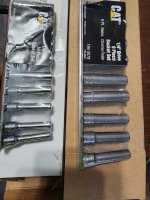
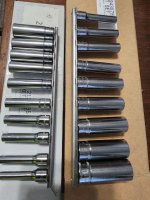
I bought the CAT 1/4" deep sets in Metric and SAE , just to look and compare, should be available to pick up on Monday. I don't have any brand new Snap On Sockets to set side by side and compare. There is a faint possibility I can buy the Snap On single sockets to fill in the odd sized but 3 sockets 4.5, 5.5, 15mm with shipping well exceeds the price of the two CAT sets.
Hakeem, what I truly hope is you throw on your latex gloves, buy some sockets that allow you to work and earn a comfortable living while not incurring a lifetime of debt. I would tend to believe that either the CAT sockets or Snap On sockets in one's hand performing the task, the feel, the sensation would be identical. Mentally one would suspect the the Snap On would ''feel better" knowing the price paid. In a similar vein because I am cheap and I seek out deals, if I were to find a bargain deal on a set of Snap On sockets ,mentally I know those would feel great , not because they are superior to the CAT sockets, but because I would have bought them for a very good, bargain price which mentally makes them more enjoyable for me.
The 2 - 1/4" drive Cat sets ,the 9 piece Metric deep, 10 piece SAE deep cost me $98.06 after tax.
Hakeem, what I truly hope is you throw on your latex gloves, buy some sockets that allow you to work and earn a comfortable living while not incurring a lifetime of debt. I would tend to believe that either the CAT sockets or Snap On sockets in one's hand performing the task, the feel, the sensation would be identical. Mentally one would suspect the the Snap On would ''feel better" knowing the price paid. In a similar vein because I am cheap and I seek out deals, if I were to find a bargain deal on a set of Snap On sockets ,mentally I know those would feel great , not because they are superior to the CAT sockets, but because I would have bought them for a very good, bargain price which mentally makes them more enjoyable for me.
The 2 - 1/4" drive Cat sets ,the 9 piece Metric deep, 10 piece SAE deep cost me $98.06 after tax.
Last edited:
rust in the eye
Well-known member
Many of the unwashed masses want their sockets to say “Snap-On” and are willing to pay whatever the price.Snapon is clearly quite proud of their product and I don’t think they would want to dilute their high falutin brand by selling the exact same product at a discount to the unwashed masses.
mreisner
Well-known member
Kind of on a case by case basis some are the same and some are different slightly I've seen. 3/8 metric shallow sockets I've had both new Snap-on and new Cat and they were identical fit and finish. Over Christmas I got a set of metric hex bits and the chrome and the general polish of them was not quite as nice as a set of Snap on SAE hex sockets purchased earlier in the year.
I think you are mischaracterizing how manufacturing works.I disagree and here's why; Actual manufacturers that manage to sell at retail have tremendous profit margins. What does it really cost Snap-on to make a socket? More than others certainly given US labor and better materials but still pennies. Rolling a private label on your usual product for bulk orders would seem a simple and still profitable choice. This discussion proves plausible deniability of the facts if so.
Does it make sense to have a separate line or to interrupt production for these short(comparatively)runs? Using a less expensive steel doesn't seem to make sense either as they no doubt have very good pricing for their "usual", buying small quantities of another may cost as much or more. Corners could be cut with heat treating, etc. but again that would seem an interuption in the workflow of a well oiled machine.
All my thoughts, of course, are nothing more than conjecture but make sense to this guy.
I had a friend, now passed, that had very close connections to Snappy who no doubt could have gotten us the answer but alas..
Typically it starts with an order, in my case from a customer, in Snap Ons case, it’s probably a stock check. That order triggers, say a set of 1/2” chrome 6 pt shallow SAE sockets. That order triggers procurement of the steel, labels for the packaging, the plastic packing, and then something goes to the factory floor to initiate in house manufacturing.
Where I work, that used to be paper (now digital). That paper instructed how each manufacturing process would go and what happens to the finished product. The planning paperwork would include what tooling gets loaded into what machines along with what software programs get loaded. Some machines could have tool changers, some not.
The factory would be configured to run that specific one product, (i.e. one size, X qty) and the paperwork would follow (actually lead) the product through the facility.
Today that paper work might say we’re making 1000 3/4” snap on sockets. Tomorrow the paper work could say something different.
The factory isn’t a black box that makes one thing, and you just push start.
It’s likely at any given time, there are multiple orders running thru the factory, each with their own paperwork. You wouldn’t wait until one order was complete before you triggered the next order. That’s why when they filmed a video of the process for ”how its made” we saw each step, but they had different orders running at each step. Some were snap on orders, some were Williams.
The paperwork controls the product, not the machines. It’s not McDonald’s where only fries get cooked in the french fry machine. The paperwork could set how long sockets get media tumbled, how long the heat treat soaks are, what the max temp for temper ovens etc etc
rust in the eye
Well-known member
My thoughts are that economy of scale offered by their existing manufacturing process outweighs any savings that might be obtained through different process. I for sure don't know, nor does anyone else here, so far anyway.
Perhaps someone with intimate knowledge will chime in, we'd certainly all like to know.
Perhaps someone with intimate knowledge will chime in, we'd certainly all like to know.
neophyte
Well-known member
It was said that Williams dockets were dimply Snap-On dockets with different toll marks and s thinner plating coating.
I have no clue if this is true, but a thinner plating coat would take less time, and save a bit if money on the plating mix, which saves significant money over hundreds of thousands of sockets, both in time, electrical cost, and plating material.
The Williams sockets supposedly weren’t quite as “precise” to fastener size, which would and could correspond to a thinner plating, leaving a slightly looser fit, if the sockets were made using the same forming tooling as a Snap-On socket.
I know Armstrong/Danagher, who used to make a number if the Craftsman tools, did a similar thing, since some Armstrong and Craftsman wrenches were almost the same, and had a very distinctive proprietary design.
The less expensive Craftsman wrenches had a thinner plating, and lacked the notch in the jaw that the Armstrong version had.
I presume with these wrenches, Danagher simply manufactured batches of the wrench forging, and then just finished the broaching and plating and name stamping whenever one brand needed more wrenches.
As far as whether CAT sockets are the same as Snap-On ones, the base dockets may be the sane, but the roll stamping and plating finish could be different thicknesses, or the same, depending on whatever the contract Snap-On had with CAT was.
The major cost is making the forming dies, and the production line. If Snap-On can run some extra sockets during down time when Snap-On branded ones aren’t needed, they would.
CAT is likely paying fir the toll stamping dies as part of their contract.
I would also expect the production cost of a socket is 10% or less of Snap-On’s retail price, probably less or way less.
Students can buy Snap-On at 50% of retail cost, and Snap-On wants to make decent money on those sales as well, since Snap-On still has to warrantee the tools if the tools break.
I suspect plenty of industrial tool retailers are paying 25%-40% of the list retail price for the tools they sell, with highly automated tool products having a way higher markup, such as 1/4” insert bits.
Plenty of manufacturers make the same products, with different labels, to be sold by customers at way different markups.
Years ago, I knew some girl whose parents owned a clothing manufacturer, and they basically mentioned that their parents would sew different band labels into the exact same product for different customers.
The T-shirts I bought at Target were identical, except for label, to ones I saw at Some high end department store on clearance. The clearance price was $40, marked down from $80. Target sold the same shirts for $15-$20, and the shirts could be bought on sale for about $10, somewhat regularly.
The shirts were a soft cotton so I bought a bunch since I regularly shop at Target.
I have no clue if this is true, but a thinner plating coat would take less time, and save a bit if money on the plating mix, which saves significant money over hundreds of thousands of sockets, both in time, electrical cost, and plating material.
The Williams sockets supposedly weren’t quite as “precise” to fastener size, which would and could correspond to a thinner plating, leaving a slightly looser fit, if the sockets were made using the same forming tooling as a Snap-On socket.
I know Armstrong/Danagher, who used to make a number if the Craftsman tools, did a similar thing, since some Armstrong and Craftsman wrenches were almost the same, and had a very distinctive proprietary design.
The less expensive Craftsman wrenches had a thinner plating, and lacked the notch in the jaw that the Armstrong version had.
I presume with these wrenches, Danagher simply manufactured batches of the wrench forging, and then just finished the broaching and plating and name stamping whenever one brand needed more wrenches.
As far as whether CAT sockets are the same as Snap-On ones, the base dockets may be the sane, but the roll stamping and plating finish could be different thicknesses, or the same, depending on whatever the contract Snap-On had with CAT was.
The major cost is making the forming dies, and the production line. If Snap-On can run some extra sockets during down time when Snap-On branded ones aren’t needed, they would.
CAT is likely paying fir the toll stamping dies as part of their contract.
I would also expect the production cost of a socket is 10% or less of Snap-On’s retail price, probably less or way less.
Students can buy Snap-On at 50% of retail cost, and Snap-On wants to make decent money on those sales as well, since Snap-On still has to warrantee the tools if the tools break.
I suspect plenty of industrial tool retailers are paying 25%-40% of the list retail price for the tools they sell, with highly automated tool products having a way higher markup, such as 1/4” insert bits.
Plenty of manufacturers make the same products, with different labels, to be sold by customers at way different markups.
Years ago, I knew some girl whose parents owned a clothing manufacturer, and they basically mentioned that their parents would sew different band labels into the exact same product for different customers.
The T-shirts I bought at Target were identical, except for label, to ones I saw at Some high end department store on clearance. The clearance price was $40, marked down from $80. Target sold the same shirts for $15-$20, and the shirts could be bought on sale for about $10, somewhat regularly.
The shirts were a soft cotton so I bought a bunch since I regularly shop at Target.
This has been settled years ago here in multiple threads- there have been Williams sockets mixed in with sealed Snap On sets- they're all made on the same assembly line, along with the CAT sockets. There's a "how's it made" video, or similar, that people have screenshotted them mixed in on the actual line.
You are paying for the tool truck service and warranty with SO; the outrageous SO price has nothing to do with the "US Government" FFS; that guy driving the truck is getting a ~100% markup on typical hand tools, and the rest of the price premium is warranty, and of course there's the built in default for deadbeat customers.
But I guess we need to debate this for another 400 posts
You are paying for the tool truck service and warranty with SO; the outrageous SO price has nothing to do with the "US Government" FFS; that guy driving the truck is getting a ~100% markup on typical hand tools, and the rest of the price premium is warranty, and of course there's the built in default for deadbeat customers.
But I guess we need to debate this for another 400 posts
So beyond all the arguments about if it's genuine 100% snap on or some other lower tolerance from a parallel process. I'm sure it's still great stuff with the CAT roll mark. So my question is, what are the best dealers for online sales? I have 3 dealers that i pass by frequently but they are all part of the same franchise and never seem to have tool deals or great prices.
Nobody-named-Olli
Well-known member
My observation is that there are some downright phenomenal deals to be had from US CAT dealers.
When I bought the 1/4” socket driver here in Germany, the price was OK but far from a deal or let alone worth the whole process basically. Encouraged by what I had read on here since then, I put together a list of tools I wanted and e-mailed it to my rep at the CAT Dealer a whole while ago. The quote I got was either laughable/ “let’s see if the guy is an idiot” bait, or the “hidden message” please don’t bother us ever again. Which is totally fine, I don’t mind.
But it got me thinking that, like with a lot of other businesses/suppliers, pricing has a lot to do with sales volume. So my best guess is, if I was running a couple of CAT machines purchased through that dealer, pricing would be very, very different.
And that brings me to the situation in the US, to me it seems dealers are simply giving heavily discounted pricing to basically everyone. Whether that is by accident/ because no one cares, or they don’t have the time/ interest in setting up different prices for different buyers, I obviously don’t know.
I’d really enjoy it while it lasts. If the word get’s out too far, that might change overnight.
Kind regards,
Olli
When I bought the 1/4” socket driver here in Germany, the price was OK but far from a deal or let alone worth the whole process basically. Encouraged by what I had read on here since then, I put together a list of tools I wanted and e-mailed it to my rep at the CAT Dealer a whole while ago. The quote I got was either laughable/ “let’s see if the guy is an idiot” bait, or the “hidden message” please don’t bother us ever again. Which is totally fine, I don’t mind.
But it got me thinking that, like with a lot of other businesses/suppliers, pricing has a lot to do with sales volume. So my best guess is, if I was running a couple of CAT machines purchased through that dealer, pricing would be very, very different.
And that brings me to the situation in the US, to me it seems dealers are simply giving heavily discounted pricing to basically everyone. Whether that is by accident/ because no one cares, or they don’t have the time/ interest in setting up different prices for different buyers, I obviously don’t know.
I’d really enjoy it while it lasts. If the word get’s out too far, that might change overnight.
Kind regards,
Olli
alinc100
Well-known member
As near as I can tell pricing is regional and varies from dealer to dealer. What region are you in? As posted above I placed my first order on Friday and likely pick up tomorrow Jan 12th. EDIT TO ADD: example Metric socket set 200-813 13 piece shallow, 12 point set is $66.11 at my local dealer.So beyond all the arguments about if it's genuine 100% snap on or some other lower tolerance from a parallel process. I'm sure it's still great stuff with the CAT roll mark. So my question is, what are the best dealers for online sales? I have 3 dealers that i pass by frequently but they are all part of the same franchise and never seem to have tool deals or great prices.
Attachments

Last edited:
The sockets aren't identical to Williams. The Williams are quite different, visually, from the Snap On and CAT sockets.CAT could be identical to Williams and that would be my assumption. There’s absolutely no reason why Snap on would sell their best products under another brand name for less. That just doesn’t pass the sniff test.
Snap On isn't selling their product for less - CAT is. Snap On is not diluting their brand because almost no one is cross-shopping these tools or even knows that CAT's hand tools exist.
You can go to the local CAT dealer and test out your theory for about $50 and get a great socket set out of it.
I'm in the northwest and see the same price for that set.As near as I can tell pricing is regional and varies from dealer to dealer. What region are you in? As posted above I placed my first order on Friday and likely pick up tomorrow Jan 12th. EDIT TO ADD: example Metric socket set 200-813 13 piece shallow, 12 point set is $66.11 at my local dealer.
Vinny
Well-known member
I'm in the northwest and see the same price for that set.
68.75 here in Los Angeles, but there's a coupon for 20% off hand tools on the site which would knock it down even more.
200-8413 is the set number.
reader2580
Well-known member
The local Cat dealer website has a link to parts.cat.com that displays the list prices they charge for Cat parts including the tools. I am sure those who have access to high volume accounts get even cheaper prices. The prices are quite reasonable for USA sockets. The wrench prices seem high to me, but I might be out of touch with wrench pricing.
I love the folks who will buy Snap-On over Cat because Snap-On has better resale value. I buy my tools to use, not to resell.
I love the folks who will buy Snap-On over Cat because Snap-On has better resale value. I buy my tools to use, not to resell.
mdrawde
Well-known member
151.46 NZD for that set, works out to ~87 USD.As near as I can tell pricing is regional and varies from dealer to dealer. What region are you in? As posted above I placed my first order on Friday and likely pick up tomorrow Jan 12th. EDIT TO ADD: example Metric socket set 200-813 13 piece shallow, 12 point set is $66.11 at my local dealer.
alinc100
Well-known member
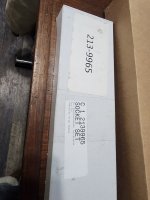
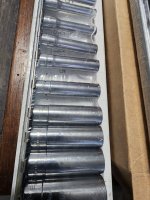
And here they are. The Metric set looks much more like Snap On than the SAE set that I get a Williams vibe off of. I don't have and BNIB Snap On ,open and unwrapped to compare chrome level/sheen with.I bought the CAT 1/4" deep sets in Metric and SAE , just to look and compare, should be available to pick up on Monday. I don't have any brand new Snap On Sockets to set side by side and compare. There is a faint possibility I can buy the Snap On single sockets to fill in the odd sized but 3 sockets 4.5, 5.5, 15mm with shipping well exceeds the price of the two CAT sets.
Hakeem, what I truly hope is you throw on your latex gloves, buy some sockets that allow you to work and earn a comfortable living while not incurring a lifetime of debt. I would tend to believe that either the CAT sockets or Snap On sockets in one's hand performing the task, the feel, the sensation would be identical. Mentally one would suspect the the Snap On would ''feel better" knowing the price paid. In a similar vein because I am cheap and I seek out deals, if I were to find a bargain deal on a set of Snap On sockets ,mentally I know those would feel great , not because they are superior to the CAT sockets, but because I would have bought them for a very good, bargain price which mentally makes them more enjoyable for me.
The 2 - 1/4" drive Cat sets ,the 9 piece Metric deep, 10 piece SAE deep cost me $98.06 after tax.
Attachments
-
 20260115_084303.jpg443.9 KB · Views: 56
 -
 20260115_084306.jpg565.2 KB · Views: 49
 -
 20260115_084307.jpg518.6 KB · Views: 56
 -
 20260115_084335.jpg778.5 KB · Views: 58
 -
 20260115_084339.jpg719.6 KB · Views: 58
 -
 20260115_084344.jpg761.4 KB · Views: 59
 -
 20260115_084401.jpg768.4 KB · Views: 65
 -
 20260115_084407.jpg759.4 KB · Views: 69
 -
 20260115_084501.jpg782.2 KB · Views: 65
 -
 20260115_084504.jpg736.5 KB · Views: 87
kams1973
ALLIANCE MEMBER
My guess is they are identical as it would require big investment to set up a separate USA production line just for Cat labeled stuff. Simply switching marking dies for a run of standard product would seem to me more cost effective. Leading to or letting customers believe the Cat tools were somehow a lesser quality could justify the price difference.
What the Cat tools demonstrate for me is the huge profit margins on Snappy branded stuff. I'll wager some of the Cat branded sells for less than the truck salesman's cost, which surely pleases them to no end.
Any Snappy dealers here wish to comment?
AND while those interested in CAT tools are listening would someone please tell me if they offer 1/2" dr. fractional inch(SAE) SIX point shallow sockets? I've browsed the catalogs I can find on-line and only find 12pt. Seems odd, no?
Attachments

rust in the eye
Well-known member
Thank you, sir.
I've already bought them. No doubt they are Snappy, even have the same greasy stuff on them.
I've already bought them. No doubt they are Snappy, even have the same greasy stuff on them.
rust in the eye
Well-known member
I thought the same about the SAE but the greasy kid stuff they put on them is same.And here they are. The Metric set looks much more like Snap On than the SAE set that I get a Williams vibe off of. I don't have and BNIB Snap On ,open and unwrapped to compare chrome level/sheen with.
funny stuff in this thread.
anyone remember the early kobalt tools?
how about the harley-davidison stuff that sears had back in the day?
how about some of the bahco socket sets?
i am sure there are other i have forgotten about
all stuff sourced from the snap-on williams world. not the first or last time we will see it or people worked up about it.
anyone remember the early kobalt tools?
how about the harley-davidison stuff that sears had back in the day?
how about some of the bahco socket sets?
i am sure there are other i have forgotten about
all stuff sourced from the snap-on williams world. not the first or last time we will see it or people worked up about it.
here is my thought on whether it is the same as one brand or another.
i bet the same material are used no matter what brand is on them. may there be a bit more polishing or an extra layer of chrome? maybe.
my guess is that the biggest cost differentials are in packaging, distribution, warehousing and largely advertising/promotion.
those differences alone, how cat and snap-on operate are vastly different.
i bet the same material are used no matter what brand is on them. may there be a bit more polishing or an extra layer of chrome? maybe.
my guess is that the biggest cost differentials are in packaging, distribution, warehousing and largely advertising/promotion.
those differences alone, how cat and snap-on operate are vastly different.
kams1973
ALLIANCE MEMBER
Factor in warranty as well.here is my thought on whether it is the same as one brand or another.
i bet the same material are used no matter what brand is on them. may there be a bit more polishing or an extra layer of chrome? maybe.
my guess is that the biggest cost differentials are in packaging, distribution, warehousing and largely advertising/promotion.
those differences alone, how cat and snap-on operate are vastly different.
ChevyEFI
Well-known member
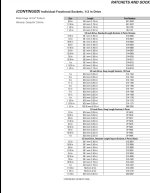
The 2nd chart in post 112 makes me wonder about the 323-6267 1-1/18 3.25" L socket.
Hey, I know, let us invite tool truck drivers to refute with bias.
It's almost like you're telling us Sears has had branded tires that were made by Goodyear.early kobalt tools?
harley-davidison stuff that sears had back in the day?
some of the bahco socket sets?
Hey, I know, let us invite tool truck drivers to refute with bias.
Snaparxon
Well-known member
The only way to know for sure and settle this debate is ask AI.
Silver Lexus
Well-known member
i wonder if the Torque Test channels on YouTube should test both sets and see how the metals hold up. If they perform the same then that would be a good indication.