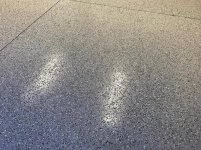
So I finished up the floor on my 28x36 detached garage and I think it came out pretty well. A couple lessons learned and observations to help the next person, some of which echo the other recent post:
1. Use 18" rollers not the standard rollers that come in the AP kit. I didn't figure this out until it came to the topcoat. The larger rollers are faster and are less likely to leave roller marks.
2. If you have a large area, divide it into sections and figure out how much you should be applying per section. Don't wait until you get to the end and realize you have a lot left over and you need to do another coat.
3. Get the spiked shoes. I didn't have them and had to have an exit strategy and roll my way to the door with no ability to go back while still wet.
4. I didn't do flakes because as a working garage I thought it would make it hard to find small parts when I dropped it. In hindsight, I was very careful while rolling and still have some roller marks and areas where thickness or color was slightly inconsistent. The flakes would most likely have masked all of that.
5. Definitely use the anti-slip additive. The epoxy coat was super slippery (in socks anyway) even when dry. The additive is not difficult to work with as long as you remix the material in the bucket every time before you pour more in your tray. Also don't run your tray too low either as the grit will settle in the bottom and you could get clumps. If you do get a concentration just roll it out before it sets.
6. If you own dogs...in my case two black labs...don't let them anywhere near your project. I let them in once when completely dry and I blew the garage afterwards and I was still struggling to pull the occasional hairs out throughout the application of epozy and topcoat. They stand out like a sore thumb and it's no fun getting them out of the floor, then out of your roller and then trying to find a safe place to put them.
7. Two people is definitely easier than one. It was helpful to have my wife mix up the next batch while I rolled and to patrol for the aforementioned stray hairs or bugs that decided to make themselves a permanent part of the project. Just make sure your helper doesn't cover your sleek new Dewalt LiIo drill with clearcoat.
8. This will be obvious but good lighting would be nice. In my case, my garage was recently built and I haven't had a chance to do electric yet. For a few reason I needed to get the floor done asap and move some vehicles and tools in to make way for three tons of pellet in my primary garage. This meant doing the work by daylight and shoplights. Not sure I would do that again. I am still curious how it's going to look under the lights...that is when there are lights.
9. If you tape off the edge of the garage where it crosses under your garage door like I did, don't pull up the tape before you topcoat. For some reason I decided to pull it up before my second application of topcoat. I figured overlapping it slightly would "seal the edge". Whether it did that or not, it definitely discolored the bare concrete on the other side of the line. I will have to see if I can clean that up a bit.
10. I rented a floor grinder and did the acid etch just to be safe. If you haven't used a floor buffer/grinder get ready for some fun. I was seriously ready to take it back to Home Depot and claim it was defective because it launched itself uncontrollably to my left as soon as I pressed the lever. Took me about ten minutes to get the hang of controlling it.
Overall, I think it came out very nice although only time will. I was very nervous about doing it. I tried to epoxy my main garage 15 years ago and it failed miserably after a couple years and I have lived with that ever since. Probably a low end product from Home Depot and the prep was not thorough as this time around. In the spring, I will be going back to AP and see if I can fix that...this time with flecks!
1. Use 18" rollers not the standard rollers that come in the AP kit. I didn't figure this out until it came to the topcoat. The larger rollers are faster and are less likely to leave roller marks.
2. If you have a large area, divide it into sections and figure out how much you should be applying per section. Don't wait until you get to the end and realize you have a lot left over and you need to do another coat.
3. Get the spiked shoes. I didn't have them and had to have an exit strategy and roll my way to the door with no ability to go back while still wet.
4. I didn't do flakes because as a working garage I thought it would make it hard to find small parts when I dropped it. In hindsight, I was very careful while rolling and still have some roller marks and areas where thickness or color was slightly inconsistent. The flakes would most likely have masked all of that.
5. Definitely use the anti-slip additive. The epoxy coat was super slippery (in socks anyway) even when dry. The additive is not difficult to work with as long as you remix the material in the bucket every time before you pour more in your tray. Also don't run your tray too low either as the grit will settle in the bottom and you could get clumps. If you do get a concentration just roll it out before it sets.
6. If you own dogs...in my case two black labs...don't let them anywhere near your project. I let them in once when completely dry and I blew the garage afterwards and I was still struggling to pull the occasional hairs out throughout the application of epozy and topcoat. They stand out like a sore thumb and it's no fun getting them out of the floor, then out of your roller and then trying to find a safe place to put them.
7. Two people is definitely easier than one. It was helpful to have my wife mix up the next batch while I rolled and to patrol for the aforementioned stray hairs or bugs that decided to make themselves a permanent part of the project. Just make sure your helper doesn't cover your sleek new Dewalt LiIo drill with clearcoat.
8. This will be obvious but good lighting would be nice. In my case, my garage was recently built and I haven't had a chance to do electric yet. For a few reason I needed to get the floor done asap and move some vehicles and tools in to make way for three tons of pellet in my primary garage. This meant doing the work by daylight and shoplights. Not sure I would do that again. I am still curious how it's going to look under the lights...that is when there are lights.
9. If you tape off the edge of the garage where it crosses under your garage door like I did, don't pull up the tape before you topcoat. For some reason I decided to pull it up before my second application of topcoat. I figured overlapping it slightly would "seal the edge". Whether it did that or not, it definitely discolored the bare concrete on the other side of the line. I will have to see if I can clean that up a bit.
10. I rented a floor grinder and did the acid etch just to be safe. If you haven't used a floor buffer/grinder get ready for some fun. I was seriously ready to take it back to Home Depot and claim it was defective because it launched itself uncontrollably to my left as soon as I pressed the lever. Took me about ten minutes to get the hang of controlling it.
Overall, I think it came out very nice although only time will. I was very nervous about doing it. I tried to epoxy my main garage 15 years ago and it failed miserably after a couple years and I have lived with that ever since. Probably a low end product from Home Depot and the prep was not thorough as this time around. In the spring, I will be going back to AP and see if I can fix that...this time with flecks!
 . If you have a big garage or slightly overweight, I recommend using some locktite as you tighten the nuts. Extra $3 will give you extra peace of mind.