To avoid these ads, REGISTER NOW!

Automatic garage ventilation

MushCreek

Well-known member
Joined
Jan 14, 2015
Messages
9,743
Location
Upstate South Carolina
I'm going to rig up a way to ventilate the wife's (attached) garage. Believe it or not, they are planning to add this to building codes at some point. What I want is to have a vent fan come on whenever the garage door opener is cycled, and have it run for a while. I could use the circuit for the lights, but they only stay on for 4 minutes- not long enough. I'm going to use the light circuit to fire a timer relay, which will run the fan up to an hour, which should be enough. Anyone else have a ventilator, automatic or not? I'm curious what others have done.

I got a 210 CFM fan at HD marked down to $20. I'll duct it outside. I'm not worried about make-up air, as the garage isn't that tight. Plenty of air should come in around the overhead door. I just want to keep the exhaust funk from seeping into the house.
 
To avoid these ads, REGISTER NOW!

toplessHO

Well-known member
Joined
Oct 20, 2014
Messages
14,007
Location
central florida
I'm going to rig up a way to ventilate the wife's (attached) garage. Believe it or not, they are planning to add this to building codes at some point. What I want is to have a vent fan come on whenever the garage door opener is cycled, and have it run for a while. I could use the circuit for the lights, but they only stay on for 4 minutes- not long enough. I'm going to use the light circuit to fire a timer relay, which will run the fan up to an hour, which should be enough. Anyone else have a ventilator, automatic or not? I'm curious what others have done.

I got a 210 CFM fan at HD marked down to $20. I'll duct it outside. I'm not worried about make-up air, as the garage isn't that tight. Plenty of air should come in around the overhead door. I just want to keep the exhaust funk from seeping into the house.

thats not a very big fan
 

DC73

Well-known member
Joined
Dec 27, 2014
Messages
1,627
Location
Lubbock TX
thats not a very big fan

It's big enough to completely recycle the air twice in one hour for a 600 sq. ft. garage (and that assumes 10' ceilings).

MushCreek - I know a guy that did something similar in his garage. He rigged up a bathroom exhaust fan with the switch being one of the push button timers with various times such as 5 min, 10 min, 30 min, 60 min etc. He placed the switch near the house entrance and just taps the timer for how long he wants the fan to run as he enters the house.

Even with the exhaust fan, I would recommend sealing all potential air transmission points between the house and the garage. Doing so will minimize the extent that pollutants can enter the house from the garage and it will also help to prevent your new exhaust fan from pulling conditioned air from the house. Caulk and cans of spray foam are cheap. Pull the trim from around the door frame and spray foam there. Caulk around the threshold. Caulk any gaps between sheet rock and electrical boxes on common walls. Caulk below any baseboards on common walls. In general just think about any place that might allow air to move between the two areas and caulk or seal accordingly. One caveat - be careful caulking or foaming inside electrical boxes themselves. Those boxes require a sufficient volume of air to prevent overheating the cables. You can seal where the cables exit the boxes but don't seal in such a way that it reduces the overall volume of the box. Best to do this from the exterior side of the box which isn't always possible with old construction.

DC
 

sixty4

Well-known member
Joined
Dec 1, 2007
Messages
1,424
Location
CT
I have an old corvette that stinks my place up pretty good when I pull it into my house garage. This is what I did to solve the problem. Its on a timer switch, so when I pull it in and walk in the house I can turn the timer on. I often wonder why code does not require something like a fan to be interlocked to the garage door openers myself.


Modern Jess

Well-known member
Joined
Jan 2, 2011
Messages
1,362
Location
Bay Area, California
I just finished up an automatic ventilation system in my workshop. In my case, it is to take advantage of favorable temperature differences between inside and outside, but I programmed some time limits while I was at it. I used a xytronix temperature controller and did my own programming. A timer relay is the right way to go for your application.

Will be watching to see how this project goes.
 
OP
M

MushCreek

Well-known member
Joined
Jan 14, 2015
Messages
9,743
Location
Upstate South Carolina
The garage is 15 X 22 inside, with a 9' ceiling, so I think an hour would be plenty. I want to make it automatic so the wife doesn't have to think about it. The only thing in the garage will be her car (I get the big barn).

The house is already pretty well sealed, since I just built it to exceed code. The door into the house is a self-closing fire-rated door with pretty good seal. Still, seals shrink and wear out over time. I have a CO detector in the house, too, in case the car is left running and the door is propped open. I also like the idea that the fan will already be running by the time she gets out of the car and opens the house door. Hopefully, the negative air pressure will lessen fumes coming in the house.

When I researched this, I found companies that make systems for ventilation. Some of them recommend having the fan run 24/7, but I think that that's a waste of electricity. If it seems like there isn't enough air flow, I'll add an intake vent near the floor.

Our house is ICF, and very, very tight. We have a ventilation system, but even so, smells tend to linger much longer than the leaky old houses I'm used to.
 

gungatim

Well-known member
Joined
Jan 8, 2013
Messages
8,101
Location
west mich
I've never heard of this, doesn't your garage roof have vents? I have a 3-stall attached garage, 2 stalls have drywall ceiling, but 3rd stall is raftered with open ceiling. entire roof has vents. if I run the big block vette (it's smelly with 3 carbs) or my wife starts her car in the morning to warm up, we never have had any exhaust smell. of course, if the vehicle is going to run more than just backing in or out, the garage door is open.

are you planning to run the vehicles in the garage with the door shut??
 
OP
M

MushCreek

Well-known member
Joined
Jan 14, 2015
Messages
9,743
Location
Upstate South Carolina
The garage attic is vented, but the garage will be full drywalled- no way for fumes to get out.

I wouldn't run a vehicle for any amount of time without an exhaust vent system. I've noticed that the exhaust smell lingers in the garage for quite a while, and comes into the house when you open the door. Not a big deal; just something I want to do while I'm in the building mode.
 

GP0256

Member
Joined
Jan 14, 2015
Messages
18
I too am thinking of ventilating my garage and was wondering if anyone had ever tried or thought of ventilating it through a cupola on the roof? I am installing 2 cupola's with weather veins on my barn roof for nostalgic reasons, but I am thinking, why now hook up a fan to them. Any thoughts?
 

CNGsaves

Well-known member
Joined
Sep 26, 2012
Messages
13,233
Location
KS and OK
Is wife forgetful or too sleepy coming home that she falls asleep with the car running and the garage door shut??

Don't see a need for this in South Carolina. This will be open air to outside letting in moisture when high humidity, or cold during winter.

Is there natural gas water heater in garage?? < < THIS might necessitate a vent, but still would be cold weather issue.

Where is furnace for the house??
 

jimindm

Well-known member
Joined
Oct 29, 2011
Messages
2,395
Location
Des Moines, Iowa
I can understand why the OP wants to do this. I do think it is a little over kill for the everyday garage.

If you do indeed get all of the air leaks sealed, that fan will create negative pressure in the garage. Not a lot, but it will. With out a fresh air vent, any fan will pull fresh air in from some where. My guess will be the overhead door seals.

What you have to think about, is what you are trying to exhaust. Tail pipe exhaust likely will linger close to the floor. Putting a fan in the ceiling and sucking in around a overhead door, will predominately exhaust the area in between. Likely nothing down near the floor.

I have a gable fan in a wall of my finished garage. I have no fresh air vent. It can get pretty smokey in there on occasion. When I feel I need to turn it on, it will quickly vent the area between the open overhead door, or the open walk in door. It takes a while before it clears out the complete garage.

To vent it properly you need to provide fresh air. This can be as simple as PVC pipes ran from the roof, in the walls down to the floor. Just cut some slots in a cap, where it come through the wall.

If you choose not to add fresh air intake. I would figure out a way to move the air around in the garage, while it is venting. This can be done with any kind of fan.

While I can certainly understand your concerns for wanting a system like this, the true fact is that there are hundreds of thousand of home built that do not have it.
 

DC73

Well-known member
Joined
Dec 27, 2014
Messages
1,627
Location
Lubbock TX
@MushCreek - you have a good plan. I have a buddy who used to work in the field of environmental engineering helping people with sick buildings and sick houses. What you are doing is what he recommended to me. There is the potential for a lot of nasty fumes in the garage. Best to keep those fumes out of the house.

DC
 

jwvess00

Well-known member
Joined
Jul 25, 2009
Messages
167
Location
Paris, KY
Hi there!

Others have mentioned timers and such, but you're wanting automatic operation related to the garage door. As an EE I can think of a few ways to do that, and they're all kind-of complicated. I'm sure others here with experience in industrial control could come up with some sort of PLC that would do the job.

Intersting but a bit of a pain, really, and if you sell the house an inspector would be really confused by it. I'd look into home automation stuff instead.

There are a few types of systems out there, but they all work similarly. Replace the outlet for your fan with one used in home automation, which will let you turn the fan on and off. You'll also need an interface to your garge door so you know when it's opened and closed, and you'll need some sort of controller -- either your home computer or one of their standalone boxes.

Or maybe not even that complicated. I just stumbled across a motion sensor switch with a timer up to 30 minutes that can switch motor loads, and it stands alone -- no controller required. It wouldn't be tied to the garage door, but would run the fan when someone was in the garage.
 

CNGsaves

Well-known member
Joined
Sep 26, 2012
Messages
13,233
Location
KS and OK
^ ^ This is the solution . . . . no cutting in walls to outside.

Just use one of those cheap X-10 wireless controllers that turn on outlets. Plug a BIG fan pointing at the car that's turned on HIGH and plugged into X-10 wireless device. When wifey hits button for garage door with her remote in car, she also hits button on separate X-10 remote that turns on big fan.

While garage door is still up, the fan will be blowing car exhaust back outside down at ground level. By the time wifey gets to man door to house, enough "dirty" air should have been pushed out of garage. Have another X-10 wireless remote next to man door to house and shut off fan.

http://www.x10.com/x10-home-automation/controllers/wireless.html
 

wssix99

Well-known member
Joined
Mar 2, 2011
Messages
5,155
Location
Chicago, IL
I do think it is a little over kill for the everyday garage.

It does really improve the air quality and keep down the car stink.


If you do indeed get all of the air leaks sealed, that fan will create negative pressure in the garage. Not a lot, but it will.

+1 A 200 CFM fan is plenty, but not having a fresh air intake will cut down its efficiently a ton.


I'm going to rig up a way to ventilate the wife's (attached) garage. Believe it or not, they are planning to add this to building codes at some point. What I want is to have a vent fan come on whenever the garage door opener is cycled, and have it run for a while. I could use the circuit for the lights, but they only stay on for 4 minutes- not long enough.

We just did this for our new garage. Chicago City code requires ventilation, but we are sealed and heated in the garage, so they approved a mechanical system to provide the air exchange. (Our fan is a HRV, which retains some of the heat for us.)

I think you can hook it up to your lights. (We are doing that with electrical contractors. The fan goes on whenever the garage door lights are on or someone manually turns on the garage lights.) With a 10 minute delay in a 1000 square foot (13-14' high ceiling) we only need 50 CFM. So, at 4 minutes at 210 CFM, you should be just fine unless the garage is gigantic.

ASHRAE has a calculation for air changes in garages. Attached is a spreadsheet I put together to do the calculations. If you fill in the yellow cells for your situation, it should calculate the CFM you need for good CO air quality.
 

Attachments

  • Garage Ventilation Calculator.zip
    5.9 KB · Views: 12
OP
M

MushCreek

Well-known member
Joined
Jan 14, 2015
Messages
9,743
Location
Upstate South Carolina
Theoretically, the fan would take 14 minutes to do one complete air change, but obviously efficiency will suffer no matter what, so I figured 1/2 hour to an hour. The timer relay is adjustable, so I can try it and give it the sniff test.

As for just rigging up a big fan to an X-10- you're assuming my wife would remember to do it, and remember to turn it off. Also- How would it work when she leaves in the AM?

I know the whole thing is overkill, but I'll only have about $200 in it. Our house is my own design, and has a lot of custom touches that are overkill. That's part of the fun of designing and building your own house- I could never afford to pay someone else to do this stuff!
 

sublimate

Well-known member
Joined
Aug 4, 2010
Messages
776
Location
Colorado
With a 10 minute delay in a 1000 square foot (13-14' high ceiling) we only need 50 CFM. So, at 4 minutes at 210 CFM, you should be just fine unless the garage is gigantic.

I'm not understanding the math here.
Your 1000 square foot garage with 13-14' ceilings has 13,000 to 14,000 cubic feet.
A 50 CFM (cubic feet per minute) fan would take about 270 minutes (4.5 hours) for one complete change. 10 minutes would seem to do almost nothing.

Also looked at your spreadsheet and it seems to conflate area with volume. There's even no input for ceiling height - would produces the same CFM recommendation whether you have 7' ceilings (7,000 cuft) or 20' ceilings (20,000 cuft).
 
Last edited:

Chris705

Well-known member
Joined
Nov 1, 2012
Messages
834
Location
The Finger Lakes of NY
Just a thought here... but how about powering the fan from the OH door operator light circuit, via screw in adaptor to accept power cord? Or a constantly powered OH light socket with screw-in motion sensor with adjustable time setting with another screw in adaptor to replace light bulb with a cord? Fan-tech in line fan with ducted low intake and that should make it simple? I think 200cfm fans would be minimal draw of current?
 

JACDes

Well-known member
Joined
Dec 23, 2014
Messages
204
Location
IL
So you think they will amend the HVAC code for single family, I don't.

Enclosed garages for Muli-family and Commercial use are ventilated, and have been for decades.

The current method to ventilate typically employs a CO detector that is connected to an exhaust fan(s) and motorized dampers(s). (fresh air intake) The system only runs when COs levels are elevated.

The fan(s)and dampers must be sized accordingly to allow for ample air exchange based on the sized of the parking structure to reduce CO levels to safe level in a short period of time.

For an unheated space this is not a big deal but can be problematic & for single family garages which are conditioned. You are comparing 2-3 car garage to a paking structure.

Most normal people pull in or out of their home garage, the air exchange from opening a 16x6'8 door is more than ample for this brief period.

No reason to be warming up a car that sits overnight in a garage, pull out and go. All attached garages I have seen have a gas curb... a step.. to keep gas fumes from coming into the home.
 
Last edited:
OP
M

MushCreek

Well-known member
Joined
Jan 14, 2015
Messages
9,743
Location
Upstate South Carolina
You wouldn't think that they would require residential sprinkler systems, either, but many areas require them, and they are in the code, although it's up to the individual state to decide. In another 20 years, you won't be allowed to go outside unless you're wrapped in bubble wrap!

I'm going to use the light circuit from the opener, but it doesn't run long enough (4 minutes). I'll use it to fire a timer relay, from which I can adjust the run time. The fan draws 96 watts.
 
To avoid these ads, REGISTER NOW!

JACDes

Well-known member
Joined
Dec 23, 2014
Messages
204
Location
IL
Residential sprinkler systems are in the code for new single family home construction because people were asleep at the wheel when their local government allowed this to happen. Complete overkill IMHO. I grew up in homes without them so did millions of others americans and we are still here.

Fire sprinklers in a house does more damage then protect the property...

Smoke and CO detectors will get you out of home in time well before you need a fire sprinkler system.

Commercial properties, high rises etc.. makes total sence..
 

Modern Jess

Well-known member
Joined
Jan 2, 2011
Messages
1,362
Location
Bay Area, California
I grew up in homes without them so did millions of others americans and we are still here.

That's called survivorship bias. The ones that died in fires aren't here to speak, and this kind of statement is therefore an error of logic.

Note that I'm completely neutral on the subject of residential sprinkler systems. I'm just pointing out that you can't really use "I'm still alive" as a data point.
 

JACDes

Well-known member
Joined
Dec 23, 2014
Messages
204
Location
IL
Sorry Mr Spock.

neither are the millions who lived in the same homes and died from other causes.

I suppose we don't need cure for cancer either because these cancer survivors are all biased.
 

Modern Jess

Well-known member
Joined
Jan 2, 2011
Messages
1,362
Location
Bay Area, California
Sorry Mr Spock.

You probably meant that as a pejorative, but I'll take it as a compliment anyway. :lol_hitti

neither are the millions who lived in the same homes and died from other causes.

I suppose we don't need cure for cancer either because these cancer survivors are all biased.

Neither of those things make your argument more (or less) true.
 

JACDes

Well-known member
Joined
Dec 23, 2014
Messages
204
Location
IL
for someone who is claiming to be neutral you sure are over playing your hand...your dad own sprinkler pipe shop? LOL
 

Modern Jess

Well-known member
Joined
Jan 2, 2011
Messages
1,362
Location
Bay Area, California
for someone who is claiming to be neutral you sure are over playing your hand...your dad own sprinkler pipe shop? LOL

I'm just pointing out that you would fail (badly) in a real debate for such an obvious error in logic.

And no, I have no connection whatsoever to anything to do with sprinklers. It just drives me crazy when people make stupid arguments.
 

Lu-Max

Well-known member
Joined
Jan 8, 2014
Messages
745
I built a simple but reliable exhaust into the ceiling of the garage on a former house.
I used a louvered fan installed near the roof peak that opened automatically when the fan came on, and a mechanical close-on-rise thermostat to control it. This setup was to simply exhaust hot air during the warmer months. It came on when it reached the set temperature, and did a great job of keeping the garage a lot cooler. The same setup could easily be modified to remove exhaust fumes via a simple relay-triggered timer.
 

NOMAD

Well-known member
Joined
Jan 17, 2007
Messages
419
why not jut buy an attic vent? Put it where you want, its made to "vent".
I plan on doing this very thing although may end up with a slightly "tacked together" look.
During the 4 months it is above 95-100 here in SoCal my non a/c garage is miserable. A new roof went on and I had a dormer vent put in so that helped a little. I now plan on putting in an electric fan with a timer so that I can exhaust the hot air a little more effectively. The roof is not insulated but I do plan on finishing out the drywall in the garage mainly for looks.

There is one 10x10 bonus room that is fully insulated at the back of the garage. As long as I keep the door closed a window A/C should make my workout/hangout room perfect. Still need to pump as much hot air out of the garage as I can though.
 

eddiemc2

New member
Joined
Dec 8, 2014
Messages
2
What about a solar skylight, the new ones can be programmed to open at multiple times, close when it rains, RF remote can be mounted anywhere.
fresh_air_vss_tax_credit.jpg
 

wssix99

Well-known member
Joined
Mar 2, 2011
Messages
5,155
Location
Chicago, IL
Also looked at your spreadsheet and it seems to conflate area with volume. There's even no input for ceiling height

You'd have to ask ASHRAE's PhD's who made the formulas. (I just put them in to a spreadsheet.) There is a citation in the spreadsheet. The formulas do calculate CO concentration based on square footage of garage. My wild-*** guess is because the CO production is a number estimated based on square footage (since running car's wouldn't be stacked vertically) and any effect of a third dimension would cancel out.


Theoretically, the fan would take 14 minutes to do one complete air change

A 50 CFM (cubic feet per minute) fan would take about 270 minutes (4.5 hours) for one complete change. 10 minutes would seem to do almost nothing.

I think the point of the ASHRAE equation is to economize air changes and only estimate the air movement required to keep CO below a certain concentration.

The formulas don't clear out all the funk in the air because they don't do full air changes - just enough to get the CO out that is being produced over time.

For my garage, I also have the HRV hooked up to the regular switch lights so the air is changing while I'm working in there. I can also turn on the fan if I want better air quality than the timers on the garage door opener lights provide. (With regard to the fan running on those timers - I want the fans to run at a minimum for electricity and heat economy. Just enough to meet code.)
 

hughfree

Well-known member
Joined
Aug 30, 2011
Messages
125
Location
Fayetteville, GA
I have spent the better part of my career designing industrial ventilation systems for various industries. I would like to clear a few misconception regarding ventilation that might help with thoughts regarding garage and shop exhaust systems.
I would like to offer a few design considerations:

1. The greater the distance between an exhaust point and fume / dust source the less effective the system will be....a good example of this would be to try and **** out a candle. You stand a better chance of burning your lips than you do extengushing the candle. There are some variation to this such as trying to capture hot fumes. You take advantage of natural tendency of the hot air rising to improve the effeciency of fume removal.

2. You cannot "**** air out of a bottle".....the air will come from somewhere and if you do not design for the intake it most likely will come from where you don't want it to come (Murphy's law :eye crazy:)

3. Induced make up air will "generally" travel in a "line of sight" path from the intake point to the exhaust point. When the intake point is a significant distance from the exhaust point it will follow the contours of the walls and ceilings in the space.

4. Objects in motion want to stay in motion until acted on by another force...this is true for air. This is why you always blow out a candle instead of **** out a candle. In most cases it is much more efficient to blow fumes to an exhaust source that it is to **** fumes.

5. Consider the fume...what are the natural tendencies of the source that you are trying to capture. In the case of exhaust fumes...they are heavier than air and will tend to "lay" on the floor.

6. Consider the location of the exhaust.....the closer you are to the source the more efficient your system will be (i.e. the less air you will need to move). Generally speaking, the amount of exhaust needed to capture a fume / dust increases by the square of the distance from the exhaust point. For fumes heavier than air you need to have an exhaust point that is low in the space.

7. Consider the location of the make up air...remember you can't **** air out of a bottle and if you don't design for it you will probably "pay" for it.

8. Consider your objective....i.e. do you have to remove the fume or contain the fume.

Relating this to our topic...in general, garage exhaust systems are great for removal of heat (assuming that the exhaust point is high in the space) however they will be ineffective in the removal of fumes that are heavier than air. They will however contain fumes within a space and generally speaking, in the case of an attached garage, keep the fumes from entering the house.

Sorry for the epistle...
 

Modern Jess

Well-known member
Joined
Jan 2, 2011
Messages
1,362
Location
Bay Area, California
I have spent the better part of my career designing industrial ventilation systems for various industries. I would like to clear a few misconception regarding ventilation that might help with thoughts regarding garage and shop exhaust systems.
I would like to offer a few design considerations:

1. The greater the distance between an exhaust point and fume / dust source the less effective the system will be....a good example of this would be to try and **** out a candle. You stand a better chance of burning your lips than you do extengushing the candle. There are some variation to this such as trying to capture hot fumes. You take advantage of natural tendency of the hot air rising to improve the effeciency of fume removal.

2. You cannot "**** air out of a bottle".....the air will come from somewhere and if you do not design for the intake it most likely will come from where you don't want it to come (Murphy's law :eye crazy:)

3. Induced make up air will "generally" travel in a "line of sight" path from the intake point to the exhaust point. When the intake point is a significant distance from the exhaust point it will follow the contours of the walls and ceilings in the space.

4. Objects in motion want to stay in motion until acted on by another force...this is true for air. This is why you always blow out a candle instead of **** out a candle. In most cases it is much more efficient to blow fumes to an exhaust source that it is to **** fumes.

5. Consider the fume...what are the natural tendencies of the source that you are trying to capture. In the case of exhaust fumes...they are heavier than air and will tend to "lay" on the floor.

6. Consider the location of the exhaust.....the closer you are to the source the more efficient your system will be (i.e. the less air you will need to move). Generally speaking, the amount of exhaust needed to capture a fume / dust increases by the square of the distance from the exhaust point. For fumes heavier than air you need to have an exhaust point that is low in the space.

7. Consider the location of the make up air...remember you can't **** air out of a bottle and if you don't design for it you will probably "pay" for it.

8. Consider your objective....i.e. do you have to remove the fume or contain the fume.

Relating this to our topic...in general, garage exhaust systems are great for removal of heat (assuming that the exhaust point is high in the space) however they will be ineffective in the removal of fumes that are heavier than air. They will however contain fumes within a space and generally speaking, in the case of an attached garage, keep the fumes from entering the house.

Sorry for the epistle...

Excellent post. Thanks for that.
 

DC73

Well-known member
Joined
Dec 27, 2014
Messages
1,627
Location
Lubbock TX
I have spent the better part of my career designing industrial ventilation systems for various industries. . . .
Sorry for the epistle...

Good post. Thanks for the info.

How would you design a system for the OP's garage? It sounds like you may be recommending that he use his fan to **** in outside air and put an exhaust grille somewhere for the air to get pushed out of. A possible problem with that approach would be if the situation led to positive pressure in the garage and actually pushed contaminants into the house. Given that he's primarily trying to get rid of exhaust fumes, what are the ideal locations for the intake and exhaust locations whether pushing or pulling with the fan?

DC
 
OP
M

MushCreek

Well-known member
Joined
Jan 14, 2015
Messages
9,743
Location
Upstate South Carolina
That's a good question. I put the fan in the ceiling, but if CO fumes tend to sink, maybe it should be down by the floor? I figured that hot exhaust fumes would rise, so the ceiling vent should take care of it before they cool. I'm not really all that worried about CO; more about the odor of the exhaust. If CO sinks, I'm good, because the house is 20" higher than the garage floor.
 

Kaizen

Well-known member
Joined
Jan 9, 2015
Messages
6,938
Location
New England
hey mush. I helped install one of these types of systems at a yogurt factory up here so when the semi backed into the inside garage the fans kicked on for like 20 minutes sucking out all the fumes. very advanced system but worked awesome. after 5 min you couldn't even smell the diesel.
For you all above have great suggestions. I would definitely get a way bigger fan. someone mentioned the ones with a louver door that you use in attics. yeah you'll have to cut a bigger hole BUT the increased cfm's mean you can use the light circuit so move enough air in a shorter time. also most openers have time adjustments so you can keep the light on more time. simple and no complicated relays or timers.
To the cupola poster that is how air has been evacuated for hundreds of years. I've even seen one that had gas burners below it in savanna where they lit the burner and in theory the rising hot air sucked up the other hot air. For you I would use a whole house fan. only problem is without the fan in the way you can have the cupola open all the time and constantly moving air. the fan will seal when off. if sealing isn't important an attic fan is good. just get it big as you can fit.
 

QUIKSVT

Well-known member
Joined
Sep 8, 2007
Messages
88
Location
Hilliard, OH
image.jpg
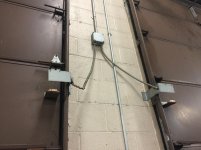
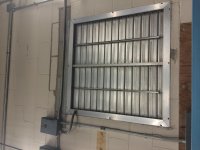
This is one of the fans and sensor on door. It will run for a few minutes after door is opened or closed. We have two 36" fans. Intake on other end of bay.
 
OP
M

MushCreek

Well-known member
Joined
Jan 14, 2015
Messages
9,743
Location
Upstate South Carolina
My opener is limited to 4 minutes for the light circuit- no adjustment. Also, it is limited to 200 watts, which means I'd need a relay to operate a big fan anyway. I have all the parts; I'll have it all hooked up quickly once the weather cooperates.
 
To avoid these ads, REGISTER NOW!
Top Bottom