To avoid these ads, REGISTER NOW!

Back Feeding With A Generator

kc-steve

Well-known member
Joined
Jun 22, 2010
Messages
4,240
Location
Kansas City
You are describing an inlet.
However, without an interlock somebody could turn on the "generator" breaker when you have utility power. That would energize the inlet.
If someone where to open the cover and touch the prongs, bad news.

Not saying you would but crazier things have happened.

I'm the only one that would ever do any of that and I also taped the generator breaker with masking tape labeled "default is OFF". :D

The main point I was making was how I avoided the suicide cord.

Steve
 
Last edited:
To avoid these ads, REGISTER NOW!

aus55

Member
Joined
Jan 29, 2008
Messages
19
We regularly lose power for days at a time so we have a proffesionally installed cutover switch between mains and generator at the switch board. generator feeds the house and nothing back to the mains. When the power goes out, start the generator and flip the switch and back in business. 6kv runs the whole house, no extension leads on the ground and everything is still protected by the circuit breakers.
We used to run a generator and leads everywhere but the convenience of the generator hard plugged in is worth doing properly.
It is llegal in Australia to do home handyman electrical work for good reason. We had the switch and feed in point added when the house was built but they can be added later. Why risk it for the sake of a couple of hundred bucks to get it done properly.
 

rlitman

Well-known member
Joined
Oct 18, 2010
Messages
24,579
Location
Long Island
No, pulling a modern CT meter will not disconnect the power.. The power does not go through these meters; they only monitor the power flow via a clamp device similar to what we use when doing a starter amperage draw.

"Regular" meter,, ya,,, pull them and you are isolated from the power line. Power company will have to come out to replace meter seal.... Better than Freeze damage, for sure... Sure agree with the transfer switch...

I have some CT meters that use a "Form 9S" meter pan. Do you really see that in a residential application? I can't picture it, but you are correct that pulling a CT meter will not disconnect the power. It is actually worse than that. If you pull the CT meter without shorting the CT's, you can blow up the CT's when current is run through them.
My meter pans for CT meters have knife switches on all the wires to short the CT's, and disconnect voltage.

As for a conventional pass through meter, don't just pull the meter. Rotate it to around 2 o'clock and put it back in. That way you can re-install the ring and keep the weather out of the pan without re-making the connection.

Lead story on NBC news tonight showed a guy back feeding his generator in Atlanta. Had a power cord going from the generator in the carport into the house through the door. The news reported talked about power outages and this guy being fortunate to have the generator shown in the background.

Who says he was back feeding. When I run my small Honda generators, I run an extension cord into the house, and plug the refrigerator into the cord.
 

Mandres

Well-known member
Joined
Jun 22, 2006
Messages
1,152
In a public forum like this the answer is that there is no safe way to backfeed from a generator. It's illegal and dangerous for both your family and the utility workers trying to help you. Period.

The problem is that when knowledgeable people discuss the reality of doing this safely the less-knowledgeable only hear that it's ok to do it.
 

MikeF2316

Well-known member
Joined
Dec 29, 2012
Messages
9,605
Location
Thornhill, ON
Please don't back feed, you could kill someone. A few years back the power went out after a storm and a good neighbor of mine called and said his generator would keep throwing the breaker.(breaker on generator) I stopped by his house to see what the problem was. He had apparently hired a handyman not a professional electrician. He installed a 50 amp double breaker wired to a plug for the generator instead of a lock out style. The neighbor didn't remember to turn off the main breaker. :shocking: after I explained what was going on he hired me to redo it.

I don't understand why this isn't mentioned more often. If you backfeed and you leave your main breaker on, your puny little generator will be trying to start up all your neighbour's fridges. Or at least the neighbours without generators. All you're going to do is pop the breaker on your generator.
 

jmauld

Well-known member
Joined
Feb 13, 2005
Messages
672
Location
NC
What do homeowners, who are feeding the grid with solar power, do when the power goes out? Do they have a switch that disconnects their power source?

If I were a lineman, with the availability of I power sources today (solar, wind, generators, etc), I'd check, double check and then still treat that line like it was live. I'm not justifying back feeding a generator, I just wouldn't trust people these days considering how accessible things are now.
 
Last edited:

Charles (in GA)

Well-known member
Joined
Jan 11, 2006
Messages
12,489
Location
50 mi south of Atlanta
To avoid the suicide cord, I found a special plug/box at Home Depot that is basically a semi-covered male plug that I have in the garage. It must be opened to connect the generator. From there I ran a line back to the main box where it is connected to breaker I leave in the off position. So when everything is connected I then switch the main breaker off and the generator breaker on.

I still would like to find some sort of voltage regulator though because I fear running microprocessors off an unregulated voltage.

Steve

You still need an interlock that prevents the main and the generator breakers from both being closed at the same time. Usually a sliding piece of metal on shoulder screws. I bought a genuine Square D one for my QO panel, from an Ebay seller for $52 shippped. It comes with a metal drill pattern template to properly drill the holes. I had to move a couple of breakers to open up the two upper right positions. I have the outside box (the inlet box) mounted and some of the PVC conduit run under the back porch but never finished the installation. Today I'm hoping the lines stay up and a tree doesn't get them. Lots of limbs down today, saw one tree split in half when a limb got too heavy.

Other brands of panels can use UL approved interlocks made/marketed by a third party.

http://www.interlockkit.com/

Search Ebay using the term "interlock kit" and you get tons of returns. Many are Square D, Siemens/Murray, and Cutler-Hammer branded interlocks, others are the interlockkit.com

Charles
 
Last edited:

dtcooper

Active member
Joined
Jan 30, 2014
Messages
30
This goes on top, a safety statement.
From what I read here and some of the questions posted, you should not be hooking up a generator to your panel without the transfer switch. Please don't take me wrong, but this is one area that you can't say " I thought........"

However, there is the guys and girls that can do it safely. I have a background that includes procedures and policy's and its just a discipline that helps make the difference.

Another thing with a dryer is there is no neutral, just the two hots and a ground. True, the neutral can feed on the ground of the dryer circuit, but this creates a potential grounding issue, a generator feed needs four conductors to be proper. Will it work, yes, done all the time.

I have always turned the main off, hooked cord to a spare breaker as I'm on well water and the separate cords are not a option.
After going through three hurricanes in a season, my son and wife are well versed on the positions of the breakers and sequence.Also, there is no one else around that could possibly " do something stupid". We still have our fear/ respect for electrical power. We have done without power if I wasn't there to do the initial hookup and check. ( course I paid for that later)

We are in a area of acreage and the power companies will come through and check everything before they even do a repair. The generators get shut off when they show up, even if it takes a few hours for power to come back on, as they will just cut the branch feeding our pole.

The transfer is the best way no doubt, but IF you know what you are doing and understand electrical workings and safety, no reason to carpet bomb everything.

I will be installing a lockout on both my main and the generator breaker this season.

My opinion, flog away.

Homes built since 1996 have had 4 wire dryer receptacles mandated by the NEC. Therefore they have a neutral included. Some jurisdictions may not have enacted it right then. But it's definitely the rule everywhere by now. 3 wire might still be around in older homes. But any newer dryer than 2000 model, will require a neutral to have 125/250v, for electronics, etc. Hence the 4th wire.

A transfer switch is the best option. An interlock with an inlet and cord would probably be second best.

"Knowing to pull meter or turning off the main to avoid back feeding the utility" is waaaaay down the list of preferred methods.
 

Norcal

Well-known member
Joined
Mar 16, 2008
Messages
13,752
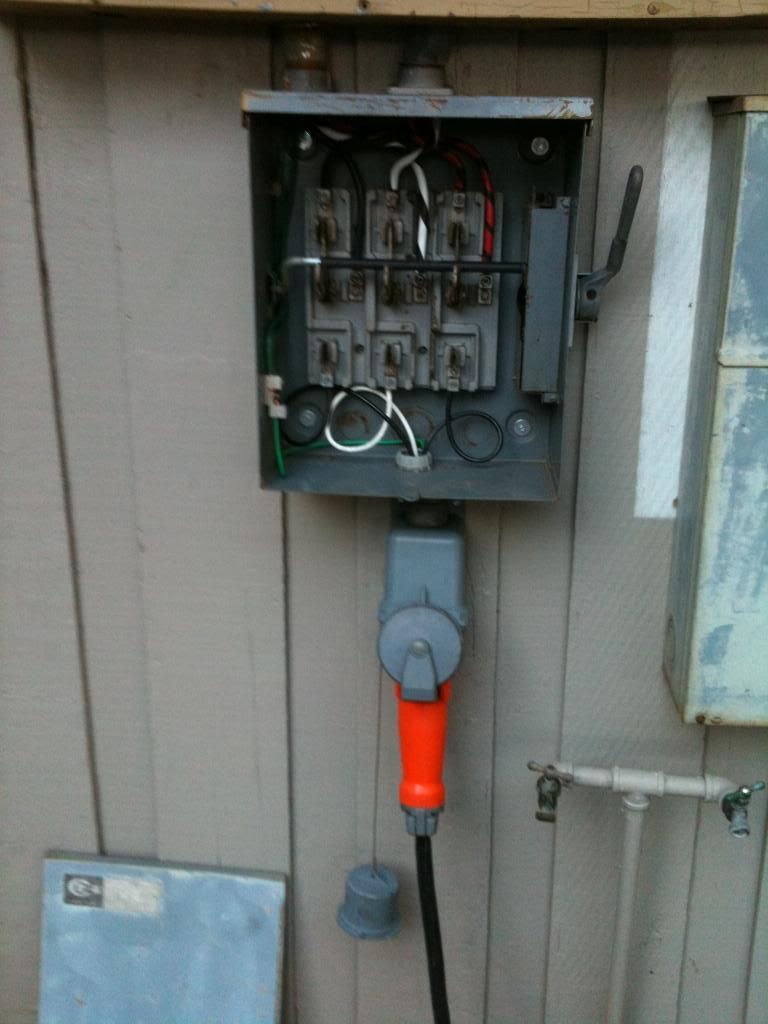
Here is a double throw switch with the cover removed, the orange connector below is the generator feed.


There is no way to backfeed power with this setup.
 

jmarkwolf

Well-known member
Joined
Jan 15, 2013
Messages
1,809
Location
Southeast Michigan
Here is a double throw switch with the cover removed, the orange connector below is the generator feed.


There is no way to backfeed power with this setup.

I like this setup. When you're in generator "mode" simply don't run high demand appliances, etc. Why isn't this system more common?

Much more straight forward than transfer switch systems that require a subpanel containing "selected" breakers, as well as a switch between them.
 

steve308

Well-known member
Joined
Nov 20, 2011
Messages
2,070
Check out GenerLink.com - Lots of good info on their product, however, it may not be allowed by your local power company. The web site will let you know.
 

theoldwizard1

Well-known member
Joined
Feb 22, 2011
Messages
43,076
Location
SE MI
I like this setup. When you're in generator "mode" simply don't run high demand appliances, etc. Why isn't this system more common?

Much more straight forward than transfer switch systems that require a subpanel containing "selected" breakers, as well as a switch between them.
Unquestionably, THIS IS THE BEST WAY TO HOOK UP A GENERATOR !

IMG_0002.jpg


It costs more than a simple interlock (although it is safer because it switches the neutral also).
Edit : I can't find a 3PDT 200A safety switch in a rainproof enclosure for under $1,500 ! :shocking:

Compare to the "selected" transfer switches, it requires some brain power to use correctly (like not turning on loads that will exceed the capacity of the generator).
 
Last edited:

95blklsc

Well-known member
Joined
Dec 11, 2009
Messages
45
I run a 200A manual transfer switch and a 100A reverse service plug as well. I have my gen set on 8" casters and I roll it out of the garage and plug it in. I used some very heavy 1awg four conductor type w mining cable. If you are doing it yourself make sure you REALLY know what you are buying, there are a ton different plug variants.

Something for everyone to keep in mind if they want to go this route, look for used stuff. Just the 100A pin and sleeve plugs will run you $1000 a side on grainger, never mind the $300 back box. A 200A manual transfer switch will run you $1500-2000. I was able to find my SE rated square d DPDT switch for $250 locally and the 100A reverse service plug and socket for $300 after a ton of searching on ebay.

http://www.grainger.com/Grainger/HUBBELL-WIRING-DEVICEKELLEMS-PinSleeve-Inlet-3D129?Pid=search

http://www.grainger.com/Grainger/HUBBELL-WIRING-DEVICEKELLEMS-PinSleeve-Connector-6C553?Pid=search

I ran 2" EMT conduit inside and 2" schedule 80 PVC outside. I used all stainless cement anchors as well as SS 2 hole straps. I did the entire run in 1 awg THHN and I also ran wire for my future shed right behind the house in the conduit.

I also installed a utility return alarm that sounds when the grid is available again.

A short time later I installed an industrial size surge protector as well.

Here are a few pics, although I don't really have any from when I finally had it completely finished.

Here is a link to the album, but I'll put a few pics in here.
https://plus.google.com/photos/1050...ms/5922725248166718785?authkey=CLKfr9PEpILxDA

IMG_2117.JPG


IMG_2879.JPG


IMG_2894.JPG


IMG_2933.JPG


x4l6yLA4WRVDP2aRObckuWpTKlwweM7LJGMzJ0SnTFI=w507-h676-no


IMG_2713.JPG


IMG_2893.JPG


IMG_2706.JPG


IMG_2404.JPG


IMG_2668.JPG


IMG_2373.JPG


pAPeljCkaGr3JtCWmZ8tfFKp9pt5WQZudeULnWwwy5o=w507-h676-no


IMG_2149.JPG


IMG_2173.JPG
 

eljefino

Well-known member
Joined
Feb 21, 2008
Messages
336
^ You win at this. :D

Depot just last week had a sale on a 2500/3250 watt generator for $179. Oddly that's what I paid for my 4-circuit UL listed transfer switch which is eleventy billion times less glamorous.

People think, "Oh I should get a generator." They rarely proceed to the next step, "oh, these extension cords going through open windows are ghetto."

The issue with suicide plugs is you get lucky half a dozen times then something happens-- the generator starts surging, missing, running out of gas, and your lights are dim, and your fridge compressor sounds like death. You yank the "inside end" to protect all this stuff and you're then sitting in the dark holding a live male plug.
 

tdkkart

Well-known member
Joined
Jun 17, 2006
Messages
6,887
Location
Eastern Iowa
Unquestionably, THIS IS THE BEST WAY TO HOOK UP A GENERATOR !

IMG_0002.jpg


It costs more than a simple interlock (although it is safer because it switches the neutral also).
Edit : I can't find a 3PDT 200A safety switch in a rainproof enclosure for under $1,500 ! :shocking:

Compare to the "selected" transfer switches, it requires some brain power to use correctly (like not turning on loads that will exceed the capacity of the generator).


You don't need a 200A disconnect.
My system is setup similar to the one above, with a manual knife disconnect.
My main panel has a 60A breaker which feeds a 60A sub-panel through the center of the knife switch. The sub-panel contains all critical circuits that will be fed by the generator, well pump, furnace, a few lights etc.
The other side of the knife switch goes to my "input" plug which is a male twistlock in an enclosure on the outside of the house.

Connect the generator to the input outside, pull the knife switch which disconnects the sub-panel from the main panel and connects it to the generator. Generator power cannot get to even the main panel, let alone out through the main feed.
 

95blklsc

Well-known member
Joined
Dec 11, 2009
Messages
45
You don't need a 200A disconnect.
My system is setup similar to the one above, with a manual knife disconnect.
My main panel has a 60A breaker which feeds a 60A sub-panel through the center of the knife switch. The sub-panel contains all critical circuits that will be fed by the generator, well pump, furnace, a few lights etc.
The other side of the knife switch goes to my "input" plug which is a male twistlock in an enclosure on the outside of the house.

Connect the generator to the input outside, pull the knife switch which disconnects the sub-panel from the main panel and connects it to the generator. Generator power cannot get to even the main panel, let alone out through the main feed.

If you are switching upstream of your man panel and have a 200A service you absolutely need a 200A transfer switch that is SE rated.

I'm setting up my parents house the way you described though. There is a 100A manual transfer switch that home depot sells that isn't a bad deal. It feels like a toy compared to the square d unit, but it works and it's only $100. They have a small gas unit that can't power the entire house so running a 200A transfer switch upstream of the main panel just isn't necessary. My system can power the entire house without an issue so setting up mine the way I did made sense. There are definitely a lot of different ways to to safely install a generator, it all depends on the goals of your back up system. Due to a few reasons I wanted to have long term reliable power that had the capacity to run electric ovens, dryers, 5 ton AC, lights etc.
 
Last edited:

jmarkwolf

Well-known member
Joined
Jan 15, 2013
Messages
1,809
Location
Southeast Michigan
The issue with suicide plugs is you get lucky half a dozen times then something happens-- the generator starts surging, missing, running out of gas, and your lights are dim, and your fridge compressor sounds like death. You yank the "inside end" to protect all this stuff and you're then sitting in the dark holding a live male plug.

Well put!
 
To avoid these ads, REGISTER NOW!

theoldwizard1

Well-known member
Joined
Feb 22, 2011
Messages
43,076
Location
SE MI
You don't need a 200A disconnect.
My system is setup similar to the one above, with a manual knife disconnect.
My main panel has a 60A breaker which feeds a 60A sub-panel through the center of the knife switch. The sub-panel contains all critical circuits that will be fed by the generator, well pump, furnace, a few lights etc.
The other side of the knife switch goes to my "input" plug which is a male twistlock in an enclosure on the outside of the house.

CORRECT ! My point was switching EVERYTHING is very expensive !

This does require the "forethought" of knowing what to put into the sub-panel. Even with only a 60A "main" on the sub-panel, you could easily run 8-12(?) "typical" 120V circuit As for 240V circuits, I would only run a well pump and sump pump.
 

theoldwizard1

Well-known member
Joined
Feb 22, 2011
Messages
43,076
Location
SE MI
I run a 200A manual transfer switch and a 100A reverse service plug as well. I have my gen set on 8" casters and I roll it out of the garage and plug it in. I used some very heavy 1awg four conductor type w mining cable. If you are doing it yourself make sure you REALLY know what you are buying, there are a ton different plug variants.
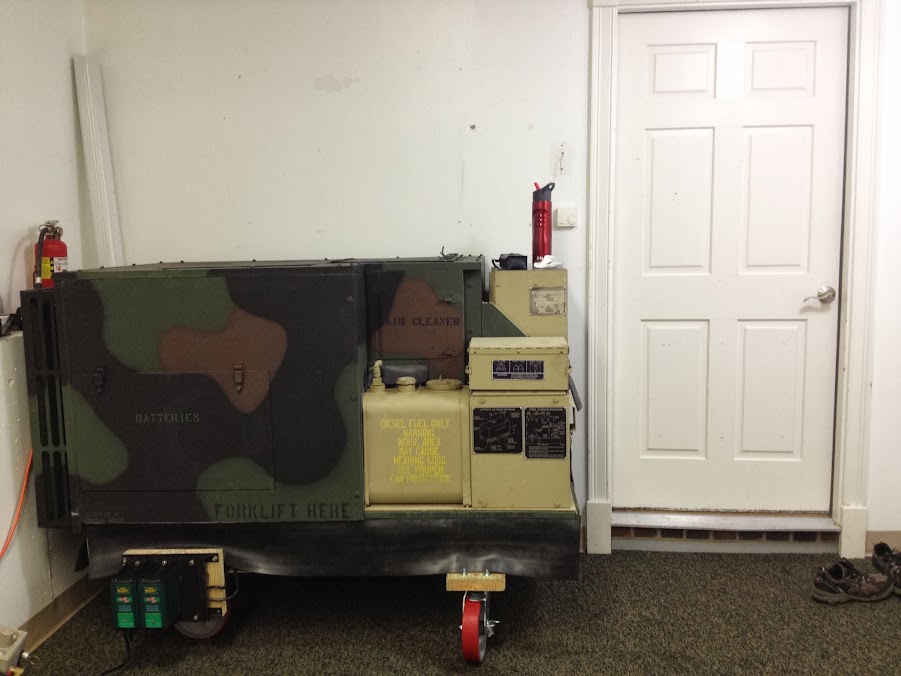
Nice work and there is no question that MEP-003 can handle that load. Of course I'm sure it consumes a lot of diesel !

I noticed that all neutrals are connected (not switched) in your switch box. Are the 2 small gauge wires that connect at the bottom left grounds ? Where do the come from ?

With an unswitched neutral there is a (theoretical) possibility of a voltage difference between neutral and ground at the generator, unless there is a path from generator ground to the system bonding point that I don't see.

Next time you have your generator hooked up, check the voltage at the generator between neutral and ground.
 

east_tn_emc

Well-known member
Joined
Aug 30, 2008
Messages
426
Location
East Tennessee
I realize there are strong feelings on both sides of this issue about back-feeding a panel.

Just to toss in my recent experiences:
1) I talked to both a line-crew supervisor and the local utility-board inspectors about back-feeding my panel with a generator-interlock. They were all 100% fine with it and had no concerns or issues as long as I did have the interlock.
2) my next-door neighbor retired from another nearby local power company. He said that his power company was fine with them as well.

For what it is worth, I have 2 generators...a 6.5kh Honda Power Systems unit and a MEP-003a. The Honda used to seem like a really well built and heavy-duty generator until I got my MEP......those things are beasts!
 

95blklsc

Well-known member
Joined
Dec 11, 2009
Messages
45
Nice work and there is no question that MEP-003 can handle that load. Of course I'm sure it consumes a lot of diesel !

I noticed that all neutrals are connected (not switched) in your switch box. Are the 2 small gauge wires that connect at the bottom left grounds ? Where do the come from ?

With an unswitched neutral there is a (theoretical) possibility of a voltage difference between neutral and ground at the generator, unless there is a path from generator ground to the system bonding point that I don't see.

Next time you have your generator hooked up, check the voltage at the generator between neutral and ground.

The 003A is a beast. The one I have was rebuilt in 06 or 07 under the tier two reset proceedures. It has a rebuilt engine as well as new gauges, paint, pumps, and most of the wiring. It runs very good and takes some serious loading without skipping a beat. It really doesn't consume a whole lot of fuel when it's lightly loaded. It will burn around 0.5 gallons an hour when I'm just running a few lights, TV, the HVAC. At full load it's rated at 1.1 gallons an hour but I haven't kept it loaded heavy enough for a long enough period of time to see how close to or over that spec it actually is. I think for it's size it is really pretty fuel efficient compared to small gas, NG, and LP gen sets.

Yea those two small lines are grounds, one runs to the gen set plug, the other is for the future shed feed (4awg if I remember correctly). It's not pictured but another ground was also run up to the main panel grounding bar. The main panel is the only neutral/ground bonding point. The neutral and ground bond has been disconnected at the generator. I have checked for any voltage differential as well as resistance. There isn't any voltage differential and the resistance is extremely low due to the size cable that I ran.


I have a 30 gallon tank on a trailer right now, but I also have a 100 gallon Peterbuilt tank that I plan to replace it with to have some reserve fuel.

Current aux tank set up:
photo+2.JPG


Mock up of a future set up:
IMG_2771.JPG
 

JohnK007

Well-known member
Joined
Sep 13, 2007
Messages
807
Location
Downers Grove, IL
How important is it to isolate the neutral? On many of the manual transfer switch kits I see a neutral isolator is offered as an add-on option which leads me to believe that it is not universally used. Why is that? I'm looking to install a transfer switch this Spring for my 6800 watt generator and want to do it right.
 

95blklsc

Well-known member
Joined
Dec 11, 2009
Messages
45
There isn't a need to switch neutral in most cases. Read up on separate derived systems and decide for yourself. Be sure to pay attention to ground/neutral bonding. On a system that doesn't switch neutral the only bond should be at the panel. Many generators come with this bonded and it should be unbound in most cases, it's worth looking into. If you aren't sure talk to you local inspector. It's the type of thing that will functionally work with it bonded in either location but it doesn't meet code and could pose a safety issue in a fault condition.
 

rlitman

Well-known member
Joined
Oct 18, 2010
Messages
24,579
Location
Long Island

Where's you get the TVSS?

It looks very similar to ones I have at work, except those are 3 phase, 480V. Your looks like it was originally 3 phase before you hooked it up.

Mine have a disconnect switch that locks out power when you open the cover. Strange that yours does not.
 

95blklsc

Well-known member
Joined
Dec 11, 2009
Messages
45
I got it from ebay actually, it was new in the box for an excellent price. Around $350 if I remember correctly. Here is the catalog listing for it http://www.grainger.com/Grainger/ww...D+TVS2EMA12A&N=0&GlobalSearch=true&sst=subset

I contacted square d to talk to them about using this on a split phase 120/240 application since it is the exact same internal modules as the 120/240 version. This was a 120/208 three phase unit. I thought maybe I'd just remove or not connect one module. They said it would be perfectly fine to use, just to not leave a module floating. Connect one phase to two of the modules and it will actually give you more protection on that line. There are a few variants of it, some with a disconnect. I would have liked one but that is just what was avaialble. I do like the counter feature. We lost power for about an hour a few months ago and when the power returned it registered 330 surges that were suppressed.

One thing to keep in mind when installing something like this is to install it at the top of the buss bar, keep the wires as short as possible, twist the wires, maximize bend radius, and do not use metallic conduit between this box and the breaker it is attached to since it acts like a choke and allows a significant amount more voltage to build on the buss before this clamps in a high frequency event.
 

TractorJeff

Well-known member
Joined
Dec 8, 2013
Messages
3,309
Location
Elkhorn, WI
Thank You for this little piece of info!
"since it acts like a choke and allows a significant amount more voltage to build on the buss before this clamps in a high frequency event"
 

Stuart in MN

Well-known member
Joined
Sep 8, 2005
Messages
22,992
Location
Minneapolis

dledinger

Well-known member
Joined
Apr 14, 2009
Messages
345
Interesting MEP 003. I've never seen one with a full housing like that.

I remember warming my leather gloves over the exhaust on one in Norway in the mid 1990s, only to find out that my sythetic glove liners were molten when I put them back on. Your hands haven't been cold until you've been soaked in diesel while working on fuel system in the arctic.

The same year we pulled MEP 006s (60kw) that were preserved in the 1960s out of the caves and used them for a couple months. Had three in parallel running our unit. Ran like champs....didn't drop power once the entire time. Tweak the throttles every hour to keep the load equally shared, and drain the water out of the fuel daily, and shut one down to change the oil every ten days.

The MEP series replacements, TQGs (8XXA and B), are being phased out in favor of the newer AMMPs generators. Sure would be nice to have and 803 or 2 sitting out back. Everything larger than 10kw is 3 phase only. The 803s are quiet and super reliable.
 
Last edited:

dledinger

Well-known member
Joined
Apr 14, 2009
Messages
345
I have a 30 gallon tank on a trailer right now, but I also have a 100 gallon Peterbuilt tank that I plan to replace it with to have some reserve fuel.

You'd be in really good shape if you could get your hands on a drum adapter and aux fuel line kit.

Wouldn't need anything but a 55 gal drum or two.
 

theoldwizard1

Well-known member
Joined
Feb 22, 2011
Messages
43,076
Location
SE MI
How important is it to isolate the neutral? On many of the manual transfer switch kits I see a neutral isolator is offered as an add-on option which leads me to believe that it is not universally used. Why is that? I'm looking to install a transfer switch this Spring for my 6800 watt generator and want to do it right.
The Reliance Controls transfer switch box (sold under many other names, but they are all the same) is one of the most popular of this style

20216A.jpg


does NOT switch the neutral !


The Generac optional neutral isolation kit appears to be nothing more than a heavy duty SPDT relay (at least 240V 30A) with a 120V coil. I assume the coil is wired across the one of the hots and the neutral from the generator feed. The SPDT contacts switch the neutral from the power company to the generator.
 

95blklsc

Well-known member
Joined
Dec 11, 2009
Messages
45
Interesting MEP 003. I've never seen one with a full housing like that.

I remember warming my leather gloves over the exhaust on one in Norway in the mid 1990s, only to find out that my sythetic glove liners were molten when I put them back on. Your hands haven't been cold until you've been soaked in diesel while working on fuel system in the arctic.

The same year we pulled MEP 006s (60kw) that were preserved in the 1960s out of the caves and used them for a couple months. Had three in parallel running our unit. Ran like champs....didn't drop power once the entire time. Tweak the throttles every hour to keep the load equally shared, and drain the water out of the fuel daily, and shut one down to change the oil every ten days.

The MEP series replacements, TQGs (8XXA and B), are being phased out in favor of the newer AMMPs generators. Sure would be nice to have and 803 or 2 sitting out back. Everything larger than 10kw is 3 phase only. The 803s are quiet and super reliable.

I would love to pick up a TQG sometime. I always keep a few auction searches going for those, but they don't come up often. When they do they usually go for big bucks. The only downside to those is wet stacking if you don't keep them loaded at 20-30%. The air cooled MEP's really don't have that issue since they run a little warmer.

I'm not sure when, but that housing was an add on called an ASK (acoustic supression kit). I was lucky enough to run across one new in the crate. Since I had a gen set with literally two hours on it since the rebuild I couldn't pass it up. Before the kit I was measuring about 105dB at the control panel without any real loading. It was very loud to say the least. The ASK is usually good for about a 10dB reduction, but I found a lot of areas to improve and I got about 30dB reduction in total. I'm around the mid 70's next to the panel and 68dB or so at 15-20 feet. I may add a muffler to get it down a few more, but it is completely acceptable at it's current level.

It sounds like the military gen sets kept you guys going for a while. They are pretty awesome sets for the money, although you have to be ready to learn about them and work on it yourself if necessary. I'm not sure how many local generator repair guys would want to touch it. I really didn't spend any more than your typical whole house 15-20k unit that doesn't have a brush less gen head and essentially is a Briggs and stratton engine.

You'd be in really good shape if you could get your hands on a drum adapter and aux fuel line kit.

Wouldn't need anything but a 55 gal drum or two.

I have the drum adapter. I want a fuel trailer that is easy to move around, get filled, or sell the fuel. 55 gallon drums are particularly easy to move around by yourself. I figure I'll need to sell the fuel every couple of years and refill so I want it easily mobile. I also want a way to potentially be able to pump fuel out of another tank if needed during an extended regional outage. Many people around me heat with oil so there is plenty of fuel around to purchase in a pinch if the local station pumps are down. I do plan on getting my pump set up on the trailer so I can pump in or out of the tank.

I currently have a valved quick connect fitting on the gen set aux feed and the aux tank and an additional fuel water separator for when I'm running on aux fuel.

This was the ASK before installation:
IMG_2064.JPG


IMG_2128.JPG


IMG_2130.JPG


This is my aux fuel filter/seperator and quick connect fitting. It is behind a panel that I removed for mounting. I'm able to hook it up with the panel in place as well as replace the filter cartridge if needed. I'm running a 30 micron filter on this. The main fuel system is converted to spin on filters and I'm running a 10 micron with a drain followed by a large 2 micron.

IMG_2946.JPG


IMG_2955.JPG
 

arroberts

Well-known member
Joined
Mar 8, 2010
Messages
196
Location
Central Ohio
Funny thing about the popular mechanics article listed above is that it still uses a suicide cord to connect the gen to the transfer panel.
 

Stuart in MN

Well-known member
Joined
Sep 8, 2005
Messages
22,992
Location
Minneapolis
Funny thing about the popular mechanics article listed above is that it still uses a suicide cord to connect the gen to the transfer panel.

You're right - I hadn't noticed that before. Obviously, the cord should have a male connection on one end to plug into the generator, and a female on the other that plugs into a male connection on the side of the house.
 

rlitman

Well-known member
Joined
Oct 18, 2010
Messages
24,579
Location
Long Island
They said it would be perfectly fine to use, just to not leave a module floating. Connect one phase to two of the modules and it will actually give you more protection on that line. There are a few variants of it, some with a disconnect. I would have liked one but that is just what was avaialble. I do like the counter feature. We lost power for about an hour a few months ago and when the power returned it registered 330 surges that were suppressed.

One thing to keep in mind when installing something like this is to install it at the top of the buss bar, keep the wires as short as possible, twist the wires, maximize bend radius, and do not use metallic conduit between this box and the breaker it is attached to since it acts like a choke and allows a significant amount more voltage to build on the buss before this clamps in a high frequency event.

Nice price! The individual replacement modules run me over $1000 a piece. Everything gets more expensive on 480V. . .

I've had bad luck with the counter. So far I have had them replace the counter on one of them three times, and it is failing again. On my other two, I haven't had an issue yet (knock on wood).

Actually for a top fed buss, you want the TVSS connected at the bottom for the same reason that you want to maximize bend radius to minimize impedance. The surge will follow the straight path down the buss first, and the TVSS then acts as a node, stopping it before it reflects back up the buss.
 

95blklsc

Well-known member
Joined
Dec 11, 2009
Messages
45
You can find entire units with the ASK on it but they are typically beat up and missing parts. Finding a fresh tier two reset set along with a new in the crate ASK is pretty much like finding bigfoot it seems.

I did pay nearly $1000 for the ASK but I think it was worth it. It was unbearably loud to have right behind the house without it. The amount of time it would have taken to make something that is both function and well made would have taken a bit of time, the cost was worth it I think. I could have built an enclosure with a cemt pas for less but I really wanted to keep it in the garage which is warm and dry just for the longevity of it. I plan to have this thing indefinitely so nice storage conditions were important. I always try to plan for the long term with equipment.

I really wasn't ready to spend the money but after being without power for four days in a row last winter my wife and I decided that it was time and I was going to do a set up that would last many years and be able to power everything in the house. We also live down a long driveway and we have our own transformer that is about 100 feet in the tree line before the house feed goes underground. It is very susceptible to tree damage and we would be last priority since we are the only house it services. I wouldn't be surprised if we have a week or more without power in a hurricane or large storm.
 

95blklsc

Well-known member
Joined
Dec 11, 2009
Messages
45
Nice price! The individual replacement modules run me over $1000 a piece. Everything gets more expensive on 480V. . .

I've had bad luck with the counter. So far I have had them replace the counter on one of them three times, and it is failing again. On my other two, I haven't had an issue yet (knock on wood).

Actually for a top fed buss, you want the TVSS connected at the bottom for the same reason that you want to maximize bend radius to minimize impedance. The surge will follow the straight path down the buss first, and the TVSS then acts as a node, stopping it before it reflects back up the buss.


Yea, the replacement modules are very expensive. It's almost worth finding another whole unit on ebay and keeping it for spares. But I figure I'll just find another one if this one gets fried.

Do you have any documentation discussing placement at the end of a buss? Everything I had read cites that mounting it as close as possible to the main breaker is ideal. It will have the lowest impedance between it and the main lines to give it as much of a chance as possible to start suppressing before the pulse can reach the entire buss bar. Think of it as a short duration but high wave coming down a narrow channel, you want to open up an overflow pool as soon as possible to divert the surge. If you wait until it reaches the end of the buss, the wave has already started propagating down the branched circuits and suppression is less effective. I understand your point of the bend radius, and a breaker being a sharp bend, but you will have that weather you place it at the top or the bottom of the buss. Placing it at the top minimizes the buss impedance between the TVSS and the main breaker while the impedance of the wires and breaker to the TVSS remain constant regardless of location.
 
Last edited:
To avoid these ads, REGISTER NOW!
Top Bottom