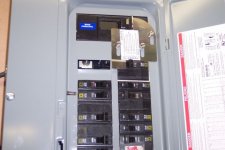
Help me out here. The UL listed and approved metal interlock plate prevents the back feed breaker and the main from being enabled at the same time - we all agree on this. When the main is off, Line 1 and Line 2 from the grid to the house are severed - the house ground still goes to the ground rod, and the common from the grid is still connected. Then, when the back feed breaker is enabled, Line 1 and Line 2 from the generator is then routed to the buss bars in the panel, while (in my case), the generator plug's ground and common are always directly connected to the neutral and ground bars in the panel.
Please explain the difference between this and a transfer switch - I don't see any. To my knowledge, and I may be wrong, the transfer switch is only realigning Line 1 and Line 2 from the grid to the generator, just like what is achieved by having the main closed and the generator breaker enabled. In my view, the metal plate and the transfer switch simply provide an interlock to protect people from themselves and ensure that its one or the other (never both), and are the proper Code way of doing things.
I don't understand the comments about how with the main closed one could back feed the grid. When the power company jerks the meter, you loose Line 1 and Line 2, nothing else. The same as the main being closed.


 beat away.