To avoid these ads, REGISTER NOW!

bathroom subfloor moisture mystery

stickshift

Well-known member
Joined
Nov 16, 2011
Messages
1,236
Location
northeastern US
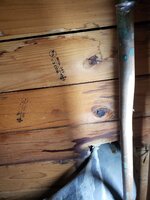
I had a toilet leak, and since I had to replace the wax ring, I used this as an opportunity to replace old toilet with a modern toilet. I had cut out the ceiling below when I was trying to identify the leak and the subfloor around the flange was wet. After replacing the toilet, the subfloor wasn't drying out, despite there being a hole in the ceiling below to provide good airflow. Using a pinless moisture meter (this one), the wettest spots of subfloor are immediately adjacent to the flange. On the "softwood" setting of the meter, the relative moisture level in the wettest spot is 53%. It drops as you move away from the flange, and by 3 boards away, relative moisture level is in the teens (perfectly normal).

I stopped use of this toilet 3 weeks ago (still hooked up to water supply that is turned on, but no flushes) to see if the subfloor would dry out, which would let me know the seal at the flange is leaky. Just measured today and the spots immediately adjacent to the flange are still at 53% relative moisture. How can this be?

The copper water pipes in the area are dry. And the highest moisture levels are right around the flange, so I don't think it's the supply pipes.

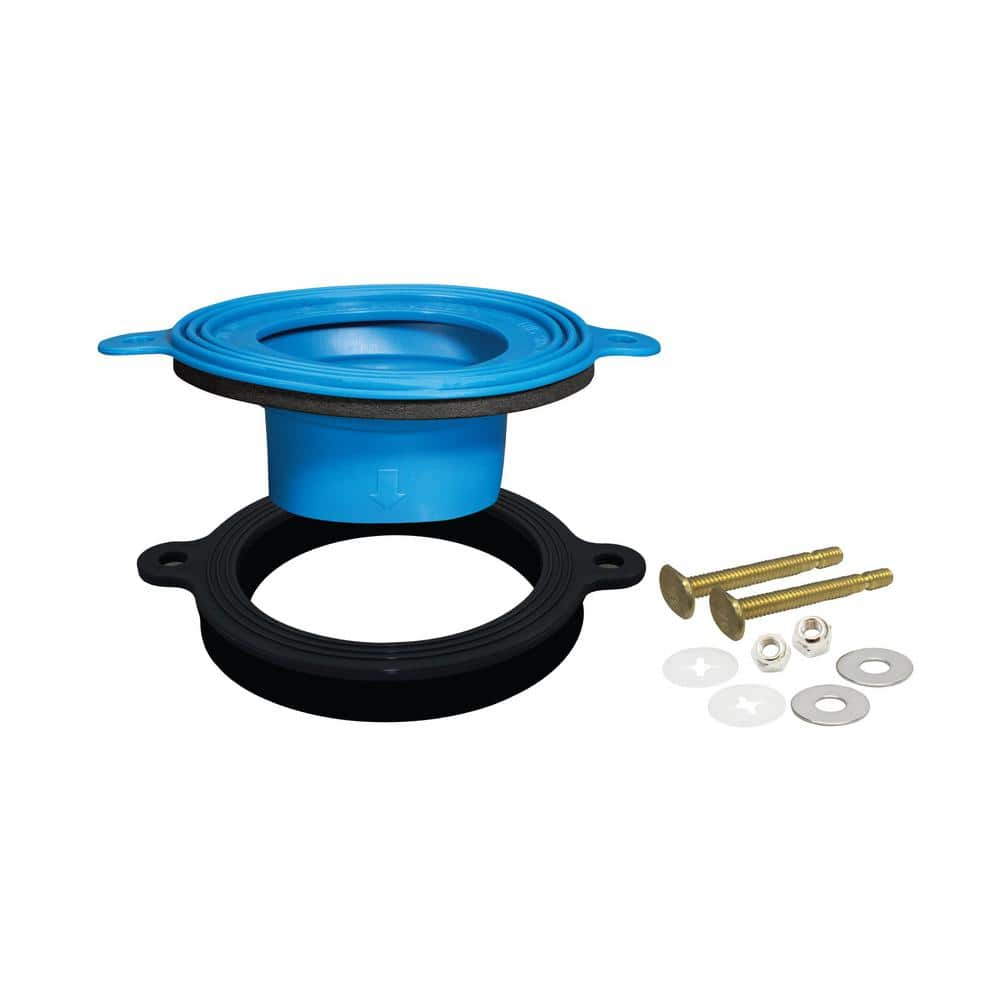
When replacing the toilet, I removed the old wax ring and installed the Better Than Wax wax-free seal. Perhaps that's not a perfect seal and water vapor from the bowl is permeating into the subfloor? I'm reaching here . . .

Any ideas or suggestions on steps to further diagnose? I can pull the toilet and see if subfloor dries out, but wondering if there are less invasive steps to diagnosing. Maybe use a heat gun to force dry the subfloor and see if moisture returns?

2021-09-04 12.02.41.jpg
 

Attachments

  • 2021-09-04 11.56.36.jpg
    2021-09-04 11.56.36.jpg
    498 KB · Views: 100
  • 2021-09-04 11.56.53.jpg
    2021-09-04 11.56.53.jpg
    343.6 KB · Views: 100
Last edited:
To avoid these ads, REGISTER NOW!
OP
S

stickshift

Well-known member
Joined
Nov 16, 2011
Messages
1,236
Location
northeastern US
Can you feel any moisture on the outside of the toilet near the bottom ? If your house water is cold enough it might be sweating ?

No, as @firebirdparts points out, the water in the bowl hasn't changed in 3 weeks, so it's at room temp, so no condensation.

Another strange aspect to this is how the reading on the moisture meter at the wettest spot hasn't changed at all. The meter works and I've used it to locate water leak onto drywall before (using the drywall setting). And when I use it on this subfloor, the readings vary as you move it around. The fact that it hasn't changed despite the hole in the ceiling allowing good airflow (which means there must be some evaporation) suggests that moisture is entering the wood at the same rate at which it is leaving. Strange, no?

Theoretically, if I taped some plastic wrap to the subfloor and measure it a few days later, it should have a higher moisture content, since I would have retarded evaporation, but not affected the moisture ingress.
 
Last edited:

FMB4

Well-known member
Joined
Jan 19, 2017
Messages
2,926
What flooring do you have in your bathroom? Sheet vinyl, tile/grout, or vinyl tile squares, etc?
 
OP
S

stickshift

Well-known member
Joined
Nov 16, 2011
Messages
1,236
Location
northeastern US
is that a lead bend off the toilet? is it possible that there is a small flow of water that is unoticed keeping the tank & bowl full, and a slight leak in the lead bend , enough to keep the floor wet ?
Yes, the elbow is lead, and several decades old, so it's possible there are tiny holes in it, but they'd have to be high up on the elbow, near the flange, or at the joint between the flange and elbow, for the leak to wet the subfloor. Any holes below that would leak onto the drywall ceiling (or onto the floor below, now that I've cut out that area of ceiling).

And the entire toilet is new, including tank internals.

But I cannot rule out what you are suggesting based on what I've done to this point, so I just turned the supply valve off.
 
OP
S

stickshift

Well-known member
Joined
Nov 16, 2011
Messages
1,236
Location
northeastern US
hook up a small fan to blow on the sub floor.
that way you can be sure of drying it out
Good idea, will do.

Hole in ceiling underneath + 3 weeks should have been plenty, but doesn't hurt to force the issue and is easy to do.
 
Last edited:

CraigStu

Well-known member
Joined
May 22, 2014
Messages
4,033
Location
Blacksburg, Va
I'd ad a small space heater to the fan. A stack of boxes, or a step ladder for it to sit on. Be sure it is a heater w/ the little sensor underneath so, if it tips over, it goes off.
 

Bert_

Well-known member
Joined
Dec 24, 2016
Messages
9,729
Location
NW Iowa
I blame this thread for jinxing me...

Last night I could hear a slow drip in my basement. Sure enough it was dripping in the crawl space under my bathroom. Flexible supply line in the vanity was leaking at the connection. Newest plumbing in the whole house.:rant:

I've got a fan blowing in the crawl space and one pointed at the vanity right now.
 

Jeepster04

Well-known member
Joined
Jun 25, 2013
Messages
3,098
Wow, had no idea lead elbows like that existed, cool.

Are you sure its still wet and not just stained?
 
Last edited:

SALIV8

Well-known member
Joined
Dec 11, 2008
Messages
2,114
Location
chicago and s/w michigan
If you used the green foam type wax ring replacement that thing is junk. Not only does it leak but it delaminates as well turning into a sponge holding the water.

I’m susprised there’s not an industry standard these things must meet to be able to be sold.
 
To avoid these ads, REGISTER NOW!
OP
S

stickshift

Well-known member
Joined
Nov 16, 2011
Messages
1,236
Location
northeastern US
If you used the green foam type wax ring replacement that thing is junk. Not only does it leak but it delaminates as well turning into a sponge holding the water.

I’m susprised there’s not an industry standard these things must meet to be able to be sold.
Yeah, I've heard that about the foam type wax-free seals.

I used the Better Than Wax seal without the spacer.
 

ambenz

Well-known member
Joined
Dec 12, 2010
Messages
4,236
Location
NW Chicago Suburbs
After reading All the responses and reading your replys, it is obvious, the toilet leaked in the first place at that spot as something gave away/changed and even with a new toilet and ring seal, the problem remains.
It has to be the lead elbow itself or as you commented, "....at the joint between the flange and elbow." I recommending to remove/inspect/repair/replace those two items and verify that joint was the cause. While not in use, the joint wasn't under pressure and weeping into the sub-floor, possibly overfilling the bowl do to a misaligned flapper?
When flushed, I bet you see a spray or water run along the tell tale CHALK LIKE stain on the lead elbow shown in your photos.
I do hate plumbing with a passion and once fixed, NEVER mess with it!
Good luck GJ member..."I FEEL YOUR PAIN!"
 

PCustoms

Well-known member
Joined
Jul 23, 2011
Messages
22,861
Location
VT
Those blue rubber seals ****.

Wax. Tried and true.

Your floor is likely still 50% moisture as the grout was saturated and the tile is keeping the moisture trapped.
 
OP
S

stickshift

Well-known member
Joined
Nov 16, 2011
Messages
1,236
Location
northeastern US
After reading All the responses and reading your replys, it is obvious, the toilet leaked in the first place at that spot as something gave away/changed and even with a new toilet and ring seal, the problem remains.
It has to be the lead elbow itself or as you commented, "....at the joint between the flange and elbow." I recommending to remove/inspect/repair/replace those two items and verify that joint was the cause. While not in use, the joint wasn't under pressure and weeping into the sub-floor, possibly overfilling the bowl do to a misaligned flapper?
When flushed, I bet you see a spray or water run along the tell tale CHALK LIKE stain on the lead elbow shown in your photos.
I do hate plumbing with a passion and once fixed, NEVER mess with it!
Good luck GJ member..."I FEEL YOUR PAIN!"
Yes, it's certainly possible it's the joint of the flange to elbow or very high up on the elbow (above the wood subfloor, where I cannot see). That fix is the most labor intensive of all potential fixes, so I'm trying to diagnose the issue before going that route. And yes, we have flushed the toilet while I'm up on a stepladder with a flashlight checking the elbow for water, so if there is a tiny hole in the elbow, it's above the subfloor and seeping into the subfloor and not spraying/running down the elbow.

Now that water supply is shut off, and I have fan running pointed at subfloor, I should be able to get that subfloor dry. Once dry, it should not get wet again. If it does, then the water source is not the toilet's water supply. Assuming it doesn't get wet again, I'll turn on the water supply and ensure there is zero leak from tank into bowl (there certainly wasn't any noticeable leak). Assuming subfloor is dry to that point, then I'll flush several times; if subfloor moisture level shoots back up, then I'll know the problem is the flange/elbow joint or very high up on the elbow, because the toilet's horn is inside that blue rubber seal, and that seal's horn is inside the flange (and I shimmed toilet and snugged down the flange bolts), so I don't think there's an issue at the seal itself.
 

FMB4

Well-known member
Joined
Jan 19, 2017
Messages
2,926
Tile and grout. The tile around the toilet is dry.
I'd start by re-grouting and sealing the tile or, at least, sealing the grout. And again, as others have said, go with a good wax ring (extra thick if possible). Tile and grout kitchen and bath floors can be a pain in my experience.
 
OP
S

stickshift

Well-known member
Joined
Nov 16, 2011
Messages
1,236
Location
northeastern US
I'd start by re-grouting and sealing the tile or, at least, sealing the grout. And again, as others have said, go with a good wax ring (extra thick if possible). Tile and grout kitchen and bath floors can be a pain in my experience.
Even if the grout got wet, the grout can dry back out into the bathroom. Also, with a proper seal of the toilet to flange to elbow, there's no way the grout gets wet going forward. So while the bathroom could use a regrouting, that's not going to resolve the leak into the subfloor.
 

FMB4

Well-known member
Joined
Jan 19, 2017
Messages
2,926
Even if the grout got wet, the grout can dry back out into the bathroom.
Grout is porous unless sealed. Such porosity can, and often will, result in a downward capillary action which in this case flows towards the wood subfloor. Measuring moisture on any tiled surface can be pretty iffy. Wood, of course, soaks up water like the sponge that it is. That said, a wax ring is the best way to go imo. Otherwise, the OP is facing a seal failure at the toilet to flange, or at the flange to elbow, or both. That said I agree with member ambenz in that it's likely the lead elbow. Btw, the use of lead anything in plumbing ended in the 1950s, which again, points to a seal issue at the 70 or more old lead elbow.

@ stickshift; you might consider buying, or renting, an infrared moisture camera. Not sure if such a camera would help in in your case, but they can very effective in tracing the source of roof leaks.
 

FMB4

Well-known member
Joined
Jan 19, 2017
Messages
2,926
At this point, I think we should backup and start at the most likely reasons for a damp toilet area subfloor by checking for a water leak at the tank inlet water supply hose and fitting, the tank to bowl ring seal, and the 2 tank to bowl hold down bolt seals.
 

glentre

Well-known member
Joined
May 21, 2016
Messages
909
Location
Gloucester, Virginia
Looks like the OP is on the right track but needs time to let things dry out completely first before being able to find what is leaking. Maybe nothing is actually leaking at this point.

BTW, the lead elbow is called a lead bend. They were purchased by the plumber from his material supplier in various lengths which he would cut to fit. He would "wipe a joint" which entails attaching a brass furl to one end. He would first use a small triangular scraper to scrape the oxidized lead to expose a bright lead surface so molten solder could adhere to the lead. He would then brush on lamp black to where he did not want the solder to stick. At that point, he would take a ladle of molten solder and carefully pour it over the joint between the furl and the lead, using a small pad to gently form the solder into a raised ring around the joint. With a wiping motion, he would keep pouring the solder and molding it as it cooled and started to solidify until he had a nice wide raised joint. It was an art the plumbers learned after many painful burns playing with molten solder. In fact, many jurisdictions required a journeyman plumber to "wipe a joint" in front of an inspector in order to get his master plumber's license. The furl end was then connected to the cast iron pipe (the stack) using hemp Oakum and poured lead for a water tight joint. The end extending through the floor was left well above the rough flooring with a flat sheet lead or copper piece soldered to the lead to seal it. The floor tile was then installed. Before setting the toilet, the lead was cut off about an inch or so above the finished floor, a brass floor flange fitted over the lead and the lead hammered down over the floor flange to anchor the flange to the floor, ready for the wax seal and mounting of the toilet.

Sometime during the early fifties, plumbers could purchase lead bends with the furls already factory attached. Not long after, pvc pipe was introduced and the use of cast iron pipe and toilet lead bends ceased to exist.

Glen
 

jkuro

Well-known member
Joined
Apr 28, 2009
Messages
552
ABS is the cheapest but it's also noisy, that's way most people use it. You pay more for PVC and the thicker walls make it quieter. And no PVC is not ****!
 

jetnow1

Well-known member
Joined
Jun 27, 2016
Messages
511
Location
CT.
I have had a new toilet that had a crack in the built in trap, tore that toilet up and replaced the seal 4 times before I found the crack. Was a name brand toilet also.
 

icthruu74

Well-known member
Joined
Jul 26, 2015
Messages
330
Location
Michigan
I had an old house that had just a lead flange on The subfloor. The toilet bolts were hanger bolts into the subfloor. But considering the toilet hasn’t been used, I’d start with the supply line and tank to toilet joint.
 

The Cobbler

Super Moderator
Staff member
Joined
Oct 24, 2013
Messages
25,898
Location
Niagara Region, Ontario, Canada
bad (leaking) copper supply line in the wall ?
just got me thinking of a job I did years ago. Long story, coles notes version here. did a shower enclosure for customer, asked me to replace the toilet seal at same time as it randomly leaked. did that. a few weeks later they called back, toilet still randomly leaking. I was busy on a job so I hired my plumber friend to go replace for me . he said no signs ff seal leaking, but put a new one on.
called back again. toilet randomly leaking. This is getting to all of us.
plumber friend & I go into house to check wtf is going on.
Turned out it was a drywall screw into the copper water line ( behind the vanity, ) running to toilet that would randomly leak , rust shut, corrode again, leak, seal up and so on.
 
To avoid these ads, REGISTER NOW!
Top Bottom