
To avoid these ads, REGISTER NOW!

Battery testers

signcrafter

Well-known member
Joined
May 9, 2012
Messages
12,605
I have a car that used to be my daily driver and a few months ago I parked it while driving another vehicle. The battery has been dead for a while. I'm guessing that there is some paracitic draw on it. I put the charger on it tonight on automatic trickle charge and will see what happens in the morning. I just went out and it started. Is there a decent tester that doesn't cost an arm and a leg that works? I see the HF battery tester gets really good reviews and isn't to expensive, http://www.harborfreight.com/digital-automotive-battery-analyzer-66892.html. Or should I pick up a carbon pile tester like this, http://www.harborfreight.com/500-amp-carbon-pile-load-tester-91129.html. The battery is only about 3 maybe 4 years old. But I would still like to add a decent battery tester to my tools for future situations. Any advice on a decent relatively cheap battery tester?
 
To avoid these ads, REGISTER NOW!

ddawg16

Well-known member
Joined
Jul 11, 2008
Messages
21,005
Location
S. California
All you really need to test a battery is a voltmeter.

With the battery installed in the car....and the meter connected to the battery....check the voltage....with no load, it should be around 12.5 volts or higher. If not...slap the charger on it.

After charging....if still below 12.5....bad battery...

If above 12.5 volts....crank the engine while measuring the voltage. If it drops below 10V....bad battery.

Disclaimer....

The above voltages are from memory....I might be off a 1/2 volt or so....

But the main point is....measuring the voltage while cranking the engine is one of the best ways to tell if a battery is good or not. If the voltage tanks.....bad battery...but if it only drops a couple of volts....good battery.

Now is a good time to go outside and test the battery on a good car....I think you will find that there is little difference from car to car if the battery is good.
 

JASTECH

Well-known member
Joined
Oct 21, 2009
Messages
2,671
Location
Gering, NE
Your battery the Flooded type? If so it is most likely sulfated, in that case a desulfater via pulse charger will give your battery new life.
 
OP
S

signcrafter

Well-known member
Joined
May 9, 2012
Messages
12,605
Does your battery have liquid inside of it?

I believe most batteries have liquid inside of it. I don't think it's a "serviceable" battery where you can open caps and add water like the older batteries. I think most newer batteries aren't "servicable" anymore.

What is a pulse charger?
 

SpeedCoach

Well-known member
Joined
Oct 18, 2007
Messages
633
Location
Chicagoland
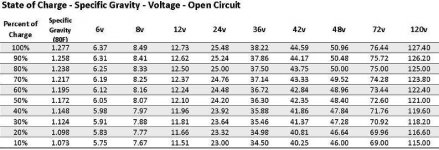
Here is a state of charge chart that covers a wide range of voltages. most of what I've read says to check the SOC 12 HOURS after a charge as some batteries can maintain a "top charge" for quite a while, giving you a false reading.

Pulse chargers (desulfators) send a "wave" through the battery plates that basically shakes sulfate off the lead plates inside the battery so that it can be redissolved back into the electrolyte solution. some folks swear by them, some say a properly maintained battery wont need it.
 

Attachments

  • StateofChargeChart.jpg
    StateofChargeChart.jpg
    53.8 KB · Views: 26

miketyler

Well-known member
Joined
Sep 10, 2009
Messages
635
Location
Cedar Hill, TX
Is a Battery Tender a pulse type charger? That is their main sell isnt it that they dont over-charge and they eliminate sulfating and can extend the life of both wetcell (lead)and dry cell batteries like Optomas.

BT-Plus-Large.jpg
 

crankshaftdan II

Well-known member
Joined
Feb 25, 2009
Messages
1,293
Location
Milwaukee, burbs.
Ifyou are just looking for a cheep tester-look at walmart in the rv/boat section as they have a basic unit for about $7.00-it gives a dead/med chg/good chg. condition and is small enough to be stored in the glove box. I have one in each vehicle as a stock item for emergency use.:dunno:
 

e-tek

Well-known member
Joined
Dec 19, 2007
Messages
10,690
Location
Saskatoon, SK
I believe most batteries have liquid inside of it. I don't think it's a "serviceable" battery where you can open caps and add water like the older batteries. I think most newer batteries aren't "servicable" anymore.

What is a pulse charger?

I'm guessing he meant to ask if it's a "regular" battery or is it a newer AGM (Absorbed Glass Mat) type? As far as one being a pulse charger - who would know?!


**** dawgg - do you know everything or are you Googling before you answer?? LOL!!
 
OP
S

signcrafter

Well-known member
Joined
May 9, 2012
Messages
12,605
Thanks for all the advice. I've had the charger on 2amp automatic overnight and it's still charging. I'm going to let it charge until the charger says it's done and then take the surface charge off and see what the voltage is.

What is the best way to take the surface charge off? I've read to leave the headlights on for a certain time. How long? That HF tester is looking nicer and nicer to be able to just hook it up and see the voltage and the battery capacity and the CCAs.
 
To avoid these ads, REGISTER NOW!

Danglerb

Well-known member
Joined
Sep 6, 2007
Messages
9,736
Location
SoCal
Surface charge should be gone in a couple min with the lights on, that is a good sized draw. I just charge and let it sit for an hour or so, maybe start the car once, then check.

I think the tester I linked to in the 2nd post is both better and cheaper than the HF, but both are overkill for simple occasional testing.

Despite being around for a number of years now the whole desulphating issue seems a bit fishy and lacking in hard data to suit me.
 

theoldwizard1

Well-known member
Joined
Feb 22, 2011
Messages
43,514
Location
SE MI
All you really need to test a battery is a voltmeter.

With the battery installed in the car....and the meter connected to the battery....check the voltage....with no load, it should be around 12.5 volts or higher. If not...slap the charger on it.

After charging....if still below 12.5 (12.7)....bad battery...

If above 12.5 (12.7) volts....crank the engine while measuring the voltage. If it drops below 10V....bad battery.
Measuring voltage while cranking is not always accurate. Some meters can not "keep up" with the voltage fluctuations (which are normal).

After charging (at least overnight), turn the headlight and high beams on for about 10 minutes and then check the voltage. If below 10.5-11.0, start shopping for a new battery.


BTW, most "maintenance free" (adding water not required) flooded (wet) cell battery can (and IMHO should) be "topped off" with water by carefully prying the caps off. City water is fine. If you have a well I would uses distilled water.
 

Lurch67

Well-known member
Joined
Dec 2, 2012
Messages
169
Location
Near Philly, Yo.
I don't believe voltage testing is accurate. Seen a battery with 10V start. Batteries usually fail in the 3-5 year range depending how long it sat on the shelf. If you need a new battery, check the date code to recieve the freshest battery.

IMHO, there is no way to tell a bad/failing battery until your stuck on the road with a dead one. Usually fail in the winter since the cold oil makes the engine harder to turn over and output current is lowest due to low temps. High temps are also hard on battery.
 

Skin

Well-known member
Joined
Feb 24, 2010
Messages
11,713
Location
Boston
Just a few things to add.

1. Parasitic draw or not if you're not going to be driving the vehicle for months remove the battery and leave it on a tender or leave it charging via a tender in the vehicle.

b. Just because a battery shows good voltage during cranking, and especially after charging which is just a surface charge, does not mean its good. Alternately there could be a problem with the charging system.

3. there are two primary types of batteries (regular batteries, not fancy aftermarket ones). There is liquid in both. The maintenance free type are entirely sealed and do not vent gasses. There is generally a viewable window with a green dye in it, when this dye blackens the cells are at the end of their life and the battery needs to be replaced. The other style is a battery with caps which can be removed so that the cells can be checked with a hydrometer and/or emptied/refilled if required although if its functioning properly and if the caps aren't broken they wont really lose liquid or vent gasses either.

Im with lurch that any battery in the 3-5 year range is fair game for replacement. You'll hear people brag about getting 7-10 years out of a battery, and that's all well and good, but that's like saying you went 20k on an oil change. Neglect is neglect and eventually it will bite you in the rear. Honestly whats a battery run, $100-$140 on the high end? Cheap insurance if you live in an area that experiences weather that you really don't want to be stranded in. Also worth mentioning is newer vehicles have systems that have become very dependent on a strong battery voltage in order to function correctly. Mandatory replacement every 5 years is a pretty good rule to abide by in my opinion.
 
Last edited:

JASTECH

Well-known member
Joined
Oct 21, 2009
Messages
2,671
Location
Gering, NE
Skin, I go 20k on oil change, I use Amsoil Syn. oil and Amsoil filters. Get the lab to test, then use it some more.
>
Batteries can and will last longer and hold more punch if desulfater and maintainer is used.
 

db130

Well-known member
Joined
Nov 14, 2010
Messages
157
Location
Massachusetts
What you want is a capacitance tester that can test "actual" CCA of a battery versus the "rated" CCA that's on the label.

A Kent-Moore J-42000 for instance or an OTC 3183 or a Mac BT8300 or Cornwell KB8300.

The last 3 appear to be identical units, just rebranded. I have the Cornwell version that I bought on ebay. The problem is that these testers often cost more than a new battery. It was worth my while for me as I am the "fleet manager" for friends and family.
 

jvitez

Well-known member
Joined
Nov 30, 2009
Messages
2,429
Location
Big Sky Country, Canada
Time means your battery is probably in need of replacement.

Charging an automotive battery on 2 amps may never allow a full charge if significantly discharged. You need 5-10 amps, preferably on an automatic charger unless really deeply discharged (an automatic charger has a self protection circuit that won't allow it to charge if the voltage is very low).

A conductance tester is far better than the old carbon pile testers, but they both work. After using a carbon pile tester you've significantly discharged the battery again so have to recharge it. Kind of a pain. Not so with conductance testers.

"Conductance is a measurement of the battery's ability to produce current. To measure conductance, the tester creates a small signal that is sent through the battery, then measures a portion of the AC current response. As a battery ages, the plate surface can sulfate or shed active material, which adversely affects its ability to perform. Conductance is a measure of the plate surface available in the battery, which determines how much power the battery can supply."


BatteryMINDer chargers advertise themselves as desulphation chargers. I have an older 4 amp version of this one:

http://batteryminders.com/details.php?prod=2012

I've kept 2-4 boat/car batteries charging all winter when hooked up in parallel. I've got an 8 year old automotive battery that tests at 90-92% capacity using my SnapOn conductance type battery tester which I attribute to using the Batteryminder charger.

Battery Tenders work very well, I've got one too, but don't advertise as desulphation chargers.
 

HOTFR8

Banned
Joined
Mar 2, 2007
Messages
24,498
Location
Castlemaine, Victoria. The Hot Rod Centre of Austr
Is a Battery Tender a pulse type charger? That is their main sell isnt it that they dont over-charge and they eliminate sulfating and can extend the life of both wetcell (lead)and dry cell batteries like Optomas.

BT-Plus-Large.jpg

Sometimes they may not charge a dead flat battery. To get round that you may need to jumpstart the vehicle run it for a short time then connect that type of charger style tender. Sulfation is eliminated by these chargers simply because they float or tender holding the battery at about 12.5 or 13 volts.
 

Stick

Well-known member
Joined
Dec 12, 2007
Messages
2,302
Location
Alaska
IMHO, there is no way to tell a bad/failing battery until your stuck on the road with a dead one. Usually fail in the winter since the cold oil makes the engine harder to turn over and output current is lowest due to low temps. High temps are also hard on battery.

IMHO, with the right tools, it's completely possible to find a battery on it's way out well before it has failed, even if it "passes" most battery tests. I'm a big fan of Albin Moore's method of starting/charging system analysis using a labscope. if you're too lazy to click the link, the basics are that you don't want voltage to drop less than 8.6v while cranking, and you don't want the battery looking for a charge rate of more than 2-3A after two minutes of run time. You will need a lab scope to check out inrush voltage though, as a typical meter isn't fast enough to take an accurate measurement of something as fast as inrush voltage.

Using this method has found several problems with starting/charging system problems that other mechanics couldn't duplicate with traditional testing methods. It's always nice to pinpoint and repair a "mystery" problem that someone else couldn't locate. The thing to keep in mind is that a "pass" on one method of testing doesn't mean that the battery (or other component) is good, it only means that it can pass that particular test.
 
Last edited:

Danglerb

Well-known member
Joined
Sep 6, 2007
Messages
9,736
Location
SoCal
More than one way to test a battery, but I am not convinced any are a LOT better than any other. I used a $5 3 led cigarette lighter tester from Radio Shack for about 20 years without error until the wire to the center post broke from being soldered instead of crimped. When I solder it back I expect another 20 years out of it.

That said I think I would buy the Solar BA7 since it will quickly test a battery even if it doesn't have a full charge.

Trickle charge maintainers don't remove sulfation by keeping the voltage, they "prevent" it. The things with high frequency pulses claim to remove the crystals, but I haven't seen solid proof of it or that it lasts.
 
To avoid these ads, REGISTER NOW!
Top Bottom