trboxman
Well-known member
I use grease and make sure I clean and relube once a year.


Very cool graph, did you make it or find it somewhere?
My opinion differs a little. The graph is helpful and informative but does not prove or show that 'teeth' is a "poor method to measure"; to me, it does just the opposite.
The curve doesn't really start to flatten out until you get up over 80 teeth or so. So, at least in the 20 to 80 tooth range (steep part of the curve), the tooth count represents big changes in swing arc.
As you stated, the diminishing return only applies to swing arc, but in terms of variety from which we make our choices, it may be viewed as just the opposite of diminishing return, whatever that may be called.
Tooth count alone might be insufficient evidence because it does not account for the function of the pawl mechanism. I would have to guess that if the function of the various pawl mechanisms could be superimposed on the graph, it would be very informative also.
If there were a perfect tooth count, everyone would use it, and if the rest of the mechanism were insignificant, there wouldn't be 10,000 ratchet patents.
It is important to point out that 'teeth' is a poor method to measure ratchet swing arc as it is non-linear and has a diminishing return on additional teeth.

Great post!
One small observation, wrenches or ratchets that are rough to the touch are really 'matt' finished, or just 'unpolished'. (e.g. a lot of Gedore wrenches)
Satin finish is quite different, it's smooth to the touch, but just lacks the mirror polish. Used by firms such as Stahlwille, and is very practical!
Just found this link. Thank you.
I'm almost 40, and have a bunch of ratchets of various types that I have accumulated over the years and have never known to lube a single one.
I'm intrigued to see if it does indeed seem to make any difference worth the effort.
I'll also experiment with various types of lube. I have a can of dry teflon spray that I use for a lot of stuff..works very well..wonder how it will work in a ratchet.
I prefer round head rats over pear head, but that is just a matter of personal preference. In actuality I think pear heads are superior - from a value/investment point of view.
Typically round head rats have the gear teeth in the head, whereas pear head rats have the teeth on the drive gear. Thus, all the wear with pear head rats is between the gear drive and pawl(s), so all the worn parts are replaced with a rebuild kit. Not so with the round head. You can replace the center cluster and get a new pawl(s) and springs, but any wear on the gear teeth in the head remain. Eventually those teeth will wear to the point of slippage, and there's no remedy other than replacing the whole ratchet.
So, if you use the tool daily for your job, a roundhead ratchet will wear out before a pear head ratchet does - assuming you don't break the tool abusing it.
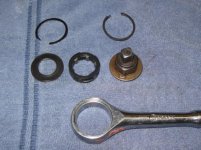
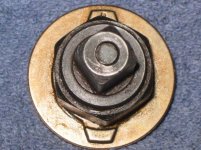
About the only roundhead that avoids the teeth wear problem is a "gearless" ratchet, and here are some pics of the internals of a Kobalt version.
I’ve seen one or two of them before....
I prefer round head rats over pear head, but that is just a matter of personal preference. In actuality I think pear heads are superior - from a value/investment point of view.
Typically round head rats have the gear teeth in the head, whereas pear head rats have the teeth on the drive gear. Thus, all the wear with pear head rats is between the gear drive and pawl(s), so all the worn parts are replaced with a rebuild kit. Not so with the round head. You can replace the center cluster and get a new pawl(s) and springs, but any wear on the gear teeth in the head remain. Eventually those teeth will wear to the point of slippage, and there's no remedy other than replacing the whole ratchet.
So, if you use the tool daily for your job, a roundhead ratchet will wear out before a pear head ratchet does - assuming you don't break the tool abusing it.
About the only roundhead that avoids the teeth wear problem is a "gearless" ratchet, and here are some pics of the internals of a Kobalt version.