To avoid these ads, REGISTER NOW!

Beginners guide to ratchets and wrenches.

To avoid these ads, REGISTER NOW!

ultimateplayer

Well-known member
Joined
Jan 4, 2012
Messages
53
Very cool graph, did you make it or find it somewhere?
My opinion differs a little. The graph is helpful and informative but does not prove or show that 'teeth' is a "poor method to measure"; to me, it does just the opposite.
The curve doesn't really start to flatten out until you get up over 80 teeth or so. So, at least in the 20 to 80 tooth range (steep part of the curve), the tooth count represents big changes in swing arc.
As you stated, the diminishing return only applies to swing arc, but in terms of variety from which we make our choices, it may be viewed as just the opposite of diminishing return, whatever that may be called.
Tooth count alone might be insufficient evidence because it does not account for the function of the pawl mechanism. I would have to guess that if the function of the various pawl mechanisms could be superimposed on the graph, it would be very informative also.
If there were a perfect tooth count, everyone would use it, and if the rest of the mechanism were insignificant, there wouldn't be 10,000 ratchet patents.

I was thinking about how this graphic would be useful to a newb, and as one related to tools, but not statistics, I think the cost per tooth would be a good measurement. For instance, the standard RP Craftsman has 36 teeth, at a new cost (regular price) from Sears of $15.99 for a price of $0.444 per tooth. The premium grade ratchet new cost is $59.99 with 84 teeth for a price per tooth of $0.714. When you consider the increase in cost per tooth of 61%, it could help someone evaluate their needs in terms of fine tooth vs standard ratchet.

Then again I could be getting way to deep in the analysis for most people, but that's just how I look at things. If people were interested, I could do this analysis on a couple standard (regularly discussed) brands here on GJ.
 

otis66

Well-known member
Joined
May 28, 2010
Messages
1,875
It is important to point out that 'teeth' is a poor method to measure ratchet swing arc as it is non-linear and has a diminishing return on additional teeth.
RatchetArc.jpg

So I really don't need an 80 plus tooth ratchet?
 

cgv69

Well-known member
Joined
Jan 11, 2012
Messages
1,033
Location
Boone Co., KY
I've only skimmed through but it looks good so far. One suggestion...

I'm not sure if there is an "official" definition but when talking wrenches, we often hear about "long pattern" and "extra long pattern" pattern designs. Is this an official length or range of length a specific size wrench needs to be to be considered long pattern or extra long pattern?
 

jetmech09

Well-known member
Joined
Mar 26, 2012
Messages
254
The thing about the hi-lok fitting right and not needing the wrench is wrong. You are applying torque. Until the collar compresses enough to overcome that torque, the fastener will spin.
 

PowerDubs

Well-known member
Joined
Jan 20, 2009
Messages
406
Just found this link. Thank you.

I'm almost 40, and have a bunch of ratchets of various types that I have accumulated over the years and have never known to lube a single one.

I'm intrigued to see if it does indeed seem to make any difference worth the effort.

I'll also experiment with various types of lube. I have a can of dry teflon spray that I use for a lot of stuff..works very well..wonder how it will work in a ratchet.
 

Dave455

Well-known member
Joined
Mar 19, 2013
Messages
5,805
Location
Sussex, England
Great post!

One small observation, wrenches or ratchets that are rough to the touch are really 'matt' finished, or just 'unpolished'. (e.g. a lot of Gedore wrenches)

Satin finish is quite different, it's smooth to the touch, but just lacks the mirror polish. Used by firms such as Stahlwille, and is very practical!
 
To avoid these ads, REGISTER NOW!

djb2

Well-known member
Joined
Apr 3, 2010
Messages
639
Location
Redwood forests
Great post!

One small observation, wrenches or ratchets that are rough to the touch are really 'matt' finished, or just 'unpolished'. (e.g. a lot of Gedore wrenches)

Satin finish is quite different, it's smooth to the touch, but just lacks the mirror polish. Used by firms such as Stahlwille, and is very practical!

The finish is 'matte' (derived from a French word that is approximately "faded" or "worn"). It's more commonly called 'cast' or 'as cast' even when it results from the forging die finish.

A satin finish results when the forged or cast piece is ground somewhat smooth on some surfaces, such as a raised panel. Plating further smooths the surface.
 

PowderKeg

Well-known member
Joined
May 20, 2008
Messages
961
Location
Little Rock, AR
Just found this link. Thank you.

I'm almost 40, and have a bunch of ratchets of various types that I have accumulated over the years and have never known to lube a single one.

I'm intrigued to see if it does indeed seem to make any difference worth the effort.

I'll also experiment with various types of lube. I have a can of dry teflon spray that I use for a lot of stuff..works very well..wonder how it will work in a ratchet.

Cleaning out the dried up gunk and using fresh lube will make a major difference in many ratchets (just good lube will make some rough/clunky ones feel several times better), but it won't cover up (by much) damaged/burred/chipped gears/pawls/teeth.

As far as type and frequency of lube, ask a dozen questions and you'll get a dozen answers - everyone seems to have their own personal favorite. I've gone through a handful of different stuff and will likely try a few more.
 

bonneyman

Well-known member
Joined
Apr 22, 2010
Messages
8,792
Location
Desert SW
I prefer round head rats over pear head, but that is just a matter of personal preference. In actuality I think pear heads are superior - from a value/investment point of view.
Typically round head rats have the gear teeth in the head, whereas pear head rats have the teeth on the drive gear. Thus, all the wear with pear head rats is between the gear drive and pawl(s), so all the worn parts are replaced with a rebuild kit. Not so with the round head. You can replace the center cluster and get a new pawl(s) and springs, but any wear on the gear teeth in the head remain. Eventually those teeth will wear to the point of slippage, and there's no remedy other than replacing the whole ratchet.
So, if you use the tool daily for your job, a roundhead ratchet will wear out before a pear head ratchet does - assuming you don't break the tool abusing it.

About the only roundhead that avoids the teeth wear problem is a "gearless" ratchet, and here are some pics of the internals of a Kobalt version.
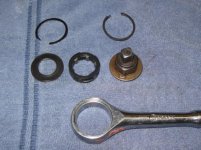
 

Attachments

  • IMG_6925.jpg
    IMG_6925.jpg
    55.7 KB · Views: 27
  • IMG_6926.jpg
    IMG_6926.jpg
    58.7 KB · Views: 26
  • IMG_6927.jpg
    IMG_6927.jpg
    61 KB · Views: 24
  • IMG_6928.JPG
    IMG_6928.JPG
    94.6 KB · Views: 24

platypus20

Well-known member
Joined
Nov 16, 2008
Messages
226
Location
camillus, ny (syracuse)
I prefer round head rats over pear head, but that is just a matter of personal preference. In actuality I think pear heads are superior - from a value/investment point of view.
Typically round head rats have the gear teeth in the head, whereas pear head rats have the teeth on the drive gear. Thus, all the wear with pear head rats is between the gear drive and pawl(s), so all the worn parts are replaced with a rebuild kit. Not so with the round head. You can replace the center cluster and get a new pawl(s) and springs, but any wear on the gear teeth in the head remain. Eventually those teeth will wear to the point of slippage, and there's no remedy other than replacing the whole ratchet.
So, if you use the tool daily for your job, a roundhead ratchet will wear out before a pear head ratchet does - assuming you don't break the tool abusing it.

About the only roundhead that avoids the teeth wear problem is a "gearless" ratchet, and here are some pics of the internals of a Kobalt version.

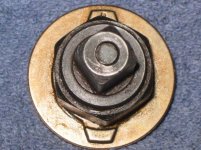
I’ve seen one or two of them before....
 

maximummax

Banned
Joined
Dec 18, 2019
Messages
16
Location
California
I prefer round head rats over pear head, but that is just a matter of personal preference. In actuality I think pear heads are superior - from a value/investment point of view.
Typically round head rats have the gear teeth in the head, whereas pear head rats have the teeth on the drive gear. Thus, all the wear with pear head rats is between the gear drive and pawl(s), so all the worn parts are replaced with a rebuild kit. Not so with the round head. You can replace the center cluster and get a new pawl(s) and springs, but any wear on the gear teeth in the head remain. Eventually those teeth will wear to the point of slippage, and there's no remedy other than replacing the whole ratchet.
So, if you use the tool daily for your job, a roundhead ratchet will wear out before a pear head ratchet does - assuming you don't break the tool abusing it.

About the only roundhead that avoids the teeth wear problem is a "gearless" ratchet, and here are some pics of the internals of a Kobalt version.


Newb here with newbie question:

I"d like to buy a used S-K ratchet, 3/8" drive. I checked alloy-artifacts.org, but couldn't find answers to the following.

Is one era (Wayne vs Dresser vs Diamond) more durable gear-wise, or does it just depend on the individual ratchet's use history? Besides the Diamond and Wayne markings, are there other ways to identify the vintage/year the ratchet was made?

I found a $14.99 S-K Diamond 3/8" ratchet for sale that looks and is reportedly in good condition. That's cheaper than what I can find on Ebay and my local garage/estate sales and swap meets aren't coming up with any S-K ratchets. Is that $14.99 a good deal?

Also, I see that S-K round-heads are popular on the Vintage section of Garage Journal and there are lots of used vintage S-K reportedly in good condition on Ebay, which seems to contradict the limited lifespan of the in-head gears that would make them more of a cult/collector's tool. I think I understand your explanation of the in head-gears and need to replace the entire ratchet if the teeth wear out in the head. But would you help me understand this paradox between your explanation and what I'm seeing on Ebay in terms of prevalence and popularity of the round heads?
 
Last edited:
To avoid these ads, REGISTER NOW!
Top Bottom
