Other than being a cool double ended (3/8 x 1/2) nut driver, I didn't know these were classic Telco tools until I did some research. Not branded BELL. But the "216C" marking took me to a few other related posts here.
You have the new one
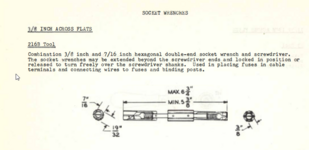

Other than being a cool double ended (3/8 x 1/2) nut driver, I didn't know these were classic Telco tools until I did some research. Not branded BELL. But the "216C" marking took me to a few other related posts here.
Hey, thanks for the documentation prompt.You have the new one
Hey, thanks for the documentation prompt.
I saw the prior conversation. Are we sure the "C" suffix signifies "new" (meaning, same tool, but later production than "216B")? What did the implicit predecessor (216A) in that scheme of thinking do? Or is it rather a related but different tool that could be the same production era or even older than some of the 216B's I have seen? The ends on this 216C do not pull out, they are not provisioned to pull out, and there are no screwdriver blades inside. Do we think the later version was designed to do less (regress in functionality)? Or was the "C" version of the 216 always just the socket wrenches? On top of that all that, I am pretty sure the translucent amber handle is vintage Cellulous Acetate Butyrate (CAB).
But I am interested in learning more.
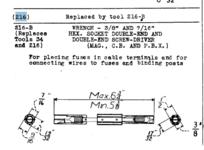
No later than 1974 based on the BSP I just excerpted.The 'C' version must be newer than 1954 from what I can gather.
The 1974 BSP I excerpted noted the series of replacements (216->216B->216C) for the same job, but did not show the 216 or 216B. You posted an excerpt showing the 216B in a document and now a different excerpt, also of a 216B, from a different document, but neither one shows the 216. (Please cite the documents you are excerpting from.) I was poking around in the Telecom Archives and couldn't find either the 216 or 216B.If we back up to the 30's the 'B' version replaces the 216.
No later than 1974 based on the BSP I just excerpted.
The 1974 BSP I excerpted noted the series of replacements (216->216B->216C) for the same job, but did not show the 216 or 216B. You posted an excerpt showing the 216B in a document and now a different excerpt, also of a 216B, from a different document, but neither one shows the 216. (Please cite the documents you are excerpting from.) I was poking around in the Telecom Archives and couldn't find either the 216 or 216B.
Also could you share the link to the document where you found 216C?
The Telecom Archive
The Telecom Archive

The nickname turned up in searches, Jock, including the prior convo I linked in post #288, but no photos of the "can" itself. Thanks.Those double-ended nut drivers (the -C version) were called a "can wrench"
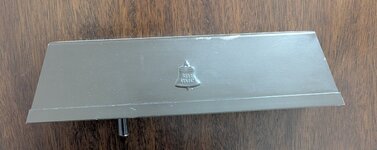
How many screws? How many security guards? And what time does the courthouse close?A brown metal lamp attached to the side embossed with a Bell System logo.

Negative on the pay phone. It has everything else-stool, hardware etc. The courthouse is from the mid 1800's.Awesome booth -did it still have a working pay phone inside?


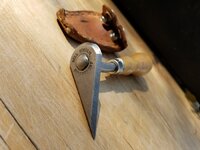
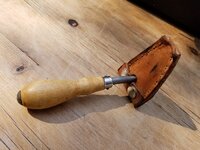
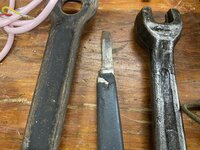
Mine came with a leather sheath (technically, "Hook Guard"), with two snaps, which is a good thing, because it's lethal sharp!@Private Lugnutz and @Tarnished had similar ones some years back, maybe others have shown up.
Indeed!It's called a shave hook...

And woodworkers use those as paint prep tools, or to smooth grain. I have a three pack of different shapes. One like Jim’s, one like this, and a gooseneck I think,It's called a shave hook, used to clean lead cable and lead sleeves for hot lead wiping

Me either.I would have never thought to look for Bell on such a tool!




 telco items.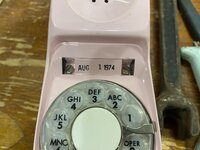
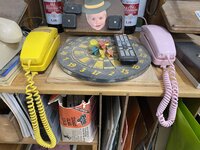
 But I did eventually talk them into upgrading. Wasn’t back on a repair call that I could ever remember. At a function I thanked the salesman for getting it off my hands. Don’t remember buying myself another beer
  for the remainder of the evening.


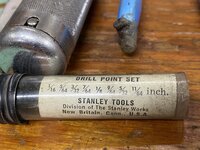
A fellow I formerly workd with is turnied 90 and still lives in his home. We chat every so often and he called me the other day. He asked me if I wanted some of his old tools. He said keep what you want make up a tool box for your Grandson, give the rest away and whatever you have left toss out.. Some of the non telecom tools I have posted on http://www.garagejournal.com/forum/showthread.php?t=360891
Here are a few pics of some of Ken’s

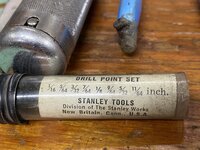
I was looking for a Yankee Drill as I had sent mine back shortly after being issued it. Just didn’t need it. But when I seen Ken’s originall blade container. I never was issued the container but had all the original bits that didn’t make it back with the drill. When I was cleaning out one of my work tool boxs, I still had the bits or what I believed were the bits for the Yankee drill. I relocated them and yes I had the full set likely never used.
did they date code the Bell issued tools inside the handles?I found a pair of Klein/Bell System dykes at a NV estate sale yesterday.

Lemme poke around. If I have a Bell marked, it’s yours to complete your set if you want it.I was looking for a Yankee Drill as I had sent mine back shortly after being issued it. Just didn’t need it. But when I seen Ken’s originall blade container. I never was issued the container but had all the original bits that didn’t make it back with the drill. When I was cleaning out one of my work tool boxs, I still had the bits or what I believed were the bits for the Yankee drill. I relocated them and yes I had the full set likely never used.
These have a date code. Looks like the second quarter of 1956.did they date code the Bell issued tools inside the handles?
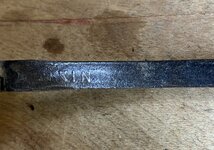
Do Telephone Company Service People have really tiny fingers?
Ken had 2 similar **** ins in better condition but had promised them elsewhere.I have two of those Yankee drills, one of them being an ex-Bell System in fact. One's in the basement shop, the other is in the utility room hardware drawer. Both have full sets of newish drills (Garrett Wade) in them and I use them routinely for drilling small holes. Quicker and simpler than getting out either of the eggbeaters (one big, one small) and locating the drill index.
Lemme poke around. If I have a Bell marked, it’s yours to complete your set if you want it.
If not a Bell, I have a brand new looking one. More later.
I would speculate the dial is designed to be used by gloved hands (the points) or some readily/constantly available rounded tool that fits perfectly in the rounded depressions.Do Telephone Company Service People have really tiny fingers?
I would speculate the dial is designed to be used by gloved hands (the points) or some readily/constantly available rounded tool that fits perfectly in the rounded depressions.
No, not Bell systems. I’m sure it was a highly described and documented tool, which cost a bunch of money, is called a scriber, and shaped exactly like a ball point. More likely a pencil for the era, that may predate a Bic, not so ubiquitous back then.I always figured a ball point pen