
To avoid these ads, REGISTER NOW!

Bench grinder problems

DadsTools

Well-known member
Joined
Jul 27, 2017
Messages
1,852
What "obvious bearing problem"? He said it turns freely. A grinder with a centrifugal start switch (like this one has) will not turn as freely as a PSC grinder.

The motor has a starting problem. An electric motor that isn't turning will turn all of the electricity it consumes directly into heat. If a bad capacitor, faulty start switch, or faulty wiring is preventing the start windings from working, the motor will get extremely hot rapidly.

You should know that.

You're jumping to all sorts of conclusions, when the reality is that the grinder probably just needs a re-wire and a cleaning. It's worth throwing $40 in parts and time at. Worst comes to worse, you have a bunch of wire and cord for something else.
"Probably" is the operative word. He said when he spun it by hand, it only rotated a "few times." That thing should spin quite a bit before it stops. I'm sure you know that.

BTW, whose $40 are we talking about here? Yours or his?
 
To avoid these ads, REGISTER NOW!
OP
B

bbcmudtruck

Well-known member
Joined
Apr 14, 2015
Messages
54
Depends on whether they're pressed on the arbor--considering the age and brand, they might be. You'll have to find the exact correct size replacements, and you won't know that until you tear it apart. Unless some expert in here can tell you precisely what size they are and where to order them without having inspected them first. Then let's hope the channels for them in the casting and the arbor are are still fine--if there's corrosion on the arbor under the bearings, once you remove them and clean the arbor it will no longer be the same diameter because of the metal loss due to the oxidation. Very critical for something turning heavy wheels at those kinds of rpms.

Hey, but have at it. No sweat off anyone else's back here. We're just talking--you're the guy who has to do the work.

As for buying a new one, it just depends on how heavy you're going to use it and what you can spend. Think about it--if everything made today is no good, almost no one would own a working bench grinder! Doesn't sound like you're going to do machine shop production work. Mechanics just need them sometimes to remove rust or grind a screwdriver or tool, sharpening, or modify'fabricate a part. Read online forums that are more machine-shop oriented and see what they like.

Good luck!
No sir, no machining lol. Just the type of everyday stuff you described. I'm OK with dumping some money in to this one to see if it will work. I do respect your opinion though and appreciate your help.

Sent from my SM-G935P using Tapatalk
 
OP
B

bbcmudtruck

Well-known member
Joined
Apr 14, 2015
Messages
54
"the bearing issue it obviously has" ?? How can you tell that without it running? OP needs to first check to see if it's wired for 115 or 230 volt and go from there. How's a person supposed to learn if they don't try? It's not rocket science, or anything to be afraid of, just use care and common sense and ask questions as needed.
Thanks bud, you summed it up pretty good. If it is worth fixing, I would like to give it a shot and learn a little along the way!

Sent from my SM-G935P using Tapatalk
 

DadsTools

Well-known member
Joined
Jul 27, 2017
Messages
1,852
"the bearing issue it obviously has" ?? How can you tell that without it running? OP needs to first check to see if it's wired for 115 or 230 volt and go from there. How's a person supposed to learn if they don't try? It's not rocket science, or anything to be afraid of, just use care and common sense and ask questions as needed.
He stated that when he spun it by hand, it only turned a few times. That thing should spin for quite awhile. Don't need to turn the power on for that test.

I'm just trying to save the man potential aggravation on something he didn't buy specifically for its purpose anyway--it came with a lot along with other items he was really buying the lot for.

As for learning, I don't recall anyone mentioning he was looking for an educational experience. He was asking if it was worth messing with. You're assuming he wants to learn about fixing old grinders. That may be your goal, but perhaps not his.
 
OP
B

bbcmudtruck

Well-known member
Joined
Apr 14, 2015
Messages
54
Before condemning the bearings or anything like that, you need to get it running.
10/4. I'm going to tear into it a little more this evening. I'll post up some pictures along the way so that you guys can see what I'm seeing. Hopefully that will help you guys that understand how to fix these things guide me in the correct direction. Thank you!

Sent from my SM-G935P using Tapatalk
 

American Locomotive

Well-known member
Joined
Jan 8, 2017
Messages
10,929
Location
Rhode Island
Very critical for something turning heavy wheels at those kinds of rpms.
It's a low-speed 1700 RPM grinder. Many universal grinding wheels comes with cheap plastic shaft size adapters. It's really not that critical.

"Probably" is the operative word. He said when he spun it by hand, it only rotated a "few times." That thing should spin quite a bit before it stops. I'm sure you know that.

BTW, whose $40 are we talking about here? Yours or his?
I have three bench grinders, if I give them each a light turn, none of them continue turning for more than a few revolutions. The one with the wire-wheel stops turning nearly instantly from the bristles. This grinder has a wire wheel on it, too.

It's impossible to judge the bearings without powering the machine up.
 

MFolks

Well-known member
Joined
Feb 3, 2013
Messages
1,045
Location
Springfield Mo.
Are there any electrical motor repair shops nearby? If so,they might be able to sell you a replacement capacitor,bring in the old one,but make a drawing of where the wires connect to first,or some easy to see photo's with your cell phone camera.
 
OP
B

bbcmudtruck

Well-known member
Joined
Apr 14, 2015
Messages
54
Are there any electrical motor repair shops nearby? If so,they might be able to sell you a replacement capacitor,bring in the old one,but make a drawing of where the wires connect to first,or some easy to see photo's with your cell phone camera.
None that I'm aware of, but I'm sure there is within 50 miles or so. I'm more or less wanting to tackle this myself to keep it a budget friendly venture. If it doesn't work, I wont be out any serious money. If it does work, then I'll have a monster bench grinder for little invested, plus hopefully some knowledge gained along the way!

Sent from my SM-G935P using Tapatalk
 

Cruzan80

Well-known member
Joined
Jul 22, 2015
Messages
4,167
Location
Denver, CO
Anything in quotes is referred to by it's easiest identifiable name, not neccesarily the most technical.

Easiest way to start is by slowly disassembling the unit. Take the guards off, the wheels, the inside guards and see if the lights can un-mount without disconnecting wiring. At this point, you should have a "motor" with two steel arms sticking out. Next, take pictures of any and all wiring. Disconnect the switch and capacitor. See if any of the wires coming out of the motor have numbers printed on them. Look under each plate to see if you can find a wiring diagram to tell you how this is to be wired for 115/230.

At this point you can start to check things. Does the switch maintain continuity when switched on (easy to test via multimeter)? You can see how much a new capacitor is by reading the numbers. Replacing bearings will prboably involve taking the "cones" off the outside of the "motor" (parts outside the nameplate). They most likely have numbers and letters printed on the outside, so it is easy to match them to existing parts. If not, you need to measure the outside and inside diameter.

Needed tools for the above? Screwdrivers, pliers/wrenches, wire cutters (maybe), camera, bearing puller (maybe). New supplies (at this point)? Power cord, capacitor, switch, thhn (for inside wiring), bearings (maybe). There is a chance that after all of this there is a break somewhere in the coil, preventing it from ever working correctly without lots of money, but unlikely.

Make your own decision. I have a CM block grinder which I will be doing the same as the above, already partially torn down. Not rocket science, and there is lots of help here to walk thru testing parts.
 

pcmeiners

Well-known member
Joined
Aug 13, 2009
Messages
7,831
Location
In the only town in Pennsylvania, Bloomsburg.
"It's impossible to judge the bearings without powering the machine up. "

The bearing are likely more then 10 years old... especially if they have shields, they should automatically be replaced. If not replaced, the old bearing will have in the least more friction, wasting electric and added heat due to the grease break down.
 

Dozerhand

Well-known member
Joined
Dec 9, 2010
Messages
626
Location
Illinois
You should probably goggle "discharge capacitor" before you get poking around in there to much.
 

yhprum

Well-known member
Joined
Jul 27, 2006
Messages
1,380
Location
Brisbane Australia
None that I'm aware of, but I'm sure there is within 50 miles or so. I'm more or less wanting to tackle this myself to keep it a budget friendly venture. If it doesn't work, I wont be out any serious money. If it does work, then I'll have a monster bench grinder for little invested, plus hopefully some knowledge gained along the way!

Sent from my SM-G935P using Tapatalk
\
The older the shop, the better in this case.
 

American Locomotive

Well-known member
Joined
Jan 8, 2017
Messages
10,929
Location
Rhode Island
The bearing are likely more then 10 years old... especially if they have shields, they should automatically be replaced. If not replaced, the old bearing will have in the least more friction, wasting electric and added heat due to the grease break down.
10 year old bearings should automatically be replaced? Seriously? I have a bench grinder from 1946 with the original bearings. It's works great.
 

My Old Tools

Well-known member
Joined
Jun 4, 2014
Messages
5,427
Location
Hamrick Lake, TX
"Probably" is the operative word. He said when he spun it by hand, it only rotated a "few times." That thing should spin quite a bit before it stops. I'm sure you know that.

BTW, whose $40 are we talking about here? Yours or his?

Actually, you are wrong again. New bearings have quite a bit of resistance due to the grease in them. Bearings that spin forever have no grease and need serviced or replaced. You also don't know anything about quality cast iron machinery. It might have a bad winding, but it most likely has a bad $8 capacitor. You can test that with a decent meter without spending any money. Capacitors are available on Amazon, Grainger, MSC, McMaster, and your local electrical supply house. Take it in and let them match it. Same for bearings, the local bearing house can match them.
 
Last edited:
OP
B

bbcmudtruck

Well-known member
Joined
Apr 14, 2015
Messages
54
Thanks for all the help and encouragement fellas. This is truly what the gj was designed to do! I'm sure dads tools has messed with these things before and I dont take any negativity from his opinion on what to do with it. He is trying to save me money and unessesary labor on a project that may or may not work. I appreciate that!

On the other hand, I appreciate all of you guys encouraging me to give it a shot and see what happens. Worse case scenario I spend an additional 50 bucks or so and it turns out to be junk. Best case scenario is that I wind up with a monster of a bench grinder for a small investment in time and money. With all of the helpful guys chiming in here, I'm hoping for the later!

Thank you guys, I really appreciate the help thus far. I will post up some progress as soon as it happens!

Sent from my SM-G935P using Tapatalk
 

CrotalusAtrox

Well-known member
Joined
Mar 5, 2016
Messages
796
Location
The Great Southwest
Fix it up and learn something about fixing a grinder they are pretty easy. If it doesn't work then move on. It looks like the cap maybe cracked change it out there about $8 clean up the wiring and change the bearings. If this is the first time you do this it might take you a couple hours to get it running. If you don't have the time try and find a Baldor, Wissotta or another Dayton that is already working and use it to your hearts content. If you decide to fix it PM me if you get into any binds.
 
OP
B

bbcmudtruck

Well-known member
Joined
Apr 14, 2015
Messages
54
Did you change the plug ? I have done so, missing that is was a 220v plug. Tried to run it on 110v, veeeery slow !

Brian
No not yet. I've been swamped with work and haven't had the chance to tear into it yet. Thanks for the help though!

Sent from my SM-G935P using Tapatalk
 
OP
B

bbcmudtruck

Well-known member
Joined
Apr 14, 2015
Messages
54
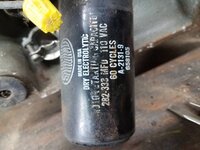
OK here is a little progress. This is the capacitor. a4c8acca8e9b68ad0ac8a988c0358893.jpg

Sent from my SM-G935P using Tapatalk
 

Attachments

  • a4c8acca8e9b68ad0ac8a988c0358893.jpg
    a4c8acca8e9b68ad0ac8a988c0358893.jpg
    81.9 KB · Views: 2
OP
B

bbcmudtruck

Well-known member
Joined
Apr 14, 2015
Messages
54
I'm having a little difficulty finding an exact replacement in the 282-338 MFD numbers. Do those have to be exact, or can there be a little leeway?

Sent from my SM-G935P using Tapatalk
 
To avoid these ads, REGISTER NOW!

exmaxima1

Well-known member
Joined
Jun 25, 2011
Messages
6,339
Location
Midwest
OK here is a little progress. This is the capacitor. a4c8acca8e9b68ad0ac8a988c0358893.jpg

Sent from my SM-G935P using Tapatalk

If that capacitor is correct, you have a Cap-Start motor (not a Cap-Run), and will have a centrifugal switch of some sort inside the motor. That would also explain the lack of spinning by hand as the switch would have some drag.

As far as uF value, anything that fits in the range listed on the cap will suffice. Just make sure it is rated at the same voltage (or higher).

I would pop the ends off the motor and see if you have a switch. If not, you indeed have a cap-run motor as suggested earlier. BTW the cap you show is much newer than the grinder, and it's possible that someone installed the wrong type/value which could explain the overheating issue.
 
Last edited:

The Cobbler

Super Moderator
Staff member
Joined
Oct 24, 2013
Messages
25,812
Location
Niagara Region, Ontario, Canada
being the grinder was originally rated for 115/230, and the cap is only 110v I suspect it has been changed
the cap should be rated for at least the highest voltage the motor is rated for
 
OP
B

bbcmudtruck

Well-known member
Joined
Apr 14, 2015
Messages
54
OK, I'll pop the ends off and look for a switch and we will go from there. Thanks for the help thus far!

Sent from my SM-G935P using Tapatalk
 
OP
B

bbcmudtruck

Well-known member
Joined
Apr 14, 2015
Messages
54
OK, I have the ends off and it looks like there is a switch in there. Now that we know that, what capacitor should I put back in it?d99ef9cb89b453d9edd9dc703a21e3b6.jpg

Sent from my SM-G935P using Tapatalk
 

Attachments

  • d99ef9cb89b453d9edd9dc703a21e3b6.jpg
    d99ef9cb89b453d9edd9dc703a21e3b6.jpg
    266.6 KB · Views: 1
OP
B

bbcmudtruck

Well-known member
Joined
Apr 14, 2015
Messages
54
Here's a better picture of the switch. There's nothing broken or any bare wires. It all looks to be in pretty good shape. The bearing in this side appears to be in worse shape than the other side though. I'm going to go ahead and replace them both while I have it apart. Bearing number 99205 is what is on the seals. Where's a good place to get quality replacements?3d66a8873f242375c4cd3afefec6eb94.jpg

Sent from my SM-G935P using Tapatalk
 

Attachments

  • 3d66a8873f242375c4cd3afefec6eb94.jpg
    3d66a8873f242375c4cd3afefec6eb94.jpg
    264.2 KB · Views: 1

American Locomotive

Well-known member
Joined
Jan 8, 2017
Messages
10,929
Location
Rhode Island
Switch looks pretty grungy. See those copper strips there? Those are the switch contacts. Make sure those are clean, and that the circular contact ring on the switch itself is clean.
As for the start capacitor, just find a start capacitor within that MFD range, doesn't have to be exactly a match. As for voltage, anything over 230v will be okay.

Do the bearings turn smoothly? If so, I'd leave them alone. I'd only think about touching them if they turn roughly, or sound crunch when turning them. It's pretty easy to bend a grinder's shafts way out of whack changing bearings.
 
Last edited:

captaindiode

Well-known member
Joined
Jul 8, 2013
Messages
370
Location
NC
Doesn't have to be exact. Electrolytic capacitors can be +/- 20%. I would shoot for 300 MFD @ 125V ( if you are running ar 120). Be sure it is a motor starting capacitor.
 
OP
B

bbcmudtruck

Well-known member
Joined
Apr 14, 2015
Messages
54
OK thanks fellas! The bearings turn smooth and dont have any grinding sound or crunchy. The bearing on the left side turns freely, but it is slightly harder to turn than the right side. I would explain it as having a feeling of being full of grease vs the other side. I wont replace them if I dont need to. I'll clean everything up real well before I put the sides back on. Would acetone be ok to use on the copper strips/contacts?

Sent from my SM-G935P using Tapatalk
 
OP
B

bbcmudtruck

Well-known member
Joined
Apr 14, 2015
Messages
54
Is this what I'm needing? 531ad874f5991d7a79d202a3b808bce1.jpg

Sent from my SM-G935P using Tapatalk
 

Attachments

  • 531ad874f5991d7a79d202a3b808bce1.jpg
    531ad874f5991d7a79d202a3b808bce1.jpg
    112.6 KB · Views: 1

American Locomotive

Well-known member
Joined
Jan 8, 2017
Messages
10,929
Location
Rhode Island
If the bearings turn smooth with no obvious grinding, leave them alone. If they do turn out to make noise, it's not too bad to take the grinder apart.

I would just lightly clean the contacts with something like a scotch-brite pad.

Edit: Yeah, that capacitor would be fine. Don't worry about the voltage. It's pretty much meaningless, as I've seen plenty of older 120/240v motors with factory start carps rated at 120v. The start capacitor is connected for such a short time, that it doesn't really matter.

Where it really starts to matter is with run capacitors - but you don't have those.
 
Last edited:

CrotalusAtrox

Well-known member
Joined
Mar 5, 2016
Messages
796
Location
The Great Southwest
That centrifugal switch isnt bad at all just clean the fragil copper connections with some steel wool but be careful. American Locamotive how in the heck would you bend a shaft changing bearings???
 
Last edited:

American Locomotive

Well-known member
Joined
Jan 8, 2017
Messages
10,929
Location
Rhode Island
That centrifugal switch isnt bad at all just clean the fragil copper connections with some steel wool but be careful. American Locamotive how in the heck would you bend a shaft changing bearings???
Grinder shafts are pretty long and spindly. A sufficiently stuck bearing with a big-angry-bearing-puller that's not quite centered could definitely tweak the shaft.
 

2oolhound

Well-known member
Joined
Dec 18, 2010
Messages
5,918
Location
BC Canada
I'm glad you are tackling this. It will be an awesome grinder.

What bearing seems gummy? The reason I ask is because the shaft appears to be blue from heat in the 1st pic which would indicate a faulty bearing. Most grinders without a means of lubrication have sealed bearings. If you don't have oil cups or grease fittings on your outer casting you have sealed bearings unless you repack them with grease occasionally. Grinder bearings usually have metal shields on the sides to block out metal particles created from grinding. Looking up your bearings they say "no seals" so maybe there is a way to lube them. Usually there will be an "S" (seal) or "Sh" (shield) or other code along with the number to indicate if sealed and if so what type of seal so pay attention to the full part number.

Hopefully I'm wrong about the blueness on the shaft and you can re-use the bearings. I've always tested bearings by putting some side and then downward force on them while turning them slowly feeling for any grit or unevenness. . They should be smooth as glass with no detectable resistance. It the gummy one has dry grease I'd clean by soaking in gas or other solvent then blow dry with a compressor. It should turn smoothly afterward. If you turn a new bearing fast it is quiet. The more worn they get the louder they get.

If you examine inner and outer bearing races you will see they have a mirror finish where the rollers or balls contact. Eventually this mirror finish will become dull where the contact areas that bear the load are. Next the dullness turns to pitting at the same time the contact areas get deep enough that there is too loose a tolerance. If you put your finger inside the inner race and hold the outer race you can feel free play. At this point the bearing is wore out. A slight dull finish is ok but any tiny bumpy feeling under pressure from pitting or any looseness between the inner and outer races is not.
 

DadsTools

Well-known member
Joined
Jul 27, 2017
Messages
1,852
Kind of thought by what you were saying at the beginning of this thread there was a problem with the bearings. Apparently other issues as well. Obviously, there's a lot more than just rewiring it as someone else aggressively opined. And yes, there could be a problem with the spindle, which you'll discover once you pull the bearings. Remember, this needs to turn heavy wheels at high rpms with tight precision. Like I said before, sometimes with these antiquated electrical devices, it's like buying a fixer-upper house that doesn't seem to need much....that is, until you start opening up the walls. Hope you get lucky.
 

American Locomotive

Well-known member
Joined
Jan 8, 2017
Messages
10,929
Location
Rhode Island
Which picture do you see evidence of shaft blueing? I don't see that anywhere. A bearing that got hot enough to turn the shaft blue isn't going to turn smoothly, and would have certainly melted that plastic switch.
 

My Old Tools

Well-known member
Joined
Jun 4, 2014
Messages
5,427
Location
Hamrick Lake, TX
I've run grinders that the bearings were so loose they rattled. These are not high precision devices. If the bearings feel smooth but you think one is a little dry, you can pry back the shield and put some grease in it. In reality, the bearings are so cheap it's easier to just change them if you have an arbor press or a decent bearing puller. Odds are it will run a long time on what is in there. And now you know how to pull it apart if you need to change them later. Throw the capacitor in there and try it out. It isn't going to explode. Everything in my shop is 50+ years old. Hell, my 32" Crescent bandsaw was built in 1910 or so and still has it's babbit bearings. My 10" Baldor grinder needs bearings based on it coasting for 5 minutes after I turn it off, but I just haven't found the time. It still grinds just fine. I would get it running before I worried about bearings.
 
Last edited:
OP
B

bbcmudtruck

Well-known member
Joined
Apr 14, 2015
Messages
54
Appreciate the input fellas. I ordered the capacitor yesterday evening. I'm gonna try to find a new power cord in town today. I should be looking for 12/3 correct?

Sent from my SM-G935P using Tapatalk
 

My Old Tools

Well-known member
Joined
Jun 4, 2014
Messages
5,427
Location
Hamrick Lake, TX
Any electrical supply including Lowes and HD will have soft jacket cord. 12/3 should be fine and pick up a high quality plug for whichever voltage you are going to use.
 
To avoid these ads, REGISTER NOW!
Top Bottom