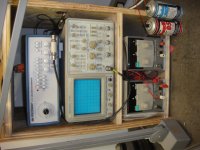
I'm going to start out by admitting I don't actually need an oscilloscope. I have always wanted one. I will probably never end up with a fully outfitted electronics bench but a scope is one of those things that I will get. My end goal is to have in addition to my pc/tablet/phone repair bench a complete enough setup to call a 'small electronics lab' minus the cleanroom. I don't intend to have all the various signal and standard generators and all the rest. I do want enough to to more than what you can do with a mid-high end multimeter.
Someday I really want to get a nice vintage analog as well as a modern digital, but that's not what this is about.
So. Let's say I want to buy a bench unit oscilloscope. A pawn shop near me has a Beckman 9020 though I didn't look at whether it's the 'Industrial' or 'Circuitmate'. They also have a Leader LBO-310 Ham. I haven't seen either one turned on and working, no info about calibration, etc etc. They told me they plugged an electric guitar in with an adapter and saw the waveforms it made, so each one functions. I don't think they have a 'full' probe set for either one.
In comparison this portable at 10kHz and one input, might do everything I 'need' or not. I have had the Rigol DS1054z on my wish list for a while. At 50MHz and 4 channels it's nicer than all the rest, but more costly and probably more than I will ever really need or utilize.
Aside from the Rigol, the Beckman is the nicest with dual inputs & 20MHz bandwidth, but I honestly don't know if I 'need' any more than the 10k bandwidth the others can do. Can someone tell me other than size and portability would you buy the portable one over the Beckman assuming it's working properly? My intended uses is testing simple components, building guitar & bass electronics, perhaps locating faults in circuits for tube & solid state amps if I can, and whatever general consumer electronics repairs I might otherwise have to pay for if it comes along. Right now if something goes wrong with a tablet for instance, I replace a board instead of being able to pinpoint a component failure. That may never change but to give you an idea of what I'm aiming for here.
Finally if I buy either one from the pawn shop what kind of things can I bring there to test it out? I have only a few components, several values of capacitors for my basses and a huge variety of resistors, but no chips of any kind. The main thing is I don't have any standards, traceable or otherwise, or a bench power supply, or anything really like that. I figure if I plug it into the mains and see the 60Hz sine wave, that's something. I could bring my car battery charger from the garage and watch the volts go up and down in a trickle charge mode.
I have used scopes in the past but only for very limited uses like finding matching resistors, comparing outputs from effects pedals with a 2 channel, mostly stuff I have been shown how to do in the past. Much of which I have also learned to do with a multimeter since. I don't have a specific job coming up that needs one but seeing they had two in there got me thinking at least I have two to choose from if I go through the effort to test one out.
Someday I really want to get a nice vintage analog as well as a modern digital, but that's not what this is about.
So. Let's say I want to buy a bench unit oscilloscope. A pawn shop near me has a Beckman 9020 though I didn't look at whether it's the 'Industrial' or 'Circuitmate'. They also have a Leader LBO-310 Ham. I haven't seen either one turned on and working, no info about calibration, etc etc. They told me they plugged an electric guitar in with an adapter and saw the waveforms it made, so each one functions. I don't think they have a 'full' probe set for either one.
In comparison this portable at 10kHz and one input, might do everything I 'need' or not. I have had the Rigol DS1054z on my wish list for a while. At 50MHz and 4 channels it's nicer than all the rest, but more costly and probably more than I will ever really need or utilize.
Aside from the Rigol, the Beckman is the nicest with dual inputs & 20MHz bandwidth, but I honestly don't know if I 'need' any more than the 10k bandwidth the others can do. Can someone tell me other than size and portability would you buy the portable one over the Beckman assuming it's working properly? My intended uses is testing simple components, building guitar & bass electronics, perhaps locating faults in circuits for tube & solid state amps if I can, and whatever general consumer electronics repairs I might otherwise have to pay for if it comes along. Right now if something goes wrong with a tablet for instance, I replace a board instead of being able to pinpoint a component failure. That may never change but to give you an idea of what I'm aiming for here.
Finally if I buy either one from the pawn shop what kind of things can I bring there to test it out? I have only a few components, several values of capacitors for my basses and a huge variety of resistors, but no chips of any kind. The main thing is I don't have any standards, traceable or otherwise, or a bench power supply, or anything really like that. I figure if I plug it into the mains and see the 60Hz sine wave, that's something. I could bring my car battery charger from the garage and watch the volts go up and down in a trickle charge mode.
I have used scopes in the past but only for very limited uses like finding matching resistors, comparing outputs from effects pedals with a 2 channel, mostly stuff I have been shown how to do in the past. Much of which I have also learned to do with a multimeter since. I don't have a specific job coming up that needs one but seeing they had two in there got me thinking at least I have two to choose from if I go through the effort to test one out.