I'm making a little compressed air cooler with some 1/2" copper pipe and I'd really like to make some bends in it. I could use soft copper, but it cost twice as much, and I don't want to use compression fittings. Is it possible to bend 1/2" type M hard temper pipe with a conduit bender? Do I have to anneal it first? Do I need to fill the pipe with sand?


You are using an out of date browser. It may not display this or other websites correctly.
You should upgrade or use an alternative browser.
You should upgrade or use an alternative browser.
Bending hard copper pipe?
- Thread starter Sneeze357
- Start date
rockwithjason
Well-known member
you would have to anneal it at the least. I have seen it done with small bends.
gmwelder86
Well-known member
Anneal yes. Fill with sand no. Just make sure you flush it out with water after you heat it up before you hook it up to the compressor.
plumbstupid
Well-known member
Try going to a scrap yard and buying the length of soft copper you need or find a plumber and see if you can buy a small amount from them. Type M is gong to be difficult to bend.
rmmiller
Well-known member
It's like stepping over a dollar to pick up a dime isn't it? Say you save by half going this route but you go too far and wreck to tubing and have to buy more, there goes the savings. You don't have to use compression fittings with the soft, you could flare it.
You need to use a different type of bender than a conduit bender, whether its annealed, or soft. A conduit bender will pinch the tube.
REMS and yellow jacket make a bender for copper refrigeration tubing that also works with soft copper tubing. It looks like this:
http://www.ebay.com/itm/Yellow-Jack...055?pt=LH_DefaultDomain_0&hash=item2c76adf947
REMS makes a bender for hard copper pipe, but its expensive, so I think the cheapest approach is either fittings, or use soft copper. They do make long turn radius fittings that will reduce the drag.
Good luck,
Chris
REMS and yellow jacket make a bender for copper refrigeration tubing that also works with soft copper tubing. It looks like this:
http://www.ebay.com/itm/Yellow-Jack...055?pt=LH_DefaultDomain_0&hash=item2c76adf947
REMS makes a bender for hard copper pipe, but its expensive, so I think the cheapest approach is either fittings, or use soft copper. They do make long turn radius fittings that will reduce the drag.
Good luck,
Chris
djjsr
Well-known member
Follow the link below to a pdf of the copper tube handbook. Scroll down to page 41 for information on bending. The table will show you the types, sizes and radii.
http://www.copper.org/publications/pub_list/pdf/copper_tube_handbook.pdf
http://www.copper.org/publications/pub_list/pdf/copper_tube_handbook.pdf
Del Swanson
Active member
- Joined
- Dec 29, 2010
- Messages
- 34
NEVER EVER use type "M" copper for compressed air use! The best is black pipe. Don't use galvanized as pieces could flake off and get lodged into orifices or shoot out of an air nozzle. If you must use copper, use type "K" (refrigeration). If you don't want to spend the money on "K" use "L". "M" is used for drains and is not intended for pressure use. Always isolate vibration with a flexible connector between the compressor and the piping. Use dirt legs and pitch the main run to a drain.
djjsr
Well-known member
NEVER EVER use type "M" copper for compressed air use! The best is black pipe. Don't use galvanized as pieces could flake off and get lodged into orifices or shoot out of an air nozzle. If you must use copper, use type "K" (refrigeration). If you don't want to spend the money on "K" use "L". "M" is used for drains and is not intended for pressure use. Always isolate vibration with a flexible connector between the compressor and the piping. Use dirt legs and pitch the main run to a drain.
Sorry, I disagree with almost everything you've posted. M can be used for pressure and will easily meet the pressure requirements for the average garage compressor. It is not for drains. DWV copper is for drains. Go back to that link I posted for the copper tube handbook. Scroll down to tables 3a, 3b and 3c.
But you're right about isolating the vibration.
Wouldn't filling the pipe with sand solve that?A conduit bender will pinch the tube.
I've never heard of anybody using 1/2" copper pipe for any sort of drain ever in my life. It's rated to at least a few hundred PSI. 2" copper pipe maybe."M" is used for drains and is not intended for pressure use.
What is it that makes soft copper tubing so soft anyway? Is it a different material or is it just annealed differently?
wssix99
Well-known member
Follow the link below to a pdf of the copper tube handbook. Scroll down to page 41 for information on bending. The table will show you the types, sizes and radii.
http://www.copper.org/publications/pub_list/pdf/copper_tube_handbook.pdf
Great link!
JakeKohl
Well-known member
When bending brass tubing for wind instruments, they typically fill them with water and freeze them prior to bending. The ice keeps the brass from pinching. I have no idea if that is better or worse than sand but might be a thought.
mygarageone
Well-known member
Sorry, I disagree with almost everything you've posted. M can be used for pressure and will easily meet the pressure requirements for the average garage compressor. It is not for drains. DWV copper is for drains. Go back to that link I posted for the copper tube handbook. Scroll down to tables 3a, 3b and 3c.
But you're right about isolating the vibration.
Agreed , M copper has been used for yrs as a pressure pipe . It will be plenty safe for a air piping.
mygarageone
Well-known member
You will be frustrated as hell trying to bend hard copper , spend the money and save your self lots of aggravation..
Last edited:
Kevin54
MEMBER EMERITUS
Not sure about copper, but I had to form some hard aluminum tubing and not have any kinks in it. A tubing bender would not work without flattening the bend some. So what I did was take two blocks of aluminum and mirror imaged a cut 1/2" deep in each block, then used an arbor press to push the tubing through. I ended up with a beautiful bend that was still completely round within .005.
What kind of bend are you looking to put into the copper? And how tight of a bend?
BTW.....sand and water will not work. We tried it with aluminum, thinkiing that it would, but to no avail.
What kind of bend are you looking to put into the copper? And how tight of a bend?
BTW.....sand and water will not work. We tried it with aluminum, thinkiing that it would, but to no avail.
Mr onetwo
Well-known member
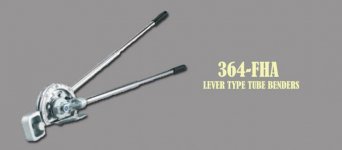
As a commercial master plumber I have bent miles of 1/2" copper tubing.Imperial makes the best bender IMHO...http://imperial-tools.com/products/364-fha-lever-type-tube-benders You MUST use type L tubing.I would not use type M in an air system because of vibration and corrosion concerns.You can get that bender used for less than $50.Plan on wasting a 10ft stick practicing.We always positioned the printing facing out...seemed to help with tearing....a little WD40 may help, but I never used it.
Attachments
Last edited:
Mr onetwo
Well-known member
Here's a decent set you can make an offer on. http://www.ebay.com/itm/Imperial-Ea...291929?pt=BI_Pipe_Benders&hash=item27de89b799 
Those are cheaper than I'd think. Would this multi size unit work?
http://www.ebay.com/itm/3-16-1-4-3-...822709?pt=BI_Pipe_Benders&hash=item4d18b25735
http://www.ebay.com/itm/3-16-1-4-3-...822709?pt=BI_Pipe_Benders&hash=item4d18b25735
87jeepwrangler
Well-known member
- Joined
- May 23, 2013
- Messages
- 195
This doesn't exactly answer your question, but if you end up going the soft copper route, look into spring bending. You essentially slide a spring over the outside of the pipe, and bend it by hand. The spring doesn't allow the pipe to crush.
RPH
Well-known member
They also make 180* u turns that can be sweated on. This would keep the radius very tight.
jwith68
Well-known member
Sorry, I disagree with almost everything you've posted. M can be used for pressure and will easily meet the pressure requirements for the average garage compressor. It is not for drains. DWV copper is for drains. Go back to that link I posted for the copper tube handbook. Scroll down to tables 3a, 3b and 3c.
But you're right about isolating the vibration.
djjsr, I agree with you. Nothing wring with using type M in an air system at all. Vibration isolation is important, but no less important for type K or L.
For those that haven't bothered to look at the Copper Handbook link, rated working pressures (not burst) for type M up to 250°F for 1/2", 3/4", and 1" are 850, 701, and 580 psi, respectively.
shamrock12
Well-known member
Would a thicker copper tubing work better for heat dispensation? (cooling the compressed air)
Kevin54
MEMBER EMERITUS
Would a thicker copper tubing work better for heat dispensation? (cooling the compressed air)
Chances are it wouldn't. What you would need is something similar to a heat sink to help cool. Just like a radiator, or like your baseboard hot water heat, there is fins to pull the heat away from the tube. The tube itself retains heat until you have fins to dissipate heat from the tube and pull it to the fins.
I don't know how thick the tubing is in baseboard hot water radiators but if the tubing was thick enough, it would probably be ideal for linking together, and running the air through. In an 8' baseboard HW register, there is probably 100 or so aluminum fins.
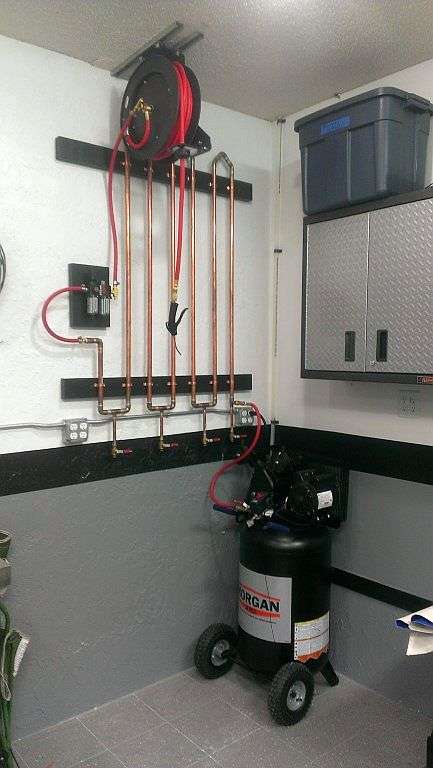
One of the members on here built a panel for his compressor, and I can't remember which member it is, but he had maybe a 4'x4' panel with copper tubing running up and down across the panel in maybe a series of 8 loops or so. It was all soldered together using elbows and straights, then had a few drops to catch water vapor.
I can try to find it later, and I may have saved a pic or two of it.
This is a bit off topic but we used
to bend steel for hydraulic lines.
We had a mandrel bender that was
bench mounted. Turn the crank to
what ever angle needed. Flared
the end. Good to 3500 PSI for industrial machinery.
Sent from my SCH-S720C using Tapatalk 2
to bend steel for hydraulic lines.
We had a mandrel bender that was
bench mounted. Turn the crank to
what ever angle needed. Flared
the end. Good to 3500 PSI for industrial machinery.
Sent from my SCH-S720C using Tapatalk 2
mygarageone
Well-known member
Chances are it wouldn't. What you would need is something similar to a heat sink to help cool. Just like a radiator, or like your baseboard hot water heat, there is fins to pull the heat away from the tube. The tube itself retains heat until you have fins to dissipate heat from the tube and pull it to the fins.
I don't know how thick the tubing is in baseboard hot water radiators but if the tubing was thick enough, it would probably be ideal for linking together, and running the air through. In an 8' baseboard HW register, there is probably 100 or so aluminum fins.
One of the members on here built a panel for his compressor, and I can't remember which member it is, but he had maybe a 4'x4' panel with copper tubing running up and down across the panel in maybe a series of 8 loops or so. It was all soldered together using elbows and straights, then had a few drops to catch water vapor.
I can try to find it later, and I may have saved a pic or two of it.
Fin tube copper is way to thin , not for pressure at all , it's actually thinner than dwv copper.
b-body-bob
Well-known member
One of the members on here built a panel for his compressor
Here is one thread, there are others
http://www.garagejournal.com/forum/showpost.php?p=3733787&postcount=46
akdiesel
Well-known member
I have bent hundreds of feet of stainless tubing. 035, 049, 065 etc wall thickness. I believe the standard copper tubing is 035 or 049 wall thickness.
The only stainless tubing I have bent the crinkled was 3/4" 035.
I have bent some copper tubing with good results but not 180 deg bends. I would believe the typical tubing bender would accomplish this task. The tubing benders are designed to allow for a clean bend for the types of wall thickness available.
Stainless tubing might be an option but the fittings can get a little expensive. The tubing is not that much more than copper.
The only stainless tubing I have bent the crinkled was 3/4" 035.
I have bent some copper tubing with good results but not 180 deg bends. I would believe the typical tubing bender would accomplish this task. The tubing benders are designed to allow for a clean bend for the types of wall thickness available.
Stainless tubing might be an option but the fittings can get a little expensive. The tubing is not that much more than copper.
Kevin54
MEMBER EMERITUS
Fin tube copper is way to thin , not for pressure at all , it's actually thinner than dwv copper.
I figured it would be, but the concept if the way it's made is more what I was sort of getting at. Thanks for posting though that it is way too thin. I didn't know for sure, so I'd hate for someone to do it and get hurt. That would be like using PVC for an airline

Here is one thread, there are others
http://www.garagejournal.com/forum/showpost.php?p=3733787&postcount=46
B-Body.....that's not the one I was thinking of, but it's the same concept. The one I saw had a solid piece of plywood behind it, but this one would probably be better as it has room for air flow all around it. Thanks for the time you spent looking it up and posting it.

If you find yourself using type L after all this advise you should be able to find it for the exact same price be it soft or hard drawn tube.I've been buying it since 1973 in small and extremely large quantities and have never paid a different price for soft vs. hard.
Del Swanson
Active member
- Joined
- Dec 29, 2010
- Messages
- 34
Sorry, I disagree with almost everything you've posted. M can be used for pressure and will easily meet the pressure requirements for the average garage compressor. It is not for drains. DWV copper is for drains. Go back to that link I posted for the copper tube handbook. Scroll down to tables 3a, 3b and 3c.
But you're right about isolating the vibration.
You can disagree all you want. I'm a journeyman Steamfitter with 20 years experience. I've seen first hand the damage using the wrong materials brings. I've had to fix a lot of "but the book said..." disasters. Do what you want, I just gave my professional opinion.
Do what you want, I just gave my professional opinion.
Welcome to the Jungle... (20 year+ Journeyman Electrician...)
Sent from my iPad using Tapatalk
stinkdad 021
Member
djjsr
Well-known member
....... "M" is used for drains and is not intended for pressure use.
You can disagree all you want. I'm a journeyman Steamfitter with 20 years experience.
Reference?
You can disagree all you want. I'm a journeyman Steamfitter with 20 years experience. I've seen first hand the damage using the wrong materials brings. I've had to fix a lot of "but the book said..." disasters. Do what you want, I just gave my professional opinion.
OK, I'll bite, what kind of damage have you seen? The book says type M is good for several hundred PSI...is the book wrong? Vibration will not be an issue here, it is not directly connected with a hard line to a compressor.
Even if copper was to burst...it will just split and let the air out. It does not explode/shatter like PVC or steel.
LS6 Tommy
Well-known member
I'm a Journeyman fitter, too, with almost 30 years experience in HVAC, Pharmaceutical manufacturing & Facilities Maintenance Management. I'm in no way discounting Del Swanson's knowledge or experiences, but my bet is the problems he encountered were brought on by misapplication, poor joint quality/wrong filler material. Even the safe rating of Annealed M at 300* F is roughly twice what any basic shop use air compressor will ever put out. It's also higher than or almost equal to the rating on most average spec 3/8" rubber compressed air hose.
On a side note, almost all discharge pipes coming off the cylinder heads on an air compressor are Annealed copper. I can't honestly say what type, though.
If you're absolutely dead set on making your own cooler & you want to use something with fins on it, go to an HVAC company and ask if they'll sell you a used condenser coil that has the same size tubing from a scrapped unit. I'm going to assume the cost of getting the used coil will be prohibitive, though. I had access to that stuff, so it was almost a zero cost project. Anyway, a condenser coil would be rated for much more pressure than what you're going to expose it to. I did that on all the smaller compressors in my old plant that didn't have refrigerated aftercoolers. You just cut a section out, flush it & braze your fittings right to it. It really does a nice job.
Tommy
On a side note, almost all discharge pipes coming off the cylinder heads on an air compressor are Annealed copper. I can't honestly say what type, though.
If you're absolutely dead set on making your own cooler & you want to use something with fins on it, go to an HVAC company and ask if they'll sell you a used condenser coil that has the same size tubing from a scrapped unit. I'm going to assume the cost of getting the used coil will be prohibitive, though. I had access to that stuff, so it was almost a zero cost project. Anyway, a condenser coil would be rated for much more pressure than what you're going to expose it to. I did that on all the smaller compressors in my old plant that didn't have refrigerated aftercoolers. You just cut a section out, flush it & braze your fittings right to it. It really does a nice job.
Tommy
Last edited:
mygarageone
Well-known member
M copper has been used for pressure water piping for years and with proper solider joints it certainly will handle air from a compressor . DWV copper is a totally different copper thickness .
Residential homes use M copper and commercial jobs use L copper.
And how do I know this ? Lic master plumber for 35 yrs.
Now having said all of that , I still would not use M and try to bend it. Because when you do you are stretching the outside curve on the pipe , there by making it thinner.
I think LS6 tommy has a great idea , get an old a/ c coil which will handle the pressure.
Heck a brand new A coil is only a couple hundred bucks. Or use soft copper as previously suggested , because that's what I would do.
Residential homes use M copper and commercial jobs use L copper.
And how do I know this ? Lic master plumber for 35 yrs.
Now having said all of that , I still would not use M and try to bend it. Because when you do you are stretching the outside curve on the pipe , there by making it thinner.
I think LS6 tommy has a great idea , get an old a/ c coil which will handle the pressure.
Heck a brand new A coil is only a couple hundred bucks. Or use soft copper as previously suggested , because that's what I would do.
A big A/C coil does sound like a good idea. I've thought about using one off a window AC before but it's too small. I know I've seen the big ones from a heat pump on craigslist.
Either way the rest of the pipe I'm going to run will be M, I need a few hundred feet.
Either way the rest of the pipe I'm going to run will be M, I need a few hundred feet.
You can bend it in a conduit bender. If you don't anneal it, you will get some dents/kinks. If you do anneal it first, it will be very easy. You don't need sand.
Annealing it is simple. For anyone who doesn't know, all you have to do for copper is heat it red hot. That's it. Unlike steel, you don't have to cool it slowly. Just heat the section you want to bend. You can even use a propane torch. Goes quicker if you use some insulation behind it like a fire brick or piece of Hardibacker cement board.
I just did this last weekend myself.
Annealing it is simple. For anyone who doesn't know, all you have to do for copper is heat it red hot. That's it. Unlike steel, you don't have to cool it slowly. Just heat the section you want to bend. You can even use a propane torch. Goes quicker if you use some insulation behind it like a fire brick or piece of Hardibacker cement board.
I just did this last weekend myself.
LS6 Tommy
Well-known member
You can anneal it, but remember you can also buy it annealed for the same cost as drawn.
Tommy
Tommy
You can anneal it, but remember you can also buy it annealed for the same cost as drawn.
Tommy
Maybe at a plumbing supply house, but not a place like Home Depot. Do they sell soft copper in the same size as hard so it can be soldered into the same fittings?
I'm still curious what the difference is between soft and hard pipe? Is it just the annealing? Or is it a slightly different material?