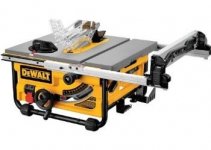
I purchased a Ridgid from Home Depot about 10 years ago. It's a contractor saw that comes with a stand with wheels. You can pick up one end and wheel it around like a wheelbarrow. I compared it to Craftsman and Dewalt contractor saws, and I liked it the best. It's well put together, easy to use, and you can adjust the fence to be dead-nuts in most positions. It cuts pretty well with the factory fence and has decent power. I've ripped lots of wood for shelves and miscellaneous projects, I've made smooth cuts in MDF and particleboard, and I've cut aluminum plate, plastic, tile, etc. with the correct blades. I've even ripped 4x8 sheets of 3/4" plywood with it, though I'd MUCH rather use a circular saw and a guide. It's been a good saw so far. However, it's not perfect:
-It has a built-in table extension that allows you to cut over 24" wide. The extension isn't flimsy, but it flexes enough that the fence will not clamp as tightly on the extension as on the main table casting. I've had the fence move after bumping it with a piece of wood.
-The blade guard and riving knife are easy to knock out of alignment, which will either make the riving knife go out of alignment with the cut, or move the guard to where it can touch the blade. Since the guard is clear plastic, you can see every damn blade mark on it clear as day. Yup, this is experience talking.
-The miter gauge is decent, but I'd like it if it fit a bit more snugly in the channel. Granted, this is a relatively inexpensive, portable saw, but still...
-The table insert is steel. It's retained by a flathead screw and the height is adjusted with four small grub screws threaded through the insert. These can be cranked down to adjust the insert height and vice-versa. However, the steel is so thin that it flexes easily. That means that if you screw the plate down tight enough to not loosen every third or fourth cut, the steel will flex and sometimes catch the edge of the wood as it is fed through the saw. Adjustment is always a balancing act between having the leading edge stick up from the table, and having the edge flush but having the middle bow up slightly.
-I'd like to buy or make a few blank table inserts. That was I can make my own zero-clearance inserts. However, because the original is retained with a single screw and a spring clip, and because it's so thin, I don't know if I'll be able to come up with something.
-The table is aluminum and will scratch, especially if what you're cutting has an unseen/unnoticed bit of cut-off staple sticking out of it. I see that scratch every time I use the saw. Grrrrr.....
-It's LOUD. I know, I know, universal motors are always loud. Still, this thing screams like a banshee. Hearing protection is mandatory.
-No access inside the saw from the back. Changing blades means removing the table insert, which means putting it back into place later and dealing with the aforementioned alignment issues.
-The cord holder on the back is just plain stupid. It's like a fixed plastic spool with a cutout to grip the end of the cord. You're supposed to wind the power cord around it and then clip it into the cutout. The cutout doesn't hold well, and if you wind up the entire cord, it blocks you from getting to the cutout anyway. I wind up what I can and then tuck the plug out of the way.
It sounds like I'm complaining a lot, but this saw has been a good investment. It's made a lot of sawdust over the years, works fine, is easy to adjust, and is reliable. It's not a real cabinet saw, but it's a decent, portable contractor saw. There are a few areas that can be improved, and in the last 10 years, Ridgid may have improved them. I don't know. I do know that there wasn't a Craftsman saw at the time that could touch it in terms of quality, and there wasn't a Dewalt saw at the time that could match its price.