To avoid these ads, REGISTER NOW!

Bethlehem "Quickway" Socket Sets - Bethlehem Spark Plug Co.

To avoid these ads, REGISTER NOW!

LesserSon

Well-known member
Joined
Feb 7, 2016
Messages
5,047
Location
PA USA
I’ve been tinkering with a printable mock-up of the wooden box under-lid label. I haven’t figured how to add a clean graphic of Quickway logo. And I have a very limited number of fonts, which only approximate the original typeface(s). I wish I had my desktop from 1998 - I had a full version of PhotoShop and hundreds of ttf fonts sorted into descriptive folders.
attachment.php
 

Attachments

  • Quickway%20label.pdf
    80 KB · Views: 142
Last edited:

LesserSon

Well-known member
Joined
Feb 7, 2016
Messages
5,047
Location
PA USA
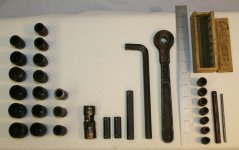
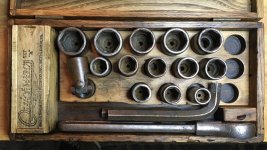
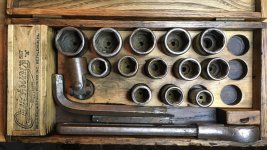
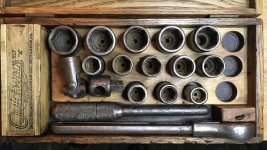
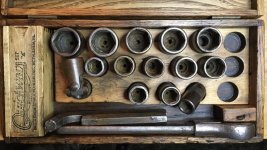
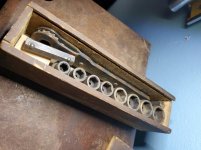
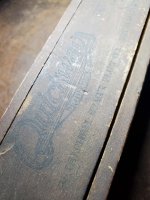
And today I got to use the list to check a “complete” no.”D” set from eBay. I should have counted the eBay photo more carefully - I’d have known one of the 1/2dr sockets was missing before I bid. Still, the “A” box has a very legible logo stamped on it, despite MISSING ITS BOTTOM (a little harder to detect from the photos), and that was what drew me to bid. The seller explicitly stated in the item description there was no large wooden box, so that’s not an issue.
The missing socket is the 3/4” (no.24), which is (sadly) also missing from my first set.
The ratchet is in better condition than the one I already had. Three of the 1/2dr sockets are stamped BETHLEHEM - 15/16, 23/32, 17/32. Only the 27/32 seems to be missing a fraction stamp. None of the 3/8dr sockets appear to be stamped, though all are knurled. One does seem to have something, but it is illegible, if it is characters at all. Most have linear dings, so it could be just that.
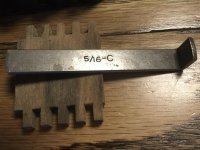
Also included for reasons beyond my ken, a small lever(?) marked 5/16-C.

BTW, someone else snagged the $20 A-set. I chose this one for what appeared to me to be a more distinct logo, plus the upgrade in completeness and condition over my previous set. I figured if it didn’t sell, I’d snag it later. But oh well, congrats to the new owner.
 

Attachments

  • ACDF1A47-9717-4A3F-A78C-DC213848FCDD.jpg
    ACDF1A47-9717-4A3F-A78C-DC213848FCDD.jpg
    148 KB · Views: 14
  • 0E3AF836-6D52-4BB2-A2DA-66AD4FF0A5DE.jpg
    0E3AF836-6D52-4BB2-A2DA-66AD4FF0A5DE.jpg
    144.8 KB · Views: 14
  • BFF1B1B4-992F-40BF-8CF2-3A95FB494B98.jpg
    BFF1B1B4-992F-40BF-8CF2-3A95FB494B98.jpg
    150.1 KB · Views: 14
Last edited:

LesserSon

Well-known member
Joined
Feb 7, 2016
Messages
5,047
Location
PA USA
When I saw the 15/16 socket was stamped BETHLEHEM, I figured the other sizes would correspond to the identically-stamped sockets in my first set, but NO! Only the 15/16 is stamped in both sets.
1st set: 15/16, 7/8, 5/8
2nd set: 15/16, 23/32, 21/32, 17/32.
Conclusion - some days they stamped them, some days they didn’t.
 

Private Lugnutz

Well-known member
Joined
Mar 30, 2012
Messages
30,473
Location
The Authentic Jersey Shore
I’ve been tinkering with a printable mock-up of the wooden box under-lid label.
At the risk of overstepping, LS, I'm not sure why you're taking this approach.

The "label" on the wooden boxes I have seen was burned in to the wood (See post #33 on page 2 and post #46 on page 3), embossed with a red hot die-stamp.

I know how I would recreate that. I would find the best version of the lid with a label that you can, play with the size of a few print-outs until it's to scale, firmly glue or tape it to the lid as a template, and then get a wood-burning kit with an extra fine tip and simply trace the label, burning right through the black text on the paper template into the wood.

It won't be as uniformly and sharply precise as a die, but it doesn't have to be perfect, because nobody has or has seen a perfect factory condition example of the lid, and you can distress the lid (carefully blurring and fuzzing the label here and there with a wire brush or 0000 steel wool) to make any perceived imperfections in your burning less noticeable and more aged.

Just a suggestion for you to try or reject as you see fit.
 
Last edited:

LesserSon

Well-known member
Joined
Feb 7, 2016
Messages
5,047
Location
PA USA
I'm not sure why you're taking this approach...because nobody has or has seen a perfect factory condition example.
You answered your own question. The best examples are hard to read in real time. I am making and correcting mistakes of interpretation in the process of compiling the pattern, not on the final wood surface itself, where they could not be corrected if done live with pyrography. (The mistakes of execution will be another matter, but less than if I was attempting to do it simultaneously.) If I had the equipment (to print upon an inflexible, flat surface) - which I don’t - I would print the final version of my pdf onto a metal plate in wax, then etch the plate in acid to produce the stamp/die you describe. I could then make as many lid replicas as I cared to.
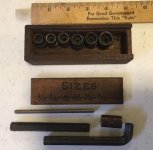
Having never seen a lid in person, until just this afternoon, I will not dispute that the original was made using a heated plate. I’ve seen other boxes stamped that way. I’m not sure heat will be necessary. I think simply pressing the wood fibers down with a metal instrument would be sufficient, followed with a stain.
That technique would afford making multiple cumulative passes, minimizing errors of execution. I have never done pyrography. It just seems that there would be a tendency toward a freehand/script look to the results, especially without expertise.
 
Last edited:

Oldtuleguy

Well-known member
Joined
Nov 4, 2017
Messages
10,453
I would probably get an 1/8 thick piece of door skin veneer and do it on that, rather than risk the nice lid. If it works just cut it to fit in the lid.
 

LesserSon

Well-known member
Joined
Feb 7, 2016
Messages
5,047
Location
PA USA
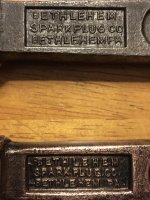
Cleaning up the second ratchet. It’s in better overall condition. The inside of the head (and the action) is smoother, the screws are in good shape, faceplate fits better. And it has retained much more copper. Interesting how different the lettering is on the two forged-in panels. Smaller, tighter spacing, and periods after the CO., PA., and (on reverse) U.S.A. The date code is JN (Oct1922) on the second (coppery) ratchet, and JO (Oct1923) on the first.
 

Attachments

  • B79DE568-0B27-426E-A5B5-CE112607976D.jpg
    B79DE568-0B27-426E-A5B5-CE112607976D.jpg
    122 KB · Views: 14
  • 57D1BB56-9B11-4AA5-A3B0-21BF6E211F39.jpg
    57D1BB56-9B11-4AA5-A3B0-21BF6E211F39.jpg
    135 KB · Views: 17
  • 733184FB-862B-4F19-97A0-3F74618E485B.jpg
    733184FB-862B-4F19-97A0-3F74618E485B.jpg
    139 KB · Views: 15
  • 09B73E78-9A24-416E-976C-FF907D7EFC9E.jpg
    09B73E78-9A24-416E-976C-FF907D7EFC9E.jpg
    145.6 KB · Views: 15
Last edited:

LesserSon

Well-known member
Joined
Feb 7, 2016
Messages
5,047
Location
PA USA
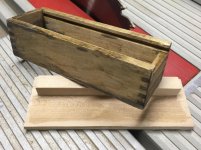
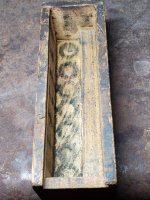
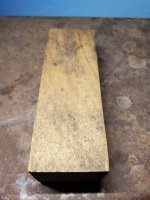
I cut a piece of basswood to thickness to make a bottom for the bottomless A set box.
Someone who has one, tell me: there IS supposed to be a bottom, right?
And, is it just a flat slab of the same thickness as the walls? Not rabbeted on the edge to set into the walls?
 

Attachments

  • B239D319-E082-4B93-A037-87C36DC99705.jpg
    B239D319-E082-4B93-A037-87C36DC99705.jpg
    147.2 KB · Views: 11

Oldtuleguy

Well-known member
Joined
Nov 4, 2017
Messages
10,453
Looks like just a flat piece that was glued to the bottom. There is a piece of 7/16 square stock in there.
 

Attachments

  • 20200209_040200.jpg
    20200209_040200.jpg
    148.4 KB · Views: 18
  • 20200209_040219.jpg
    20200209_040219.jpg
    112.8 KB · Views: 11
  • 20200209_040235.jpg
    20200209_040235.jpg
    96.3 KB · Views: 11
  • 20200209_040247.jpg
    20200209_040247.jpg
    96.8 KB · Views: 10
  • 20200209_040252.jpg
    20200209_040252.jpg
    69 KB · Views: 12
Last edited:

LesserSon

Well-known member
Joined
Feb 7, 2016
Messages
5,047
Location
PA USA
THANK YOU both.
OTG - thanks for measuring that spacer, and for pointing it out. I don’t think that I had noticed it in other images, but it makes a lot of sense to make the driver more accessible without having to dump the whole box out each time.
Here’s what I came up with.
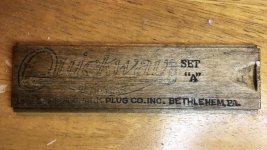
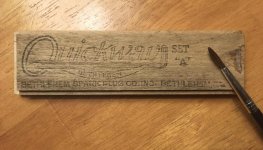
Historical-integrity-wise, I probably shouldn’t have done the retouching of the lid logo, but it was a bit weak, and I wanted to try. I started by tracing around the existing lettering with clear shellac and a no.0 round brush - VERY TEDIOUS. Then I used a very thin blackened shellac over the letters. Light sanding to remove the sketchy blobs and flatten the surface, then a coat of clear shellac rubbed out with BLO. Much of it is “improved,” but I can see my shaky hand in places. I wouldn‘t do it again, or at least, not without greater cause than I had. And I’d use finer sandpaper than the 400grit I did use.

BTW, I did NOT use the brush shown in two pics. Too big for the job.
 

Attachments

  • 913C212C-7DD3-4EA3-A6CD-3DE3C5E7A104.jpg
    913C212C-7DD3-4EA3-A6CD-3DE3C5E7A104.jpg
    152.1 KB · Views: 10
  • 3D575F4E-A722-4054-9984-921EFA7FC020.jpg
    3D575F4E-A722-4054-9984-921EFA7FC020.jpg
    154.3 KB · Views: 15
  • CF9C226D-4EEF-4408-B656-B34AB5D2D708.jpg
    CF9C226D-4EEF-4408-B656-B34AB5D2D708.jpg
    153.2 KB · Views: 12
  • 30D0B475-0332-4A05-9A4B-89467F8553FF.jpg
    30D0B475-0332-4A05-9A4B-89467F8553FF.jpg
    150.2 KB · Views: 10
  • 4854960E-D86B-4312-BF4E-2CC89869F377.jpg
    4854960E-D86B-4312-BF4E-2CC89869F377.jpg
    150.8 KB · Views: 14
  • 61FC89D3-6B56-4BCE-BF94-70F4C30BCBEE.jpg
    61FC89D3-6B56-4BCE-BF94-70F4C30BCBEE.jpg
    153.1 KB · Views: 12
  • A27C66D3-354A-4F6C-B1BB-AA19E16D9187.jpg
    A27C66D3-354A-4F6C-B1BB-AA19E16D9187.jpg
    150.7 KB · Views: 10
Last edited:

LesserSon

Well-known member
Joined
Feb 7, 2016
Messages
5,047
Location
PA USA
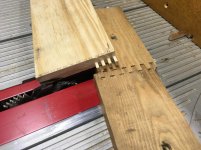
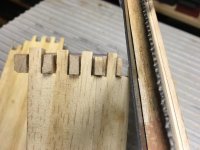
Arrg - box joints are kicking my **** today. I have had the intent of reproducing the chestnut box for the more complete D set. Careful scrutiny revealed the joints are 1/6” to each finger, which I tried to cut today in pine. I felt the number required suggested tools beyond a backsaw and chisel.
First I took a stab at creating a dedicated saw with a outrigger to register in the previously cut notch. Then I tried to figure out a jig that would allow me to use a single blade in the table saw. Both of these approaches failed because the kerf of the blades was too thin to make the gullets in a single pass. At this size I just couldn’t maintain the consistency to cut evenly.
That realization led me to dig out a stackable dado set, but with two blades the minimum kerf is 1/4”. I made a jig anyway and cut some 1/4” joints. Despite the greater precision, they look clunky at this scale compared to the 1/6” joints. I could of course make 1/8” joints with a single blade...The “Set-A” box is made of 1/4” linden with 1/8” joints?
Time to quit for the day and sleep on it. Maybe inspiration will strike.
Wonder if I can source a 11/64” kerf rip blade with a 5/8” arbor...8” or 10” diameter?
Answer - no. Maybe 100 years ago, but today’s cheap, under-powered saws have mushroomed the market for thin and ultrathin blades (also reducing sawdust and the amount of error from cutting on the wrong side of the line). So...stack two thin-kerf skilsaw blades? Maybe.
 

Attachments

  • F23E1A2D-EA61-4B87-94B7-A6E443CC3176.jpg
    F23E1A2D-EA61-4B87-94B7-A6E443CC3176.jpg
    150.8 KB · Views: 18
  • 04BDA92B-B978-40E5-8144-722713B48FCF.jpg
    04BDA92B-B978-40E5-8144-722713B48FCF.jpg
    122.3 KB · Views: 18
  • B69415BE-578C-4F04-8CB2-43DC5A20BC90.jpg
    B69415BE-578C-4F04-8CB2-43DC5A20BC90.jpg
    155.9 KB · Views: 16
  • DB9A242E-53AF-4621-A1B2-3002BDD31355.jpg
    DB9A242E-53AF-4621-A1B2-3002BDD31355.jpg
    149.4 KB · Views: 17
Last edited:

Oldtuleguy

Well-known member
Joined
Nov 4, 2017
Messages
10,453
What about a router bit. I have used them to cut notches, they come in a lot of widths.
 

LesserSon

Well-known member
Joined
Feb 7, 2016
Messages
5,047
Location
PA USA
Yes, router bits come in a bewildering number of shapes and sizes. In the seventies and eighties there was a school of woodworking that revered the simple and eminently versatile router above all other tools. I think I have four or five working routers, and probably the very bit I’d need for this. Plus, I know I have a dovetail jig that might work. Problem is, I hate routers. They make the loudest, most annoying noise, and loft the finest, most clogging dust of any of my power tools.
But that’s all academic now, because I went ahead with two 6-1/2” circular saw blades with a few paper discs sandwiched between. I made a new jig, screwing it up twice. By the third assembly, the registration peg had drifted a minute distance away from the cutout, so all the cuts, though exactly the right width, were spaced out, not on .333” centers, but on .353” centers. The fingers were too thick to slide together!
But all was not lost. I grabbed a Heller NuCut ******* that by divine providence mitigated the error and simultaneously squared up the rough bottoms of the gullets. The paper discs had left a thin “W” profile because I was using ATB blades and had no chipper blade in my setup. The joints wound up being a little oversize (17 in 6”, rather than 18 in 6”), but I’ll settle for that. If I hadn’t screwed up the jig, they would have been perfect.
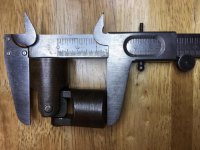
Trimming the sides to the internal depth of the box required a couple decisions. Because of the way it is riveted together, the universal adapter really only allows the lid to close when folded one way. It is a full 2” if bent the other way. I could make the sides generous enough to accommodate it in either position, but that would also allow the ratchet and other sockets to hop around inside. I decided to make it 1-7/8”.
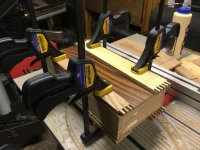
Anyway, the hard part is over, and now comes gluing.
 

Attachments

  • 530A4BD8-C231-4107-A875-A987A66681E2.jpg
    530A4BD8-C231-4107-A875-A987A66681E2.jpg
    154.4 KB · Views: 13
  • C4D948E0-1C61-4DF9-A401-0CDBE9A64EBC.jpg
    C4D948E0-1C61-4DF9-A401-0CDBE9A64EBC.jpg
    151.8 KB · Views: 14
  • C35E8490-DEF4-45A5-A431-2BBE4D31D623.jpg
    C35E8490-DEF4-45A5-A431-2BBE4D31D623.jpg
    156.7 KB · Views: 13
  • B971F037-6BC0-406C-9929-7D5B99C872DA.jpg
    B971F037-6BC0-406C-9929-7D5B99C872DA.jpg
    150.1 KB · Views: 9
  • 19ACBD70-0CEE-4F3E-BCB0-E25D0086BB61.jpg
    19ACBD70-0CEE-4F3E-BCB0-E25D0086BB61.jpg
    150.4 KB · Views: 10
  • 097DE112-4F36-4D2E-9D39-1DB79BFF3FBA.jpg
    097DE112-4F36-4D2E-9D39-1DB79BFF3FBA.jpg
    150.9 KB · Views: 7
Last edited:

LesserSon

Well-known member
Joined
Feb 7, 2016
Messages
5,047
Location
PA USA
Satisfied with the tone and sheen of the chestnut exterior, I replicated the internal socket-holder today. I started by making a paper pattern from the original. As previously determined, the divider (as well as the A-set slide box) is basswood. The stock for the repro came from a tree my dad had taken down to make room for his garage 18 years ago. (The chestnut was reclaimed from a desk I had found abandoned along a bike-trail while living in Norristown PA in the late 80s. The desk may have dated from the 30s or 40s. I haven’t seen a living chestnut over 6” in diameter in my life, so it is a dwindling resource. Basswood not so much.)
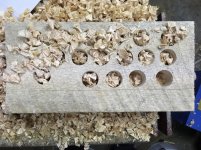
I wish I had a 1-1/16 forstner bit, but my set jumps from 1” to 1-1/8”. And I wish I had one working drill press, instead of three disassembled ones. There’s probably a bit of moisture in it because this season there’s little call for heat nor a/c. The only real issue is the universal socket, because it is very snug in the original box, particularly in winter. If I had done this a month ago, the 1” forstner bit would have been ideal. I used it with masking tape for a depth gage, then relieved the all the holes a little with a round file, which ironically put them a little out-of-round. As my objective is to make it look old and worn, I think that’s okay.
I then cut 9/16” thick slices and trimmed them down. Sanded and shellacked all sides to avoid warping. When I’m ready to glue, I’ll sand off 1/16” from the bottom, so the glue will grab, and the wide-shouldered sockets will sit low enough under the lid.
 

Attachments

  • 78DB0C7A-9AE0-4320-97C9-1088163B6E0D.jpg
    78DB0C7A-9AE0-4320-97C9-1088163B6E0D.jpg
    137.6 KB · Views: 8
  • CF735BA3-6CE9-43B8-84BA-8619104BEBE1.jpg
    CF735BA3-6CE9-43B8-84BA-8619104BEBE1.jpg
    161.6 KB · Views: 8
  • B9DBA35A-0470-4171-9135-486837F34F0D.jpg
    B9DBA35A-0470-4171-9135-486837F34F0D.jpg
    158.7 KB · Views: 8
  • 69913A81-C44C-4E30-B1C7-47E3A559F537.jpg
    69913A81-C44C-4E30-B1C7-47E3A559F537.jpg
    149.9 KB · Views: 7
  • 3D766736-5B59-487C-AE31-431D70277B65.jpg
    3D766736-5B59-487C-AE31-431D70277B65.jpg
    153.9 KB · Views: 8
  • 3561BE99-C5DD-483A-A4F1-D04E80AE8F12.jpg
    3561BE99-C5DD-483A-A4F1-D04E80AE8F12.jpg
    148.7 KB · Views: 9
Last edited:
To avoid these ads, REGISTER NOW!

Farmer J.

Well-known member
Joined
Sep 18, 2016
Messages
1,995
Location
UK, Cornwall/Hertfordshire.
Good project LS. Thanks for posting the progress.
Still got plenty of big Chestnut trees here, and recently planted 5 more around the farm which one of my kids grew from nuts.. but I'm not sure if they're the same species as there.
 

LesserSon

Well-known member
Joined
Feb 7, 2016
Messages
5,047
Location
PA USA
I'm not sure if they're the same species as there.

They’re not. Same genus, though (Castanea). Japanese chestnut (crenata) is the most resistant to the blight fungus, followed by Chinese chestnut (mollissima). Your Spanish/European chestnut (sativa) was hit by the fungus mid-century, but is partially protected by a virus (CHV1) that disrupts the fungus. American chestnut (dentata) was decimated from 1900-1940s, and has not recovered. The virus does not spread naturally in NA. The small trees I have seen are sprouting from surviving roots, but succumb just as they begin to flower and produce nuts. There is a program to produce a blight-resistant hybrid, but since the goal is blight-resistance, some of the unique virtues of the American species might have to be sacrificed.
The wood itself was used in furniture, trim and flooring, and is often mistaken for oak. But chestnut is far less dense and lacks prominent medullary rays that characterize oak. Working with it, I have found it very prone to splitting. I don’t know if that is more owing to its grain or age. I had earlier posted that it reacted with a brown toner I was using, turning pink, but thinking more about it, that particular piece had been bleached by my father, so maybe chemical residue from that process was the actual culprit.
 

Farmer J.

Well-known member
Joined
Sep 18, 2016
Messages
1,995
Location
UK, Cornwall/Hertfordshire.
They’re not. Same genus, though (Castanea). Japanese chestnut (crenata) is the most resistant to the blight fungus, followed by Chinese chestnut (mollissima). Your Spanish/European chestnut (sativa) was hit by the fungus mid-century, but is partially protected by a virus (CHV1) that disrupts the fungus. American chestnut (dentata) was decimated from 1900-1940s, and has not recovered. The virus does not spread naturally in NA. The small trees I have seen are sprouting from surviving roots, but succumb just as they begin to flower and produce nuts. There is a program to produce a blight-resistant hybrid, but since the goal is blight-resistance, some of the unique virtues of the American species might have to be sacrificed.
The wood itself was used in furniture, trim and flooring, and is often mistaken for oak. But chestnut is far less dense and lacks prominent medullary rays that characterize oak. Working with it, I have found it very prone to splitting. I don’t know if that is more owing to its grain or age. I had earlier posted that it reacted with a brown toner I was using, turning pink, but thinking more about it, that particular piece had been bleached by my father, so maybe chemical residue from that process was the actual culprit.

Thanks for explaining that LS, very interesting. I really should have looked it up! The Chestnut here splits easily and is great for cleft rail fences and also used for splitting into thinner sections for sheep hurdles and garden fences. Not used so much in modern times though but still done where it's required for history and appearance. It's a very splintery wood when it dries out so not used so much for indoor furniture here. We have 2 types growing here which look the same but the nuts are quite different. Sweet Chestnut has lovely edible nuts and Horse Chestnut nuts are nothing like that!
 

LesserSon

Well-known member
Joined
Feb 7, 2016
Messages
5,047
Location
PA USA
Yes. We have horse chestnut here - Aesculus is the genus. I looked that up, too. Native to central Greece, so transplanted both here and England.
The American chestnut was once ubiquitous. In addition to its role as a primary mast-producer (I mean wildlife - and human - food, not sailing), it was used for split-rail fences, timbers, flooring, sheathing, and log cabins because of rot resistance, and I suppose, ease to split and work with saw, chisel and rasp. I’ve come across the odd stud or joist in my own home (though it’s mostly eastern hemlock).
Its open, porous grain would seemingly make fine detail problematic - most furniture I’ve seen is fairly plain and rectilinear. My childhood bedroom set was chestnut (purchased used), in the Eastlake style, but finished honey blonde without the carved details being ebonized, as is more characteristic.
In addition to its use by designers preferring native species, it was used as the core for a lot of veneered furniture, where the splintery quality is irrelevant, and the light weight makes even large pieces relatively easy to move.
 

LesserSon

Well-known member
Joined
Feb 7, 2016
Messages
5,047
Location
PA USA
I toned and shellacked the socket holders yesterday. Note the finished top vs the lighter bottom - I intend to sand all residue from the bottom before gluing into the box shell. I need not have been concerned about the 1” diameters being too small - repeatedly sanding layers of finish widened them appreciably.
Cutting the top from the bottom on a table saw was a breeze.
However, dry-fitting the socket-holder before staining the interior of the box has revealed a 3/32” error in the interior front-to-back dimension of my boxes (yes, I’ve made two). I’d prefer to rip it off the back of the socket holder, but then the larger sockets will no longer fit against the back wall, if, as seems likely from the hole-spacing of the original, that is where they should go. Honestly, if I were to start over, I would disregard the hole-locations of the original example, because some of the spacing just doesn’t make sense to me. Additionally, I would make the interior vertical space a full 2” because that would allow the ell-handle to store with the short leg vertical, instead of floating somewhat loosely on its side. (There is an abrasion mark on the A-set box that supports the horizontal storage theory.)
I may take a very thin bit off the back, relieve one socket hole a bit, and notch out a little pocket for the ratchet head from inside the front of the lid and base. The combination of these small adjustments should restore some flexibility to the layout without requiring starting from scratch (despite how enjoyably distracting it has been from the stay-at-home order).
Alternately, I may make two new socket holders, with my own “rational” layout, and better (true circle) holes. I could improve the stain procedure, too...

Edit - showing the interior staining procedure, meant to assure maximum glue adhesion.
Finally finished my label mockup (attachment). Done entirely in MS Publisher, augmented with copious amounts of patience and fortitude.

EDIT - photo of printout on ivory copy paper, then cut out and “aged” in coffee grounds. 3B9485A2-7283-4CD1-9E6F-3F7975C48811.jpegExperimenting with the idea I could simply glue it under the lid - an honest, telling departure from the originals.
attachment.php
 

Attachments

  • 636C147A-8A4B-4633-8BAC-44125F14F423.jpg
    636C147A-8A4B-4633-8BAC-44125F14F423.jpg
    103.3 KB · Views: 16
  • FF2F1AA8-41FF-4984-9821-7A26C47FF3FA.jpg
    FF2F1AA8-41FF-4984-9821-7A26C47FF3FA.jpg
    153.1 KB · Views: 19
  • 63941F51-C06C-4BC5-A0B9-B2ACD2114DDD.jpg
    63941F51-C06C-4BC5-A0B9-B2ACD2114DDD.jpg
    148.8 KB · Views: 24
  • 27684DBD-9658-40B2-8E69-954B8129171E.jpg
    27684DBD-9658-40B2-8E69-954B8129171E.jpg
    127.7 KB · Views: 12
  • 22B13F87-8EFA-4EC9-B876-CFF78511362A.jpg
    22B13F87-8EFA-4EC9-B876-CFF78511362A.jpg
    102.3 KB · Views: 10
  • Quickway SetD label.pdf
    103.3 KB · Views: 112
Last edited:

Private Lugnutz

Well-known member
Joined
Mar 30, 2012
Messages
30,473
Location
The Authentic Jersey Shore
The layout of the wooden box "D" set is completely different than the layout in the metal box "D" set, so I can't offer any comments or advice, LS. But I will say those are handsome boxes that do justice to the tools.
 

LesserSon

Well-known member
Joined
Feb 7, 2016
Messages
5,047
Location
PA USA
Thanks, guys.
I opted to relieve the front lip of the shells to accommodate the profile of the ratchet. That choice saved me from remaking the socket holders, and really, I think it holds the rachet with a bit more stability than the original design. The downside is I will not be able to place two latches where they should be on the front, because there is insufficient wood to hold the screws on the right hand side. I’ll put a single latch in the center - a further departure from the original.

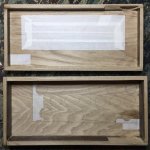
Edit - here’s the original on bottom (with reproduction lid), new guys in top. I’m holding out for a better idea before also installing the hook and staple upside-down on the top guy. Open; I left “shadows” unstained for parts list and serial number labels.
 

Attachments

  • A13A3737-028B-49BD-B35C-D4CD02F024AB.jpg
    A13A3737-028B-49BD-B35C-D4CD02F024AB.jpg
    153.3 KB · Views: 10
  • ACD0F0D0-DB60-4E6B-86E2-92EC8F87678E.jpg
    ACD0F0D0-DB60-4E6B-86E2-92EC8F87678E.jpg
    154.8 KB · Views: 8
  • 6F22B10D-6975-48F7-9F46-3708B2746082.jpg
    6F22B10D-6975-48F7-9F46-3708B2746082.jpg
    148.3 KB · Views: 8
  • A1B42483-8ED6-4671-816B-E90301F17350.jpg
    A1B42483-8ED6-4671-816B-E90301F17350.jpg
    152.8 KB · Views: 9
  • 84C77943-7F45-413B-A719-D10C9AE8C696.jpg
    84C77943-7F45-413B-A719-D10C9AE8C696.jpg
    149 KB · Views: 8
  • 7D03251F-1E1B-435F-8587-4DDAADF85A5B.jpg
    7D03251F-1E1B-435F-8587-4DDAADF85A5B.jpg
    148.8 KB · Views: 8
  • 8641240A-834F-4F38-83AA-DFBEA37319EE.jpg
    8641240A-834F-4F38-83AA-DFBEA37319EE.jpg
    144.5 KB · Views: 14
Last edited:

LesserSon

Well-known member
Joined
Feb 7, 2016
Messages
5,047
Location
PA USA
The layout of the wooden box "D" set is completely different than the layout in the metal box "D" set, so I can't offer any comments or advice, LS.
Yeah, and the advertisement image shows the tools bursting out of the box, so I’m not sure anyone can really know for sure.
I’ve tried a few variations and made some deductions. Based on weight distribution, I’m fairly convinced the largest sockets belong along the back wall, with the largest on the left. I think the universal should be on the left, too. The two small gaps on the far left and far right puzzled me until I realized they allow the ell to sit on its side with the short leg protruding through either gap.
As I stated before, I’d prefer the short leg stick straight up, but then it interferes slightly with the lid. (2” exactly like the universal with the upper rivet horizontal- makes me wonder if the wood could have shrunk enough to account for the fit issue.)
The gap on the right also accentuates that there are two 1/2” sockets (one as an “adapter”), so I think they belong on the front right.
Now, I realize that the sliding tee handle is supposed to be a separate purchase, but the front edge of the socket holder matches its profile exactly, so I think the designer intended at minimum that the box could accommodate it as an upgrade. Only problem with that is the hex drive head that slides onto it cannot be left on for storage in the slot, and since the head is secured to the shank with a screw, placing the head in a socket hole with the screw still in it makes the head too tall for the lid to close. Which means the screw can be lost, and of course, one of the sockets must be displaced from its home.
 

Attachments

  • F104693C-B3EB-4FC9-90DD-63BB955957F9.jpg
    F104693C-B3EB-4FC9-90DD-63BB955957F9.jpg
    157.1 KB · Views: 14
  • A9586FAF-64B6-4177-9CA1-AD856C850A6F.jpg
    A9586FAF-64B6-4177-9CA1-AD856C850A6F.jpg
    157.7 KB · Views: 11
  • 1D5E2C06-7710-472B-B590-4E948C97BC10.jpg
    1D5E2C06-7710-472B-B590-4E948C97BC10.jpg
    158.4 KB · Views: 12
  • EF72F518-1F14-476E-B258-49D84DA30CDC.jpg
    EF72F518-1F14-476E-B258-49D84DA30CDC.jpg
    157.2 KB · Views: 11

Farmer J.

Well-known member
Joined
Sep 18, 2016
Messages
1,995
Location
UK, Cornwall/Hertfordshire.
I think the new boxes look great, and the layout is as good a guess as the information allows.
Not wishing to derail the thread further by going on about Chestnut trees, but here's a couple of springtime pics of some of my young ones which have just come out in leaf and hopefully will provide lumber for future generations! Thought you may enjoy seeing them, and a thank you for sharing your knowledge. J.
 

Attachments

  • DSC04925.jpg
    DSC04925.jpg
    159.2 KB · Views: 14
  • DSC04926.jpg
    DSC04926.jpg
    147.1 KB · Views: 15

davethorik

Well-known member
Joined
Sep 14, 2013
Messages
4,992
Location
Norka, Ohio
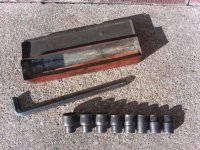
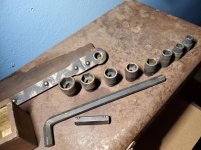
Well, i guess I'm in the club now. Picked up this Bethlehem Quickway set "C" today. (4" Utica adjustable for scale)

It looked like i was missing a socket, but all 8 are there, 5/16"-3/4", box must have a little extra room.

7/16" hex drive. No markings on sockets.
 

Attachments

  • 20200506_180806.jpg
    20200506_180806.jpg
    156.6 KB · Views: 21
  • 20200506_180944.jpg
    20200506_180944.jpg
    153.7 KB · Views: 22
  • 20200506_180743.jpg
    20200506_180743.jpg
    157.6 KB · Views: 20
  • 20200506_180709.jpg
    20200506_180709.jpg
    158.5 KB · Views: 20

Private Lugnutz

Well-known member
Joined
Mar 30, 2012
Messages
30,473
Location
The Authentic Jersey Shore
Congrats, Dave, and welcome to the club! The Set C and Set C Special boxes are the same size, and the Set C Special comes with a ratchet and a short extension, so yeah, it's a little roomier with just the Set C inside. And that gap is normal.
 

Oldtuleguy

Well-known member
Joined
Nov 4, 2017
Messages
10,453
wooden box special set c
 

Attachments

  • 20200914_225434.jpg
    20200914_225434.jpg
    151.6 KB · Views: 15
  • 20200914_225417.jpg
    20200914_225417.jpg
    150.1 KB · Views: 17
  • 20200914_225601.jpg
    20200914_225601.jpg
    107.2 KB · Views: 13
  • 20200914_225608.jpg
    20200914_225608.jpg
    148.6 KB · Views: 10
  • 20200914_225645.jpg
    20200914_225645.jpg
    118.4 KB · Views: 9
  • 20200914_225650.jpg
    20200914_225650.jpg
    130.5 KB · Views: 12
  • 20200914_225426.jpg
    20200914_225426.jpg
    147.7 KB · Views: 15

Private Lugnutz

Well-known member
Joined
Mar 30, 2012
Messages
30,473
Location
The Authentic Jersey Shore
Oh, very nice! I didn't mean to imply otherwise. It was purely a 'slippery slope avoidance' decision for me. To explain, as I said to 4.c at the time, I have Set "A", Set "C", Set "C SPECIAL", Set "D", and Set "F" - but all in the later steel boxes. If I open the 'wood box' door with a dupe "C Special", I'd have to go wooden on all the others! :lol: (So far, I have seen no evidence of the 11/16-inch drive "F" set coming in a wooden box.)
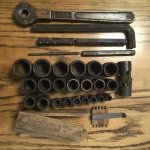
I'm looking for the leather case sets ("B" and "E") and the folding blade.
 

LesserSon

Well-known member
Joined
Feb 7, 2016
Messages
5,047
Location
PA USA
Is the function of the “folding blade” still a mystery, or has one come to light somewhere?
 
To avoid these ads, REGISTER NOW!
Top Bottom