To avoid these ads, REGISTER NOW!

Bike torque wrench error tolerance

Doozer75

Well-known member
Joined
Oct 24, 2009
Messages
260
Location
Buffalo NY
You are wrong with respect to digital means nothing if the torque wrench uses a strain gauge to measure torque as most digital torque wrenches do as these are quite accurate and robust. If it's just a digital display on an analog wrench then that means nothing.
I work in a test lab. I know what a strain gauge is. You can tweak them out of shape too.
Digital means nothing. Get whatever you got certified.

-D
 
To avoid these ads, REGISTER NOW!

dnschmidt

Well-known member
Joined
Oct 3, 2014
Messages
7,272
Location
Phoenix, AZ
I work in a test lab. I know what a strain gauge is. You can tweak them out of shape too.
Digital means nothing. Get whatever you got certified.

-D
Nobody said that you shouldn't have your torque wrenches tested. What I'm saying is that strain gauge digital torque wrenches are far more robust and stay accurate longer than a clicker that relies on a spring.
 

Meursault74

Well-known member
Joined
Apr 1, 2019
Messages
21,958
Location
Southern California
I work on my bikes. I have a beam type torque wrench. The only places I used them are for the bottom bracket install and the cranks onto the spindle. If they're not tight enough you'll ****** things up when they loosen up and you could ruin your frame and/or cranks. I suppose I should use it on the pedals too, but I haven't.

Aside from carbon fork legs, I don't have carbon parts on my bikes. I've heard they are more sensitive and expensive so it may be wise to watch it there as well.
 

jayemm

Well-known member
Joined
Dec 18, 2018
Messages
1,525
Location
up high down low
Like this one? ;) Good enough for Andy Hampsten to win the Giro on one back in the day. :)

1724559200315.png
Well, the Huffy's I saw "back in the day" in the 1960's were a little different. Things like 2.125" tires on 26" rims and coaster brakes (Bendix baby!). The "English" (skinny tire) bikes had 3 speed Sturmey -Archer. Some of the older bikes I remember had 28" rims and skip-link chains and sprockets. Real dinosaurs. Guess I'm showing my age. LOL
 

Pexto

Well-known member
Joined
May 5, 2018
Messages
638
Like this one? ;) Good enough for Andy Hampsten to win the Giro on one back in the day. :)

1724559200315.png

Yeah, that bike was not a Huffy, except for the decals! Serotta made most of the "Huffy" bikes for the 7-Eleven team, but apparently Andy's Giro bike was made by John Slawta (Land Shark).

I have fond memories of watching Andy race in the early 80's. I never met him but one of the guys I rode with was friends with Andy, so we would go to races and cheer for him.
 

Meursault74

Well-known member
Joined
Apr 1, 2019
Messages
21,958
Location
Southern California
Well, the Huffy's I saw "back in the day" in the 1960's were a little different. Things like 2.125" tires on 26" rims and coaster brakes (Bendix baby!). The "English" (skinny tire) bikes had 3 speed Sturmey -Archer. Some of the older bikes I remember had 28" rims and skip-link chains and sprockets. Real dinosaurs. Guess I'm showing my age. LOL
To be completely transparent, the only thing "Huffy" on that bike I posted was the paint job. That's why I put the ;)
 

Meursault74

Well-known member
Joined
Apr 1, 2019
Messages
21,958
Location
Southern California
Yeah, that bike was not a Huffy, except for the decals! Serotta made most of the "Huffy" bikes for the 7-Eleven team, but apparently Andy's Giro bike was made by John Slawta (Land Shark).

I have fond memories of watching Andy race in the early 80's. I never met him but one of the guys I rode with was friends with Andy, so we would go to races and cheer for him.
Yeah I know it wasn't a Huffy that's why I put the "wink".

In the 1999 Tour, the time trial bike Armstrong used said "Trek" as that was the sponsor, but that was a Litespeed frame.
 

Ricky Joe

Well-known member
Joined
Sep 15, 2013
Messages
2,452
Location
Roanoke, Va.
The original poster mentioned something that no one addressed. He put lube on the threads. That is going to throw off his torque and generate the problem he is having. You don’t even need to change torque wrenches to have repeatable inaccuracy.
 

manbike26

Well-known member
Joined
Sep 23, 2015
Messages
223
Location
Boise ID USA
@Grant Gunderson , @manbike26 I always like your posts on bike tools and maintenance.

Tagging you here for your thoughts if you don’t mind.

Thanks in advance.
Thanks for the tag! I'm certainly no expert on torque wrenches, but I'll weigh in with my opinion anyway.

I feel like the "clicker" style wrenches aren't super reliable. I have a few affordable models that I used over the years and never felt that they were highly accurate. Best guess is +/- 5 to 10% accuracy? But they are great to give to a ham-fisted consumer.

I personally have a couple of older craftsman clicker style wrenches. These have worked well for me for over a decade. If I were buying another torque wrench again today, it would probably be a mid-range clicker style. I think they are usually assumed to be accurate to about 3-5%?

Beam wrenches (while I don't own any) were what we used in training environments where tools got beat up and used frequently. The downside is difficulty of reading the wrench. If I remember right, split beam styles were what was used in testing environments where known torque was really important. I think the accuracy was closer to 2-3%?

A testing engineer said to me once, "the key to torque wrench accuracy is regular calibration by a professional". Said another way: if you really want it accurate, you send it away to a company that specializes in torque wrench accuracy.

A design engineer once told me, "we tend to design about 30-35% strength over the needed use." Said another way: You can probably over-tighten that bolt about 30% before bad stuff happens.

So my logic has always been that 27% buffer between 30% over-built and 3% accuracy keeps me and my riders safe.

All of the above is worth what you paid for it.
 
OP
F

fishwatcher

Well-known member
Joined
Jan 26, 2023
Messages
751
Thanks for everybody’s input.

This is for bike maintenance. And mostly the easy stuff.. like disc brake mounts, seat post bolts (clamped to carbon seat rails), stem bolts for carbon fiber bars.

Based on the feedback, the range accuracy of my torque wrenches can’t be for surely known without getting them calibrated professionally.

However the range of error tolerance is probably just fine with the 1-3nm difference of reading I get between the tools I have.

I could compare it to a digital device, but seems like designed in tolerance is probably fine for the lack of accuracy I might have between the three torque wrenches I would use.

Thanks to everybody for your input. I didn’t realize Park Tools torque wrenches might be that far off. It doesn’t zero out (that should have clued me in) and the instructions say to bend it back to zero to “calibrate it”. This might have been my first clue that it’s not the best tool for the job.

Since the three tools are within 2-3nm of each other.. I think I should be fine. It was just a curiosity thing.. about how wide tolerances could be.
 
Last edited:

acer66

Well-known member
Joined
Dec 4, 2010
Messages
4,418
Location
Western North Carolina
For small stuff I use a Ritchey 5NM Multi Torque key.

The good thing even if it is off it does not give you enough leverage to screws things up easily.
 
OP
F

fishwatcher

Well-known member
Joined
Jan 26, 2023
Messages
751
For small stuff I use a Ritchey 5NM Multi Torque key.

The good thing even if it is off it does not give you enough leverage to screws things up easily.
The specs for the bolts on my bike are between 6nm- 10nm. The range on the tools I have is up to 10nm, up to 7, or up to 20 something (too lazy to look at it right now).
 

PCustoms

Well-known member
Joined
Jul 23, 2011
Messages
22,769
Location
VT
The specs for the bolts on my bike are between 6nm- 10nm. The range on the tools I have is up to 10nm, up to 7, or up to 20 something (too lazy to look at it right now).
Remember to try to stay with the center of a wrenches range.

Some wrenches are not reliable in the extreme 10-20% range
 

HannibalLecter

Well-known member
Joined
Aug 26, 2023
Messages
402
Thanks for everybody’s input.

This is for bike maintenance. And mostly the easy stuff.. like disc brake mounts, seat post bolts (clamped to carbon seat rails), stem bolts for carbon fiber bars.

Based on the feedback, the range accuracy of my torque wrenches can’t be for surely known without getting them calibrated professionally.

However the range of error tolerance is probably just fine with the 1-3nm difference of reading I get between the tools I have.

I could compare it to a digital device, but seems like designed in tolerance is probably fine for the lack of accuracy I might have between the three torque wrenches I would use.

Thanks to everybody for your input. I didn’t realize Park Tools torque wrenches might be that far off. It doesn’t zero out (that should have clued me in) and the instructions say to bend it back to zero to “calibrate it”. This might have been my first clue that it’s not the best tool for the job.

Since the three tools are within 2-3nm of each other.. I think I should be fine. It was just a curiosity thing.. about how wide tolerances could be.
I too mess quite frequently with bikes (I am a mechanical engineer, that moonlights as a bike mechanic because I still learn german that I need to get a proper job)

My advice would be to ditch the click type park tool and get a norbar tti 4-20 . These are calibrated from factory, according to ISO 6789 and are guaranteed for 5000 clicks or six months and will come with a certificate of accuracy and printed data sheet. Now imho you dont need to be more accurate for a bike and although an electronic torque wrench is generally more accurate i find them really inconvenient and inaccurate for the low torques for the simple fact that they dont <<yield>> by clicking and you can easily overshoot.
As for lubricating the threads, that is a big no no, almost always the stated torque is dry torque. By lubricating the threads you probably overshoot by 20%.

You also need a bigger torque wrench that can do pedals, cassettes, centerlock lock rings and bottom brackets. For bottom brackets you need it to also work in the opposite direction.
I would buy a stahlwille click style manoskrop with push through ratchet anvil
I have a Facom j306-100MF but sadly it works only on right hand tightening direction.
If the torque wrench comes with a legit iso calibration certificate id consider doing more an excess.
Now if you are a pro mechanic and you use it all the time yes, checking and calibrating will be needed after some time.

Also, If you use to double click the torque wrench, lose that habit,as you shorten the period it stays calibrated
 
To avoid these ads, REGISTER NOW!
OP
F

fishwatcher

Well-known member
Joined
Jan 26, 2023
Messages
751
I too mess quite frequently with bikes (I am a mechanical engineer, that moonlights as a bike mechanic because I still learn german that I need to get a proper job)

My advice would be to ditch the click type park tool and get a norbar tti 4-20 . These are calibrated from factory, according to ISO 6789 and are guaranteed for 5000 clicks or six months and will come with a certificate of accuracy and printed data sheet. Now imho you dont need to be more accurate for a bike and although an electronic torque wrench is generally more accurate i find them really inconvenient and inaccurate for the low torques for the simple fact that they dont <<yield>> by clicking and you can easily overshoot.
As for lubricating the threads, that is a big no no, almost always the stated torque is dry torque. By lubricating the threads you probably overshoot by 20%.

You also need a bigger torque wrench that can do pedals, cassettes, centerlock lock rings and bottom brackets. For bottom brackets you need it to also work in the opposite direction.
I would buy a stahlwille click style manoskrop with push through ratchet anvil
I have a Facom j306-100MF but sadly it works only on right hand tightening direction.
If the torque wrench comes with a legit iso calibration certificate id consider doing more an excess.
Now if you are a pro mechanic and you use it all the time yes, checking and calibrating will be needed after some time.

Also, If you use to double click the torque wrench, lose that habit,as you shorten the period it stays calibrated
Great tips. I appreciate the time you and others have taken to answer in this thread.

$200 for a torque wrench, that’s quite expensive. At the risk of having tools that are off by a nm or two, I’m going to stick with what I have for now.. going off the assumption that torque specs are conservative and as mentioned above, overshooting them by a bit is okay.

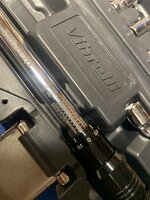
The click type I have is not by Park Tools. It’s a brand called Vibrelli and was bought on Amazon for $50. Many brands look just like this from Amazon with different names. I checked and the upper range is 20nm.

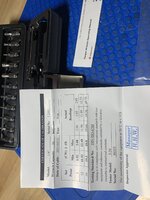
The Vibrelli came with a certified ISO calibration sheet, but I don’t have a lot of confidence that it is legit. The actual readings are printed, not hand written on the certificate, and the technician’s initials are stamped on the sheet.
IMG_1041.jpeg
🤷🏻‍♂️

I did another check just now.. click type vs the Lezyne. I think I’ve been reading the indicator wrong on the click type. 🤦🏻‍♂️ I was looking at the indicator 1nm higher than I should have.

IMG_1042.jpeg

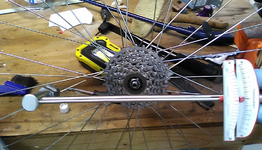
Comparing these two.. they are equivalent. The Park Tools beam tool is the one that’s off by 1nm.

In summary, I’ve learned from you all, so thanks again. I believe my torque wrenches are “close enough”. My initial user error made the results and concern for tolerance worse than reality. With no actual calibration test.. I could still be off.

I have another EPAuto brand click type (also shown in the picture above) from Amazon that goes up to 108nm for heavier duty applications like a bottom bracket.

Thanks GJ.
 
Last edited:

pfaustus

Well-known member
Joined
Feb 6, 2016
Messages
361
was it the top of the line model?
Like one of the made in England Raleigh made Huffys from the 80s? You know, from when English industries use of pre-great war practices and machinery was catching up to them, but it was still better quality than Huffy ever managed?
 

545_days

Well-known member
Joined
Oct 30, 2016
Messages
583
Location
Texas
I have a cautionary story about torquing fasteners to "feel."

I work on large scale petrochemical projects, and for years we had a recurring problem with units tripping off line a couple of times a year due to loose wires on terminal strips. A unit trip can cost hundreds of thousands to millions of dollars.

Every project would have layers of checks, culminating with the owner's technicians (very experienced guys, generally hired after proving themselves as the cream of the crop of contractors) going through every junction box and terminal strip, tightening the screws on the thousands and thousands of terminals by feel and tugging on the wires to ensure that none were loose... but the spurious shut downs still occasionally happened.

A few projects ago, we decided that insanity was doing the same thing and expecting different results, so we purchased torque screwdrivers, and had them calibrated by a lab. Every terminal strip was torqued to specification with a calibrated tool, documenting who checked, the date, tool used, and a copy of the calibration certificate.

The universal feedback we got from the instrument techs was "Damn, we had no idea that terminal screws were supposed to be torqued that hard! You would expect the plastic terminal strips to come apart with that much force!"

Problem solved, no more spurious shut downs caused by loose instrument wires.
 

PCustoms

Well-known member
Joined
Jul 23, 2011
Messages
22,769
Location
VT
I have a cautionary story about torquing fasteners to "feel."

I work on large scale petrochemical projects, and for years we had a recurring problem with units tripping off line a couple of times a year due to loose wires on terminal strips. A unit trip can cost hundreds of thousands to millions of dollars.

Every project would have layers of checks, culminating with the owner's technicians (very experienced guys, generally hired after proving themselves as the cream of the crop of contractors) going through every junction box and terminal strip, tightening the screws on the thousands and thousands of terminals by feel and tugging on the wires to ensure that none were loose... but the spurious shut downs still occasionally happened.

A few projects ago, we decided that insanity was doing the same thing and expecting different results, so we purchased torque screwdrivers, and had them calibrated by a lab. Every terminal strip was torqued to specification with a calibrated tool, documenting who checked, the date, tool used, and a copy of the calibration certificate.

The universal feedback we got from the instrument techs was "Damn, we had no idea that terminal screws were supposed to be torqued that hard! You would expect the plastic terminal strips to come apart with that much force!"

Problem solved, no more spurious shut downs caused by loose instrument wires.

Sorry, cream of the crop electrical techs who don't own/use torque screwdrivers?

If a vendor built a control cabinet for me and I found out they didn't tighten to mfr specs with proper tools that's the last cabinet they'd build. And I have fired guys for not using proper tools.
 

PCustoms

Well-known member
Joined
Jul 23, 2011
Messages
22,769
Location
VT
^^ totally different kettle of fish than bicycles.
Agreed, was responding to 545 days


I've got Craftsman torque wrenches and some torque drivers for the bike though. Can't remember what I worked on recently, but saw it had a torque spec and went "Really?" Then remembered the small driver set. IIRC they're Wiha.
 

545_days

Well-known member
Joined
Oct 30, 2016
Messages
583
Location
Texas
Cream of the crop generally equates to experienced instrumentation troubleshooters. These guys don't do assembly work, but they are the owners representatives, and the owner supplies their tools.
 

rlitman

Well-known member
Joined
Oct 18, 2010
Messages
24,596
Location
Long Island
...The only things I can think of that really require a torque wrench to work on would be spoke ******* but I don't see that type of wrench in the photo.
I couldn't think of an occasion where measuring torque on a spoke ****** would be of any use. Spoke tension is important (to an extent), but the relationship of tension to torque is just not linear enough to be able to use a torque wrench on spoke *******, plus while you want the spokes to be within a range of tensions, in order to account for rim irregularities, you will always end up with difference tensions on just about every spoke.
 

ronkz650

Well-known member
Joined
Oct 29, 2022
Messages
220
Location
Denver, CO
All I know about spoke tension is my experience on motorcycles. Torque the spokes every 4000 miles to the 6nm spec in my case, and for the most part they don't need much, but just that little bit keeps everything perfectly set. If you go by the ping test for tension, that just doesn't work. 60,000 miles and my motorcycle wheels are perfectly round and spokes tightened to spec.
 
OP
F

fishwatcher

Well-known member
Joined
Jan 26, 2023
Messages
751
All I know about spoke tension is my experience on motorcycles. Torque the spokes every 4000 miles to the 6nm spec in my case, and for the most part they don't need much, but just that little bit keeps everything perfectly set. If you go by the ping test for tension, that just doesn't work. 60,000 miles and my motorcycle wheels are perfectly round and spokes tightened to spec.
With bike wheels, spoke tension is measured by a tension meter. Not by torque measurement on the spokes themselves.
 

Attachments

  • IMG_1066.png
    IMG_1066.png
    431.2 KB · Views: 8

Meursault74

Well-known member
Joined
Apr 1, 2019
Messages
21,958
Location
Southern California
I work on my bikes. I have a beam type torque wrench. The only places I used them are for the bottom bracket install and the cranks onto the spindle. If they're not tight enough you'll ****** things up when they loosen up and you could ruin your frame and/or cranks. I suppose I should use it on the pedals too, but I haven't.

Aside from carbon fork legs, I don't have carbon parts on my bikes. I've heard they are more sensitive and expensive so it may be wise to watch it there as well.
Used the torque wrench today on a cassette lockring. I was hearing some tinkling/creaking while on some of the larger cogs. I took the cassette off, cleaned everything and then lightly brushed some grease on the hub/cassette interface and also on the threads. I went a little above the 40NM prescribed, but that's because I had greased the threads. It was probably as tight as I've always done without the reading.

Seemed to cure the noise, at least for riding up and down the alley a few times after. I'll see later how well it hold up

On another of my bikes, I had that lock ring loosen up once. Guess I didn't tighten it enough that time. I have the torque wrench and the socket, why not use it?

1725138601285.png
 

Odd-job

Well-known member
Joined
Aug 13, 2017
Messages
2,268
Location
SF Bay Area
Until I started investing in torque wrenches I didn't realize I was under torquing that lock ring. My feel ***** and it was made even worse with the notchiness. While I've never had one fall off, its nice to minimize the creaking.
 

seber

Well-known member
Joined
May 31, 2016
Messages
4,195
Location
Deep East Tx.
I'm just a hack but I take torque seriously. My method may get some hackles up but has worked for me for many decades. I got my beam style wrench calibrated and trust it to stay correct. I use that to check my split beams. The split beams have been consistent now for more than twenty years so at this point I probably would not even need to test them. I do anyway, about once a year.
 

mlyonsdc

Well-known member
Joined
Nov 23, 2018
Messages
238
Location
USA
I've done a couple of highend bike builds and I couldn't imagine working on the newer bikes without a tq wrench.

IMO Comparing an 80's Huffy or even Litespeed bike to a modern tour bike is like comparing a Model T to a Ferrari.

I actually had kind of the same question as the OP I was going to make a post about. So instead of making another post on the same topic I'll just highjack this one lol.

I have a variety of clicker TQ wrenches I rely on, a 1/2" Proto which is my go to for engine building, and variety of Craftsman 3/8, 1/2" and an Inch/# clicker tq wrenches. Lately I have questioned the accuracy of the Craftsman wrenches especially my 3/8 one which I use a lot. My buddy has a high end Snap On digial Tq wrench we checked a few of the bolts on my engine vs the Craftsman and it seems to be off a good bit. At least compared to his high end Snap On.

My Tq wrenches are old and I have not calibrated any of the Craftsman ones but did have the Proto calibrated once. I was looking for a way to check them and calibrate them and found an article on how to do it with weight and a vise


I am may be looking for suggestions on purchasing a decent accurate 3/8" torque wrench that won't break the bank? My buddies Snap On is definitely not in the budget. I would like to come up with a way to calibrate and check the ones I already have. I am thinking that Hobo stain gauge maybe a simple method and I can compare a few to each other and see what I come up with.
Thanks
 

ericm

Well-known member
Joined
Apr 17, 2016
Messages
1,963
Location
Southern Oregon
Been a while since I worked on a bicycle but I don't recall ever using a torque wrench.

On good bikes it's important to use a torque wrench on the bottom bracket and crank bolts. I use a torque wrench on stems when the bars are carbon fiber. And on suspension bolts on mountain bikes.

There's not a lot of extra material on good bikes, as they're designed to be light. And mistakes can be expensive or get you hurt.
 

mlyonsdc

Well-known member
Joined
Nov 23, 2018
Messages
238
Location
USA
So I went to HF today and picked up one of the Quinn strain gauges listed above to test the 5 Tq wrenches I have.

3/8" Craftsman 25-250 in/lb that is 8-9 yrs old and never calibrated
3/8 Craftsman 10-75 ft/lb that is well over 20yo and never calibrated
1/2" Craftsman 20-150 ft/lbs that may be over 35 yo and never calibrated and I retired to tq lug nuts
1/2" Proto 30-150 ft/lbs that I've had

I set it up with head studs Tq to 80# so the wrench should click off and the strain gauge will read the highest reading. I tested all of them at least 3 times

First the in/# I set to 60 in/# and got 5ft/lbs with the Quinn strain gauge
3/8" Craftsman ft/lbs I set to 20 and got 20 exactly at least 3x, this is the one I thought was heavy
1/2" Craftsman ft/lbs that was retired to lug nuts set to 50 and spot on
1/2" Quinn digital that I bought just to do heavy stuff set to 50 and got 48-50 every time

The high end Proto which is the only one I had calibrated set to 50 I got 58-59.

I also just went through a whole ordeal with stretching rod bolts with this wrench and now that I know it is 8-10# heavy it makes perfect sense and is within the torque and stretch which the rod bolt manufacturer was telling me. I switched rod bolts over this and really didn't need to.

Apparently my cheap **** is pretty good and I think that Quinn strain gauge is spot on too. I am going to give my Proto to my machinist to have it calibrated and re-check it. I am also going to check my buddies expensive snap on which I think he has had calibrated a few times
20240902_164013.jpg

To keep this bike related, my last bike build in 2019 and still my daily when I still ride. It was a little over 16# like it was in pic #2 with no light.
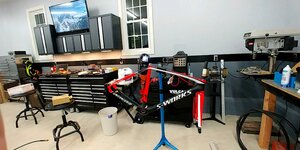
36382.jpeg
0930191844.jpg
 
Last edited:
OP
F

fishwatcher

Well-known member
Joined
Jan 26, 2023
Messages
751
So I went to HF today and picked up one of the Quinn strain gauges listed above to test the 5 Tq wrenches I have.

3/8" Craftsman 25-250 in/lb that is 8-9 yrs old and never calibrated
3/8 Craftsman 10-75 ft/lb that is well over 20yo and never calibrated
1/2" Craftsman 20-150 ft/lbs that may be over 35 yo and never calibrated and I retired to tq lug nuts
1/2" Proto 30-150 ft/lbs that I've had

I set it up with head studs Tq to 80# so the wrench should click off and the strain gauge will read the highest reading. I tested all of them at least 3 times

First the in/# I set to 60 in/# and got 5ft/lbs with the Quinn strain gauge
3/8" Craftsman ft/lbs I set to 20 and got 20 exactly at least 3x, this is the one I thought was heavy
1/2" Craftsman ft/lbs that was retired to lug nuts set to 50 and spot on
1/2" Quinn digital that I bought just to do heavy stuff set to 50 and got 48-50 every time

The high end Proto which is the only one I had calibrated set to 50 I got 58-59.

I also just went through a whole ordeal with stretching rod bolts with this wrench and now that I know it is 8-10# heavy it makes perfect sense and is within the torque and stretch which the rod bolt manufacturer was telling me. I switched rod bolts over this and really didn't need to.

Apparently my cheap **** is pretty good and I think that Quinn strain gauge is spot on too. I am going to give my Proto to my machinist to have it calibrated and re-check it. I am also going to check my buddies expensive snap on which I think he has had calibrated a few times
20240902_164013.jpg

To keep this bike related, my last bike build in 2019 and still my daily when I still ride. It was a little over 16# like it was in pic #2 with no light.
36382.jpeg
0930191844.jpg
Thx for sharing your results!

That’s awesome that all of your lower end torque wrenches are still accurate and consistent.

Wow.. 16 lbs. very nice bike. I have an older Specialized Tarmac SL2. It’s a little heavier than yours, but still rides great.
 
To avoid these ads, REGISTER NOW!
Top Bottom