You are using an out of date browser. It may not display this or other websites correctly.
You should upgrade or use an alternative browser.
You should upgrade or use an alternative browser.
Black & Decker Workmate
- Thread starter abstamaria
- Start date


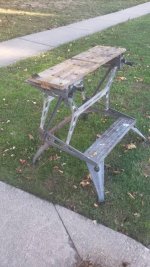
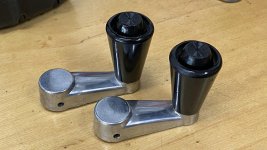
I found this one on Facebook marketplace, it was close by and the price was right. She needed just a little work and new handles.Should work well for me.
Can you check the bottom surface of the jaws and tell me the 5-digit code there, probably something like "720 12"? You have a very late-production Type 2, judging by the features, so the code could be very helpful. The jaws on that one may open to 5-1/2", for example, wider than most Type 2's. Thanks.
Jonathankamm
Well-known member
In the U.S. it was the Workmate 79-004. In Canada, it was the Jobmate 3980. The Jobmate had a unique feature--a pair of removable metal covers for the jaws--but was otherwise basically the same as the 79-004.
Apart from the power strip is it a type 6 with an “H” frame?
The 79-004, in spite of only ever being sold (as far as I can tell) as a Type 1, can have features that are all over the place. It has some from the 79-001 Type 2 (aluminum H-frame, 4 screw-in feet on the legs, the double-layer jaws), the Type 4 (the all-plastic handles, all steel parts painted, the style of label on the jaws), and the Type 6 (the bumper feet for sawhorse height, the plastic top-release levers, the one-piece base-release catch, the single-layer jaws, the black H-frame bushings). They can even have single-layer MDF jaws, which I don't think were used on the 79-001 until the Type 7.
For a sort of ultimate inconsequential piece of trivia, I believe it was the only Workmate to ever pair the aluminum H-frame with the black plastic bushings.
For a sort of ultimate inconsequential piece of trivia, I believe it was the only Workmate to ever pair the aluminum H-frame with the black plastic bushings.
jkherd
Well-known member
Can you check the bottom surface of the jaws and tell me the 5-digit code there, probably something like "720 12"? You have a very late-production Type 2, judging by the features, so the code could be very helpful. The jaws on that one may open to 5-1/2", for example, wider than most Type 2's. Thanks.
Coding 723 23 type 2 is the information on the bottom.
Thanks. This was made during the last several weeks of production of the Type 2, on May 31, 1977.
The vise handle sitting on top must be one of the originals, right? And, if you don't mind, does it have the 5-1/2" opening jaws rather than the Type 2's standard 4"?
The vise handle sitting on top must be one of the originals, right? And, if you don't mind, does it have the 5-1/2" opening jaws rather than the Type 2's standard 4"?
jkherd
Well-known member
Thanks. This was made during the last several weeks of production of the Type 2, on May 31, 1977.
The vise handle sitting on top must be one of the originals, right? And, if you don't mind, does it have the 5-1/2" opening jaws rather than the Type 2's standard 4"?
The measurements read 4 1/2" board edge to board edge however who knows what has been done to this over the years. I was planning to replace the top in the future. The top is not in the best condition. I had wanted one of these for sometime, when this one showed up I thought it would fulfill my needs.

Jonathankamm
Well-known member
The 79-004, in spite of only ever being sold (as far as I can tell) as a Type 1, can have features that are all over the place. It has some from the 79-001 Type 2 (aluminum H-frame, 4 screw-in feet on the legs, the double-layer jaws), the Type 4 (the all-plastic handles, all steel parts painted, the style of label on the jaws), and the Type 6 (the bumper feet for sawhorse height, the plastic top-release levers, the one-piece base-release catch, the single-layer jaws, the black H-frame bushings). They can even have single-layer MDF jaws, which I don't think were used on the 79-001 until the Type 7.
For a sort of ultimate inconsequential piece of trivia, I believe it was the only Workmate to ever pair the aluminum H-frame with the black plastic bushings.
Interesting. Thanks. I pick one up tomorrow.
Attachments

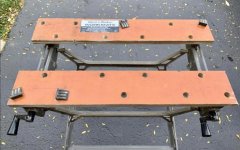
Be sure to insist on getting the original 12' extension cord with it!
I've owned two 79-004's, one of which came in its original box, and I've seen a couple of dozen online, and none of them had the extension cord. It would be cool if it said Black & Decker on it, but it's probably just generic. And we will probably never know.
I've owned two 79-004's, one of which came in its original box, and I've seen a couple of dozen online, and none of them had the extension cord. It would be cool if it said Black & Decker on it, but it's probably just generic. And we will probably never know.
The measurements read 4 1/2" board edge to board edge however who knows what has been done to this over the years.
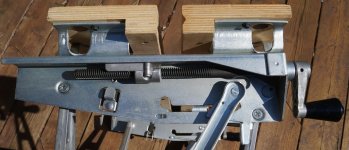
Now you've got me curious. If you look at the rear end of the side bracket that supports the jaws, there's a slot in the top of it that allows the jaws to open. Does the slot extend almost all the way to the end of the bracket, like the right-hand photo? Or does the slot end about 2-1/2" inches from the end of the bracket like the one on the left?
Attachments


jkherd
Well-known member
Now you've got me curious. If you look at the rear end of the side bracket that supports the jaws, there's a slot in the top of it that allows the jaws to open. Does the slot extend almost all the way to the end of the bracket, like the right-hand photo? Or does the slot end about 2-1/2" inches from the end of the bracket like the one on the left?
The picture on the left is closer to what I have but measures 2".
Attachments

RTM
Well-known member
For some reason I feel like I have 2 of those gripmates despite never seeing them in maybe half a decade, I don't think they had the orange inserts for the top though,
I have a pair from a previous purchase that only had one insert. I am looking at modding a modern for insert with a slot, see if it will hold. Seems many got separated.
The picture on the left is closer to what I have but measures 2".
Wow, that's new to me. I've seen the short slot and the long slot, but not one that was in between. That explains the 4-1/2" opening of the jaws (in between the common 4" and 5-1/2").
[Edit: Because of some inaccurate measurements, this is wrong. There are only two different lengths of jaw parts, no "in-between" ones.]
Can you check the threaded rod for the vise? Is its length also in between the long one shown on the left and short one on the right?
Attachments

Last edited:
jkherd
Well-known member
Wow, that's new to me. I've seen the short slot and the long slot, but not one that was in between. That explains the 4-1/2" opening of the jaws (in between the common 4" and 5-1/2").
Can you check the threaded rod for the vise? Is its length also in between the long one shown on the left and short one on the right?
Here are mine, looks like they are the same length.
Attachments


Thanks, the rod is also an in-between length. So there are three different setups for the jaw opening.
[Edit: Because of some inaccurate measurements, this is wrong. There are only two different lengths of jaw parts, no "in-between" ones.]
(I may have confused things with the way I asked the question. The pair of rods on a single Workmate always match each other. My photos showed the difference between the short and long rods from a Type 2 and a Type 4.)
[Edit: Because of some inaccurate measurements, this is wrong. There are only two different lengths of jaw parts, no "in-between" ones.]
(I may have confused things with the way I asked the question. The pair of rods on a single Workmate always match each other. My photos showed the difference between the short and long rods from a Type 2 and a Type 4.)
Last edited:
jkherd
Well-known member
Thanks, the rod is also an in-between length. So there are three different setups for the jaw opening.
(I may have confused things with the way I asked the question. The pair of rods on a single Workmate always match each other. My photos showed the difference between the short and long rods from a Type 2 and a Type 4.)
Sorry about the confusion, this one is my first workmate, I always wanted one because I knew it would be very useful in my shop. I'm really not certain what my model mine is. I've learned a lot about them in the past week and still learning more.
Jonathankamm
Well-known member

AceofSpad3s
Well-known member
- Joined
- Oct 1, 2014
- Messages
- 1,808
I ended up deciding to keep my 200 at least until I find another, so started looking around for a new rubber foot.. A rebuild kit for most of the jaws, handles AND includes bench dogs is going for $16 on amazon, but for 2 little rubber boots they want $10,
Now we know where black and decker are making their money on these things
Now we know where black and decker are making their money on these things
Jonathankamm
Well-known member
I ended up deciding to keep my 200 at least until I find another, so started looking around for a new rubber foot.. A rebuild kit for most of the jaws, handles AND includes bench dogs is going for $16 on amazon, but for 2 little rubber boots they want $10,
Now we know where black and decker are making their money on these things
The most common workmate available is the 200. They can be had for $5-$10. Just use it for parts.
bargainhuntingking
Well-known member
Black & Decker Workmate

Rainy day here thus busted out the blue 400 and did a little work on it, washing it for the first time since getting it from the ReStore, tightening it’s fasteners, straightening some bent brackets, oiling it, smoothing it’s operation, putting it through it’s paces and getting more familiar with its operation (flip up vertical jaw, etc.).
Here’s the 200 in the middle:

Lots of workmate functionality between these 3 types.
Rainy day here thus busted out the blue 400 and did a little work on it, washing it for the first time since getting it from the ReStore, tightening it’s fasteners, straightening some bent brackets, oiling it, smoothing it’s operation, putting it through it’s paces and getting more familiar with its operation (flip up vertical jaw, etc.).
Here’s the 200 in the middle:
Lots of workmate functionality between these 3 types.
Attachments


Last edited:
It's been three weeks since I first asked for the code numbers from your Workmates, so here is an update on how the documentation of Workmate 79-001 production dates is going.
First, thanks so much to the owners who have provided the Brockville production codes from their Workmates! I obviously could not do this without your help.
Second, some numbers. I now have production code info on 66 Workmates. (My initial goal is 100, so please provide info on yours if you haven't yet.) It is dominated by Type 2's (38 of them) and Type 4's (12 of them). There are 3 to 5 each of the Type 1, 6, 7, and 8. There are no Type 9's yet.
And then, some examples of interesting dates. I have enough data to pinpoint some transitions only roughly. For example, the switch from the production of the Type 1 to the Type 2 took place between early March and late June 1975. Although a fairly long window, this is still more than we ever knew previously.
Other transitions are now documented much more precisely. For example, the Type 2 was produced up through late June 1977 and followed immediately by production of the Type 4 starting in July 1977. Similarly, production of the Type 4 ended in October 1978 and production of the Type 6 started that same month.
Some of the parts changes for the Type 2 are now known quite precisely as well. For example, Black & Decker changed the center core of the vise handles from metal to plastic in the last half of June 1976. Similarly the 4-rib step was replaced by the 3-rib step in mid-October 1976.
And for my last, but perhaps most notable, example, we now know when the most visible change of all happened. That was during the production of the Type 4, when the H-frame changed from cast aluminum to stamped steel in December 1977 or January 1978.
There are many more parts changes visible in the data and now with identifiable dates, but I'm not going to list them all here.
You can read all about the Brockville production codes at my blog page:
https://h-frame.weebly.com/blog
A link to the current version of the spreadsheet with the raw data of the 66 Workmates can be found several screens down on that page, under the heading "Can I See Your Data?". Or if you don't want to read the blog entry, but just look at the raw data, this is the direct link to the spreadsheet:
https://h-frame.weebly.com/uploads/1/3/0/4/130458025/workmate_79-001_brockville_codes_web.xls
First, thanks so much to the owners who have provided the Brockville production codes from their Workmates! I obviously could not do this without your help.
Second, some numbers. I now have production code info on 66 Workmates. (My initial goal is 100, so please provide info on yours if you haven't yet.) It is dominated by Type 2's (38 of them) and Type 4's (12 of them). There are 3 to 5 each of the Type 1, 6, 7, and 8. There are no Type 9's yet.
And then, some examples of interesting dates. I have enough data to pinpoint some transitions only roughly. For example, the switch from the production of the Type 1 to the Type 2 took place between early March and late June 1975. Although a fairly long window, this is still more than we ever knew previously.
Other transitions are now documented much more precisely. For example, the Type 2 was produced up through late June 1977 and followed immediately by production of the Type 4 starting in July 1977. Similarly, production of the Type 4 ended in October 1978 and production of the Type 6 started that same month.
Some of the parts changes for the Type 2 are now known quite precisely as well. For example, Black & Decker changed the center core of the vise handles from metal to plastic in the last half of June 1976. Similarly the 4-rib step was replaced by the 3-rib step in mid-October 1976.
And for my last, but perhaps most notable, example, we now know when the most visible change of all happened. That was during the production of the Type 4, when the H-frame changed from cast aluminum to stamped steel in December 1977 or January 1978.
There are many more parts changes visible in the data and now with identifiable dates, but I'm not going to list them all here.
You can read all about the Brockville production codes at my blog page:
https://h-frame.weebly.com/blog
A link to the current version of the spreadsheet with the raw data of the 66 Workmates can be found several screens down on that page, under the heading "Can I See Your Data?". Or if you don't want to read the blog entry, but just look at the raw data, this is the direct link to the spreadsheet:
https://h-frame.weebly.com/uploads/1/3/0/4/130458025/workmate_79-001_brockville_codes_web.xls
Last edited:
Jonathankamm
Well-known member
It's been three weeks since I first asked for the code numbers from your Workmates, so here is an update on how the documentation of Workmate 79-001 production dates is going.
First, thanks so much to the owners who have provided the Brockville production codes from their Workmates! I obviously could not do this without your help.
Second, some numbers. I now have production code info on 66 Workmates. (My initial goal is 100, so please provide info on yours if you haven't yet.) It is dominated by Type 2's (38 of them) and Type 4's (12 of them). There are 3 to 5 each of the Type 1, 6, 7, and 8. There are no Type 9's yet.
And then, some examples of interesting dates. I have enough data to pinpoint some transitions only roughly. For example, the switch from the production of the Type 1 to the Type 2 took place between early March and late June 1975. Although a fairly long window, this is still more than we ever knew previously.
Other transitions are now documented much more precisely. For example, the Type 2 was produced up through late June 1977 and followed immediately by production of the Type 4 starting in July 1977. Similarly, production of the Type 4 ended in October 1978 and production of the Type 6 started that same month.
Some of the parts changes for the Type 2 are now known quite precisely as well. For example, Black & Decker changed the center core of the vise handles from metal to plastic in the last half of June 1976. Similarly the 4-rib step was replaced by the 3-rib step in mid-October 1976.
And for my last, but perhaps most notable, example, we now know when the most visible change of all happened. That was during the production of the Type 4, when the H-frame changed from cast aluminum to stamped steel in December 1977 or January 1978.
There are many more parts changes visible in the data and now with identifiable dates, but I'm not going to list them all here.
You can read all about the Brockville production codes at my blog page:
https://h-frame.weebly.com/blog
A link to the current version of the spreadsheet with the raw data of the 66 Workmates can be found several screens down on that page, under the heading "Can I See Your Data?". Or if you don't want to read the blog entry, but just look at the raw data, this is the direct link to the spreadsheet:
https://h-frame.weebly.com/uploads/1/3/0/4/130458025/workmate_79-001_brockville_codes_web.xls
I appreciate your work. Great job. It really inspired my interest in workmates.
Jonathankamm
Well-known member
Sunny day. Thought I’d take some pics. Here’s 6 of my “H” frames. The 3 in the front are refurbished. Cleaned with new parts, rust removal, paint and new top boards. I have one other Type 4 that is in pieces right now. The single one pictured is the latest one I finished.
Attachments



DaveT
Well-known member
Sunny day. Thought I’d take some pics. Here’s 6 of my “H” frames. The 3 in the front are refurbished. Cleaned with new parts, rust removal, paint and new top boards. I have one other Type 4 that is in pieces right now. The single one pictured is the latest one I finished.
That’s some awesome work there Jonathan. Are any of those tops replacements? If so are you using Baltic birch?
AceofSpad3s
Well-known member
- Joined
- Oct 1, 2014
- Messages
- 1,808
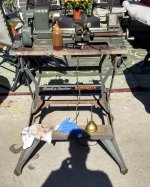
Considering I haven't seen maybe but one broken one for sale at garage sales in the past few years I was driving to pick up this toy lathe when I saw the familiar pattern of black folded legs on the side of the road with some furniture. It's a type 7, I heard of workmates with power strips but it looks like it's just an add on from the owner.
Surprisingly enough it all seems to work and is complete aside from the spring latches that hold it closed are bent, so it opens when moving it around.
I don't know whats a more annoying, getting hit in the leg when I pick one up since it doesn't latch, or my blue one where one of the spring on one side is doesn't get pushed far enough in, so you have to pry it out while pushing it up when unfolding it. Well for the prices payed you can't get everything
Surprisingly enough it all seems to work and is complete aside from the spring latches that hold it closed are bent, so it opens when moving it around.
I don't know whats a more annoying, getting hit in the leg when I pick one up since it doesn't latch, or my blue one where one of the spring on one side is doesn't get pushed far enough in, so you have to pry it out while pushing it up when unfolding it. Well for the prices payed you can't get everything
Last edited:
Jonathankamm
Well-known member
That’s some awesome work there Jonathan. Are any of those tops replacements? If so are you using Baltic birch?
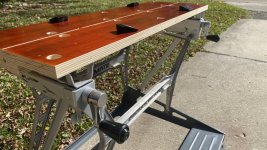
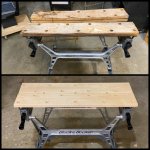
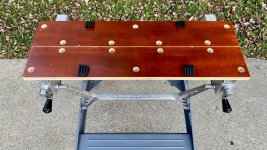
Yes. I replaced the tops. The dark ones are Baltic birch with traditional cherry stain. The other one is solid maple.
Attachments


DaveT
Well-known member
Yes. I replaced the tops. The dark ones are Baltic birch with traditional cherry stain. The other one is solid maple.
Very nice work!
AceofSpad3s
Well-known member
- Joined
- Oct 1, 2014
- Messages
- 1,808
I've been meaning to make some bottom shelves for a while and was planning on fixing it in place, would it interfere with the legs when they are folded up and using it with just the H frame open?
Bigbandguy
Well-known member
Considering I haven't seen maybe but one broken one for sale at garage sales in the past few years I was driving to pick up this toy lathe when I saw the familiar pattern of black folded legs on the side of the road with some furniture. It's a type 7, I heard of workmates with power strips but it looks like it's just an add on from the owner.
A minor point. The Craftsman 109 is a step up from a "toy" lathe. It has its limitations to be sure. Looks like you got a chuck with yours which is not all that common. Many just used a faceplate and dog. The 1/2 inch spindle does limit finding a decent chuck. I think you got a pretty nice machine for small stuff and soft metals. It is a good machine to learn on if nothing else. To keep the thread on point, the workmate is probably sturdy enough for such a lightweight lathe although a bench top likely would be better.
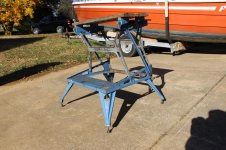
Picked up a type 3 today, it's a bit scruffy but it works fine.
I felt sorry for the seller, a lady probably in her 60's who recently lost her hoarder husband to a stroke and is cleaning out his sheds so she can sell the property and move on to something that she can afford with just her income. She said that they never had trouble in all the years that they lived there (5 acre rural property) but after she advertised on CL and Facebook people have been breaking into the sheds and stealing everything they can. Probably people that come to buy something, look around, then come back later to grab what they can. She took me to about 6 sheds to see if I wanted to buy anything else that she had left (wasn't much there) and a couple of the doors had obviously been pried open and the locks broken off. Plenty of slimeballs out there.
I felt sorry for the seller, a lady probably in her 60's who recently lost her hoarder husband to a stroke and is cleaning out his sheds so she can sell the property and move on to something that she can afford with just her income. She said that they never had trouble in all the years that they lived there (5 acre rural property) but after she advertised on CL and Facebook people have been breaking into the sheds and stealing everything they can. Probably people that come to buy something, look around, then come back later to grab what they can. She took me to about 6 sheds to see if I wanted to buy anything else that she had left (wasn't much there) and a couple of the doors had obviously been pried open and the locks broken off. Plenty of slimeballs out there.
Attachments


AceofSpad3s
Well-known member
- Joined
- Oct 1, 2014
- Messages
- 1,808
A minor point. The Craftsman 109 is a step up from a "toy" lathe. It has its limitations to be sure. Looks like you got a chuck with yours which is not all that common. Many just used a faceplate and dog. The 1/2 inch spindle does limit finding a decent chuck. I think you got a pretty nice machine for small stuff and soft metals. It is a good machine to learn on if nothing else. To keep the thread on point, the workmate is probably sturdy enough for such a lightweight lathe although a bench top likely would be better.
The chuck is in pretty sorry shape, didn't look real close until pulling it apart, got quite a few broken threads, but it seems like it'll hold things, at least for a while.
Of course I had a motor off a drill press that was sitting in a milk crate for 5 years, and sold recently because surely I won't need it. Then after that a few months ago there was a $5 craftsman motor with a built in switch at a sale that I passed on because I don't need it taking up room, and I only sold mine for $20, surely it wouldn't be worth the hassle or be worth much. Then I was informed there was a table saw sitting on the road nearby a few weeks ago that I didn't bother about because I don't use mine as is.
And of course NOW I get something that needs a motor,everyone else wants more money for them than I did
Schrödinger's lathe is what it is, you can use a lathe to make parts for itself, but in order to use a new tool post, you need the t-nut, which you can't make without a tool holder which I don't have. In order to make a backing plate for a new chuck, you need a machine and chuck bigger than this to handle making something so large out of a more tough material. This sort of thing is exactly why having at least two of everything is so necessary
I wasn't planning on using a workmate as a base, but it could be an idea, I was planning on laminating several sheets of plywood and mounting it onto that, then maybe onto a metal table, but since I also use a workmate as my table saw base when I pull it out every once in a while, it might be a idea to keep things out of the way.
Outlawmws
Well-known member
Make your lathe base and add a cleat on the bottom for the Workmate jaws. I do most bench tools this way...
Jonathankamm
Well-known member
Dovetail clamps are getting popular in the woodworking community. I thought workmate tops would be the perfect opportunity. Router a dovetail groove anywhere and you’ll be able to make use of dovetail clamps. No aluminum rails or tiny little screws that might not hold. I added a couple to the latest top I was making. I think they look pretty sharp. Like a pinstripe down the center. Opens up lots of new clamping possibilities.
Attachments
-
 EDED47BB-5AB4-49AA-B4B2-0195DDD688C7.jpg144 KB · Views: 47
 -
 0E1B8916-10BA-42D8-A04A-D8C42806DE01.jpg62.1 KB · Views: 53
 -
 71F3EE09-4589-409A-81A1-AF835495F183.jpg147.6 KB · Views: 48
 -
 252449BB-4F10-4C99-8F37-2A4CDAA010C5.jpg117.5 KB · Views: 50
 -
 AC4D4BA4-D264-48FA-9A74-09FDFBEAD423.jpg151.9 KB · Views: 47
 -
 943FC8A5-5806-4501-AFFF-B8DB724DB122.jpg141 KB · Views: 51
DaveT
Well-known member
Dovetail clamps are getting popular in the woodworking community. I thought workmate tops would be the perfect opportunity. Router a dovetail groove anywhere and you’ll be able to make use of dovetail clamps. No aluminum rails or tiny little screws that might not hold. I added a couple to the latest top I was making. I think they look pretty sharp. Like a pinstripe down the center. Opens up lots of new clamping possibilities.
That’s a great idea Johnathan! I have not pulled the trigger on any MATCHFIT clamps yet but I have had them in my Amazon wish list for over a year.
Jonathankamm
Well-known member
That’s a great idea Johnathan! I have not pulled the trigger on any MATCHFIT clamps yet but I have had them in my Amazon wish list for over a year.
My only issue is their price. They are a little pricey for a simple clamp.
DaveT
Well-known member
It's been three weeks since I first asked for the code numbers from your Workmates, so here is an update on how the documentation of Workmate 79-001 production dates is going.
First, thanks so much to the owners who have provided the Brockville production codes from their Workmates! I obviously could not do this without your help.
Second, some numbers. I now have production code info on 66 Workmates. (My initial goal is 100, so please provide info on yours if you haven't yet.) It is dominated by Type 2's (38 of them) and Type 4's (12 of them). There are 3 to 5 each of the Type 1, 6, 7, and 8. There are no Type 9's yet.
And then, some examples of interesting dates. I have enough data to pinpoint some transitions only roughly. For example, the switch from the production of the Type 1 to the Type 2 took place between early March and late June 1975. Although a fairly long window, this is still more than we ever knew previously.
Other transitions are now documented much more precisely. For example, the Type 2 was produced up through late June 1977 and followed immediately by production of the Type 4 starting in July 1977. Similarly, production of the Type 4 ended in October 1978 and production of the Type 6 started that same month.
Some of the parts changes for the Type 2 are now known quite precisely as well. For example, Black & Decker changed the center core of the vise handles from metal to plastic in the last half of June 1976. Similarly the 4-rib step was replaced by the 3-rib step in mid-October 1976.
And for my last, but perhaps most notable, example, we now know when the most visible change of all happened. That was during the production of the Type 4, when the H-frame changed from cast aluminum to stamped steel in December 1977 or January 1978.
There are many more parts changes visible in the data and now with identifiable dates, but I'm not going to list them all here.
You can read all about the Brockville production codes at my blog page:
https://h-frame.weebly.com/blog
A link to the current version of the spreadsheet with the raw data of the 66 Workmates can be found several screens down on that page, under the heading "Can I See Your Data?". Or if you don't want to read the blog entry, but just look at the raw data, this is the direct link to the spreadsheet:
https://h-frame.weebly.com/uploads/1/3/0/4/130458025/workmate_79-001_brockville_codes_web.xls
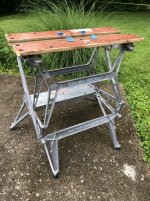
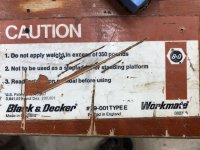
Wolf: This is the only writing I see on the bottom of my Type E. I can’t make out the top line, maybe 79-? 15. Bottom line TYPE E
Attachments

Jonathankamm
Well-known member
Free workmate. Curb Alert. Near Appleton WI.
https://appleton.craigslist.org/zip/d/neenah-curb-alert-black-and-decker/7216355640.html
https://appleton.craigslist.org/zip/d/neenah-curb-alert-black-and-decker/7216355640.html