To avoid these ads, REGISTER NOW!

Black & Decker Workmate

wolfcj

Well-known member
Joined
Apr 24, 2017
Messages
599
Wolf: I have 2 of the 79-004’s. I thought you were only looking for markings on the 79-001.

Yes, I did say that.

However, I recently started a new section of my web site for "Related Models". The 79-004 is the first entry there. I explain the the generally unrecognized, but pivotal, importance of the 79-004 to the Workmate story. I think any Workmate fan will find it interesting.
https://h-frame.weebly.com/workmate-79-004.html

Interestingly, I have three dates for 79-004's and they cover a span of only seven weeks.

So now I'll ask anyone else out there with a 79-004 with a production code on the jaws to provide it for my list. Thanks!
 
Last edited:
To avoid these ads, REGISTER NOW!

andyvh1959

Well-known member
Joined
Feb 15, 2020
Messages
2,590
Location
Green Bay WI
One of the best Christmas gifts I ever got was a Workmate 200 back in the late 70's. Built kitchen cabinets on it. Used it as the engine stand to rebuild the engine for my Suzuki GS1000. Now its in my new garage build project as the base for the Delta compound angle 10"saw. Last spring I bought a used 550 for $35. I still shop CL for another 200 to go with my old Workmate. My 1t Workmate is really beat up but working great. Now that I think about it my brother in law got a 200 at the same time I got mine and I know he barely ever used his.

I really like the post earlier that someone had replaced the tops of his Workmate with varnished hardwood. Looks good enough to be a shop display item, almost have to careful not to mess it up.
 

wolfcj

Well-known member
Joined
Apr 24, 2017
Messages
599
One of the best Christmas gifts I ever got was a Workmate 200 back in the late 70's.

I too got my first Workmate (79-001 Type 4) as a gift, in 1978, and I loved it. Your 200 was part of the second generation of Workmates for the U.S. starting in 1983. You can see the 200 in Black & Decker's 1983 catalog on [URL="https://h-frame.weebly.com/documents.html"]the Documents page of my web site[/URL]. The 1982 catalog just above it features all the first-generation models.
 

Rackman_00

New member
Joined
Feb 2, 2011
Messages
1
Hi, I recently picked up a 79-001 Type 2 that has lots of paint spatters on the legs and lower structure. Has anyone found a paint remover that might work without harming the factory paint?

Thanks,

Mark
 

wolfcj

Well-known member
Joined
Apr 24, 2017
Messages
599
I have tried lots of things and none of them worked. The problem is that the factory paint is extremely soluble. Any kind of lacquer thinner, toluene, acetone, xylene, Goof-Off, adhesive remover, denatured alcohol, etc. will wipe the factory paint right off along with the spatters. Even full-strength Simple Green softens it and starts to remove it, and, if I remember right so does isopropyl alcohol. Mineral spirits and naphtha are okay for it, but they don't touch most spatters either. If you find something that works, I would love to know.

On the other hand, I have found the finish on the wooden jaws to be very solvent resistant, so it's easy to get spatters off them while leaving the finish.
 

Outlawmws

Well-known member
Joined
Aug 9, 2011
Messages
39,085
Location
The Badlands
If they are true spatters, you might try a sharp knife edge and see if you can pop them off? (Blade mostly flat) Its tedious work as it's one by one, but I've cleaned paint spatter off wood veneered speakers like that with good success.
 

wolfcj

Well-known member
Joined
Apr 24, 2017
Messages
599
Yes, that works great on the wooden jaws. I've done that successfully on the jaws with a razor scraper as well as using solvents. Once you get the technique, the scraper method is kind of cool. The painted steel is the real problem area.
 

Jonathankamm

Well-known member
Joined
Sep 28, 2020
Messages
67
Location
Northern Illinois
I remove what I can and repaint. First I give it a good scrubbing with Krud Kutter Tough Job remover. It will remove all the dead paint. Then wire brush and steel wool for the tough areas. 2 coats of etching primer and 2 top coats. Rustoleum 2X has been working well.
 

Attachments

  • 95A695BF-61A2-4F0E-ABA0-7531B2A44174.jpg
    95A695BF-61A2-4F0E-ABA0-7531B2A44174.jpg
    152.5 KB · Views: 82
  • E6669E6D-D94B-4040-8410-A733341FAFB3.jpg
    E6669E6D-D94B-4040-8410-A733341FAFB3.jpg
    139.3 KB · Views: 74
  • 3698A33F-E444-4394-8EA1-8A86D886F876.jpg
    3698A33F-E444-4394-8EA1-8A86D886F876.jpg
    147.1 KB · Views: 86

wolfcj

Well-known member
Joined
Apr 24, 2017
Messages
599
But I think you've said that you usually pick up Workmates that are free or very cheap, usually in poor condition, and make them as like-new as possible. My perspective, and I think that of Rackman's original question, is of Workmates that are in generally good condition to start with. We want to keep them like that, with all of the original finishes as well as some of the character of being 40 years old, so repainting is not an option. However, we would also like to do some cleaning where possible to remove some of the spills and spatters that even the good ones tend to have. Because of the paint that Black & Decker used on their steel parts, it's very difficult. I'm still hoping someone will come up with a process to achieve that.

I will note that the Type E and Type 1 are relatively easy to clean up, because none of their metal parts are painted. You can use almost any standard paint remover or solvent you wish to remove spatters and spills, with no effect on the metal. On the jaws, you can use certain solvents that won't affect the finish, and you can also use the careful "scrape/lift/pop" method that Outlaw mentions. (The latter also works well on flat metal surfaces, reducing the amount of chemical stripping needed for those.) The whole Workmate retains its patina, but can be made extremely clean.
 

RandyIA

Well-known member
Joined
Oct 19, 2020
Messages
142
Location
Iowa
I thought I could see at least one of the springs in your photos, but it's hard to tell with the lighting and the angles shown. Or are your top-release levers just flopping around loose?

The attachment points are shown pretty clearly in the fourteenth photo I referred you to.

Sorry for the late response, I've been working a lot recently.

Unfortunately I still haven't gotten down to the basement to look for those springs. No matter, if they aren't there I can get new ones. One of the local hardware stores has an excellent supply of springs. I never paid attention to whether the levers rattled around to be honest. That alone would lead me to think they are there since I don't remember that frustration with it. I believe that maybe I was thinking they were positioned on the outer side of the frame rails, I see now they are not. Rookie mistake. And I see that wouldn't even make sense anyway.

Thanks!
 

AceofSpad3s

Well-known member
Joined
Oct 1, 2014
Messages
1,808
Has there ever been an attempt at a comprehensive list of various models? Not a type study or anything in depth, more just a picture and model number and maybe how it differs from other models if it's based on the same design.
I'd like to see more of the odd workmates, but searching through 90 pages is a bit grating.
 

wolfcj

Well-known member
Joined
Apr 24, 2017
Messages
599
My H-frame site is incredibly comprehensive for the U.S. Workmate 79-001 from 1974 to 1982 ;) After that, it has zilch.

So it's probably not quite what you're looking for. I don't know any other place to suggest.

As long as we're talking about it, I just added two more models to my new Related Models page. They are both Canadian-market ones, the Workmate 79-005 and the Jobmate 3980. They are very closely related to the U.S. 79-001 and both have interesting stories.
 
Last edited:

AceofSpad3s

Well-known member
Joined
Oct 1, 2014
Messages
1,808
Outlaw: Yes, but it doesn't pertain to much besides of that specific model and accessories associated.
It is in depth, but that specific model hasn't been made for nearly 40 years, the vast majority of examples someone is likely to see is newer than that.
What I mean is a list of anything made or sold through black and decker that functions as the workmate does. Not a type study of each difference over the progression of a model but example of one and short description of the model so someone could look through it and see how the 400 is different from the 425, or learn about existence the large frame one like the 1000, or the small versions like the 8 inch hobby model, etcetera.
 
Last edited:

Jonathankamm

Well-known member
Joined
Sep 28, 2020
Messages
67
Location
Northern Illinois
My H-frame site is incredibly comprehensive for the U.S. Workmate 79-001 from 1974 to 1982 ;) After that, it has zilch.

So it's probably not quite what you're looking for. I don't know any other place to suggest.

As long as we're talking about it, I just added two more models to my new Related Models page. They are both Canadian-market ones, the Workmate 79-005 and the Jobmate 3980. They are very closely related to the U.S. 79-001 and both have interesting stories.

I’ve taken many h frame models apart. From what I can tell all the actual h frames are identical except for this JOBMATE version. Am I correct or are there some that are different. TYPE 1’s have the blue letters but other than that. Maybe over seas models are different?
 

Attachments

  • 01DA3E19-5114-49CA-9F32-5ACD70B4EC56.jpg
    01DA3E19-5114-49CA-9F32-5ACD70B4EC56.jpg
    159.3 KB · Views: 47

wolfcj

Well-known member
Joined
Apr 24, 2017
Messages
599
The part diagrams for the 79-001 (downloadable from my Documents page) show one part number for the 79-001's that were made in England and Ireland: Type E, 3, and 5. (Type E's have the blue lettering.)

The part diagrams show two alternative part numbers for the aluminum H-frame ones made in Brockville, Ontario: Type 1, 2, and 4. The one printed on the original diagram is crossed out, with the alternative hand-written. Both of those numbers are different than those for the E, 3, and 5.

For the steel H-frame models (6, 7, 8, and 9), they show two part numbers to be installed on every Workmate. One is described as "H-Frame" and the other is "H-Frame & Label". I would be surprised if there is a difference other than the label.

I don't have part diagrams for the 79-004, 79-005, or Jobmate. However, since they were made in Brockville, I would expect they use the same parts.

And since the 79-001 Type 4 switched from the aluminum H-frame to the steel H-frame in the middle of production, I suspect that the aluminum and steel H-frames are completely interchangeable across all Brockville production as well.
 

wolfcj

Well-known member
Joined
Apr 24, 2017
Messages
599
Also, come to think of it, the aluminum H-frames have their part number cast into them. You could examine all of yours, see how they match up to the numbers on the part diagrams, and tell us if there are observable differences. Sounds like a project!

And since you have a 79-004, you could confirm if it uses the same part as the 79-001's. (It almost certainly does.)
 

wolfcj

Well-known member
Joined
Apr 24, 2017
Messages
599
Here's a start for you. I did a quick survey of my cast-in H-frame part numbers.

First, the Brockville production.

My Type 1, 2, and 4 all have the same number, matching the original printed one on the part diagram. I don't have any with the alternative hand-written number. Maybe you will have one of those.

One of my 79-004's also had that same number. None of the photos of my other 79-004 shows the number clearly.

Then the ones from the British Isles.

My four Type E's all match the number on the Type E part diagram.

My Type 3 does not match its part diagram; it has an entirely new number, as does the Type 5 in the photos on my web site.
 
To avoid these ads, REGISTER NOW!

Jonathankamm

Well-known member
Joined
Sep 28, 2020
Messages
67
Location
Northern Illinois
Also, come to think of it, the aluminum H-frames have their part number cast into them. You could examine all of yours, see how they match up to the numbers on the part diagrams, and tell us if there are observable differences. Sounds like a project!

And since you have a 79-004, you could confirm if it uses the same part as the 79-001's. (It almost certainly does.)

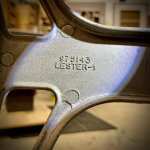
Mine are all the same part number 975143. Accept for this one and the 79-004. They have the same part number but also have LESTER -1 under the number. The one pictured has a date of 638-32.
 

Attachments

  • 08FB5C9A-C5E0-47D8-9CF9-78D51F00AC0F.jpg
    08FB5C9A-C5E0-47D8-9CF9-78D51F00AC0F.jpg
    150.4 KB · Views: 42
  • A70AF42C-8122-44A8-9B0D-FCF5AF903109.jpg
    A70AF42C-8122-44A8-9B0D-FCF5AF903109.jpg
    149.2 KB · Views: 40
  • 86AC1E91-3B90-4138-A446-54988FA08AB9.jpg
    86AC1E91-3B90-4138-A446-54988FA08AB9.jpg
    115.6 KB · Views: 47
  • 011B9BE9-B304-42F5-A984-2A4B67A18FF8.jpg
    011B9BE9-B304-42F5-A984-2A4B67A18FF8.jpg
    150.3 KB · Views: 59
  • 4A444C4C-6DD2-41F7-9211-295429F3EC0A.jpg
    4A444C4C-6DD2-41F7-9211-295429F3EC0A.jpg
    136.5 KB · Views: 70

wolfcj

Well-known member
Joined
Apr 24, 2017
Messages
599
Mine are all the same part number 975143. Accept for this one and the 79-004. They have the same part number but also have LESTER -1 under the number.
Well, that confirms your observation that yours are all identical.

All of my cast H-frames have an additional marking somewhere on the same side as the part number. My theory is that it identifies the specific mold used. I'm not an expert on casting, but I know that molds have a limited life and have to be replaced. The manufacturer may want to know at some point which mold was used to make a specific component, for example if it fails. My markings vary considerably, including "3", "1A", "S" in a circle followed by "2", "R408", and "Lester-1". I like to think the last was a creative mark in tribute to someone.

The one pictured has a date of 638-32.

Is this a new acquisition?
 

Jonathankamm

Well-known member
Joined
Sep 28, 2020
Messages
67
Location
Northern Illinois
Well, that confirms your observation that yours are all identical.

All of my cast H-frames have an additional marking somewhere on the same side as the part number. My theory is that it identifies the specific mold used. I'm not an expert on casting, but I know that molds have a limited life and have to be replaced. The manufacturer may want to know at some point which mold was used to make a specific component, for example if it fails. My markings vary considerably, including "3", "1A", "S" in a circle followed by "2", "R408", and "Lester-1". I like to think the last was a creative mark in tribute to someone.


Is this a new acquisition?

My latest was the 79-004. I’ve emailed you dates and pics of all the 79-001’s I have.
I am negotiating this TYPE 3. I hope I get it. But the person is slow to respond.
 

Attachments

  • 229C078D-D082-4755-97E8-486CC101AA0B.jpeg
    229C078D-D082-4755-97E8-486CC101AA0B.jpeg
    127.1 KB · Views: 88

wolfcj

Well-known member
Joined
Apr 24, 2017
Messages
599
That 638-32 wasn't among the three you emailed me earlier, so I figured it was new. I've added it to my list.
 

wolfcj

Well-known member
Joined
Apr 24, 2017
Messages
599
That clears that up; I had that one recorded differently. In the posting, you didn't give me the number, which I then read from your photo as 638 22. I've changed that.
 

AceofSpad3s

Well-known member
Joined
Oct 1, 2014
Messages
1,808
Found a type E for the first time, looks in pretty sorry shape though. Tempting but $10 too much and 20 miles too far for my tastes to gamble on it.
https://scontent-bos3-1.**.fbcdn.net/v/t1.0-9/s960x960/120701379_10217422115576795_7348190326351699181_o.jpg?_nc_cat=100&ccb=2&_nc_sid=843cd7&_nc_ohc=gR88CgaZiu8AX9XIjsA&_nc_ht=scontent-bos3-1.**&tp=7&oh=48f9c97c3354f8418fa14d280fc089a7&oe=5FBD4C73
 

wolfcj

Well-known member
Joined
Apr 24, 2017
Messages
599
It's hard to judge condition from photographs, but that one doesn't look that bad to me. Have you requested photos from other angles? I don't see anything obviously broken. Have you asked about that?

Some of the feet are missing, but I can't tell how many. They can be replaced, but will be a different style. Paint spills are easy to clean on the frame of a Type E. I see some rust on the steel core of the handles. The steel screws that I can see (just barely) don't look rusted. The jaws look the worst to me, but if you can tolerate their appearance they look as though they still work.
 

AceofSpad3s

Well-known member
Joined
Oct 1, 2014
Messages
1,808
I tried to contact a while ago but haven't heard back, but it's still up. Given the background looking like a dump in the literal sense and the description just being the words work bench I doubt I'll be able to get much of any detailed information.
I am not sure of how the early ones work, but on the one I just got recently, and my other newer models I have/had, I don't recall ever being able to go far enough to the point where the screw would disconnect from the nut in the dynamic jaw because I believe there are stops to prevent it. I thought something might be missing or broken because of the screw being completely disconnected from the dynamic jaw on that one.
 

wolfcj

Well-known member
Joined
Apr 24, 2017
Messages
599
Yeah, that is a possibility, but if only the stop is broken, it doesn't affect usage. You would just reconnect the screw and use it. If you look at my page on the Type E, it shows the stop, which is just screwed into the bottom of the jaw. It's the least elegant part of Hickman's design! (It's in the 16th and 17th photos.)
 

wolfcj

Well-known member
Joined
Apr 24, 2017
Messages
599
I’ve taken many h frame models apart. From what I can tell all the actual h frames are identical except for this JOBMATE version. Am I correct or are there some that are different. TYPE 1’s have the blue letters but other than that. Maybe over seas models are different?

I checked one more thing for you. I took some measurements on H-frames all with different part numbers from four different 79-001's: Type E (England, aluminum), Type 3 (Ireland, aluminum), Type 4 (Canada, aluminum), and Type 4 (Canada, steel).

I measured the height vertically between the centers of the upper and lower pivot points, and the overall width at the pivot points. I was using a tape measure, and the H-frames were installed, so my precision wasn't great, but I can say all four H-frames were within 1/16" on both measurements.

I didn't remove the screws, but it would make sense that the English and Irish H-frames might be tapped for a metric screw, making them slightly different than the Canadian production.
 

Jonathankamm

Well-known member
Joined
Sep 28, 2020
Messages
67
Location
Northern Illinois
I checked one more thing for you. I took some measurements on H-frames all with different part numbers from four different 79-001's: Type E (England, aluminum), Type 3 (Ireland, aluminum), Type 4 (Canada, aluminum), and Type 4 (Canada, steel).

I measured the height vertically between the centers of the upper and lower pivot points, and the overall width at the pivot points. I was using a tape measure, and the H-frames were installed, so my precision wasn't great, but I can say all four H-frames were within 1/16" on both measurements.

I didn't remove the screws, but it would make sense that the English and Irish H-frames might be tapped for a metric screw, making them slightly different than the Canadian production.

Thanks. Good to know. If I find any that are in too bad of shape to restore I can save the “H” frames to use in the future.

Another question:
I’m wondering if I made replacement jaws for sale for the TYPE 2 how many other TYPES would they fit? Is that the most common 79-001 jaw?
 

wolfcj

Well-known member
Joined
Apr 24, 2017
Messages
599
Another question:
I’m wondering if I made replacement jaws for sale for the TYPE 2 how many other TYPES would they fit? Is that the most common 79-001 jaw?

Did you look at the part diagrams and my type study? The Type 2 and Type 4 jaws certainly appear to be the same, but I haven't compared the part numbers. You can see that the Type 1 has different mounting blocks that require holes in the jaws that are not present on the Type 2, so there is at least that difference, even if the dimensions are the same. As far as fitting double-layer jaws for the Type 2 on a Type that originally had a single-layer, I'm not sure if there would be some incompatibility.

Working in your favor is that the Type 2 is by far the most often found 79-001 today, and the Type 4 is second. A very rough estimate is that they make up 40-50% and 20-25% of what's out there.
 

wolfcj

Well-known member
Joined
Apr 24, 2017
Messages
599
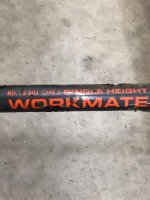
I have another request for help from Workmate owners. Do you have a Workmate 300 from the early 1980's that looks like this photo?

It should have the black (not orange) vise handles, tool storage holes in the step, "Workmate 300" written in black on the jaws, and "Workmate 300" in white (no orange) on the crossbar.

If so, can you check it for a production code on the bottom surface of the jaws or the bottom surface of the front step, and tell me what it is? The second and third photos show what the codes might look like.

I'm trying to determine just when the Workmate 300 replaced the 79-001. Thanks!
 

Attachments

  • 122202676_3569140093124570_6462650887744295772_o.jpg
    122202676_3569140093124570_6462650887744295772_o.jpg
    127.8 KB · Views: 56
  • 120926385_1036156516836812_8797327542020450062_n.jpg
    120926385_1036156516836812_8797327542020450062_n.jpg
    86.5 KB · Views: 46
  • 121063076_1081783505603315_2129599660378421992_n.jpg
    121063076_1081783505603315_2129599660378421992_n.jpg
    136 KB · Views: 46

THIRDY

Member
Joined
Feb 7, 2012
Messages
5
Location
Scotland
Hi all, what a fascinating thread! Having struggled along with a cheapo copy of the "TV tray" for the last 30 years, I now feel the urge for a "proper" workmate. (Although, in my defence I do have the smaller Workmate WM450 "Workbox", which has been well used over the years)

I don't want one of the newer all steel versions, so have started trawling the usual places (in the UK) for the older aluminium H frame models.

I am looking for a pair - the ability to put a large table top between the 2 has a certain draw for me.

My question to the group is, is the Type E more desirable that the later types 1-5? I prefer the "look" of the original fold out legs - although generally the condition of the tops is worse - but was the functionality improved on the later versions?

Thanks!
 

wolfcj

Well-known member
Joined
Apr 24, 2017
Messages
599
The Type E and 1-9 that we talk about here are all variations of the Workmate 79-001 that was manufactured in Canada and sold in the U.S. You aren't very likely to find them in the UK, so any details you learn about them may not help much in your search.

I'm not an expert on the non-U.S. models, but I've picked up a little knowledge while researching the 79-001. In the UK, the equivalent of the all-aluminum Type E was the WM325, which came in at least three Types of its own, with very minor differences. That was followed by the WM625, which switched to steel construction except for the H-frames, also with several Types. There were certain ones of these that had a steel skeleton-style frame, of slightly different design and construction than the skeleton frame of the WM325. Nothing like these was ever sold in the U.S. Others have a steel frame very similar to the 79-001 Type 1-4.

I'm sorry I don't know of any source that has comprehensive coverage of the UK/European models. If you search for Workmate WM325 and WM625 in Google UK you may be able to start to piece together what you want to know.
 

THIRDY

Member
Joined
Feb 7, 2012
Messages
5
Location
Scotland
Thanks very much for your response - I shall certainly do some more research into the UK models before jumping in!

Do you have an opinion on whether the functionality improved moving to the Type 1? Are you aware of any issues with the original style legs, other than cost of manufacture, over and above the legs that followed on?

Thanks again for sharing your knowledge!
 

wolfcj

Well-known member
Joined
Apr 24, 2017
Messages
599
I have owned four 79-001 Type E's. Two of them I sold shortly after buying, so I never used them. One I have had set up in my shop continuously for a couple of years. The fourth one is in terrible condition. I would like to get it apart and sell it for parts, but many screws are so seized up that I can't, so it just sits around.

Of the four, three had damage to one of the cast aluminum parts, all different. I think it's accurate to say that the Type E will break more easily than the subsequent Types. I've heard of steel-framed ones being damaged, but I'm quite sure it happens more rarely. I'm also sure that if I had owned any of these Type E's since new, they would not have been damaged, because I don't put extreme stresses on them.

I like the fact that the Type E weighs less than the others. I like the fact that the front legs extend sideways instead of at 45 degrees, because they don't get in my way as often as the legs on the newer ones do. The tradeoff is that it is easier to tip the Type E forward accidentally. I've never done that and don't consider it a big problem.

The way the legs fold and unfold on the newer ones is easier. You're also less likely to pinch a finger doing it than on the Type E, although you learn after a while. The spring catches for the later model legs can be more troublesome; if they accidentally get bent, it can be very difficult to get them working properly again.

The stop that limits the jaw opening on the Type E is a poor design. It has been damaged or even broken on at least one side on all four Type E's I've had. This never happens on the later ones. It doesn't have much effect on operation though.

There's a few things to consider.
 

Jeff Ivers

Well-known member
Joined
Apr 9, 2010
Messages
2,550
Location
Oklahoma
I have another request for help from Workmate owners. Do you have a Workmate 300 from the early 1980's that looks like this photo?

It should have the black (not orange) vise handles, tool storage holes in the step, "Workmate 300" written in black on the jaws, and "Workmate 300" in white (no orange) on the crossbar.

If so, can you check it for a production code on the bottom surface of the jaws or the bottom surface of the front step, and tell me what it is? The second and third photos show what the codes might look like.

I'm trying to determine just when the Workmate 300 replaced the 79-001. Thanks!

Don't know if it will help you, but I have a Workmate 300 marked as follows
WM 79-033
MF WK 8907-7 (manufacturers week)
Brazil 87
 

wolfcj

Well-known member
Joined
Apr 24, 2017
Messages
599
Don't know if it will help you, but I have a Workmate 300 marked as follows
WM 79-033
MF WK 8907-7 (manufacturers week)
Brazil 87

Thanks, but that appears to be much later than the early 80's period I'm looking for. Does it match the other characteristics I listed? I thought by the late 80's they had gone to the orange pieces and trim, and changed the label on the crossbar.
 
To avoid these ads, REGISTER NOW!
Top Bottom