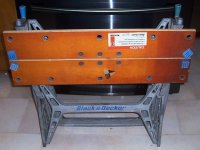
slowtwitch73
Well-known member
The 300 has the info on bottom of metal step: "221 3TY1" and "79033"
The other WM says "Type-2". The other markings are unreadable.
The other WM says "Type-2". The other markings are unreadable.


OK, hopefully this image of the 3 parts of the handle will help:
The crank arm and shaft are cast as one piece and the plastic handle pops onto the tapered shaft and the cap clips onto the solid end of the handle shaft.
I had figured the cap must be clipped on but hadn't realised the shaft would be solid at the end, as you can of course see a hole in the back of it. I had figured I could probably push the cap off the end of the shaft by knocking a drift in from behind but wasn't making any progress so upped the power and that's how the shaft sheared off the crank part!
Now I've taken one apart I can see that trying to get the end cap off in one piece to re-use will be almost impossible as it is really tight on the shaft but I'm pretty hopeful those parts I've ordered on eBay will be the right size as they seem to measure up pretty closely which would mean I can then remove the rusted end caps without worrying about how they look once I get them off.
Hope this helps.

No real story -the guy I got it from was second owner and wanted it gone as he had not space (Apt) and worried it would get stolen if left out (his Motor cycle HAD been stolen)
Yes probably the DB one. 20 min from my house. I paid $80 as it wasn't moving at their asking price, and I wasn't budging.
As to the WHY of its condition, I suspect it was bought as a gift, set aside, as a "Gimmick" and never used...
 and only 20 mins from your house. That’s incredible. It’s good to know that it went to someone who appreciates it.
No real story -the guy I got it from was second owner and wanted it gone as he had not space (Apt) and worried it would get stolen if left out (his Motor cycle HAD been stolen)
Yes probably the DB one. 20 min from my house. I paid $80 as it wasn't moving at their asking price, and I wasn't budging.
As to the WHY of its condition, I suspect it was bought as a gift, set aside, as a "Gimmick" and never used...
My kids bought me one of these for Christmas many...many....years ago. I still have it and use it, but I'll have to take a look for any markings. The metal on mine is black, so it can't be THAT old.

Gives me hope that there still some folks out there that don't do internet 'research' when selling used goods.
I long for the old days when deals abounded... now even if you are out in the boonies every nutter is asking high Ebay prices.
WOW that thing is an awesome find
)I hope I never find one. I'd be afraid to use it.
So other than collect-ability/antiquing what is so great about the early models? Are they that much lighter in weight than the newer stamped steel ones? ...
 )
)No real story -the guy I got it from was second owner and wanted it gone as he had not space (Apt) and worried it would get stolen if left out (his Motor cycle HAD been stolen)
Yes probably the FB one. 20 min from my house. I paid $80 as it wasn't moving at their asking price, and I wasn't budging.
As to the WHY of its condition, I suspect it was bought as a gift, set aside, as a "Gimmick" and never used...
I'll add a couple of other comments about the Workmate 400 that I'm reasonably sure of even without direct experience. If you know otherwise, please correct me.
The 400 and other models from the mid-1980's onward have more plastic parts than the 79-001 and others from the 1970's. For example, it's fairly common for the plastic leg latches to break.
The 79-001's up until the introduction of the Type 4 in mid-1977 have eight leveling feet. From that point on, the leveling feet were gradually replaced with non-adjustable feet, so the 400 has fixed-height feet at all eight locations.
I once saw where Popular Mechanics said the WM425 was "light" and only weighed 26 lbs...I thought WOW!....I checked with B&D and PM was off by over 10 lbs....just can't trust what you read anymore. 
... It may wind up in a museum! (I wonder if the Smithsonian has workmates?)
On the topic of weights:
The spreadsheet you are looking for is part of the type study at my "H-frame" website, whose link can be found in my signature. The spreadsheet has accurate weights for twelve different configurations of the 79-001, and it's the only place these have ever all been documented. Just click on "Workmate 79-001 Type Study" in the menu and you'll see the link to the spreadsheet on the left side of the page.
In 1975 at least three different reviews (including Popular Mechanics) and one B&D catalog mistakenly listed the weight of a 79-001 Type 1 as 24 pounds; you can find copies of all four of these on the Documents page at my site. 24 pounds was the approximate weight of the 79-001 Type E which had just been replaced in 1975 with the heavier Type 1, so the mistake was somewhat understandable. I would be very surprised if they made this same mistake for the 400 eight years later.
I find that my threshold of discomfort for the weight of a Workmate is just about 31 pounds. When I have to carry a 79-001 Type 1 or an early Type 2, I very quickly want to put it back down. The Type E is a breeze to carry and the other 79-001's are quite tolerable.
I don't get it—what's going on here?
You said:
"So other than collect-ability/antiquing what is so great about the early models? Are they that much lighter in weight than the newer stamped steel ones?"
I linked directly to three of my earlier posts that explain in some detail the pros and cons of the usability of the early models. Then I added another message with two more points on usability. No mention of collectibility in any of them. Outlaw responded with additional comments on usability. And then your only response about usability was to dismiss two of my valid comments because they aren't important to you? Instead, you switched back to talking about collectibility again?
You said:
"I hope I never find one. I'd be afraid to use it."
I responded that I use mine all the time.
Sounds like you're the one who is emphasizing collectibility over use.
There are many of us who use tools who deeply appreciate the design that goes into the best of them. The original Workmate was a breakthrough invention and an award-winning example of industrial design because it both does its job wonderfully and is inspiring to look at. I absolutely love having Hickman's original design in use in my home and shop. There's nothing whatsoever wrong with enjoying the aesthetic characteristics and the history of a tool that you use. It's also okay that the aesthetics and the history make it collectible and increase the monetary value. I feel lucky that we are still able to buy nice examples of the 79-001 Type E for as little as $50 and I wouldn't hesitate to pay much more for a nice one if I didn't already have one.
...
So if you don't mind rehashing something that you've probably explained before....is there a reason why the type 5 weighs so much less than the other steel/aluminum hybrid models? ...
<snip>
There are many of us who use tools who deeply appreciate the design that goes into the best of them. The original Workmate was a breakthrough invention and an award-winning example of industrial design because it both does its job wonderfully and is inspiring to look at. I absolutely love having Hickman's original design in use in my home and shop. There's nothing whatsoever wrong with enjoying the aesthetic characteristics and the history of a tool that you use. It's also okay that the aesthetics and the history make it collectible and increase the monetary value. I feel lucky that we are still able to buy nice examples of the 79-001 Type E for as little as $50 and I wouldn't hesitate to pay much more for a nice one if I didn't already have one.

Thanks Chris!I explain that on the page for the Type 5
https://h-frame.weebly.com/79-001-type-5.html
(Spoiler: It's lighter gauge steel.)
 So one might assume that is a desirable model based on weight until one knows the reason for the weight savings.
The spreadsheet can't really be more than a quick guide, or maybe an index of sorts, to the differences. The spreadsheet alerts people to the differences, but can't explain them without becoming ridiculously large and complicated. I added footnotes to it to explain a few things, but there's a limit to how much of that can be done and still remain effective. That's why the spreadsheet refers people to the website for complete details on each Type.
I'm a little late here, but the 'cap' that held the handle to the crank arm shaft is a variation of a Palnut or axle push nut...
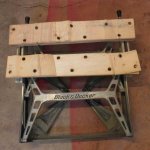


The thickness of the jaw material is not at all critical; you can make it whatever you want. Yours is the 11/16" 9-ply birch. You can find this in my Type Study spreadsheet, link can be found just below the heading "How to Recognize It" on this page:
https://h-frame.weebly.com/79-001-type-2.html
The 13-ply with the hard orange finish was very slightly more common on Type 2's.
And you answered your own question about the reinforced (double thickness) edge. It is indeed double. However, you can do whatever you want here also, make the edge even thicker if you want, or go with just a single-layer top as was used on the Type 3 and 5-9.
Yours is from the production period when the scratch guards were being discontinued:
https://h-frame.weebly.com/blog/the-least-known-feature
I don't see any in your photos, but I'd like to know if there's any "ghost" mark where they might have been.
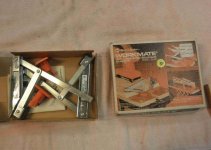
I also picked up 2 pair of the gripmates for an additional $10.85.