To avoid these ads, REGISTER NOW!

Brake bleeding

Schurkey

Well-known member
Joined
Oct 27, 2011
Messages
2,366
Location
The Seasonally Frozen Wastelands
{Sigh.}

1. If the master cylinder is tipped up in front, it doesn't matter which way the fluid is traveling--from the reservoir down to the wheel cylinders, or from the wheel cylinders up. There can be an air bubble that WILL NOT be released so long as the front of the master is the high point, and the compensating ports are at the rear and lower. IF (big IF) the master has bleeder screws at the front end...you'd be in great shape. I haven't seen a master cylinder with bleeder screws for so long I don't even think about them any more.

2. Reverse-bleeding uses the bleeder port on the wheel cylinder, to push fluid back to the reservoir. The bleeder port is the highest point of the cylinder. The outlet tube is typically lower. This leaves the potential for an air bubble right in the wheel cylinder. Reverse bleeding MUST be followed by bleeding in the usual way to be successful. As said, it's poor practice to push contaminated fluid up to the master cylinder. Better is to bleed in the normal direction to get clean fluid in the system. Then reverse bleed. Then bleed in the normal direction again to purge the remaining air in the wheel cylinder. Not my first choice. If there's an ABS device in the system, it's suicide to push contaminated fluid through it.

3. The master cylinder is not likely vented to atmosphere. The master cylinder reservoir cover almost certainly has a rubber diaphragm that keeps humidity out of the system. I have heard of Hondas that don't use the rubber diaphragm and which vent to atmosphere, but the source was unreliable and I don't believe it until I see photos.


In MY driveway, major work or an empty system gets pressure-bled. Work at the wheel cylinders gets gravity bled. I don't vacuum-bleed, and I don't reverse-bleed except sometimes I'll push the caliper piston in, which forces all the fluid in the caliper to return to the reservoir. I only do that when I know the fluid in the caliper is reasonably clean, and never with an ABS unit in the system. Otherwise, I vent the caliper when pushing the piston back in. I don't "two-man bleed" because I never have the second person.

There's LOTS of ways to bleed brakes. The only two ways I use on a regular basis is pressure bleeding and gravity bleeding.
 
To avoid these ads, REGISTER NOW!

nbpt100

Well-known member
Joined
Oct 19, 2016
Messages
2,301
Location
Massachusetts
I have only been able to vacuum bleed on front brakes. I have never been able to get it to work on rear. The run is too long.

I bought a 6 dollar Lisle one man bleeding tool nearly 20 years ago and it has always worked. I never let the Master cylinder go dry. That creates complications.
 

driftpin

Well-known member
Joined
Dec 22, 2016
Messages
11,178
Location
Miami-Dade/Broward Co. Florida
What part of, discarding the old fluid don't you understand? You need to grasp the concept of removing the dirty fluid, but for some reason, you're obsessed with "contamination of the master cylinder." There is no contamination once you remove the purged fluid, as any contaminants are discarded in the dirty fluid. I haven't seen this much obsessive concern with 'contamination' since I watched Leonardo DiCaprio playing Howard Hughes, who was also obsessed with 'contamination.'

Your insistence upon having to clean the master cylinder by disassembly when reverse-bleeding is a waste of time. There is no contamination left once you flush it out, if there was contamination, you haven't moved enough fluid to flush the system, merely continue until the fluid runs fully-clear.

You say that I "... fail to realize brake fluid is a hygroscopic liquid." No, I didn't, I just said that getting (is there an apparent pattern of thought here) obsessive about a tiny anount of water vapor that may be in the air above a half-consumed bottle of brake fluid isn't worth worrying-about. If that was the case, wouldn't manufacturers install some type of nitrogen bladder in the master cylinder, because after-all, the master cylinder is never completely-filled with brake fluid. Doesn't that atmospheric air above the master cylinder brake fluid contain water vapor too, which should be wreaking havoc on the integrity of the brake fluid? The majority of passenger vehicles probably go years without having brake fluid added unless there is brake work done. Why aren't we experiencing widespread failure of brake systems due to "hygroscopic-induced failure?" Because simply-put, it really isn't as-big a deal as you make it out to-be. As water vapor enters the brake fluid, the actual percentage of water molecules to the amount of brake fluid is very low, resulting in a slight lowering of the boiling-point of the brake fluid. You do know that the brake fluid boiling-point is the differentiation of the DOT 3, 4, and 5.1 ratings, don't you?

Why you have to stoop to bad-grammar-laced insults (it's "you're," not "your" when you are trying to use a verbal contraction, not a possessive pronoun) because you fail to agree with another member is beyond my understanding. Perhaps your tolerance and acceptance of others' opinions and experiences is "contaminated." It is you who is choosing to behave like an internet troll, disparaging people from the anonymous security of your keyboard.

Reverse-flushing is an accepted practice in both brake work and coolant systems work. It is safe, useful, fast, effective, and economical. Your opinion sir, may vary, and while I respect that, there is absolutely no reason to behave as you have. Again, have a nice day.

It not easier it just wrong.

point 1 you contaminate the master cylinder with **** and bad fluid.
you can not clean it out unless you disassemble it
Two you fail to realize brake fluid is a hygroscopic liquid

point 3 is your just a troll that is recommending a dangerous concept with out understanding what your doing.
 

DGersic

Well-known member
Joined
Mar 12, 2017
Messages
6,260
Location
DeKalb, IL
Took a peek under the hood today. I have a question about master cylinders.
I read somewhere in my web scouring that some master cylinders have a bleed screw.

Some do, but you’d know if you had them. They look just like the bleeders on your calipers.


With regards to MC bleed kits that are available from the local auto parts I noticed that people complained that the kits do not have more than one of each plastic fitting, and I would need 2 one for each outlet. I was thinking I should be able to bench bleed the MS on the vehicle with the kit(s) by having somebody depress the brake pedal slowly ?


With a couple tube nuts and a bit of brake line, you can make your own bench bleeding setup. Just flare the tube, and route it to the MC reservoir.

As others have said, you need to get the MC level to bleed it.


Sent from my iPad using Tapatalk
 

akalian

Well-known member
Joined
Apr 27, 2016
Messages
355
Location
St. George Utah
I saw an episode of Eric the Car Guy bleeding brakes a bit differently than most people. I found it interesting that he went against common knowledge about bleeding the farthest first, and instead bled the wheel closest to the Master Cylinder to avoid pushing contaminated fluid through the system.

I thought I'd give it a shot and see how it worked
Turns out it worked great, and I made a DIY over at ToyotaNation:
http://www.toyotanation.com/forum/1...8-diy-bleed-your-brakes-eric-car-guy-way.html

.
 

brownbagg

Well-known member
Joined
Mar 20, 2006
Messages
5,208
i had some long tubing, i was able to go to the rear to the master, i just sat there listen to radio getting my cardio pumping the pedal
 

LS6 Tommy

Well-known member
Joined
Dec 27, 2013
Messages
26,162
Location
Northern NJ
I'm on board with air in the master, but if bleeding/bench bleeding it doesn't fix the problem, I'd reverse bleed the rest of the system as a next step. I got a Phoenix Systems kit years ago as a freebie. I'ts been my go-to for problem bleeding...

http://www.brakebleeder.com/

Tommy
 

bubinga

Well-known member
Joined
Jul 26, 2014
Messages
12,744
Location
Bridgeport Ohio. (Across River From Wheeling WV)
I know you said you rebuilt the calipers, but if one is still hanging on the slide/guide pin, you will get the same reaction. Good pedal, until you really stand on it hard, then it will drop some, but not all the way to the floor.

The best way to resolve this is a rebuilt caliper and caliper mounting bracket with new pins, purchased as an assembly. About $110 from Amazon, FREE shipping, no core. $59 from Rock Auto, but you have pay a core charge and shipping both ways.


I'm an old school DIY. I always do a final 2 man bleed. I have also found out some cars need to have the engine running.
THIS!!!!!
Strange But VERY TRUE!!!!!
 

M_George

Well-known member
Joined
Sep 25, 2016
Messages
966
Location
Eastern Pa.
Make sure both sides of the master cylinder get bleed. I did one on my Mustang last week and had to use my HF break bleeder vacuum to get it right.
 

dmowza

Member
Joined
Oct 13, 2017
Messages
17
After rebuilding my calipers installing new pads, and rotors I have a soft pedal. I had the calipers off for some time, and I am not positive if the fluid in the master cylinder got too low.

I have bled the brakes twice with the engine off starting with the brake furthest from the master cylinder, and worked myself closer. At first I thought they were ok, but when I backed out of the garage I realized they were too spongy.

Next I tried bleeding with the engine running. The point that I am at now is I have a great pedal with the engine off, but once started the pedal goes down, and feels spongy. The pedal does not go all the way to the floor.

It's a 2005 Ford Explorer Sport Trac, and according to my Haynes manual I do not need to have the dealer bleed the brakes. Mine are bled in the conventional manner.

I do not have an ABS light lit. I am bleeding with just a wrench, and a clear plastic tube in a bottle with an assistant pumping the brakes and holding.

Any thoughts ?
Once it is verified that all pistons pads and slides move freely, check and make sure your brake hoses do not expand when pressure is applied. Once you have checked those things it doesnt leave but one thing. When bleeding brakes on an older car it is imperative that u do NOT allow the pedal to travel to the floor. It should only be depressed in its normal area of travel. What happens over time is the seal wears the bore where it nornally rides. This creates a "lip" where that normal wear pattern ends. If the pedal travels farther and the seal(s) ride over that lip they can become damaged and produce the symptoms you are describing. You will likely need to replace your master cylinder at this point to repair your issue.

Sent from my LG-H811 using Tapatalk
 
Last edited:

Tonyuk

Well-known member
Joined
Jun 9, 2017
Messages
1,539
Location
Scotland
VW's are bled starting at the wheel nearest the ABS and TCS pump. If the pressure bleeder is having trouble sending fluid to the rear you need to either up the pressure a bit or you have a restriction in the system.
 
OP
S

smalltown

Well-known member
Joined
Jul 9, 2015
Messages
985
Location
Western Maine
Almost there after ordering a MC only to get it home, and discovering I had mistakenly ordered one without cruise control. None in stock locally, but NAPA got me one overnight. Bled the MC in the vise (don't no why the bleeder kit has black tubes). In my Hayes manual they talk about plugging the outlet ports pushing in the "plunger" and holding while a helper loosens the cruise control switch port. I guess that gets any air that might be trapped at the very end of the MC. So I'm in standby mode waiting for the Grandson to get home, and give me a hand. I'd ask the wife to help, but I know how things like that turn out :headshake So tonight I should have it installed.
 

Diesel Mercedes

Well-known member
Joined
Sep 12, 2017
Messages
182
Location
Newport News, VA
I'm positive you blew the mc seals by going to the floor while bleeding.
Also power bleeders make life much easier.

Doing it via the foot is a pain and time consuming.
 

dmowza

Member
Joined
Oct 13, 2017
Messages
17
Almost there after ordering a MC only to get it home, and discovering I had mistakenly ordered one without cruise control. None in stock locally, but NAPA got me one overnight. Bled the MC in the vise (don't no why the bleeder kit has black tubes). In my Hayes manual they talk about plugging the outlet ports pushing in the "plunger" and holding while a helper loosens the cruise control switch port. I guess that gets any air that might be trapped at the very end of the MC. So I'm in standby mode waiting for the Grandson to get home, and give me a hand. I'd ask the wife to help, but I know how things like that turn out :headshake So tonight I should have it installed.
They came with tubes because they are required for bench bleeding. U place the tubes in the ports and run them into the reservoir submerging them in the fluid. This way the master cannot **** are when released after depressing it. If not used u run the possibility of having a master with air still in it.

Sent from my LG-H811 using Tapatalk
 

Diesel Mercedes

Well-known member
Joined
Sep 12, 2017
Messages
182
Location
Newport News, VA
They came with tubes because they are required for bench bleeding. U place the tubes in the ports and run them into the reservoir submerging them in the fluid. This way the master cannot **** are when released after depressing it. If not used u run the possibility of having a master with air still in it.

Sent from my LG-H811 using Tapatalk

I think he was solely talking about the color of the tubes, not the tubes themselves. My kit came with black hose as well which is STUPID! Anyway I swapped out the black hose with clear hose that I found at lowes,

So it ended up looking like this. (my master cylinder btw)

36438768391_084a30caf8_b.jpg


You got a lot more peace of mind because you can see if there are any bubbles in the tube and you can see your progress.
 

dmowza

Member
Joined
Oct 13, 2017
Messages
17
I think he was solely talking about the color of the tubes, not the tubes themselves. My kit came with black hose as well which is STUPID! Anyway I swapped out the black hose with clear hose that I found at lowes,

So it ended up looking like this. (my master cylinder btw)

36438768391_084a30caf8_b.jpg


You got a lot more peace of mind because you can see if there are any bubbles in the tube and you can see your progress.
Yeah ur right...i read it quickly and the color issue didn't register but yes black is very ignorant! Stupid manufacturer clearly no idea what it takes to install the part they made.

Sent from my LG-H811 using Tapatalk
 
OP
S

smalltown

Well-known member
Joined
Jul 9, 2015
Messages
985
Location
Western Maine
I did end up placing the tubes in a manner that I could see bubbles coming out the end. Clear would have been easier.
Anyway I did block the outlet ports. then removed the cruise control switch port, and pumped slowly. There was air trapped in there. After replacing the two tubes I bled it again slowly.
No bubbles now and the "piston(s)" became much harder to push so I think it's done.
Reinstalled, and will wheel bleed tomorrow.
 
To avoid these ads, REGISTER NOW!
OP
S

smalltown

Well-known member
Joined
Jul 9, 2015
Messages
985
Location
Western Maine
Bled the brakes this morning. Took a while to get clear fluid at the right rear. The remaining wheels I opened the bleeder screw twice, and nothing but clear fluid. That kind of surprised me.

Engine off: super hard pedal.
Engine on : I feel like I have good brakes, (not spongy at all) but I don't think I have a lot of pedal. Maybe it's just me.

Did I not bleed them enough ? With the MC full before starting I put in about 8oz of fluid while bleeding.

Gut tells me that most of the air would have come out on the furthest brake bleed ?

According to my manual this vehicle does not require the dealer activating anything for a proper bleed. I will need a state inspection sticker so it will go to the dealer anyway.

Seeing that I still have a little more brake fluid, and it doesn't last I guess I'll crawl under there, and bleed all the wheels again.
 

regguy1

Well-known member
Joined
Dec 15, 2009
Messages
4,053
Location
On Mount Olympus with Zeus
If any of the lines have a loop that goes up then back down air can get trapped in that area and not bleed properly, I recently had a similar issue with a Ford edge, the right front line had a U shaped upward loop and trapped air.
 

jsaw

Well-known member
Joined
Oct 11, 2008
Messages
1,777
Location
Geneva, N.Y.
I did every line on a chevy truck a while back. I could not get any fluid to come out of any bleeders. I finally ended up cracking the lines loose at the master cylinder, and then at the abs unit, and finally got fluid at each wheel. If the system is completely empty, sometimes it will become air locked so you dont get fluid.
 

Schurkey

Well-known member
Joined
Oct 27, 2011
Messages
2,366
Location
The Seasonally Frozen Wastelands
Engine off: super hard pedal.
Engine on : I feel like I have good brakes, (not spongy at all) but I don't think I have a lot of pedal. Maybe it's just me.
Fast 'n' easy check: On a "normal" stop--not a panic stop, or pushing hard on the pedal like you're stopping the car and a heavy trailer--just a plain ol' ordinary coming-to-a-stop-light-with-plenty-of-warning, the brake pedal should be a little HIGHER than the gas pedal as you slow.

If it's at the same height as the gas pedal, I don't worry too much IF THERE ARE NO OTHER SYMPTOMS and there's been no work on the brake system recently.

If it's lower than the gas pedal on a normal stop...there's probably something wrong.

Did I not bleed them enough ? With the MC full before starting I put in about 8oz of fluid while bleeding.

Gut tells me that most of the air would have come out on the furthest brake bleed ?
That's typical, but it can vary depending on where the biggest air bubble(s) are.

Seeing that I still have a little more brake fluid, and it doesn't last I guess I'll crawl under there, and bleed all the wheels again.
8 oz is a cup of fluid. I would probably use more when flushing a brake system. What's important is not how much fluid you use, but simple results: Did you get all the air out. (and when flushing, "is there any contaminated fluid still in the system.")

If you have drum brakes, or certain designs of disc brakes, don't forget about the brake adjustment. Disc brakes tend to be self-adjusting, except for some designs of disc brakes with a parking-brake integrated in them. For example, my Luminas have rear disc brakes that are adjusted by using the park brake. Since I don't often use the park brake, now 'n' then I have to kick and release the park brake pedal several times. A low-but-firm pedal can be a properly-bled hydraulic system connected to service brakes that are out-of-adjustment.
 
OP
S

smalltown

Well-known member
Joined
Jul 9, 2015
Messages
985
Location
Western Maine
Well I tried one last time. I found no air at any bleed point. My fluid is nice and clear unlike the dark color fluid that I bled from the system when I started.

Just for curiosity I measured from the top of the rubber pedal depressed to the floor, and had 2 inches.
I compared it with a Ford Edge we have, and it's 4 inches.

So while it's at the dealer for the State inspection I will ask them to see if they could get me more pedal. Maybe it does need the ABS unlocked or whatever it is they do to the ABS with the computer. If they are successful I hope they will tell me.

I wonder (as I have never used one) what price I would need to pay for a Scan tool that would have this kind of feature ?
 

dmowza

Member
Joined
Oct 13, 2017
Messages
17
Well I tried one last time. I found no air at any bleed point. My fluid is nice and clear unlike the dark color fluid that I bled from the system when I started.

Just for curiosity I measured from the top of the rubber pedal depressed to the floor, and had 2 inches.
I compared it with a Ford Edge we have, and it's 4 inches.

So while it's at the dealer for the State inspection I will ask them to see if they could get me more pedal. Maybe it does need the ABS unlocked or whatever it is they do to the ABS with the computer. If they are successful I hope they will tell me.

I wonder (as I have never used one) what price I would need to pay for a Scan tool that would have this kind of feature ?
Far too much. Its really on beneficial for a shop to spend that kinda money on a tool like that. Do ur brakes begin to apply as soon as u put ur foot on the brake pedal? Some cars and parts have a different pedal feel. Also consider u are far more sensative to ur pedal now that u have done work. Can u say how it comapred to the pedal prior to all the brake work?

Sent from my LG-H811 using Tapatalk
 
OP
S

smalltown

Well-known member
Joined
Jul 9, 2015
Messages
985
Location
Western Maine
dmowza can't say for sure as I have had it out of service for a while now. Fixing all sorts of things I never thought I would be doing myself. Thanks to help from Garage Journal members. I am only able to test it on the short gravel driveway, but it seems to stop pretty good. I was hoping to get up enough speed to get the ABS to activate, but had no luck.

I am searching scan tools info on garage journal. I wouldn't mind a used one if only I knew more about just what one does verses another.
 

dmowza

Member
Joined
Oct 13, 2017
Messages
17
dmowza can't say for sure as I have had it out of service for a while now. Fixing all sorts of things I never thought I would be doing myself. Thanks to help from Garage Journal members. I am only able to test it on the short gravel driveway, but it seems to stop pretty good. I was hoping to get up enough speed to get the ABS to activate, but had no luck.

I am searching scan tools info on garage journal. I wouldn't mind a used one if only I knew more about just what one does verses another.
As somone had already mentioned u can sometimes get away with cracking the fittings at the abs unit to get the air out if u have some stuck there. I have done this before when i was in a pinch and it worked. Would u say the pedal is better than it was before the replacement of the master? Also one other thing to consider is if u have replaced brake pads and rotors then the friction coefficient is reduced until they are seated to each other which can feel like a spongy pedal. It doesnt take long with new parts but if new pads are slapped onto old rotors is can be more pronounced for longer. Until u drive it for several miles i wouldnt pass final judgment.

Sent from my LG-H811 using Tapatalk
 
OP
S

smalltown

Well-known member
Joined
Jul 9, 2015
Messages
985
Location
Western Maine
I would say it's better after the MC was replaced. The sponginess is gone. (had to check spelling on that one).

New pads and rotors all the way around. Hasn't been on the road yet.
 

Chevy-SS

Well-known member
Joined
Feb 11, 2010
Messages
1,484
Location
Rhode Island
Bled the brakes this morning. Took a while to get clear fluid at the right rear. The remaining wheels I opened the bleeder screw twice, and nothing but clear fluid. That kind of surprised me.

Engine off: super hard pedal.
Engine on : I feel like I have good brakes, (not spongy at all) but I don't think I have a lot of pedal. Maybe it's just me.

Did I not bleed them enough ? With the MC full before starting I put in about 8oz of fluid while bleeding.

Gut tells me that most of the air would have come out on the furthest brake bleed ?

According to my manual this vehicle does not require the dealer activating anything for a proper bleed. I will need a state inspection sticker so it will go to the dealer anyway.

Seeing that I still have a little more brake fluid, and it doesn't last I guess I'll crawl under there, and bleed all the wheels again.


Hard pedal with engine off (and vacuum booster drained) is totally normal. Pedal will always feel 'softer' when engine is started and booster assist comes into play.

Soft pedal after bleeding usually indicates air still in system. A lot depends on your bleeding method. Gravity bleed is sufficient when replacing caliper(s), but I always used pressure bleed method if MC replaced.

Forget measuring pedal and such. You drive the car so you know what the brake pedal should feel like. Brake pedal should have tiny tick of play at top, then feel firm once brakes start to engage. Sounds like yours are not there yet.

I would want to drive the car a little bit (carefully) and make sure calipers and pads are all seated properly. Then PRESSURE bleed the system, either with a helper or a pressure tank system. If you use helper, make sure you do it the proper way.... helper would pump pedal slowly and then hold pressure, then you open bleeder and let fluid out with helper HOLDING pedal at the floor position until you have closed the bleeder, then helper pumps slowly again. Repeat procedure at every wheel.

Brake bleeding can be a little tricky at times, and I have seen systems where the brakes just plain **** (older Chevy Silverados come to mind) and it's almost impossible to get a good pedal.

If you still have issue, then let dealer bleed them.............

Good luck
 
OP
S

smalltown

Well-known member
Joined
Jul 9, 2015
Messages
985
Location
Western Maine
Well on the way to get my new tires my ABS light came on. Got the new tires and headed to the dealer appointment. According to the mechanic my work on the brakes was fine. He tested them in the dealer lot, and thinks they are fine.

However the ABS issue is integral to the hub so that needs replacing, along with a couple of rear spring shackles that are rusting through. So a small delay to be roadworthy, but I am almost there and feeling good !
 

rlitman

Well-known member
Joined
Oct 18, 2010
Messages
24,578
Location
Long Island
ABS is usually a wheel sensor issue.

The sensor has a fixed magnet with a tone wheel (a notched ring) that rotates nearby. The magnet often gets crusted up with rust particles, and if you can find it, you can usually use a blow gun to get it clean (cover your eyes!).
 

Schurkey

Well-known member
Joined
Oct 27, 2011
Messages
2,366
Location
The Seasonally Frozen Wastelands
When I had a problem with ABS, it was the final ~18 inches of wire harness next to the wheel sensor connector, leading back into the chassis.

I cut out as much of the green copper as I could reach, soldered-in fresh wire...problem solved.
 

akalian

Well-known member
Joined
Apr 27, 2016
Messages
355
Location
St. George Utah
The sensor has a fixed magnet with a tone wheel (a notched ring) that rotates nearby. The magnet often gets crusted up with rust particles, and if you can find it, you can usually use a blow gun to get it clean (cover your eyes!).

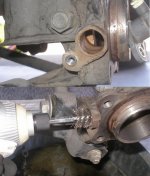
Yep, both the sensor and the tone ring can get crud on them. If you are lucky you can get the sensor out to clean it. Sometimes they are a PITA to get out, and some of them are very expensive to replace. So go slow when removing the sensor.
 

Attachments

  • bearing_greasy.jpg
    bearing_greasy.jpg
    143.6 KB · Views: 28
  • sensor.jpg
    sensor.jpg
    144 KB · Views: 29
  • sensor_abs_dirty_clean.jpg
    sensor_abs_dirty_clean.jpg
    151.6 KB · Views: 28
  • sensor_dirty_clean_hole.jpg
    sensor_dirty_clean_hole.jpg
    138.9 KB · Views: 25

Thezapper

Well-known member
Joined
Mar 15, 2014
Messages
256
Location
Toronto, Ontario
If I had to throw a dart I would say your master cylinder **** the bed. I used to bleed brakes with someone pumping and me bleeding the wheels and I would say 1 out of 10 cars I would kill the master cylinder in doing so. Why? Because when you floor the pedal the seal inside the master cylinder goes past it normal operating range and kills the seal, rust builds up there and once the seal goes over that it's done. After I purchased a pressure bleeder I never had a problem with ****** brake pedals. Do yourself a favour buy a oe master cylinder and have a shop with a pressure bleeder bleed it.
 
To avoid these ads, REGISTER NOW!
Top Bottom