To avoid these ads, REGISTER NOW!

Breaker Locations \ Gen Hookup

pattenp

Well-known member
Joined
Jun 4, 2008
Messages
10,175
Location
Virginia - USA
I know I read something about floating the neutral from Generac and it was in the instructions for the Generac transfer switch.

NOTE ON NEUTRAL BONDED GENERATORS: Some portable generators are intended for use on jobsites, and therefore are subject to OSHA regulations for GFCI protection on all receptacles. These "contractor grade" generators have their neutral wire bonded to the ground wire to pass OSHA inspection on job sites, and when connected to a transfer switch, this may cause nuisance tripping of the generator GFCI breaker. If you’re using a neutral bonded generator to power a house or building through a transfer switch, then determine if the neutral bond wire on the generator can be disabled without voiding the warranty, preferably by a dealer or a qualified electrician. NOTE: After this action, the generator will no longer pass OSHA inspection on job sites. Consult the manufacturer of your generator to determine if the neutral bond can be removed. If it can be disabled, then no modifications to your transfer switch installation are needed. If the neutral bond cannot be disabled or voids the generator warranty, you must install a Switched Neutral Kit (SNK) accessory with your transfer switch.
 
To avoid these ads, REGISTER NOW!

sands35

Well-known member
Joined
May 29, 2012
Messages
936
Location
St. Joseph, MI
Unless I am missing something wouldn't that require 4P ?

The original post started because the OP wanted to use an NEC approved interlock.


So why don't generator manufacturers un-bond the single point and then bond only the convenience outlets (a "bonding plug" on the back side of the outlet; requires an isolated ground receptacle)
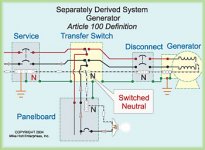
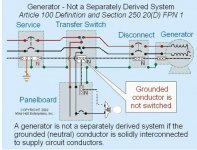
3P - yes - 1P each for N and 2 poles for both hots - for separately derived. 2P switch for not-separately derived genny system (only need to switch the hots there. (edit: don't need to switch the ground by code for either - my bad)

I'm guessing, but I suspect that most portable HW store genny's are designed for fully stand alone and portable use, not for dedicated back-up service. They assume you are going to plug your fridge and sump pump directly into the genny and not go through the main panel. Hence why N and G are bonded at the genny frame.

Reading from Cummins:

http://www.cumminspower.com/www/literature/technicalpapers/PT-6006-GroundingAC-2-en.pdf

The problem with grounding the neutral both at the normal
service and at the generator is shown in FIGURE 2.
Multiple neutral grounds would not be recommended
because ground fault current would split and (low in two
parallel paths according to the impedance of each path.
The NEC 250.24(A)(5) would prohibit a bonding jumper
between the generator neutral and ground show in
FIGURE 2.
 
Last edited:

Alchymist

Well-known member
Joined
Mar 1, 2009
Messages
4,423
Location
Central PA
4P - yes - 1P each for N and G and 2 poles for both hots.

I'm guessing, but I suspect that most portable HW store genny's are designed for fully stand alone and portable use, not for dedicated back-up service. They assume you are going to plug your fridge and sump pump directly into the genny and not go through the main panel.

Perhaps you are confusing "grounded" conductor with "grounding" conductor. In a "separately derived system", which a generator with a bonded neutral is, only the 2 hots and the neutral are switched. The EGC is interconnected.

The confusion arises with grounding conductor (the 4th wire ground) sounding similar to the"grounded conductor", which is the neutral. It is referred to as the grounded conductor because it is connected to ground at one point in the system Thus only a three pole switch is needed.
 
Last edited:

theoldwizard1

Well-known member
Joined
Feb 22, 2011
Messages
43,132
Location
SE MI
I'm guessing, but I suspect that most portable HW store genny's are designed for fully stand alone and portable use, not for dedicated back-up service. They assume you are going to plug your fridge and sump pump directly into the genny and not go through the main panel. Hence why N and G are bonded at the genny frame.

The industry is inconsistent ! The Honda EU200i, which only has 120V receptacles, has a "floating ground" (i.e. non-bonded ground) and recommends using "grounding plugs".

All medium to large (3KW-10KW) "portable" generators that I have seen, have a locking 240 outlet (NEMA L14-xxR). That outlet is almost exclusively used to connect the portable generator to a home panel for emergency backup. They also usually have a non-locking 240V outlet (NEMA 6-xxR) and a couple of 120V outlets (NEMA 5-xxR). Assuming this configuration, and further assuming that the locking receptacle would only be used to connect up to a transfer switch/home main panel, would removing (floating) the ground inside the L14 cable to the house resolve this whole issue ?
 

Alchymist

Well-known member
Joined
Mar 1, 2009
Messages
4,423
Location
Central PA
The industry is inconsistent ! The Honda EU200i, which only has 120V receptacles, has a "floating ground" (i.e. non-bonded ground) and recommends using "grounding plugs".

All medium to large (3KW-10KW) "portable" generators that I have seen, have a locking 240 outlet (NEMA L14-xxR). That outlet is almost exclusively used to connect the portable generator to a home panel for emergency backup. They also usually have a non-locking 240V outlet (NEMA 6-xxR) and a couple of 120V outlets (NEMA 5-xxR). Assuming this configuration, and further assuming that the locking receptacle would only be used to connect up to a transfer switch/home main panel, would removing (floating) the ground inside the L14 cable to the house resolve this whole issue ?

I doubt it, the neutral (which is a common point between two 120V windings) is present at all receptacles, and if connected to frame ground at any one, will be connected at all of them. Only solution is either a connection between neutral and ground for stand-alone use, or separated for backup use (if a 3 pole transfer switch is not used), at all of them. See the schematics in the previous post.
 
OP
P

pcpro15

Well-known member
Joined
Mar 22, 2011
Messages
390
Can someone set me straight on a bonding plug. I can only find 15 amp plugs ends (but the ports say 20amp). Will a 15 amp bonding plug be ok, even hypothetically using the 30 amp port with unbalanced load? I'd rather check before assuming :) Thanks for your help.
 

pattenp

Well-known member
Joined
Jun 4, 2008
Messages
10,175
Location
Virginia - USA
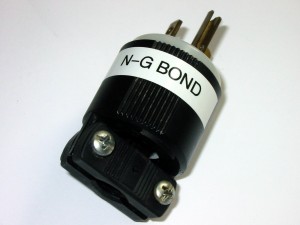
The plug for bonding the ground and neutral doesn't need to be a 20A plug, a 15A will work just fine. The plug is not used for supplying power so no load is on it. It's just a plug with no cord with the ground and neutral jumpered inside.
th

N-G-Bonding-Plug1-300x225.jpg
 
OP
P

pcpro15

Well-known member
Joined
Mar 22, 2011
Messages
390
Alchymist, you have got to be kidding me.... Thank you. I had one of those in my hand tonight but the blade orientation threw me off. As I look at the plug, you are correct. I will pick one up tomorrow.

I decided to unbond and wire up correctly. Aftet revisiting implementation cost of small house unit and sizable tank... it will never pay off for as often as it would be needed. Gas powered is best for me. My pb30 inlet and mb75 meter come in wednesday. I appreciate all of the help.:bowdown:
 

Alchymist

Well-known member
Joined
Mar 1, 2009
Messages
4,423
Location
Central PA
What I wonder is if the main service ground and the genny ground are not close to each other, then you can have a different potential between the grounds. I dunno, it all comes down to what the AHJ says anyway.

Yes, if there are two ground rods separated by some distance, there could be a potential difference between them. However, when those two rods are connected by a wire, what happens to the potential difference? Does it not seem quite likely that it goes DOWN?
 

sands35

Well-known member
Joined
May 29, 2012
Messages
936
Location
St. Joseph, MI
That will then send a current between the ground rods. More or less how a potatoe battery works. There will be current flowing until one side is corroded away. Similar to galvanic corrosion. There are reasons why grounding rules in stockyards are the way they are. Practically they shouldn't be far enough apart in most installs
 
Last edited:

Alchymist

Well-known member
Joined
Mar 1, 2009
Messages
4,423
Location
Central PA
That will then send a current between the ground rods. More or less how a potatoe battery works. There will be current flowing until one side is corroded away. There are reasons why grounding rules in stockyards are the way they are. Practically they shouldn't be far enough apart in most installs

Sp what are you getting at? :headscrat
 

2ManyProjects

Well-known member
Joined
Jul 18, 2013
Messages
757
Aftet revisiting implementation cost of small house unit and sizable tank... it will never pay off for as often as it would be needed. Gas powered is best for me.

That is a serious mistake, IMCO.

There is NO WAY you can store enough gasoline, for long enough, to ensure that it will be available (and usable) to get you through an extended (several-day) outage. Particularly with modern "gasohol" blends, the stuff turns into unburnable goo in a matter of months. Trust me on this: I have a gasoline-powered boat with two 454CID Crusader engines that **** down enough of the stuff to qualify for a "Friend of OPEC" award; and each Fall, just making the remaining fuel in the tanks live through Winter is a challenge unto itself. And do NOT count on being able to renew your supply once the outage has occurred; if you need ANY convincing on this, you never lived through Sandy (or learned any lessons from it).

Having a PROPER on-site fuel supply is an absolute requirement, if a standby/backup generator is reliably going to do you any good when the time comes that it is needed. That means either a natural gas pipeline, or a reasonable-size propane tank, period. And given that, (mis-)using a "portable" generator for this application is just silly.

 
OP
P

pcpro15

Well-known member
Joined
Mar 22, 2011
Messages
390
That is a serious mistake, IMCO.

There is NO WAY you can store enough gasoline, for long enough, to ensure that it will be available (and usable) to get you through an extended (several-day) outage. Particularly with modern "gasohol" blends, the stuff turns into unburnable goo in a matter of months. Trust me on this: I have a gasoline-powered boat with two 454CID Crusader engines that **** down enough of the stuff to qualify for a "Friend of OPEC" award; and each Fall, just making the remaining fuel in the tanks live through Winter is a challenge unto itself. And do NOT count on being able to renew your supply once the outage has occurred; if you need ANY convincing on this, you never lived through Sandy (or learned any lessons from it).

Having a PROPER on-site fuel supply is an absolute requirement, if a standby/backup generator is reliably going to do you any good when the time comes that it is needed. That means either a natural gas pipeline, or a reasonable-size propane tank, period. And given that, (mis-)using a "portable" generator for this application is just silly.


I appreciate your input, but in my case I carefully considered the options, and feel the choice I made was correct for our situation. In the past 14 years at this house, this was the first time the power was out longer that 24 hours. We were without power for 3 days. Having a scouting family, we changed our mindset to "camping mode". Besides losing the contents of the fridge, we managed just fine.

One downfall to our house is the reliance of electricity for everything. In our panel we have 2 60amp 240 circuits for our indoor unit, and a 30 amp 240 outdoor unit. From my quick numbers, a generator to run our heat / ac alone would be costly, let alone one to run an entire house. Add a tank, 500gallons of propane, and install. We are talking some serious $$$, for the one time in 14 years we had an extended outage.

After looking back on the numbers, I felt a portable unit is more than sufficient for our "actual" needs. We will do some organized breaker flipping to run what we need when we need.

To circle back to the point of no availability for gas... It is a valid point. When this happened, a convenience store up the road brought in a 100kw diesel gen on trailer, and the store (and gas pumps) were running as if nothing had happened. I certainly won't count on that every time. A farmer friend has a storage tank with DC pump if I absolutely needed it. If something hit us hard where no one within 1.5 hrs of us had power (to get gas / food), then we would just pack up our stuff and drive till we found it.
 

volleyball

Well-known member
Joined
Aug 29, 2011
Messages
4,127
Location
NY, not NYC
The problem with Sandy was that people only had a 1 or 2 gallon gas can. Wait in line, fill up go fill up generator, go back in line, repeat,repeat,repeat.
There are people who have big NG gens and what happens? the line breaks and they are in the same boat as everyone else, only out more money.
And what if you still have power but other family members don't ? I'd rather lend then my portable instead of having house guests.
There is no perfect solution. Just what you guess is best for you. For your budget.
 
OP
P

pcpro15

Well-known member
Joined
Mar 22, 2011
Messages
390
Also wanted to update. :willy_nil finished install of the PB30 inlet, and used a siding mounting block to make it flat. Ran it back to the panel. Had to move some stuff to the other side of the panel which made it longer to install. Also installed the watt meter off of the panel using a 3/4 offset. Finished off with the interlock. It is done :) Just need a cable from the inlet to the generator and we are in business. Thank you all for your help.
 
To avoid these ads, REGISTER NOW!

mrobins297aaa

Well-known member
Joined
Sep 20, 2010
Messages
3,283
Location
south east michigan
pc glad to hear you finally got this figured out.

this subject about bonding and not bonding the nuetral wire on the generator has come before and every time there's a on slot of quoting from the nec and a whole bunch of what if's
apparently this practice of bonding the nuetral on generators has been going on for years, so lets see some proof that this is killing or injuring people or is this just another 1 in a billion chance of something happening..........lets see the proof
 

Alchymist

Well-known member
Joined
Mar 1, 2009
Messages
4,423
Location
Central PA
pc glad to hear you finally got this figured out.

this subject about bonding and not bonding the nuetral wire on the generator has come before and every time there's a on slot of quoting from the nec and a whole bunch of what if's
apparently this practice of bonding the nuetral on generators has been going on for years, so lets see some proof that this is killing or injuring people or is this just another 1 in a billion chance of something happening..........lets see the proof

Just amazing the way people question the rules............WTH difference does it make weather someone gets killed or not to prove a point. The choice is clear - either you follow the rules or you don't.
 

mrobins297aaa

Well-known member
Joined
Sep 20, 2010
Messages
3,283
Location
south east michigan
Just amazing the way people question the rules............WTH difference does it make weather someone gets killed or not to prove a point. The choice is clear - either you follow the rules or you don't.

why shouldn't we question the rules?........are we suppose to blindly stick our heads in the sand?, we have way way to many rules and regulations in this country that are useless and are costing us a fortune.

it does make a difference if someone is or is not getting hurt from this, they have been hooking these generators up like this for years, so where's the need for this? was there a huge amount of people getting killed from this or hurt.....where's the proof?

as you can tell from my tone i have a bonded generator and i have not removed the bonding or purchased a $100 switch to switch the nuetral.

i have a generac GP7500E and per the manufacturer i don't need this switch.
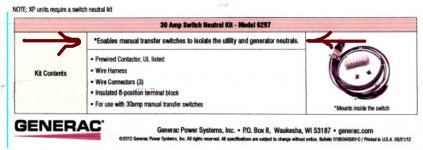
see the attached chart
generactransswitchinfo_zps7e2aac78.jpg
 

Alchymist

Well-known member
Joined
Mar 1, 2009
Messages
4,423
Location
Central PA
why shouldn't we question the rules?........are we suppose to blindly stick our heads in the sand?, we have way way to many rules and regulations in this country that are useless and are costing us a fortune.

it does make a difference if someone is or is not getting hurt from this, they have been hooking these generators up like this for years, so where's the need for this? was there a huge amount of people getting killed from this or hurt.....where's the proof?

as you can tell from my tone i have a bonded generator and i have not removed the bonding or purchased a $100 switch to switch the nuetral.

i have a generac GP7500E and per the manufacturer i don't need this switch.
see the attached chart

Dollars to donuts the generator you bought doesn't have the bond.....

Regardless, here's the scoop right from your manufacturer's own website:
http://www.generac.com/service-support/faqs/portable-generator-faqs
"Does the portable generator need to be grounded?–

Yes. For safety, the generator must be properly grounded. If it’s not grounded, you run the risk of electrocution. We strongly recommend that you check and adhere to all applicable federal, state and local regulations relating to grounding".


And why would the manufacturer sell a kit to unbond the neutral if it were not a requirement with some of their generators?

With all that said, I really could care less (but I don't) how you have your generator installed - your house, your generator. I will however continue to post what the accepted way is for installation whenever the conversation comes up, just so no one installs without at least knowing the facts. Apologies in advance if that bothers anyone.
 

Attachments

  • GENERAC.JPG
    GENERAC.JPG
    47.7 KB · Views: 12

mrobins297aaa

Well-known member
Joined
Sep 20, 2010
Messages
3,283
Location
south east michigan
Dollars to donuts the generator you bought doesn't have the bond.....

Regardless, here's the scoop right from your manufacturer's own website:
http://www.generac.com/service-support/faqs/portable-generator-faqs
"Does the portable generator need to be grounded?–

Yes. For safety, the generator must be properly grounded. If it’s not grounded, you run the risk of electrocution. We strongly recommend that you check and adhere to all applicable federal, state and local regulations relating to grounding".


And why would the manufacturer sell a kit to unbond the neutral if it were not a requirement with some of their generators?

With all that said, I really could care less (but I don't) how you have your generator installed - your house, your generator. I will however continue to post what the accepted way is for installation whenever the conversation comes up, just so no one installs without at least knowing the facts. Apologies in advance if that bothers anyone.

it doesn't bother me, but on my generator it says "bonded nuetral to frame"
and on the chart it says that only the xp models require the kit.

so what does that mean?............as far as hooking it up i have run 8-3 w/g back to my panel, so its grounded there isn't it?
 

Alchymist

Well-known member
Joined
Mar 1, 2009
Messages
4,423
Location
Central PA
it doesn't bother me, but on my generator it says "bonded nuetral to frame"
and on the chart it says that only the xp models require the kit.

so what does that mean?............as far as hooking it up i have run 8-3 w/g back to my panel, so its grounded there isn't it?

Did you think to ask Generac?
 

aandpdan

Well-known member
Joined
Nov 12, 2009
Messages
849
Location
In between MA and PA
I have a generac GP7500E and per the manufacturer i don't need this switch.

Actually, you do. You didn't read far enough. Look at the install manual for the 6294 transfer switch.

http://esp.generac.com/wp-content/uploads/2012/07/Owner-Manual-30Amp-Pre-Wired-TS.pdf Read under the "NOTE ON NEUTRAL BONDED GENERATORS"

If the neutral bond cannot be disabled or voids the generator warranty, you must install a Switched Neutral Kit (SNK) accessory with your transfer switch


Your neutral is bonded. The reason the XP models REQUIRE the switch neutral kit is that they have GFCI protection on all the breakers. The GFCI's will trip with a neutral/ground bond.
 

mrobins297aaa

Well-known member
Joined
Sep 20, 2010
Messages
3,283
Location
south east michigan
Did you think to ask Generac?

I did twice, first time on the phone after waiting fifteen minutes the person picks and is not sure, so she puts me on hold for another 10 minutes while she checks (now you would think that a company that sells generators would have this answer in 2 seconds right?, this questions must come up all the time) after another 5 minutes i get cut off.........so i send a email, next day i get a response that she needs to know my serial number before she could answer that. even tho i had the model number in the email, so last week i email her back with the serial#..........and still have heard nothing.
could this be this difficult to answer?

I did read that the xp units require the nuetral switch because they have the gfi plugs

maybe you can see why i'm so fustrated with this.
 

mrobins297aaa

Well-known member
Joined
Sep 20, 2010
Messages
3,283
Location
south east michigan
Actually, you do. You didn't read far enough. Look at the install manual for the 6294 transfer switch.

http://esp.generac.com/wp-content/uploads/2012/07/Owner-Manual-30Amp-Pre-Wired-TS.pdf Read under the "NOTE ON NEUTRAL BONDED GENERATORS"

If the neutral bond cannot be disabled or voids the generator warranty, you must install a Switched Neutral Kit (SNK) accessory with your transfer switch


Your neutral is bonded. The reason the XP models REQUIRE the switch neutral kit is that they have GFCI protection on all the breakers. The GFCI's will trip with a neutral/ground bond.

I did read that but they are talking the gfci generators otherwise why would they say in the chart only the xp models require the switch
 

aandpdan

Well-known member
Joined
Nov 12, 2009
Messages
849
Location
In between MA and PA
Nowhere on that sheet does it just refer to the GFCI equipped generators. You have to disable the neutral bond to use that switch, that's in the directions.

Regardless, this is NOT a Generac issue. It's a National Electric Code issue, NEC 250.
 

Alchymist

Well-known member
Joined
Mar 1, 2009
Messages
4,423
Location
Central PA
this subject about bonding and not bonding the nuetral wire on the generator has come before and every time there's a on slot of quoting from the nec and a whole bunch of what if's
apparently this practice of bonding the nuetral on generators has been going on for years, so lets see some proof that this is killing or injuring people or is this just another 1 in a billion chance of something happening..........lets see the proof

Have we convinced you yet? :dunno:
 

Mustang51js

Well-known member
Joined
Jan 24, 2014
Messages
1,734
Location
Haskell nj
From the way I see it under article 250.34(c) it's required to bond the grounded conductor to the frame if it's a separately derived system which a portable gen is. Unfortunately they make you cross reference things back and forth which makes people interpret things differently than others.
 

Alchymist

Well-known member
Joined
Mar 1, 2009
Messages
4,423
Location
Central PA
From the way I see it under article 250.34(c) it's required to bond the grounded conductor to the frame if it's a separately derived system which a portable gen is. Unfortunately they make you cross reference things back and forth which makes people interpret things differently than others.

If the neutral is switched, the system supplied is separately derived.
Requires neutral/ground bond at the generator.

If the neutral is not switched, the system supplied is not separately derived.
Requires neutral/ground separated at the generator.

A portable generator is not necessarily a "separately derived" system.

The whole point is that the neutral is bonded to the ground (EGC) at One and ONLY one point in the system.
 

2ManyProjects

Well-known member
Joined
Jul 18, 2013
Messages
757
I appreciate your input, but in my case I carefully considered the options, and feel the choice I made was correct for our situation. In the past 14 years at this house, this was the first time the power was out longer that 24 hours. We were without power for 3 days. Having a scouting family, we changed our mindset to "camping mode". Besides losing the contents of the fridge, we managed just fine.

I'd say "losing the contents of the fridge" is a pretty big "Besides...". :eek:

One downfall to our house is the reliance of electricity for everything. In our panel we have 2 60amp 240 circuits for our indoor unit, and a 30 amp 240 outdoor unit. From my quick numbers, a generator to run our heat / ac alone would be costly, let alone one to run an entire house. Add a tank, 500gallons of propane, and install. We are talking some serious $$$, for the one time in 14 years we had an extended outage.

You are apparently laboring under yet another misconception here.

You don't necessarily need to power the whole house in order to make effective use of a properly installed permanent standby generator. Models as small as 7kW are available:

http://www.generac.com/Residential/CorePowerSeries/7kW/
http://www.homedepot.com/p/Generac-...or-with-50-Amp-Transfer-Switch-5837/202214401
generac-5837-corepower-7kw-home-standby-generator-system-.jpg


at VERY reasonable cost (under $2,000), and could provide power to everything a jury-rigged portable generator could, PLUS additional items such as that refrigerator and your furnace (you don't need to run an A/C compressor to keep a gas- or oil-fired furnace going; hence you don't need anything like 60 Amps).

And not to belabor the obvious, but... You only need to lose a freezer-full of meats and such ONCE to more than make up whatever minor cost differences may still exist in this comparison. Meanwhile, you have side-stepped the whole refueling problem, and made the entire thing much more useful and easy to live with.


The problem with Sandy was that people only had a 1 or 2 gallon gas can. Wait in line, fill up go fill up generator, go back in line, repeat,repeat,repeat.

A small exaggeration (most folks used 5-gallon Gerry cans); but basically on-point.

There are people who have big NG gens and what happens? the line breaks and they are in the same boat as everyone else, only out more money.

I have only seen a NG line actually break ONCE. It does happen occasionally; but it's sufficiently rare that it makes the TV news every time, usually because the break is discovered in a VERY spectacular fashion, subsequently involving lots of big red trucks with flashing lights & sirens. And if/when that happens, not being able to run your generator is the LEAST of your worries.

Superstorm Sandy was something of an abberation, in that there were so many small breaks scattered about (mostly due to houses being forced off their foundations), and the entire area was so inaccessible for repair crews, that they made an "executive decision" to shut down the mains to about half of Ocean County (and IIRC, some of Monmouth County). Once they did that, the "re-pressurizing" procedures took halfway to forever, because they could not trust the integrity of ANY of the lines due to possible "backflow" contamination. In the 60+ years my family has owned that house, it was the FIRST time natural gas was unavailable.

In most places which are not subject to the unique conditions which the Jersey Shore endured during Sandy, this is simply a non-issue. The NG line can be pretty much counted on to continue to supply fuel indefinitely; and like I said above, if/when that fails to be the case, you near-certainly have several much larger and far more pressing problems anyway.


mrobins297aaa

Well-known member
Joined
Sep 20, 2010
Messages
3,283
Location
south east michigan
Did you think to ask Generac?

i finally heard back from Generac, actually twice because i got tired of waiting for a email response so i called again. and then today the email showed up.

the women on the phone from generac told me that they don't reccomend removing the bond that the generator can be used right out of the box with the 2 pole transfer switch without the nuetral switch, she said the notes in the instructions for the transfer switch only pertain to the xp models because they are there only generators with gfi protection.

she also said you should only remove the bond if local codes require it and if you do it should be done by the a generac service center, if you remove it yourself it could void your warranty. end of phone call.

below is a copy and paste response from the generac email:


"Good morning,


Thank you for contacting Generac Power Systems. My name is Sara and I will be assisting you today. You can use the unit out of box with a Gen tran switch. You should not need to remove the bond. These units do not have the gfci. If you have any other questions please let us know. Again thank you for contacting Generac and have a great day!


Sara

Customer Support

888-436-3722"

that being said I'm not saying anybody's wrong here, I'm just reporting the responses i got from the manufacturer..........what I got out of all this is the bond should be removed because that is what the nec says but i also got, based on Generac response its probably a very very small risk if it isn't.

so I guess it boils down to what you said before "either your going to follow the rules or your not"
 
Last edited:

Charles (in GA)

Well-known member
Joined
Jan 11, 2006
Messages
12,489
Location
50 mi south of Atlanta
From the way I see it under article 250.34(c) it's required to bond the grounded conductor to the frame if it's a Separately Derived System which a portable gen is. Unfortunately they make you cross reference things back and forth which makes people interpret things differently than others.

A genny is a SDS only if the neutral conductor is also switched, along with the hots. If the neutral is left connected to the POCO and the genny neutral is simply connected to it, then it does not meet the definition of a SDS.

From the 2011 NEC

Separately Derived System. A premises wiring system
whose power is derived from a source of electric energy or
equipment other than a service. Such systems have no direct
connection from circuit conductors of one system to
circuit conductors of another system
, other than connections
through the earth, metal enclosures, metallic raceways,
or equipment grounding conductors.

I'm not sure, but I believe that the 2014 NEC is even clearer, adding a statement that says that says the systems have no direct connection including a solidly connected grounded conductor.

Charles
 
To avoid these ads, REGISTER NOW!
Top Bottom