To avoid these ads, REGISTER NOW!

breakers.

neonnblack

Well-known member
Joined
Jun 7, 2010
Messages
4,913
Location
Reno, NV
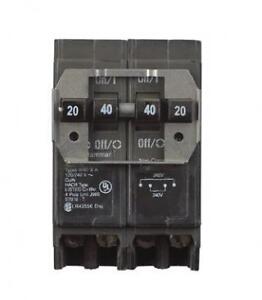
Since I'm scared to go into the electrical section I'll ask here. Is a thin double pole 50 amp breaker a suitable replacement for a regular thick one? Will be soley powering a welder on a 12 foot run of 6/2 wire.
 
To avoid these ads, REGISTER NOW!

DoyleDee

Well-known member
Joined
Jun 17, 2007
Messages
689
Location
North Texas
It should work, but just make sure your wires will not touch together. (and yes, I don't believe the sparkies will bite)
 

signcrafter

Well-known member
Joined
May 9, 2012
Messages
12,338
I've used tandem breakers for two separate circuits before. I'm not sure how a 2 pole thin breaker would work? A normal double pole breaker allows each wire to be hooked up on a different phase. A thin breaker like a tandem both legs are on one phase and won't give you 220. If you would put a thin breaker on both phases it would have to be in the middle of where the normal breaker goes and would leave a half breaker gap on the top and bottom. Maybe they make something that will work but I've never seen one. I guess I'll learn something new if someone says you can.

Why not use two tandem breakers to control 4 single pole circuits which would free up your two needed slots for a normal double pole breaker?
 

Grabber70Mach

Well-known member
Joined
Feb 3, 2013
Messages
62
I would say no. A regular two pole breaker gets its power off each phase in the panel (220V). If using a double breaker in one slot it is only utilizing one phase, I don't think your welder will operate off of one phase correctly.
 

Stuart in MN

Well-known member
Joined
Sep 8, 2005
Messages
23,074
Location
Minneapolis
If you're talking about one of those tandem breakers that fits into the space of one regular single pole breaker, it won't work. The two handles aren't tied together, and more importantly both breakers tap off the same bus bar in the panel so you won't have 240vac between them.
 

tube_guy

Well-known member
Joined
Jan 21, 2009
Messages
747
A tandem breaker will only hook to a single leg in your panel box. If you're out of room in your panel box and need to add a 220 volt circuit, you would remove another breaker and add two tandem breakers, side by side, in your panel box. Two tandem breakers would be required and each would hook to a different leg, then you would use one hot wire from each of the tandem breakers in your box to get the 220 volt circuit. Normally, you’d use the outer two switches for a single 220 volt circuit, or the inner two switches for a single 220 volt circuit. Then you would use the two unused breakers on the tandem breakers you added, to re-connect the circuit for the breaker you removed. There are also some small sheet metal add-ons that connect the switches together so you won’t inadvertently throw only half the single circuit double pole breaker, like the attached picture which shows two 220 volt circuits arranged on two tandem breakers.

A tandem breaker should work fine for a welder circuit, but not all panel boxes can use tandem breakers, so before you do any of this work be sure that your panel box properly accepts them.
 

Attachments

  • Double pole tandem breakers.jpg
    Double pole tandem breakers.jpg
    28.9 KB · Views: 40

signcrafter

Well-known member
Joined
May 9, 2012
Messages
12,338

I think I remember something about GE having two different size breaker styles. Single pole breakers came in 1/2" and 1" wide and 2 pole breakers came in 1" and 2 " styles. That breaker should work. BUT it won't work by just replacing a normal single pole wide breaker. You will have to take out two single pole wide breakers to make this work. You then will use the breaker you linked to and also 2 smaller 1/2" wide single pole breakers, one on top and one on bottom. Hope this makes sense.
 

ddawg16

Well-known member
Joined
Jul 11, 2008
Messages
21,005
Location
S. California
I think I remember something about GE having two different size breaker styles. Single pole breakers came in 1/2" and 1" wide and 2 pole breakers came in 1" and 2 " styles. That breaker should work. BUT it won't work by just replacing a normal single pole wide breaker. You will have to take out two single pole wide breakers to make this work. You then will use the breaker you linked to and also 2 smaller 1/2" wide single pole breakers, one on top and one on bottom. Hope this makes sense.

Correct.

If you look at how a load center is built...on a 240Vac panel, the line connections alternate each position.

So...for a breaker to give you 240Vac, it has to span 2 positions. If your load center is as noted by singncrafter....then your good to go.
 
OP
N

neonnblack

Well-known member
Joined
Jun 7, 2010
Messages
4,913
Location
Reno, NV
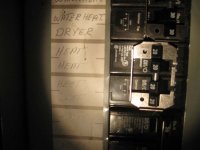
I'm just going to get a 2 inch breaker lol. I have the space, there is actually a 100amp in the spot now 2 inch. But that's obviously to large. It's not even connected, just sitting there. Don't know why.
 

theoldwizard1

Well-known member
Joined
Feb 22, 2011
Messages
43,132
Location
SE MI

I think I remember something about GE having two different size breaker styles. Single pole breakers came in 1/2" and 1" wide and 2 pole breakers came in 1" and 2 " styles. That breaker should work. BUT it won't work by just replacing a normal single pole wide breaker. You will have to take out two single pole wide breakers to make this work. You then will use the breaker you linked to and also 2 smaller 1/2" wide single pole breakers, one on top and one on bottom. Hope this makes sense.

Correct.

If you look at how a load center is built...on a 240Vac panel, the line connections alternate each position.

So...for a breaker to give you 240Vac, it has to span 2 positions. If your load center is as noted by singncrafter....then your good to go.

Is it safe ? Properly installed, ABSOLUTELY !

Signcrafter is right on the money. That 2P breaker "spans" 2 lugs/slots. You can still add 2 thin 1P breakers.

I think Square D make them the same way (I'm not saying Square D breakers are compatible with GE load centers.)
 
To avoid these ads, REGISTER NOW!
OP
N

neonnblack

Well-known member
Joined
Jun 7, 2010
Messages
4,913
Location
Reno, NV
Brain fart, and sign is correct. The dryer and range are both on the same style breaker, dont know why i didnt check how those were before, lol. Thanks guys.
 

Charles (in GA)

Well-known member
Joined
Jan 11, 2006
Messages
12,489
Location
50 mi south of Atlanta
The breaker you show IS a double pole breaker and will give you 240V. GE panels work differently than others. This breaker fits between the two stabs. GE thin breakers do not clip on the stab, but rather, clip on small U shaped pieces welded to the sides of the stab, down low on it. You put this breaker between two stabs and shove it in. You now have two blank THIN spaces on either side of it, which you fill with loose thin breakers (GE does NOT rivet single pole breakers together in pairs like other brands) or you may use thin blanking plates to close the openings on each side.

Charles
 

Charles (in GA)

Well-known member
Joined
Jan 11, 2006
Messages
12,489
Location
50 mi south of Atlanta
Some quick googling turned up this, http://www.sears.com/murray-mp25020...648S3585492901?prdNo=1&blockNo=1&blockType=G1. It goes in the spots of two single breakers and gives you two 20 amp circuits and one fifty amp circuit. It says it's for use in murray panels, I've never heard of murray panels before. What type of panel do you have?

Murray is owned by Siemens. Their breakers are the same, and legally interchangeable. Many of the panels are the same.

Charles
 

Zeke

Well-known member
Joined
Aug 13, 2009
Messages
17,176
Location
Long Beach CA, the sewer by the sea.
I have an old GE panel and breakers are impossible to find. I use another brand and remove the wire piece that prevents the breaker from seating. I do have a couple of the side mount connections. It becomes a scramble to get the other breakers, slim and double pole, all in position.

I'm about ready to gut the thing and place a load center directly behind on the inside wall.
 

Norcal

Well-known member
Joined
Mar 16, 2008
Messages
13,753
GE panels are real easy to use their THQP 1/2" breakers in, the 1" are THQL, BUT..... You cannot use any other make of twin breaker in a GE loadcenter, it will not work without jury rigging the breaker. If I could transfer the photos off my phone to the computer a picture of a GE load center interior could be posted to show the difference.
 

gcronau

Member
Joined
Oct 22, 2012
Messages
20
Location
Pittsburgh, PA area.
A tandem breaker will only hook to a single leg in your panel box. If you're out of room in your panel box and need to add a 220 volt circuit, you would remove another breaker and add two tandem breakers, side by side, in your panel box. Two tandem breakers would be required and each would hook to a different leg, then you would use one hot wire from each of the tandem breakers in your box to get the 220 volt circuit. Normally, you’d use the outer two switches for a single 220 volt circuit, or the inner two switches for a single 220 volt circuit. Then you would use the two unused breakers on the tandem breakers you added, to re-connect the circuit for the breaker you removed. There are also some small sheet metal add-ons that connect the switches together so you won’t inadvertently throw only half the single circuit double pole breaker, like the attached picture which shows two 220 volt circuits arranged on two tandem breakers.

The only problem with the above arrangement is that the resulting 2-pole breaker is considered to be "independent trip". If you manually throw the breaker, both sides of the circuit will be off. OTOH, depending how an overload/short situation plays out, you could be left with only 1 side of your 240v circuit tripped, and the other side still live. And dangerous. You really want a 1 piece "common trip" breaker that opens both sides of the 240v circuit when a failure occurs.

To the OP: I would be very leery of using a thin/tandem breaker arrangement for an *arc* *welder*. My basic instinct is that a tandem breaker is going to contain smaller/thinner/lighter components than a full size breaker, which means less ability to properly carry high current loads. And to continue to do so repeatedly, reliably, and for year after year. Regardless of whatever tests and certs UL applies to them, I'd never consider a tandem for that kind of high load application. I only use them for lighting circuits and where I know they'll be subject to light loads. I never use anything higher than a 15a or 20a tandem. I agree with what others have said here, you'd be much better off putting in 2 tandems and moving a couple of lighting circuits to the new tandems, and free up 2 full sized slots into which you can put a full-sized common-trip 2-pole 50a breaker.

And just FYI: A couple of companies make a 3 breaker unit comprised of a 2-pole 240v common trip slim unit in the middle, flanked by 2 single-pole slim breakers on either side. The whole unit uses 2 normal sized panel slots.
Square D has several different "quad" breakers in their Homeline series. Here's an example:

http://www.homedepot.com/p/Square-D...-Breaker-HOMT2020250CP/202495838#.UjqPaKzd35g
 
Last edited:

theoldwizard1

Well-known member
Joined
Feb 22, 2011
Messages
43,132
Location
SE MI
The only problem with the above arrangement is that the resulting 2-pole breaker is considered to be "independent trip". If you manually throw the breaker, both sides of the circuit will be off. OTOH, depending how an overload/short situation plays out, you could be left with only 1 side of your 240v circuit tripped, and the other side still live. And dangerous. You really want a 1 piece "common trip" breaker that opens both sides of the 240v circuit when a failure occurs.
I can't tell from the picture, but I am 99.999% certain that any 2 pole UL certified breaker will have both handles "tied" so what you describe can NOT happen.
 

gcronau

Member
Joined
Oct 22, 2012
Messages
20
Location
Pittsburgh, PA area.
I can't tell from the picture, but I am 99.999% certain that any 2 pole UL certified breaker will have both handles "tied" so what you describe can NOT happen.

Tying only the handles together does not assure that each side will common trip. Most breakers trip to a position that is about 2/3rds of the way from off to on. There's often not enough pull from the tripping breaker to also trip the handle of the other breaker. A 2-pole manufactured-and-sold-as-a-one-piece-unit breaker is tied together *internally*. It's the only way to insure that it will always common trip. It may *look* like it's only tied together at the handles, but if the bar across the handles says "common trip", then I assure you, there is additional hardware inside that is also connecting the mechanisms of each pole's breaker to each other.

But that's not what was being described in the post that I quoted. The author of that post was describing a setup in which 2 independent breakers are joined with a "handle tie". This assures that both breakers will be manually turned on and off at the same time, but it doesn't(and can't) assure that both breakers will trip at the same time. The NEC allows this combo, but requires that the breaker be labeled as "independent trip".

Independent trip is ok for setups where, for instance, a single piece of 12/3 is used to feed a common point that then separates into 2 - 12/2 branch circuits. This is done to save cable. But independent trip really shouldn't be used for a real 240v circuit, like an A/C compressor, or an oven, or gas dryer, or *an arc welder*.
 

tube_guy

Well-known member
Joined
Jan 21, 2009
Messages
747
Tying only the handles together does not assure that each side will common trip. Most breakers trip to a position that is about 2/3rds of the way from off to on. There's often not enough pull from the tripping breaker to also trip the handle of the other breaker. A 2-pole manufactured-and-sold-as-a-one-piece-unit breaker is tied together *internally*. It's the only way to insure that it will always common trip. It may *look* like it's only tied together at the handles, but if the bar across the handles says "common trip", then I assure you, there is additional hardware inside that is also connecting the mechanisms of each pole's breaker to each other.

But that's not what was being described in the post that I quoted. The author of that post was describing a setup in which 2 independent breakers are joined with a "handle tie". This assures that both breakers will be manually turned on and off at the same time, but it doesn't(and can't) assure that both breakers will trip at the same time. The NEC allows this combo, but requires that the breaker be labeled as "independent trip".

Independent trip is ok for setups where, for instance, a single piece of 12/3 is used to feed a common point that then separates into 2 - 12/2 branch circuits. This is done to save cable. But independent trip really shouldn't be used for a real 240v circuit, like an A/C compressor, or an oven, or gas dryer, or *an arc welder*.

What you say about there being no guarantee that both breakers will trip at the same time is true. Does that setup meet code? Pretty much my entire house is wired up that way and it was done by a professional electrician. Not me. And it has my town's sticker on the panel box indicating it has passed inspection. I've also seen many 220 volt circuits in other houses in our area that were done that way as well. If it's dangerous, I'd really like to know about it before something happens.
 

gcronau

Member
Joined
Oct 22, 2012
Messages
20
Location
Pittsburgh, PA area.
Maybe not on every brand of breaker, but it does on Square D QO tandem breakers ! From page 1-2 of the Square D master catalog.

View media item 33518

I'm still not sold. The header says "Common trip", but the text uses the phrase "...for Common Switching". Switching is what a human does with his hand. Tripping is what a breaker does to itself when it senses an overload or short. <insert obligatory 60's joke here...> The information is self contradicting, which makes it more likely to be useless.

And I'm sure that SqrD breakers are of the type that trip to an intermediate position that is 2/3rds of the way towards the ON position. If they were of the type that tripped to the fully OFF position, then there's a much better chance that a handle tie alone could enable the ability to common trip, but the spring pressure pushing away from the ON position, on a tripped SqrD breaker, just isn't enough to pull the other side away from the ON position.

It might be as simple as, whoever made up that catalog page, may just have made an error. Maybe the people in marketing didn't fully understand the subtlety of the issue and why there would be any difference between "trip" and "switch". I'll trust my own empirical data from physical examination of the device, over information from a catalog or marketing brochure any day. Now, if you had an actual data sheet that came with the breaker, I'd be inclined to give it a bit more weight. But the best thing to do would be to call SqrD and see if you can talk to someone(an engineer?) who understands the issue better and get a definitive answer.

As I said earlier, SqrD sells what they call a "quad" breaker that looks like 2 tandems joined together with 4 handles total. The middle 2 handles have been handle tied into a 240v breaker. (FYI: This method, and the method described above, are the only way to get 240v from SqrD tandem breakers. You need to span 2 normal slots to get both phases for 240v.)
However, I contend that the middle 2 breakers of a quad are *internally* tied together to create the common trip function. The handle tie alone doesn't do it.

But consider this: If a handle tie could reliably(every time, all the time) produce a common trip function, then there would be no need to create the quad breaker. The quads are expensive, more than the price of 2 tandems. I think the existence of the quad breaker, and the fact that people are willing to pay their higher price, argues strongly for the idea that a handle tie alone is insufficient to do the job.
 

Charles (in GA)

Well-known member
Joined
Jan 11, 2006
Messages
12,489
Location
50 mi south of Atlanta
But consider this: If a handle tie could reliably(every time, all the time) produce a common trip function, then there would be no need to create the quad breaker. The quads are expensive, more than the price of 2 tandems. I think the existence of the quad breaker, and the fact that people are willing to pay their higher price, argues strongly for the idea that a handle tie alone is insufficient to do the job.

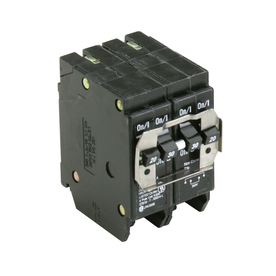
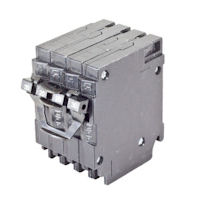
I agree, most Double pole common trip breakers have, if you peer down between them, an interconnect. However, The next three pics show different brands of quads that are TWO double pole breakers (these are NOT a dbl pole in the middle and two single poles on the outer positions, but rather a dbl pole in the middle, and a double pole made up of the two outer ones with a handle tie. You may rest assured that the two outer ones are not linked in any way other than the handle tie.

First is a Siemens (I own one of these)

235120.jpg


Second is a Cutler-Hammer type BR

786676370806lg.jpg


Third is another view of a Bryant.

$(KGrHqFHJ!0E63Ru!(Y6BO3TG2ZVF!~~60_35.JPG


Fourth is a Murray (Siemens) better view.......

$(KGrHqFHJDMFCfle+CcCBQ)1gb5iwQ~~60_35.JPG


Charles
 

gcronau

Member
Joined
Oct 22, 2012
Messages
20
Location
Pittsburgh, PA area.
I agree, most Double pole common trip breakers have, if you peer down between them, an interconnect. However, The next three pics show different brands of quads that are TWO double pole breakers (these are NOT a dbl pole in the middle and two single poles on the outer positions, but rather a dbl pole in the middle, and a double pole made up of the two outer ones with a handle tie. You may rest assured that the two outer ones are not linked in any way other than the handle tie.

When dealing with *anything* of a technological nature, you'll be well served by remembering the phrase "Things are often not what they seem".

Those breakers, especially the Cutler-Hammer BR and the Bryant, may *look* like 2 regular breakers that have been simply riveted together, but without actually taking out the rivets and looking around inside, it's hard to know for sure what you're really dealing with. It's possible (but yeah, I'll admit, extremely unlikely) that there could be some kind of internal tying mechanism between the outer 2 breakers.

And remember, I never said you couldn't make 2 2-pole breakers out of 4 little ones, my argument dealt with common trip vs independent trip. I said you couldn't make a common trip breaker simply by addition of a handle tie. The following photos do nothing to refute that.

(BTW, just a random thought, but those things are such ugly f***ing kludges! :wtf:)

First is a Siemens (I own one of these)

235120.jpg


Second is a Cutler-Hammer type BR

786676370806lg.jpg


Third is another view of a Bryant.

$(KGrHqFHJ!0E63Ru!(Y6BO3TG2ZVF!~~60_35.JPG


Fourth is a Murray (Siemens) better view.......

$(KGrHqFHJDMFCfle+CcCBQ)1gb5iwQ~~60_35.JPG


Charles

OTOH, while the middle 2-pole breaker, in all 4 of the above examples, can certainly be made into a common trip breaker, do you know for a fact that the above manufacturers claim common trip for the outer 2 poles as well? They might not.

Those units could easily be sold as a combination of a.) a 2-pole common trip breaker in the middle(for ovens/dryers/stoves/etc), and b.) an independent trip 2-pole breaker on the ends, meant to be used with multi-wire shared neutral branch circuits. The outer 2 poles could have been joined as just a simple independent breaker meant to be used to satisfy the 2008 NEC 210.4(B) requirements.

Or they could even have been sold as just 2 simple 2-pole independent trip breakers.

<time passes....>
Okay, a little Net Spelunking yields the following:

1.)The Siemans breaker is from their Q2xxxxCT2 series(where xxxx is the various combinations of amps). They are listed as 2 2-pole breakers both "with internal common trip".

2.)The Cutler Hammer BRD(or Eaton BQ) breakers only seem to be available in independent trip for both breakers. It appears they really *are* just 2 regular tandems riveted together!

3.)And of course the Bryants are just the same as Cutler Hammer BR's. Same thing. Even use the same part numbers. All independent trip. Just 2 regular tandems riveted together, with handle ties.

4.)And the Murray is just a Siemans breaker.

I haven't found anything to dispute my original hypothesis that: you can't make a common trip breaker out of 2 individual breakers simply by adding a handle tie. Doing so will only produce an independent trip 2-pole breaker. If a breaker is common trip, then it must possess some sort of internal mechanism, regardless of whether that mechanism is visible or even, whether such mechanism seems difficult or impossible to implement.

I didn't spend <cough>waste<cough> too much time looking into this. I'm sure I could have missed something. If somebody knows of a magic breaker that refutes this, hey, I'm all ears.
 
To avoid these ads, REGISTER NOW!
Top Bottom