neonnblack
Well-known member
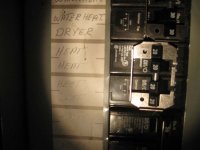
Since I'm scared to go into the electrical section I'll ask here. Is a thin double pole 50 amp breaker a suitable replacement for a regular thick one? Will be soley powering a welder on a 12 foot run of 6/2 wire.

It should work, but just make sure your wires will not touch together. (and yes, I don't believe the sparkies will bite)

http://m.homedepot.com/p/GE-Q-Line-50-Amp-1-in-Double-Pole-Circuit-Breaker-THQP250/100356520/
This is the breaker. Says its 240. It is an older ge panel.
I think I remember something about GE having two different size breaker styles. Single pole breakers came in 1/2" and 1" wide and 2 pole breakers came in 1" and 2 " styles. That breaker should work. BUT it won't work by just replacing a normal single pole wide breaker. You will have to take out two single pole wide breakers to make this work. You then will use the breaker you linked to and also 2 smaller 1/2" wide single pole breakers, one on top and one on bottom. Hope this makes sense.
http://m.homedepot.com/p/GE-Q-Line-50-Amp-1-in-Double-Pole-Circuit-Breaker-THQP250/100356520/
This is the breaker. Says its 240. It is an older ge panel.
I think I remember something about GE having two different size breaker styles. Single pole breakers came in 1/2" and 1" wide and 2 pole breakers came in 1" and 2 " styles. That breaker should work. BUT it won't work by just replacing a normal single pole wide breaker. You will have to take out two single pole wide breakers to make this work. You then will use the breaker you linked to and also 2 smaller 1/2" wide single pole breakers, one on top and one on bottom. Hope this makes sense.
Correct.
If you look at how a load center is built...on a 240Vac panel, the line connections alternate each position.
So...for a breaker to give you 240Vac, it has to span 2 positions. If your load center is as noted by singncrafter....then your good to go.
Some quick googling turned up this, http://www.sears.com/murray-mp25020...648S3585492901?prdNo=1&blockNo=1&blockType=G1. It goes in the spots of two single breakers and gives you two 20 amp circuits and one fifty amp circuit. It says it's for use in murray panels, I've never heard of murray panels before. What type of panel do you have?
A tandem breaker will only hook to a single leg in your panel box. If you're out of room in your panel box and need to add a 220 volt circuit, you would remove another breaker and add two tandem breakers, side by side, in your panel box. Two tandem breakers would be required and each would hook to a different leg, then you would use one hot wire from each of the tandem breakers in your box to get the 220 volt circuit. Normally, you’d use the outer two switches for a single 220 volt circuit, or the inner two switches for a single 220 volt circuit. Then you would use the two unused breakers on the tandem breakers you added, to re-connect the circuit for the breaker you removed. There are also some small sheet metal add-ons that connect the switches together so you won’t inadvertently throw only half the single circuit double pole breaker, like the attached picture which shows two 220 volt circuits arranged on two tandem breakers.
I can't tell from the picture, but I am 99.999% certain that any 2 pole UL certified breaker will have both handles "tied" so what you describe can NOT happen.The only problem with the above arrangement is that the resulting 2-pole breaker is considered to be "independent trip". If you manually throw the breaker, both sides of the circuit will be off. OTOH, depending how an overload/short situation plays out, you could be left with only 1 side of your 240v circuit tripped, and the other side still live. And dangerous. You really want a 1 piece "common trip" breaker that opens both sides of the 240v circuit when a failure occurs.
I can't tell from the picture, but I am 99.999% certain that any 2 pole UL certified breaker will have both handles "tied" so what you describe can NOT happen.
Tying only the handles together does not assure that each side will common trip. Most breakers trip to a position that is about 2/3rds of the way from off to on. There's often not enough pull from the tripping breaker to also trip the handle of the other breaker. A 2-pole manufactured-and-sold-as-a-one-piece-unit breaker is tied together *internally*. It's the only way to insure that it will always common trip. It may *look* like it's only tied together at the handles, but if the bar across the handles says "common trip", then I assure you, there is additional hardware inside that is also connecting the mechanisms of each pole's breaker to each other.
But that's not what was being described in the post that I quoted. The author of that post was describing a setup in which 2 independent breakers are joined with a "handle tie". This assures that both breakers will be manually turned on and off at the same time, but it doesn't(and can't) assure that both breakers will trip at the same time. The NEC allows this combo, but requires that the breaker be labeled as "independent trip".
Independent trip is ok for setups where, for instance, a single piece of 12/3 is used to feed a common point that then separates into 2 - 12/2 branch circuits. This is done to save cable. But independent trip really shouldn't be used for a real 240v circuit, like an A/C compressor, or an oven, or gas dryer, or *an arc welder*.
Tying only the handles together does not assure that each side will common trip.
Maybe not on every brand of breaker, but it does on Square D QO tandem breakers ! From page 1-2 of the Square D master catalog.
View media item 33518
But consider this: If a handle tie could reliably(every time, all the time) produce a common trip function, then there would be no need to create the quad breaker. The quads are expensive, more than the price of 2 tandems. I think the existence of the quad breaker, and the fact that people are willing to pay their higher price, argues strongly for the idea that a handle tie alone is insufficient to do the job.
1gb5iwQ~~60_35.JPG)
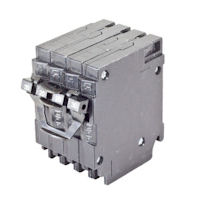
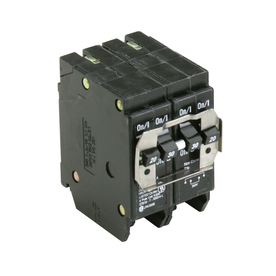
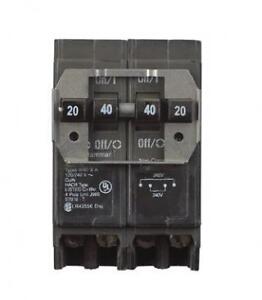
I agree, most Double pole common trip breakers have, if you peer down between them, an interconnect. However, The next three pics show different brands of quads that are TWO double pole breakers (these are NOT a dbl pole in the middle and two single poles on the outer positions, but rather a dbl pole in the middle, and a double pole made up of the two outer ones with a handle tie. You may rest assured that the two outer ones are not linked in any way other than the handle tie.
 )
)First is a Siemens (I own one of these)
Second is a Cutler-Hammer type BR
Third is another view of a Bryant.
Fourth is a Murray (Siemens) better view.......
Charles