tool_scrounge
Well-known member
The Bridgeport quil power feed is only rated for drills up to 3/8” diameter. You can go bigger with manual feed, but it will not hog material like a big drill press.


I too am an amateur and have one of each - for the reasons I listed above.Have 4 mills, zero drill presses, I'm an amateur


Huh? Who uses power feed for drilling? Do drill presses use power down feeds?The Bridgeport quil power feed is only rated for drills up to 3/8” diameter. You can go bigger with manual feed, but it will not hog material like a big drill press.
Nice shop!Now down to just 3 drill presses, which take up less room than the mill. I customize yachts. So the work is quite varied. I keep the small benchtop drill press with a countersink in it, normally. The big drill press remains on low speed; the smaller drill press usually left on highest speed. This saves me time and is a matter of convenience. The workbench/cabinets married to the drill presses largely contain all the tooling related to them. The mill and lathe have their own set of cabinets for their tooling.
The cost to buy and toll-up a mill is a whole order of magnitude greater than for a drill press, one of which can commonly be bought for as little as $100. A drill press can be placed nearly anywhere, and is easy to move. A full size mill generally requires specialized equipment to move, adding another layer of cost.
A Bport will BORE bigger holes and will do myriad other things that a drill press can't do.Huh? Who uses power feed for drilling? Do drill presses use power down feeds?
Maybe I’m ignorant. It sounds from this post that you can’t drill a huge hole with a mill. I know that’s not the case. Now my mill is a puny 1hp. I would think hp would limit either machine.
Having completely rebuilt my head and spindle I can say a Bridgeport spindle is way more robust than any comparably sized drill press I’ve ever seen. I think people use drill presses for convenience, not because they are better at drilling. I personally dont find my BP inconvenient for drilling. Only downside is hand cranking the knee down.
Otherwise absolutely everything about it seems better than a drill press to me. Just moving the table precisely under the spindle is pretty awesome in terms of drilling. I think the other huge downside of the mill is many of us don’t like drilling wood on them because we don’t want hygroscopic swarf on our ways.
I have a large (3/4" chuck) power feed drill press, but seldom use power feed as I like to be able to feel and see that I have feed right. Nothing beats the ability to just grab a part and throw into a drill vise to make a quick hole - but in my case that drill press table is set up to drill bolt patterns and can do so in a few minutes versus the hassle of hoisting the rotary stuff onto the mill (no DRO - yet). I have one set of lathe/mill/drill able to do decent size work and another set of tiny ones for very small parts and not intimidating to my grandsons as are the big stuff. You/I can indeed drill a pretty good size hole with a mill, but usually hand feeding annular cutters on mill or drill. On the tall/big part issue: 90% solved with mag drill and some planning/setup. But, overall, the big drill gets used far more than all other machine tools combined. Side note: used to be that tooling (drill bits) were kind of inconsequential in cost - I damn near faint when thinking what my index in 1/64 to 1" and 1/32 to 1 1/2 would cost today.Huh? Who uses power feed for drilling? Do drill presses use power down feeds?
Maybe I’m ignorant. It sounds from this post that you can’t drill a huge hole with a mill. I know that’s not the case. Now my mill is a puny 1hp. I would think hp would limit either machine.

The mill has a digital position readout display installed. The tape is just holding the wire to the position sensor in place.I know zero about these BridgePort machines, So, I ask why is that area in the one photo of the original post covered with insulation tape?
Just to prevent swarf from getting in? Certainly it would't be a crack?
Smoke weed, happy happy, pull handle.Have you drilled into your feed screws yet? I personally have not.
-This is not to hijack the thread, apologies if I do. Power feed can be a useful feature. I used to run a large radial drill press making/tapping larger holes in vessels, flanges, etc. When using twist drills there's a tendency for the drill lip to "grab" the material as it breaks through the other side with hand feed. This can result in very bad things happening like the drill shattering, stalling the DP motor, pulling the twist drill off the taper, or snatching the work out of the fixture while rotating. A power feed should control the up/down motion of the Z axis which controls how much downward feed the drill bites into in a controlled manner. It's much safer to use the power feed for operations like this IMO rather than risking the material pulling the helix of a twist drill into the work. Apologies for the topic detour.Huh? Who uses power feed for drilling? Do drill presses use power down feeds?
IF your power feed drive is completely without any free play, otherwise it can still let a twist drill break through hard. Kind of why I like to hand feed - I can hear and feel when the hole starts hitting other side and back off feed accordingly. Also why I so much like annular cutters. I started with brazed carbide ones many moons ago, but soon found they would chip the inserts and become expensive waste.-This is not to hijack the thread, apologies if I do. Power feed can be a useful feature. I used to run a large radial drill press making/tapping larger holes in vessels, flanges, etc. When using twist drills there's a tendency for the drill lip to "grab" the material as it breaks through the other side with hand feed. This can result in very bad things happening like the drill shattering, stalling the DP motor, pulling the twist drill off the taper, or snatching the work out of the fixture while rotating. A power feed should control the up/down motion of the Z axis which controls how much downward feed the drill bites into in a controlled manner. It's much safer to use the power feed for operations like this IMO rather than risking the material pulling the helix of a twist drill into the work. Apologies for the topic detour.
-It doesn't have to be "completely" free of play and that's a relative condition anyway. I'm not stating you're wrong but I'm not wrong either. My comments were for twist drills only, annular cutters chew metal differently. I agree with you on that point.IF your power feed drive is completely without any free play, otherwise it can still let a twist drill break through hard.
Unfortunately.......... a newbie using a BP as a drill will drill into the table ,and might even drill into the feed screw under the table ........so I suggest a proper drill will be better.
Important to point out there all sizes and kinds of drilling machines as there are milling machines. I have worked with a horizontal mill that was big enough to set up a card table and 2 chairs for the machinist and apprentice to watch the cut. Can't say I have seen a drill that big.A Bport will BORE bigger holes and will do myriad other things that a drill press can't do.
But for raw power, speed, ease and simplicity a good drill press will out perform any B-port for DRILLING large holes.
Carlton made some pretty big drills.Important to point out there all sizes and kinds of drilling machines as there are milling machines. I have worked with a horizontal mill that was big enough to set up a card table and 2 chairs for the machinist and apprentice to watch the cut. Can't say I have seen a drill that big.
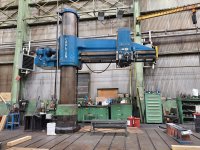
Carlton made some pretty big drills.
Oh, I agree with you there.Important to point out there all sizes and kinds of drilling machines as there are milling machines. I have worked with a horizontal mill that was big enough to set up a card table and 2 chairs for the machinist and apprentice to watch the cut. Can't say I have seen a drill that big.
I collect brass tags and have them hanging in my shop office.-I used to run a G&L about that size and a few other makes that were a bit smaller. I like radial drills.
