JoeFin
Well-known member
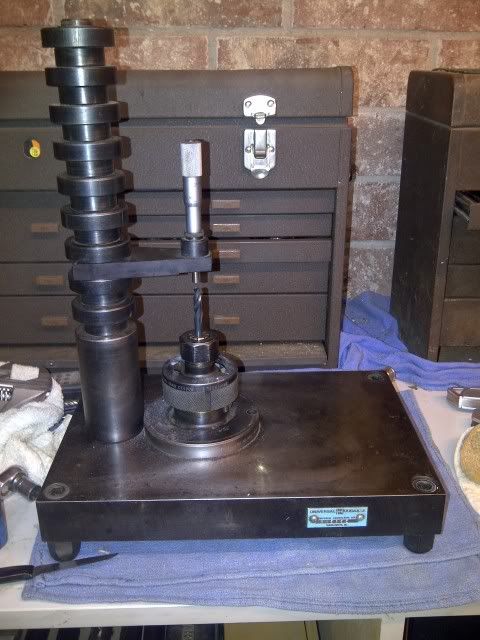
What exactly does an indicol do? Is it just a holder or is it a very special holder?
Don't waste your time with an Indicol
You'll find the Starrett Button-Back Indicator Set about 100 times more useful in your setting up
sFIZGGm+2RBSUb-))jlQ~~60_3.JPG)

What exactly does an indicol do? Is it just a holder or is it a very special holder?
Don't waste your time with an Indicol
You'll find the Starrett Button-Back Indicator Set about 100 times more useful in your setting up
I know the vise will be pricey, I have found a great deal on a new kurt vise on ebay. It is a D688 that is $455 and it is local so I can save the $95 for shipping. I don't want to spend almost $500 on a vise, but I feel it is the heart of the mill.
Why would anyone drop $500 on a new Kurt ? Every machine shop auction I've been to has a pile of them usually going for some where between $50 and $100

Why would anyone drop $500 on a new Kurt ? Every machine shop auction I've been to has a pile of them usually going for some where between $50 and $100
Regarding budgets.
From the point of view of someone who has just mostly gone through the (ongoing) process of equipping a 1-man machine shop, you will eventually likely spend on tooling an amount which will far exceed the $1200 your mill cost. Likewise with layout and setup gear. Of course you will approach this accumulation as funds allow and as opportunities arise. But in order to rough out a realistic budget with which to begin, you should try to envision what will comprise your fully equipped shop.
Just to give you some idea, my support gear:
Inside, outside, and depth micrometers 0-12" with standards, anvil mic, tube mic, blade mics, small hole gauges, dial calipers 0-12", vernier caliper 0-24", 0-36" scales, 0-24" adjustable squares, machinist's squares, protractors and compasses 0-24", scribe, T-bevel, radius gauges, surface plate, height gauge, sine bars, precision level, angle blocks, gauge blocks, V-blocks with clamps, adjustable V-block, angle plates, fixed and adjustable parallels, screw-less vises, machinist's vises and clamps, jack-screws, 1-2-3 plates, dial indicators with bases and accessories, center and edge finders, hold-downs ... plus.
Besides fly-cutters, slotting saws and boring bars, end mills include flat, radius'd and ball, round-over, roughing and tapered in various degrees, carbide and cobalt/HSS, 2 or more flutes, in sizes 1/16"-2"... plus.
Thread Snip
It's easy to spend thousands, and it's smarter to spend hundreds.
I may figure out sooner rather than later that sometimes you just need a good, expensive tool, and there may be no substitute. For now I am the guy that doesn't know any better, but will learn from his mistake.
I'll buy every Kurt you can get for $50 and I'll pay you $75.
Also the hold downs I have seem too loose on the T-slots what size are they suppose to be?
I totally agree justanengineer, yes the import collets look great but you will find that the the tolerance of the taper and ID that is ground is not very precision and this will ruin plenty of work due to the cutter pulling out.
I totally agree justanengineer, yes the import collets look great but you will find that the the tolerance of the taper and ID that is ground is not very precision and this will ruin plenty of work due to the cutter pulling out and the steel being low quality loosing it's shape. I have seen this more and more lately because of all the import tooling.
I have filed burrs from the Tee Slots on Bridgeport's because of the sloppiness of the fits. If the Tee-Slot nut is not 5/8 then do not use it.
My concern is the effect on the tool's runout. Ditto for cheap drill chucks. Good luck cutting 3/4" slot with a 3/4" end mill. Ditto for drill a 1/2" hole. Now obviously machinists have ways of doing both, and the spindle on a bridge isn't perfect. But why add to the problem?
A good machinist knows that you can't cut a 3/4" slot with a 3/4" endmill. All for the fact that one side is climb cutting and the other side is conventional cutting. With that, you get chip buildup while the cutter is cutting and you will get chip crowding and galling. You always want to use an end mill one size or so smaller to make a cut to the size you want and take a finish cut climb cutting only.


So I went on ebay and bought some end mills:

Then I got my Kurt Vise with a swivel base (one is for my Dad):

I went to a pawn shop and bought some more Chucks, Jacobs 18N and two 20N's:

I ordered some collets and hold down kits from Enco, they should be here Monday. I went through my drill bits and found that I have most sizes up to 1". I am hoping to buy an indicator and magnetic base this week so I can set everything up. I still need to find a home for my mill, it is being used to hold my extension cord right now.

I am going to get some more tooling, but after I sell my generator. If that sells on monday, I will be buying a few more goodies.
As an aside, I like the tools from Fisher Products. I have several of them.
Similarly, before you stick imported or otherwise "cheap" tooling directly into the spindle, get some bluing or a marker and check to see how it actually fits. Blue the tool's taper, insert the tool by hand, spin it lightly, and check the pattern. Every once in awhile you will find its off and wasnt worth even the cheap price, and you really dont want to take a chance of wrecking a spindle taper.
What do you use for bluing? Is it just the layout fluid like dykem? or is it something else? Anyone have a good source for it? I am going to try it out on some of my import tooling to see how it fits.