Rather than clutter of the vises thread, I thought I'd start one just to discuss this failure mode.
Some folks have said it was caused by a big hammer, not likely, and you'll see why shortly.
If a hammer struck down on something in the vise, it would have put pressure on the bottom of the slide, and the static jaw would have failed right were we always see them fail...directly under the slide, and usually framing the slide almost perfectly.
To split the top and bottom half of the body of the vise with a hammer strike from above (normal downward motion) the top of the body of the vise would have to be anchored to something above it to resist the downward load, and cause it to fail. I don't see a chain welded to it going up to the ceiling, so that theory is out.
You could split the body of the vise in half with an upward strike that hit the bottom of the dynamic jaw, but there's an even chance the dynamic jaw would break off the slide before it would split the body of the vise. Not many folks swing big hammers upwards that high...good way to hit yourself, or worse.
Then again, let's think about how a normal vise works. You turn the handle and it moves the dynamic jaw towards the static jaw, loading it the more you turn the handle.
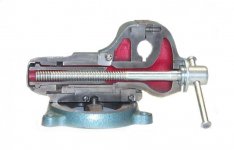
The static jaw is above, and forward of the body of the vise on this Wilton. When you put a rearward load on the static jaw, it also puts an upward load on it because of the offset (it's a lever or arm if you're into terms). The base of the vise can't move, because it's secured to the bench.
Now add that you're also pulling the back of the body of the vise towards the front of the vise as you turn the screw. The body of the vise is being compressed from front to back, and the static jaw is being pushed upwards at the same time.
At some point, the body splits when that upward load, compounded by the compression from front to rear gets too high.
That's what caused this vise to fail. Also, the owner told me he was seating a bearing with the vise when it failed (static jaw damage happened prior to the failure) and he has no reason to lie about it.
Go ahead....argue away, I'm done :thumb:

Some folks have said it was caused by a big hammer, not likely, and you'll see why shortly.
If a hammer struck down on something in the vise, it would have put pressure on the bottom of the slide, and the static jaw would have failed right were we always see them fail...directly under the slide, and usually framing the slide almost perfectly.
To split the top and bottom half of the body of the vise with a hammer strike from above (normal downward motion) the top of the body of the vise would have to be anchored to something above it to resist the downward load, and cause it to fail. I don't see a chain welded to it going up to the ceiling, so that theory is out.
You could split the body of the vise in half with an upward strike that hit the bottom of the dynamic jaw, but there's an even chance the dynamic jaw would break off the slide before it would split the body of the vise. Not many folks swing big hammers upwards that high...good way to hit yourself, or worse.
Then again, let's think about how a normal vise works. You turn the handle and it moves the dynamic jaw towards the static jaw, loading it the more you turn the handle.
The static jaw is above, and forward of the body of the vise on this Wilton. When you put a rearward load on the static jaw, it also puts an upward load on it because of the offset (it's a lever or arm if you're into terms). The base of the vise can't move, because it's secured to the bench.
Now add that you're also pulling the back of the body of the vise towards the front of the vise as you turn the screw. The body of the vise is being compressed from front to back, and the static jaw is being pushed upwards at the same time.
At some point, the body splits when that upward load, compounded by the compression from front to rear gets too high.
That's what caused this vise to fail. Also, the owner told me he was seating a bearing with the vise when it failed (static jaw damage happened prior to the failure) and he has no reason to lie about it.
Go ahead....argue away, I'm done :thumb: