To avoid these ads, REGISTER NOW!

Build Thread - 30x40

OP
R

rok_hunter

Well-known member
Joined
Apr 10, 2020
Messages
153
Location
home
...... filled the space under the pad with recycled concrete, .....

I'm going to have to look into that, how does it work as a "gravel"-ish driveway? I've got recycled asphalt for the main driveway to my house and, for this barn, was planning on a crushed gravel type material in front of the roll-up door.
 
To avoid these ads, REGISTER NOW!
OP
R

rok_hunter

Well-known member
Joined
Apr 10, 2020
Messages
153
Location
home
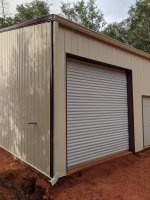
Alright, gutters are up and some more electrical has been done!

The gutter guy couldn't match the trim color with any of his suppliers so we had to go with what matched the walls. Because of shading and whatnot from a distance they still help to break up the outline of the building. I saw the trim piece on one end of the back roof corner was bent a bit to fit the gutter; not something I was stoked to see, but every now and then stuff is bound to happen. This is the same guy who did my house and a number of other projects for me so I was probably due for something to come in less than flawless.

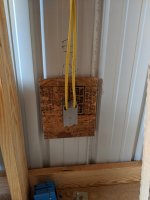
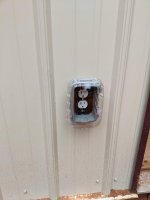
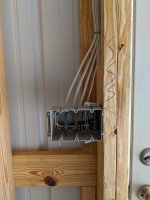
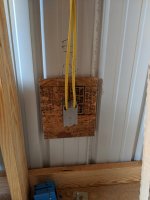
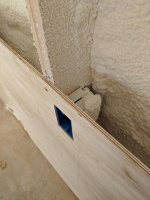
On lighting: The downside to these LED strip lights is that at 96" long...they look so tiny! Hoping they put out the advertised lumens. I thought that 36" hangers would work even near the center of the building to get them to about a 12' elevation (roof pitch = higher ceiling = higher attach point), but ended up having to purchase some chain and set the inside ends on 5' of chain hanger. The outside ends are hanging at about 2' from the ceiling to put the light at a 12' level. Bubble exterior outlet covers installed, and a nice touch on the interior that I would never have thought of - OSB on the interior wall to provide some stiffness to the outlet, instead of just the sheetmetal!
 

Attachments

  • 60.jpg
    60.jpg
    151.8 KB · Views: 129
  • 61.jpg
    61.jpg
    125.4 KB · Views: 123
  • 62.jpg
    62.jpg
    149.1 KB · Views: 127
  • 63.jpg
    63.jpg
    119.9 KB · Views: 161
  • 64.jpg
    64.jpg
    73.5 KB · Views: 154
  • 65.jpg
    65.jpg
    57.4 KB · Views: 142

Woodee955

New member
Joined
May 28, 2020
Messages
3
Location
Georgia
I'll throw in on the crushed concrete driveway. As long as who ever is crushing it has the screens set right and balances the larger pieces with the fines it will compact well. If it is too much of one or the other it doesn't like to stay together very well. I used crushed concrete for my slightly sloped driveway and it has worked well so far.

I appreciate the shop pictures also. Giving me some good ideas.
 
OP
R

rok_hunter

Well-known member
Joined
Apr 10, 2020
Messages
153
Location
home
Alright....talk about stinking weird - I had a post on here, that I'd gone back and looked at a time or two, that is now gone.

Ok so anyhow, here's a rough summary of my missing post: My electrician said he's gone far enough that I'm ready for foam insulation installation. He's left the plugs/switches out and covers off, and the plan is to get the foam sprayed in and then throw up some plywood on the interior walls. Once that is done he'll come back out and finish up his stuff, and I think I'll be complete!

I reached out to the foam installer, and he thinks he can get me sprayed this week. We'll see, and fingers crossed.

One of the things I really, really like about the guy doing my electrical work is how neat, tidy and organized he is. I've attached a couple photos of his work in the barn, as well as what the circuit breaker panel in my house looks like (he did that as well).
 

Attachments

  • 71.jpg
    71.jpg
    142.1 KB · Views: 174
  • 68.jpg
    68.jpg
    62.2 KB · Views: 166
  • 67.jpg
    67.jpg
    80.3 KB · Views: 152
  • 66.jpg
    66.jpg
    88.7 KB · Views: 137
  • 64.jpg
    64.jpg
    73.5 KB · Views: 136

Jayman17

Well-known member
Joined
Feb 6, 2017
Messages
3,793
Location
Seattle, Wa
You're not crazy because I saw your post before it disappeared and some posts I made on different threads are gone also. :wtf:
Your place looks great.

Jay
 
OP
R

rok_hunter

Well-known member
Joined
Apr 10, 2020
Messages
153
Location
home
Thanks Jayman17 and raycountryman, I appreciate it. I'm definately excited to get the thing finished, although at the same time that will just become the beginning of the next project! House garage will be turned into a gym. Work benches, shelving, etc. in the barn, starting construction of cabinets and a cement counter top for a bar in the house, building a computer desk for the kid....we've got a lot of projects lined up.

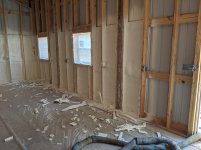
As for progress, foam was started on Friday! It's every bit as messy in person as all the pictures I saw online, to which I'm now adding my own. (In other news - anyone in Southern Alabama or the NW Florida Panhandle, and soon central Kentucky, who needs spray foam work done - shoot me a PM. Once again I've hit pay dirt with the guy who came to do my work, and I highly recommend him!)

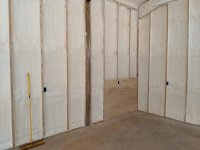
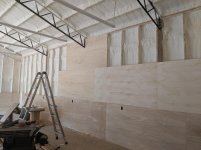
The crew did a great job of setting up and protecting the stuff I've got on the ground in the barn (mostly some leftover lumber, but critically the line set and air handler for my mini split), covered all the lights and electrical boxes, and covered the entire floor to protect it all from overspray. I'm getting 2" of closed-cell all around and, while there's some variances in thickness here and there, as far as I can tell they all error'd on the "thick" side. Every now and then I went down to peek discreetly into a window and routinely saw the installer doing quick depth-checks on his work to make sure the minimum of 2" was being laid down.

I was also impressed at how solid the foam is! I've got open cell foam in my house roof and it's sort of soft/squishy, but this closed-cell stuff is very rigid and appears to add a great deal of stiffness to the metal sheeting, just like everyone said it would.

They'll be back out Monday to finish spraying and clean up, and then I'll be starting the plywood install for interior finishing. For budget reasons I'm going to start with a single row around the base of the walls, and go to the second row only where the mini-split air handler will be. I'll come back over the next handful of weeks and finish out up to the 12' wall height.
 

Attachments

  • 80.jpg
    80.jpg
    150.9 KB · Views: 167
  • 79.jpg
    79.jpg
    113.6 KB · Views: 186
  • 76.jpg
    76.jpg
    152.7 KB · Views: 159
  • 75.jpg
    75.jpg
    148.8 KB · Views: 162
  • 74.jpg
    74.jpg
    147.7 KB · Views: 151
  • 73.jpg
    73.jpg
    147 KB · Views: 161
  • 72.jpg
    72.jpg
    104.8 KB · Views: 147
OP
R

rok_hunter

Well-known member
Joined
Apr 10, 2020
Messages
153
Location
home
I know it's been a hot minute since my last update, so here's some more progress.

As mentioned earlier the foam insulation is in, and even without HVAC, there is a noticeable difference in temperature inside vs outside the barn. I'm really looking forward to getting the mini-split up and running - I was hoping to have that fully installed this weekend but it just ain't gonna happen.

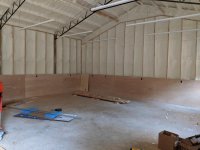
In the meantime I've started installing plywood on the interior walls. This was another subject (after the lighting was decided) that I went back and forth a lot on in regards to exactly what I wanted to use. I knew dyrwall would be too damage prone and tough for me to install (I don't know a thing about drywall mud), OSB would be cheap but I may want to paint at some point, and I read that'll absorb paint like it's going out of style, so plywood was decided upon. Next - what thickness? I did a bunch of reading and 7/16" seemed to be mentioned a lot so I started pricing that out at the local big-box store and....what do you know...they don't carry 7/16. I could get as much 13/, 15/, or 19/32" as I could stand though. So....19/32" it was. Or so I thought.

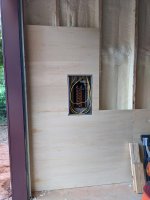
Back at the barn and talking to the electrician, I learned all the electrical boxes were mounted with a 3/8" standoff. Sooo......3/8" ply it was going to be. No big deal as it's still thick enough to be stiff with the 24" OC studs, plus it's cheaper, so I'll chalk it as an inconsequential win. However....naturally the big box store was out of 3/8" sanded ply, but they did have "Lauan" ply in the right thickness. It was a couple dollars more per sheet than sanded ply, but I was in a pinch, they didn't have an estimate on when more wood would be in, and I had to get something. Since I'm "plying" in sections as the budget allows I picked up enough to get around the building once so it's in place for the outlets and switches to get finished up.

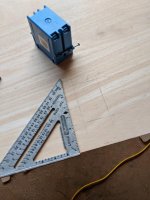
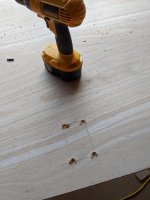
Speaking of outlets and switches - I'm sure there's a better/faster/smarter way to measure and cut the openings out of the wall material, but my method has been to lay the sheet up against the wall, trace around the outlet box, use a drill to open up each corner, and then a jigsaw to cut it out. I'm taking advantage of a new Bosch 6.5a jigsaw I bought - my old Skil Jigsaw blade collet had cracked and, while it held a blade well enough for small jobs, I knew I'd be overtasking it with all this cutting.

One of the major headaches I've run into happens to be the stud spacing in the corners of the building; the first stud from each corner is only 18" OC, and then they're 24" OC after that; as a result I am having to cut sections of ply at some odd lengths to make them fit. Plan "A" was simply to cut an 18" panel for each corner and then run 8' panels from there; it works well enough, but I've also tried in a couple places using a 66" piece to run from a corner to a couple studs down the wall. I don't know which method I like better, but used them interchangeably. I also discovered my table saw was on it's last legs, when it started bogging down trying to cut the plywood for some of these sections. I've had my eye on a new one anyhow (I can't find dado blades or a throat plate for it, it's a pretty old Craftsman model), but didn't think I'd be having to write THAT check this soon too. And of course...the one I want is out of stock everywhere locally, so my cuts have been happening with a skillsaw and the jigsaw. But you can probably tell by looking at some of the joints. Damnit.

So...that's where we stand at the moment.

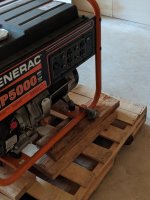
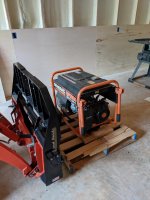
Also, note my palletized generator! Makes it very easy to move around with the tractor. It would be even easier to move around on the wheels, had I not busted one of them getting it out of the shed, but it is what it is.....
 

Attachments

  • 83.jpg
    83.jpg
    86.8 KB · Views: 105
  • 82.jpg
    82.jpg
    126.4 KB · Views: 116
  • 81.jpg
    81.jpg
    97.4 KB · Views: 124
  • 80.jpg
    80.jpg
    147.3 KB · Views: 120
  • 79.jpg
    79.jpg
    87.7 KB · Views: 131
  • 78.jpg
    78.jpg
    150.5 KB · Views: 130
  • 77.jpg
    77.jpg
    145.4 KB · Views: 117
Last edited:
OP
R

rok_hunter

Well-known member
Joined
Apr 10, 2020
Messages
153
Location
home
More photos, associated with my last post.
 

Attachments

  • 90.jpg
    90.jpg
    87.3 KB · Views: 94
  • 89.jpg
    89.jpg
    89.5 KB · Views: 107
  • 88.jpg
    88.jpg
    120.4 KB · Views: 113
  • 87.jpg
    87.jpg
    147.5 KB · Views: 113
  • 86.jpg
    86.jpg
    83.6 KB · Views: 109
  • 85.jpg
    85.jpg
    113.3 KB · Views: 108
  • 84.jpg
    84.jpg
    116.9 KB · Views: 100

Sladeharrison

Member
Joined
Jun 8, 2020
Messages
17
Location
Baker, FL
Looking Good! When I start on mine I'm probably going to PM you to get your electrical and spray foam guy. How high are you going with the plywood?
 
OP
R

rok_hunter

Well-known member
Joined
Apr 10, 2020
Messages
153
Location
home
Looking Good! When I start on mine I'm probably going to PM you to get your electrical and spray foam guy. How high are you going with the plywood?
Sure thing! Be happy to share contact info for both. Plywood plan is to go to 12' so it mates up to the horizontal 2x6 on top of the wall. The idea is that dust & debris won't be able to get into the wall spaces behind the plywood. The challenge will be in fitting/slotting the plywood around the truss supports, they come down about 10-11 inches from the 12' roofline on each 6x6 post.
I've been measuring/cutting for all the outlets, the door, etc. so I imagine it'll be the same process for the truss supports.

Sent from my Pixel 2 XL using Tapatalk
 
OP
R

rok_hunter

Well-known member
Joined
Apr 10, 2020
Messages
153
Location
home
I can't tell you how excited I am to say that electrical is complete, I now have lighting - and plugs - and (most critically in Florida) - AIR CONDITIONING!

Alright. So, I've mentioned in the past that outfitting the interior walls with plywood sheeting was going to be a phased project, and that hasn't changed. However I was able to get one particular spot finished up to what it'll all ultimately look like, so I could hang the mini-split air handler there.

I've also mentioned that I bought a DIY mini-split and, while it was DIY, the instructions pretty much sucked. The manual started with operation - then went to exterior unit installation - then went to interior unit installation - then had a section about prepping the hoses, that should have been done before either interior or exterior unit was installed but also left you with the physical impossibility of threading 25' of tubing through a hole, oh by the way don't bend it more than three times, and also don't unroll more than you actually need from the coil, and hey! your manual has a paragraph about connections labelled A, B, C and D that are no longer labelled, but you won't know that until you're comparing your manual to the one that's online, and by the way there are NO instructions for getting the interior unit back off the bracket to reposition things but it's easy because it's just a couple plastic tabs that need pressed, although they're nearly impossible to reach with any tool known to man once the unit is hanging......ok. Getting myself a bit spun up there. Suffice to say it's not difficult to do, at all, AFTER you've done your first one. Also when they say "do it yourself", it doesn't really mean ALL by yourself, because at least with the 36k unit, stuff is just large and awkward. Next time, I think I'll try to bait a friend with some beer. The assistance would have been glorious.

On to the install: The instructions included a cardboard template for the interior unit wall mount that I dutifully positioned and marked my wall attach points with, as well as the 3.5" hole for all the hoses and power lead to run. The scriptures give two different mounting heights, one for ceilings less than 9', the other for ceilings greater than 9'; mine is the latter so the base of the air handler needed to be at least 90.5" above the floor. I wanted to have the air handler centered on the back 40' wall, but that would have put the 3.5" hole straight through one of the 6x6 poles and I didn't want to play that game, so I shifted it slightly to the right for clearance. I marked my stud locations as the plywood was going up so I knew where the 2x6's were, and mounted the interior wall plate per the instructions. The 3.5" hole is supposed to slope "slightly" downhill from interior to exterior - 0.2", by the book - I got a little zealous and think I had a good 1" downhill slope. Not a super big deal, except the plastic protective tube they give you to slip through the hole protrudes about 3/8" on the bottom instead of sitting reasonably flush. Also, I've got 6" thick walls with 3/8 ply on the inside and about 1" ribs on the outside, so my standard size dewalt cordless drill juuuuust barely got the top edge of the hole saw blade through the exterior steel. Like anything else in life, just a couple inches longer would have made a helluva difference. Walking around outside to finish the drilling/hole cut, I find that I could not have nailed dead-center on one of the ribs any better if I had measured it out and tried! (Moral here - before settling on where to install the bracket, measure things out on the interior and exterior. Make sure your 3.5" hole will come out where you want on the outside, like somewhere in the 7" of FLAT sheetmetal, not anywhere on the 1.5" of ribbed sheet metal). I knew this would complicate installing the exterior trim piece for the plastic protective tube mentioned earlier, and my plan to install a cover over the exterior piping.

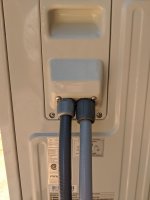
From there it was a matter of slipping that plastic protective tube through the hole, bending the refrigerant tubing on the back of the air handler out, and feeding the tubing/power lead/condensation tube through the 3.5" hole. Thence began the first of four install/removal processes for the air handler. Suffice to say: when you do it, make sure to get a roll of the protective wrap - it's not tape, like I thought it was - and wrap the tubing, drain hose and power chord before slipping them through the hole. Make sure you do it in the proper orientation with the drain tube on the bottom of the bundle as it's installed. I had the air handler on it's side for this part so the drain tube was actually on the right side as I wrapped it, but it's on the bottom when the unit is raised and rotated into position. Once the interior unit is mounted head outside and carefully bend the piping down, being careful not to kink it. Take some time to plan out how you want the rest of the refrigerant lines to run; they're a fixed length on the DIY kit (25' in my case), so I unrolled only as much as necessary to get from the interior unit lines we just bent, to the outside unit. Connect the lines to the interior unit lines hand-tight, then tighten using a double-wrench method. The kit comes with an adhesive-backed rubber material they call "sound deadening material" that gets wrapped around these connections after you've checked them for leaks, and then you're somehow supposed to be able to wrap all THAT with another piece of included foam insulation. Riiiight. Still haven't cracked that nut, and it's on my to-do list. Continuing, you've got to maneuver the remainder of this 25' roll of insulated tubing behind the exterior unit and bend the other ends of the piping (from the middle of the roll) in a fashion to connect to the exterior unit fittings without undue strain on the whole assembly. Let's just say this wasn't a PG-rated period of time. Once connected the exterior unit has a couple valves to open with an (included) allen wrench, and ta-da! Your HVAC lines are connected. Leak check again, then take that roll of protective-not-tape material and begin trying to wrap the whole 25' of tubing, and power lead, and drain hose, some of which is probably still coiled up nicely and tucked away behind the exterior unit. More creative language is helpful here and, if you find yourself coming up short with words, slice open the back of your hand on the sheet metal flange of your building so you can decorate portions of the wall/tubing/protective-not-tape material with blood. That part is also not in the instructions but I found it helpful. This is also about when I discovered my printed manual DOES update itself, because there was now a step to install a drain fitting on the bottom of the outdoor unit before you mount it to a pad. That step was not there in any of the seventeen previous times I read the manual, and I'm certain of it.

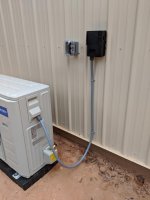
Up next is the electrical connection. My electrician installed an isolation box so it was a simple matter of pulling the power block from that to make sure I didn't electrocute myself. The electrical hookup itself was easy; remove the outside unit power panel cover plate, connect the labeled power leads to the designated spots, and put the cover back on. Since I'm always willing to complicate a simple step I bought a 1/2" screw-in conduit connector fitting and associated length of conduit to protect my power lead, mainly because it's what my electrician used to bring the 220v power to the unit and I figured things should match. Fortunately with the two conduit connector fittings installed, the cover plate needed a slight bit of grinding to fit over them; a simple task for a dremel and grinding wheel right up until the grinding stone came off the mandrel. Insert more language. I was lucky in that juuuuust enough material had been removed by then that the cover plate fit nicely back into place. From there the disconnect unit power block was re-installed and the unit was offically installed.

Next was a trip back inside the building and a quick mash on the indoor unit remote control power button...with no results. Trudge over to the circuit breaker panel and turn on the breaker, push power button again - nothing. Shake your head and mutter obscenities while installing batteries in the remote, then try again. At this point you're rewarded with the glow of the set temperature on the indoor unit, and the refreshing flow of air! The manual calls for some checks to make sure the heating & cooling functions work as they should, which only took a few minutes. Since then I've left the unit at 78°, aside from a short period I was in there working and I set it to 72°. It seems to be doing a fine job so far of regulating temperature in the building, and it's refreshing to walk in to a cool, low-humidity environment after being outside for any length of time. I haven't played with any of the other settings like 'fan only' or 'dehumidify' yet but it does a great job of pulling moisture out of the air, as evidenced by the near constant flow of water out of the drain tube when I first turned it on. Now that the building is reasonably air-conditioned the drainage has slowed to a dribble, but it ramps back up if I have the garage door open for any length of time.

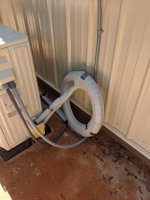
Back to what I mentioned earlier about covering the exposed outside lines; I bought a kit that is supposed to enclose the vertical portion of the lines from where they come out of the 3.5" wall hole, down to wherever you choose. If you're going to use one of these, make sure you install the top piece against your wall before threading the piping and power leads through. I didn't, effectively making the kit impossible to install. Also, I have no earthly idea HOW they expect the piping to be bent at a sharp enough angle coming out of the wall, to fit within the confines of the top piece of the cover kit. If you have a tubing bender I think you can make it happen. If all you've got are a couple of mark-1 mod-0 hands, I don't think it's possible without kinking the tubes. Additionally the concealment kit is just barely large enough to enclose the insulated pipes, power lead and drain line - there's no way it'll physically fit over the connections between the indoor unit and outdoor lines, especially after you add the sound-deadening material and then any kind of insulation over that. And, oh by the way, remember when I said all this is directly on top of one of the ribs on my sheetmetal? Yeah - that kit was about a $40 loss for me. I'm sure I'll find something somewhere in the barn that needs a fancy cover system and it'll come in handy for that! In the meantime I'm thinking about some 4" PVC, cut in half, with a 90° elbow at the top, and somehow siliconed/flex-sealed/JB-welded/clamped to the wall. More to come on that....I haven't quite figured out my solution yet.
 

Attachments

  • 97.jpg
    97.jpg
    89.9 KB · Views: 93
  • 96.jpg
    96.jpg
    104.8 KB · Views: 100
  • 94.jpg
    94.jpg
    61.3 KB · Views: 108
  • 93.jpg
    93.jpg
    128.5 KB · Views: 98
  • 92.jpg
    92.jpg
    93.5 KB · Views: 96
  • 91.jpg
    91.jpg
    146.8 KB · Views: 104
OP
R

rok_hunter

Well-known member
Joined
Apr 10, 2020
Messages
153
Location
home
Here's some more photos of the hoses and such. You can see the bend coming out of the wall, the awkward installation of the flange around the protective sleeve that I've flex-sealed in place (and need to go back with more, or silicone, to fully seal/waterproof), the bulbous fittings around the interior unit lines and outside line units, the coiled-up extra lines, the protective-not-tape-wrap (that I ran out of and need to find more to finish), and the electrical conduit connections.
 

Attachments

  • 107.jpg
    107.jpg
    49.8 KB · Views: 80
  • 106.jpg
    106.jpg
    114 KB · Views: 86
  • 105.jpg
    105.jpg
    93 KB · Views: 95
  • 104.jpg
    104.jpg
    54.6 KB · Views: 84
  • 103.jpg
    103.jpg
    45.9 KB · Views: 87
  • 102.jpg
    102.jpg
    49.4 KB · Views: 96
OP
R

rok_hunter

Well-known member
Joined
Apr 10, 2020
Messages
153
Location
home
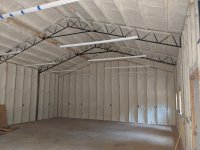
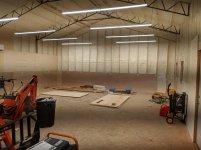
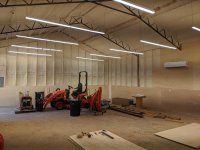
Lighting was one of my biggest stressors, and something a couple folks here have asked about. This photo doesn't do it justice - the banding/shading is from my camera and is NOT visible in the building! (I remember seeing something about this and how to fix it in another lighting thread, but that nugget has since departed the building.) I've got the 12 8' LED strips, hung at 12', and consider the lighting to be great. Walking in from outside when it's dark, and it's stunning. During the day it still brightly illuminates the interior and everything seems very evenly illuminated. Got to say I'm quite pleased with the inside. Also - fun fact: When you've got lights hung at 12', it IS in fact possible to hit them with a 16' 2x6 if you're not paying attention while moving said 2x6 around. Consider this a public service announcement.

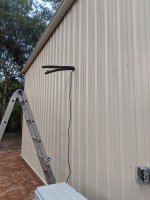
The outside light, I expected to be a bit brighter, but it's still adequate. It was a $40-something motion-sensing LED unit from the big-box store and does just fine to illuminate the area in front of the barn. It's also not so obnoxiously bright that it bothers us from the house, because the bedroom windows face this general direction and I didn't want it to be overwhelming from there so it's a 100% win in that regard. Also - those wall surfaces on the right - don't they look absolutely horrid!?!? That's all shadows and shading from the camera - you can't see it in person.

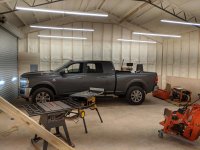
Finally, I based the depth of this barn (30') off of the length of my truck, so I could pull it in, pop the hood, and have room to work. I've since replaced that truck with one a solid foot and a half longer and, I'm happy to say, it still fits just like I wanted! Granted it's backed-in at the moment, but the dimensions are just right for me. Don't mind the two table saws - that craftsman unit died on me and has been repurposed as a mobile work station. The dewalt jobsite saw behind it blows me away with it's capability - plus it folds right up and takes up about as much space as a suitcase!
 

Attachments

  • 98.jpg
    98.jpg
    147.2 KB · Views: 167
  • 99.jpg
    99.jpg
    139.2 KB · Views: 172
  • 100.jpg
    100.jpg
    118.1 KB · Views: 159
  • 101.jpg
    101.jpg
    149.4 KB · Views: 177
Last edited:
OP
R

rok_hunter

Well-known member
Joined
Apr 10, 2020
Messages
153
Location
home
How high are you going with the plywood?

Also, update on the plywood - you can see in one of the posts where I have a spot covered up to the 12' mark. I had to slot the plywood for the truss as mentioned in my last post, and in fact had to take about 1.5" off the width of the top plywood sheet so it didn't extend past the 12' mark. I didn't want to create a pocket up at the top of the roofline to collect dust, debris, etc.
 
To avoid these ads, REGISTER NOW!

Sladeharrison

Member
Joined
Jun 8, 2020
Messages
17
Location
Baker, FL
Also, update on the plywood - you can see in one of the posts where I have a spot covered up to the 12' mark. I had to slot the plywood for the truss as mentioned in my last post, and in fact had to take about 1.5" off the width of the top plywood sheet so it didn't extend past the 12' mark. I didn't want to create a pocket up at the top of the roofline to collect dust, debris, etc.

Looks really good!

Have you tested that mini-split out yet? Just wondering if that one unit will cool off all that space a considerable amount.
 
OP
R

rok_hunter

Well-known member
Joined
Apr 10, 2020
Messages
153
Location
home
Looks really good!

Have you tested that mini-split out yet? Just wondering if that one unit will cool off all that space a considerable amount.

It's running as we speak! While I don't think it can keep up if I left the garage door open while I'm just in there tinkering, it's doing really well at keeping the space cool and has handled the door being opened & closed to get the tractor/truck in and out. When I walk in the temperature is very comfortable (it's set at 78°) and as long as I'm not in there doing calisthenics, it seems to keep up just fine. I know that last week when I was in there doing simple tasks I was soaked in sweat and stopping to stand in front of the fan every few minutes, and this week that wasn't necessary at all!
 

Sladeharrison

Member
Joined
Jun 8, 2020
Messages
17
Location
Baker, FL
It's running as we speak! While I don't think it can keep up if I left the garage door open while I'm just in there tinkering, it's doing really well at keeping the space cool and has handled the door being opened & closed to get the tractor/truck in and out. When I walk in the temperature is very comfortable (it's set at 78°) and as long as I'm not in there doing calisthenics, it seems to keep up just fine. I know that last week when I was in there doing simple tasks I was soaked in sweat and stopping to stand in front of the fan every few minutes, and this week that wasn't necessary at all!

That's awesome. I'll be storing a car in mine as well as having space for wood working and was debating on just installing an exhaust fan to run during the day (during summer) or a mini split.
 
OP
R

rok_hunter

Well-known member
Joined
Apr 10, 2020
Messages
153
Location
home
That's awesome. I'll be storing a car in mine as well as having space for wood working and was debating on just installing an exhaust fan to run during the day (during summer) or a mini split.

The exhaust fan would certainly be cheaper but won't do anything for the humidity, if that's a concern for you. If you go with light enough colors (for reflectivity, Baker Metal Works has a list of the reflectivity values for each of their colors) and decent insulation, and keep the doors closed, it'll probably stay at a reasonable temp. This one wasn't bad once the insulation was complete and I kept the doors shut. It did very well at retaining the last temperature it was exposed to; i.e. if I opened it up in the evening, the next afternoon it was still reasonably cool inside, vs. if it was open in the afternoon, going back in the next morning it was still hot as blazes. A friend of mine has a similar size building with a loft apartment on top and did not insulate the barn portion, although his metal is mounted to OSB so he's got a tiny bit of protection there, and the barn portion has never been unbearable as long as the doors are open and fans running.

The best part about the mini-split is it's a fairly easy after-the-fact addition, as long as the power us run before any insulation goes in. And now that I've got one install under my belt if you do go that route, I can swing by and offer armature advice!
 
OP
R

rok_hunter

Well-known member
Joined
Apr 10, 2020
Messages
153
Location
home
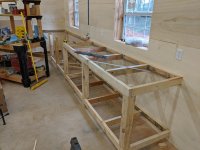
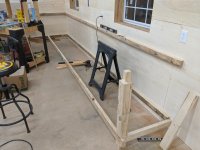
Greetings to anyone still hanging around this thread! Things have been happening over the past couple months, but I've still managed a few little things around the barn that I thought I'd share. Up first is my bench build; 16' down one wall to an 8' bench on the other in what you can call a classic "L" shape. I've since dumped the actual numbers for height and depth - I want to say 31" high and 28" deep but will have to go get the actual measurements if anyone is interested.

The build consists of 4x4 legs along the front with 2x4 structure in between, leftover (from the barn build) 2x6 wall mounts, covered with 3/4" sanded plywood. I had a really nice set of plans drawn out with measurements and all but, in a fit of organization, thought "eh - won't be needing this anymore!" and chucked them. I'll probably end up drawing up another set off of the measurements in place so I've got a design for the next one since there were minor changes, but that'll be another day. If anyone is interested in specifics I'll get those for you...and that may help spur me into action on the re-draw too.

So anyway! Bench build started with three 2x6x8 boards, ripped in half lengthwise, screwed into the studs with 3" self-tapping construction screws, 3/4" below my total bench height. There's a matching set down lower to give a shelf approximately 6" off the floor. The main intent was to reduce cost, the side benefit was a perfectly flat surface for the plywood to rest on.
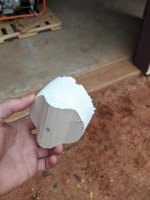
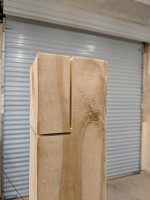
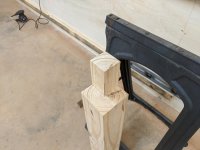
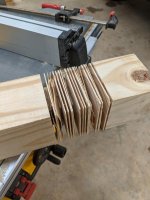
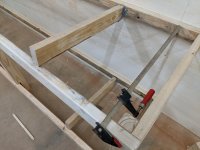
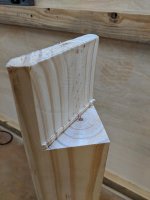
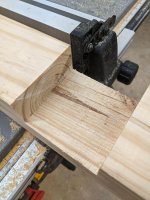
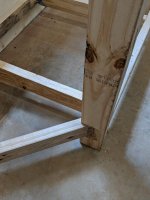
From there was a fairly tedious process of marking and cutting 4x4 posts for the legs. Since the floor isn't perfectly level this involved repeatedly setting, clamping, levelling, marking, butting, checking, trimming, and fitting. I started with a single post at the far right side of the bench and built the rest from that. The second picture shows the poor-man's dado blade, notching the cutouts on 3/16" intervals with the table saw. Photo 3 shows the exact same area after breaking the remaining "slices" out by hand and running a simple wood chisel over the surface to smooth it out. This example is actually the bottom shelf mount for the corner post; photo 4 is the same post with the top cut out. The top was easier, but still a challenge - I needed a 3.5" notch to fit the 2x4 boards, and naturally my tablesaw blade would only cut to about 3 3/8". It got close enough that I could knock the block out with a hammer and, again with the trusty chisel, take the remaining lip of material off with nothing more than hand pressure.
 

Attachments

  • 4.5.jpg
    4.5.jpg
    65.7 KB · Views: 79
  • 4.jpg
    4.jpg
    106.1 KB · Views: 82
  • 3.jpg
    3.jpg
    74.7 KB · Views: 81
  • 2.jpg
    2.jpg
    85.1 KB · Views: 92
  • 1.jpg
    1.jpg
    147.7 KB · Views: 88
OP
R

rok_hunter

Well-known member
Joined
Apr 10, 2020
Messages
153
Location
home
In continuum:

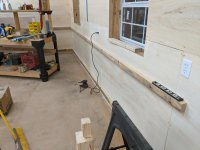
Here we see the corner post and the bottom shelf brace boards mounted. I've braced the boards to "level" so I can mark subsequent 4x4 posts. Photos 6 and 7 show the poor-man dado at work again, this time showing the notch after I broke the cutouts off by hand, before & after hitting it with the chisel. Yeah...continuity of explanation should have had these in the previous post, but you get what you pay for around here. Photo 8 shows how I cut the "corner" post between the 16' and 8' sections. There was a lot of swearing involved here.

Looking at a friends bench I saw he used 2x4 brackets to hang the mid-bench support beams, which seemed way smarter than the way I was gonna do it. Imitation is the best form of flattery, I guess. Again a fair amount of measuring, sawing, trimming and fitting was involved to account for slight variations in the 'plumb' of the wall.
 

Attachments

  • 12.jpg
    12.jpg
    148.7 KB · Views: 116
  • 11.jpg
    11.jpg
    99.2 KB · Views: 112
  • 10.jpg
    10.jpg
    147.2 KB · Views: 98
  • 8.jpg
    8.jpg
    61.5 KB · Views: 98
  • 7.jpg
    7.jpg
    106.1 KB · Views: 99
  • 6.jpg
    6.jpg
    100.8 KB · Views: 104
  • 5.jpg
    5.jpg
    148 KB · Views: 114

Jayman17

Well-known member
Joined
Feb 6, 2017
Messages
3,793
Location
Seattle, Wa
That is going to be a lot of bench space. Hopefully you don't suffer from FSD because that will be tempting. :lol:
Looking good!

Jay
 
OP
R

rok_hunter

Well-known member
Joined
Apr 10, 2020
Messages
153
Location
home
That is going to be a lot of bench space. Hopefully you don't suffer from FSD because that will be tempting. :lol:
Looking good!

Jay

Yeah....I've already got most of it full of projects in various stages, and am planning my roll-around 3.5x8 workbench that I'll also have. Can't ever have too much workspace - especially as it starts getting filled up, ya just gotta make more! LOL.

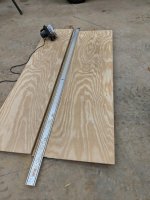
Ok, few more photos of the build. I planned for a nice 45° joint in the corner of the 8' and 16' sections and built the bracing underneath to accommodate that. As I got to that point I started realizing I don't have a good way to cut 45° lines on the ply to the tolerance my ****-retentiveness requires....so straight edge it became! As far as ripping the plywood for the workbench and shelf surfaces, a 100" clamp-on guide from Bora did the trick for my skillsaw. I wish I had that thing back when I was making all these long cuts on the wall sheathing plywood....

In the final picture you can see the bench and shelf material as installed! You may notice the shelf stops short on the left corner. I've got a couple of heavy-duty slide rails bought for another project that never came to fruition, so the plan was to throw those in and have a shelf that I could pull out for easier access. Turns out I built a bench/shelf about 28" (or was it 31"??)...and the slide rails are 38". Yeah, it's a bit of an oversight. So, now I've got a convenient cutout to sit at when I hop on my chair!
 

Attachments

  • 13.jpg
    13.jpg
    81.6 KB · Views: 80
  • 14.jpg
    14.jpg
    84.4 KB · Views: 75
  • 15.jpg
    15.jpg
    89.1 KB · Views: 80
  • 16.jpg
    16.jpg
    99.1 KB · Views: 71
  • 17.jpg
    17.jpg
    149.3 KB · Views: 98

karoc

Well-known member
Joined
Dec 19, 2017
Messages
1,988
Location
Hemphill Tx
I have gone through and read your post twice and enjoyed it both times,it is well written and good details for someone like myself is going to try DIY project like this. One of the things that caught my interest is your in Florida which ya'll get hit with hurricanes,so do we so I read with lots of interest way your shop built. Like the way you did your walls which add lot of strength and help keeps the building from racking during high winds. My build won't be an engineered build but I will borrow some of the methods use in your build.Thanks for posting,that is a fantastic shop and love color.
One question,would you know the screw spacing for roof and siding? With a good wind load like what you have wondering if spacing is different.
 
Last edited:
OP
R

rok_hunter

Well-known member
Joined
Apr 10, 2020
Messages
153
Location
home
I have gone through and read your post twice and enjoyed it both times,it is well written and good details for someone like myself is going to try DIY project like this. One of the things that caught my interest is your in Florida which ya'll get hit with hurricanes,so do we so I read with lots of interest way your shop built. Like the way you did your walls which add lot of strength and help keeps the building from racking during high winds. My build won't be an engineered build but I will borrow some of the methods use in your build.Thanks for posting,that is a fantastic shop and love color.
One question,would you know the screw spacing for roof and siding? With a good wind load like what you have wondering if spacing is different.

Thanks karoc, I appreciate that. In the interest of full disclosure I actually had a job as an author for a few years (writing technical publications/flight manuals for a major domestic aircraft manufacturer) and read a lot so, between those, I can sit down and write a reasonably coherent paragraph - ask me to break down a sentence and find a preposition or anything like that though and I'll just shrug helplessly :willy_nil .

Most of the hurricane prep is going to come from the structure, I think. The plans for my building had to go through an engineering review for hurricane code, and it's rated to 108 mph continuous and 140 mph at a 3-second gust. My understanding is most of that strength comes from the 2x6's on 24" centers around the building, and the anchor bolts that were put into the foundation to hold the walls in place (you can see them in the photos on page 1, post #4).

I can't share the plans outright because of the engineering and builder's copyright claims, but attached is a snapshot of the data the structure is designed to withstand. My build has 29 GA steel, which is the thinner (and less expensive) of the two options I had. The spray foam guy claimed installation of closed-cell foam actually further strengthens the structure, which makes sense on the surface, but I don't know the actual engineering that goes into *that* side of it.

As far as screw spacing, all the wall screws are vertically centered on the horizontal 2x6 girts (does that even make sense?) and on about 10"-12" spacing horizontally. The third photo on page 1, post 18, shows a good example. The roof is similar with screws spaced about 10"-12" on each of the lengthwise-running 2x6's connecting the trusses. You can somewhat see those screws on photo 6 of the same page/post mentioned above.

Speaking of hurricanes, we're currently staring down "sally" just off the coast. Landfall looks like it'll happen west of us so we should just be getting a lot of rain but, if there's a dramatic shift our direction, once power & internet are back on I'll make sure to share how the building held up! :rocker:
 

Attachments

  • Engineering Data.jpg
    Engineering Data.jpg
    20 KB · Views: 51
OP
R

rok_hunter

Well-known member
Joined
Apr 10, 2020
Messages
153
Location
home
Exactly.

Oddly, the 3dvisualizer keeps telling me I need 15 of them for the same size building. Looks like they are about $100 each. Have you installed your yet?

Reviewing my thread and I came across your question about the installed lights - sorry I haven't replied sooner. Sorry again if I DID already reply and missed it :dunno:

My lights are installed, and the only variance between the final setup and my electrical plan back on pg 1 was that I have them on two switches instead of three - one on the front row (door/workbench wall) and one for the back row. Illumination is plenty bright, I have not had any problems or wishes for more/brighter lighting yet. I've kept myself busy mostly with woodworking, some RC airplane work, and general maintenance on my small tractor and the overhead lights have met every need so far. The pictures I posted in post #54 with the lights on really don't do it justice for how well they light things up. The posts dealing with my workbench build, starting around #60, give you a good idea of the illumination - those were done with the lights on, mostly at night, and no flash on the camera.
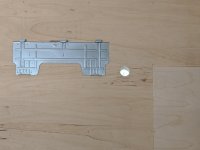
I can firmly say that at least in a 30x40, with a 12' hanging height, and spray foam/light colored plywood walls, two rows of 6 of the Lithonia lights I used are more than adequate.
 

Irbowhntr

Member
Joined
Mar 19, 2018
Messages
13
LOOKS GREAT interested to see how your mini split handle the heat load down there. I am in GA and will be adding a/c to my 30 x 50 12 ft high garage pretty much same build as yours spray foam and board over for walls.. I have a 11 x 30 room on back and the rest is open. I am wondering if I should get a 2 zone split or 2 seperate units 9kbtu for room and 18k for the open space. I just feel like the open space will need more than 18 k
 
OP
R

rok_hunter

Well-known member
Joined
Apr 10, 2020
Messages
153
Location
home
I've got to say, the mini split has handled this year just fine! I leave the building set at 75° when I'm gone and when I'm inside during the summer, take it to 72°. As long as I'm not standing by my roll-up door (it's uninsulated) or leaving the door open it stays nice and comfortable. Right now, the same 75° setting when it's FL panhandle cold also keeps it perfectly comfortable. Briefly opening & closing the big door to get equipment in & out results in temp changes inside of course, but it corrects back within minutes. I've never actually measured Temps inside the building though, just going off of the "it feels great in here!" scale.

You're 100% going to want more than a combined 27k though for your size, and I'd offer two units would provide more even temperature control. Although if you have any kind of whole-building air circulation - I'm wanting to add a WEN or Jet air filter system, for example, to help keep dust manageable - one larger unit would work. Even with the foam insulation I don't think I'd go less than the 36k my MrCool unit offers in my building.

Sent from my Pixel 2 XL using Tapatalk
 
To avoid these ads, REGISTER NOW!
Top Bottom