To avoid these ads, REGISTER NOW!

Building an overhead crane

ekimneirbo

Well-known member
Joined
Nov 21, 2018
Messages
132
Location
Kentucky
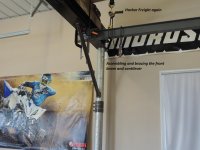
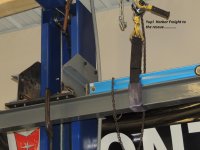
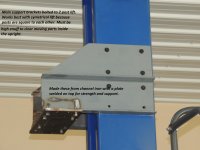
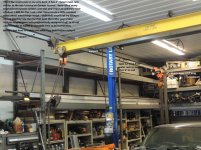
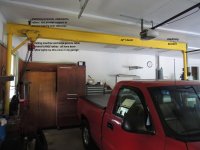
Posted this on the HAMB and someone suggested that I should also put it on the Garage Journal. I have two scratchbuilt overhead cranes in my shop. My son recently purchased a home that had a nice shop building along with a couple other out buildings that we want to make into work shops. The main building is 40x50 with 12 1/2' ceilings. It already had a two post lift in it, so we decided that we could use that as the main support for a scratch built overhead crane. The symetrical lift works well for what we wanted to do as the uprights are square to each other. You have to make brackets that can be bolted or welded to them. If bolting them in place, you have to be sure the to mount the bracket bolts higher than the moving parts inside the uprights. You also have to use plenty of top quality bolts....no grade five ****. Anyway, I had some steel that I scrounged, saved, bought at auction, etc. I did have to buy the 4" main rails new About $250 for a 40' length. Cut it in half for two 20' lengths. Crossbeams should be 6" or more. I took a couple of short I-beam lengths and made brackets to hold 2 Harbor Freight trolleys on each rail. That allows the crossbeam to rolll smoothly without cocking and gives more strength at each end of the crossbeam. You never want to lift more than what one side of the crossbeam can handle. Anyway, here are some pictures of how we built our crane. If you get ideas from this, you do so at your own risk, as we are not engineers. I have been using my lifts for 20+ years, so overbuild if there is any doubt. Even a single beam on a couple of supporting poles is a big asset.:)
 

Attachments

  • Matts Ctane 2.jpg
    Matts Ctane 2.jpg
    154.4 KB · Views: 662
  • Crane 6a.jpg
    Crane 6a.jpg
    128.6 KB · Views: 498
  • Crane 5a.jpg
    Crane 5a.jpg
    117.6 KB · Views: 493
  • Crane 4a.jpg
    Crane 4a.jpg
    104.3 KB · Views: 512
  • Crane 3a.jpg
    Crane 3a.jpg
    126.6 KB · Views: 527
  • Crane 2s.jpg
    Crane 2s.jpg
    139.9 KB · Views: 554
  • Crane 1a.jpg
    Crane 1a.jpg
    148.7 KB · Views: 548
To avoid these ads, REGISTER NOW!

ConCretin

Well-known member
Joined
Jan 20, 2011
Messages
3,379
Location
Central Maine
Welcome to the GJ and thanks for posting. Don't be shocked if you get a few posts questioning your engineering especially as it relates to the lift but it looks pretty well thought out to me. I'm curious about the intended uses and how you envision hoisted items will be moved about.
 

bczygan

Well-known member
Joined
Nov 4, 2009
Messages
22,002
Location
DETROIT! Arsenal of Scrappers
I've designed overhead cranes for GM.

Always thought it would be a great thing to have in a home shop.

Bought one at a garage sale for $50 once. Sold it on the spot for $500.

My dream would be one that covered the entire shop space.

Bill
 
Last edited:

Falcon67

Well-known member
Joined
Jun 11, 2009
Messages
18,371
Location
Merkel, TX
Someone is going to tell you that you are going to die. One day you will but meanwhile enjoy the hoist rail as I do mine.

Haha, looks way better than the sketchy unit I used to walk an old 429 out of a barn. Just a big beam rolling on top of some rails.

429Barn1.jpg
 

HoosierBuddy

Well-known member
Joined
May 9, 2006
Messages
2,936
Location
Southern Indiana
Well, I guess I won't be the killjoy that tells you you're going to die while using that.

That being said...I do think it would make some sense to assign a load rating to it.

How you would do that at this point, other than loading it until it broke, then divide that load by 5 for a good safety margin...I'm not sure.

Also...I must point out that any of us that have hung a chain hoist off an I beam, truss, or tree branch, have essentially done what you did. We've created a lifting device with no plans that document the approved loading...or any guarantee that it will hold what it needs to hold.

Even with commercially purchased cranes with proper load identification, up to date inspections, etc., etc, the main thing is to make sure you never place yourself under the load. That would be true in your case as well.

Finally, I'm curious what you use this for? I have a chain hoist in my barn (on an i beam) that I used to use quite a bit...but after installing a lift in my garage and buying a decent rolling engine crane (hoist), I never use it. It's just not convenient. If this is about pulling engines...an engine hoist would be much less expensive, take up a heck of a lot less space, and is easier to use in my experience.

Phil
 
Last edited:

Ironcrow

Well-known member
Joined
Sep 30, 2005
Messages
1,169
Location
Arizona
I do think it would make some sense to assign a load rating to it.

How you would do that at this point, other than loading it until it broke, then divide that load by 5 for a good safety margin...I'm not sure.
Take some measurements, draw a diagram, calculate suspected deflection at a given load. Say it breaks at 6 tons, but has a deflection at the end of the beam of 1/4 inch at 1 ton or whatever. Confirm that result at 1 ton. Assign a working load at whatever safety factor you think is reasonable.

In my garage, I hung a 1/2 ton electric C&M hoist on a W16x50. Because I had the huge beam for free. Since the beam is probably good for 20 tons (I didn't even bother to calculate it)...if the hoist can lift it, I'm good.
 
Last edited:

cvairwerks

Well-known member
Joined
Aug 12, 2016
Messages
7,258
Location
Within hearing distance of Texas Motor Speedway
That guy was just plain stupid for what he did. Two completely different worlds.
Good job on the crane!

Pallet rack beams are not designed for point loading. The OP, shows in photo #4 that he's point loaded the beams....Beam capacities are rated as a uniformly distributed load over the length of the beams and symmetrically loaded between the pair....ie a 6K beam will support 6k lbs, uniformly spread down the length of the beam and symmetrically placed between the pair of beams.
 
Last edited:

Cryptic1911

Well-known member
Joined
May 24, 2008
Messages
2,884
Location
Willimantic, CT
very good point, but I think this one will be fine for typical garagestuff like engines and that sort of thing. The one you posted is definitely sketchy because they had no side to side rigidity which surely didn't help the cause.. that and the fact that they are trying to lift what looks horizontal mill which probably weighs 5000lbs.
 

matt_i

Well-known member
Joined
Mar 14, 2008
Messages
10,752
Location
SE Michigan
Looks good so far, having the lift to be a point of stability really helps. That will be very handy! You could even start splitting medium-sized tractors :)

If you put a nice lever hoist on the main bridge rail (thinking Coffing LSB) it might be more than adequate for doing things like pulling engines. Having the super-fine positioning of the lever makes up for its slow speed in gaining height. The downside of a chainfall hoist is that while its fast there's the endless chain that's clanking into and scratching everything in close proximity.
 

ericlar80

Well-known member
Joined
Nov 14, 2014
Messages
362
Location
California

I love the wives in the background looking at the destruction, wondering what happened. lol

Aside from lifting way too much weight, that thing was built with so many issues though. The side beams for pallet racking are not designed to resist high torque (open c-shaped post). The guy didn't connect the two legs and the legs are on casters (you can see the green post on the left is bent). It was a heavy point load at the center...
 

cvairwerks

Well-known member
Joined
Aug 12, 2016
Messages
7,258
Location
Within hearing distance of Texas Motor Speedway
I will never understand how people come up with ideas like that and not immediately realize that it isn't going to work. :headscrat

Tommy

Because most people won't look up how ratings are determined and understand that information. It's like the goobers that utilize certain items for hard installation in their shops and get offended when it's pointed out that the ratings they are basing the installation and usage on, are not for the type service they are using it in, and maybe they should actually read the specification for once.
 

BruceMc

Well-known member
Joined
Jan 17, 2015
Messages
2,171
Location
Fairbanks, AK
I will never understand how people come up with ideas like that and not immediately realize that it isn't going to work.

From the looks of it, I'd guess it dawned on them pretty quickly.

To the OP - I have pondered doing something similar along those lines, but with my 4-post lift.
 
To avoid these ads, REGISTER NOW!

66cj225

Well-known member
Joined
Nov 4, 2011
Messages
332
Location
NH
Pallet rack beams are not designed for point loading. The OP, shows in photo #4 that he's point loaded the beams....Beam capacities are rated as a uniformly distributed load over the length of the beams and symmetrically loaded between the pair....ie a 6K beam will support 6k lbs, uniformly spread down the length of the beam and symmetrically placed between the pair of beams.

So you're saying the gas in the airplanes tanks never slosh to the low side when banked? Pallet rack loadings are all over the place; could be an engine and transmission on the middle pallet with pallets of shop rags on either side.
My point is the rating is relative- 4k# rack is lighter than 6k# etc., either would be hard pressed to store industrial dies and molds. The uneven distribution would be covered by the safety factor. The first time a fork truck hits the beam everything changes anyway.
 

cvairwerks

Well-known member
Joined
Aug 12, 2016
Messages
7,258
Location
Within hearing distance of Texas Motor Speedway
So you're saying the gas in the airplanes tanks never slosh to the low side when banked? Pallet rack loadings are all over the place; could be an engine and transmission on the middle pallet with pallets of shop rags on either side.
My point is the rating is relative- 4k# rack is lighter than 6k# etc., either would be hard pressed to store industrial dies and molds. The uneven distribution would be covered by the safety factor. The first time a fork truck hits the beam everything changes anyway.

Haven't got a clue where you get that idea that I've made that kind of comment on fuel sloshing. Sloshing depends on how the tanks are built and what baffling and porting is in them. It's also going to depend heavily on roll, pitch and yaw rates and the exact fuel level at the instant you look at the slosh.
The aerobatic fighter I used to fly a bit had a limitation to no acro with any fuel in the tip tanks do to significantly varying structural loading of both the tank body and the main wing spar, due to sloshing. A couple of gallons left in a tip tank in certain 3+ G maneuvers was enough to induce enough damage in the wing structure to require it to be pulled and changed out.

The beam manufacturer specifies that the beam will support a certain weight, when the load is evenly distributed along the length of the beam and is symmetrically distributed between the beams.

Here's the limitation notes from one manufacturer:

All capacities are expressed in pounds per pair of beams. Only gravity loading and the RMI required impact have been considered.
All values are based on a uniformly distributed load (i.e. each beam carries 50% of the load) and assume proper installation and no beam damage.
The deflection limit for all beams is the length divided by 180.
Roll-formed beams that are longer than 150” require lateral ties.
Structural beams that are longer than 108″ can require lateral ties.
Values in the table are for the beam bending only.
Please consult Springfield , Engineering for any shelf load over 10,000 lbs.
Capacities include 12.5% impact for two pallets side by side. For a three-pallet-wide shelf, the values should be multiplied by 0.95. For one pallet per shelf, the values should be multiplied by 0.90.
Capacity chart is based on current RMI specifications.

I'm quite aware about die weights, as we used to have drop hammer and forging press dies that weighed up to 70,000 pounds at work.
 
OP
E

ekimneirbo

Well-known member
Joined
Nov 21, 2018
Messages
132
Location
Kentucky
Pallet rack beams are not designed for point loading. The OP, shows in photo #4 that he's point loaded the beams....Beam capacities are rated as a uniformly distributed load over the length of the beams and symmetrically loaded between the pair....ie a 6K beam will support 6k lbs, uniformly spread down the length of the beam and symmetrically placed between the pair of beams.
Sound like someone who has read a lot of engineering books but never actually worked in a warehouse. Since your avatar depicts an airplane, I'll point out that no matter how much calculation you do, things still have to be proven to work in the real world. Before Cessna debuted the recent "Skycatcher" it crashed twice because of miscalculation. Thats after a 100 years experience and a bunch of engineering. So the proof is always in the final testing anyway. The last few years before I retired I was a property manager for a government contractor. I'll guarantee you that plenty of things that are set on pallet racking by forklift drivers are not evenly distributed. Further, many of the items have small footprints that concentrate loads in spots along the beams.
No one even has a clue how much weight is on a rack and I guarantee you nothing ever gets weighed before being put on a rack. Such is life.......

In my case I have built several "home engineered" cranes to TLAR standards.
I have 3 cranes....no, make that 4 if you count the little one in the leanto.
First one is a simple 10" I beam built about 30 years ago. Its in my garage where I used it to load/unload several large lathes, a milling machine, a large granite inspection table and a multitude of other heavy items.

I have another heavy duty crane in my pole barn that I have lifted lots of very heavy items with. I have a 10 ft sheetmetal brake. I regularly lift complete chassis with engine/trans/rearend installed, and I can raise a complete chassis up and set it on my welding tables in about 5 minutes with no help. Probably the heaviest thing I ever lifted was a steel welding table I bought at a govt auction. One of those tables with a solid steel top and large pipe legs. They had a 3/8 top on it and then welded a 1/2 plate over that.
THEN they put a 3/4 steel top on that. It was appx 5' wide and 10' long. WHY ? I don't know....it was the government. I don't use the trolley beams with the really heavy stuff like that. I have just an I beam across the top of the main rails that I use when I have something really heavy to unload. I'm afraid the trolleys might break, not the beams.This lift has 10" main rails and two 8" trolley beams.

I also have another crane in the pole barn that is similar to the one I posted. It uses 4" main rails. I use an arbitrary 1,000 lb limit, but thats subjective cause I can't weigh things. The one I posted is actually supported better than this 4" one, and I have been using this one for about 15 years with no issues. All this being said, anyone who "engineers" a crane does so at their own risk. Always err on the side of "overbuilding" and always be careful about where you stand when using a crane. As for the comment about "point loading" the beams.....everything has to have a point of attachment. The points I chose are widely spaced and near the uprights which will impart the load much better than the one picture that showed someone with a single point of loading in the middle of a pallet rack beam. The uprights weren't supported by any other crossbeams or complimentary racking. And, he just flatly exceeded the ability of his equipment. My design would probably collapse too if it were trying to move that particular milling machine. I do have all the beams labeled with an arbitrary 1,000 lb stencil except for the very front 6" crossbeam mounted on two large poles. I put a 2,000 lb label on it. So I have confidence based on my experience with other cranes I built that it will easily meet the needs my son has in his shop. See attached pictures....but build at your own risk. As for me, I'm happy with what we have. Its for "light" 1,000 lb loads....not 10K or even 6K.

One more thing....my son has another building that we put up two 35' long 6" H beams. They are mounted atop four 4" diameter poles. We will tie the uprights at each end together with some x bracing to make it very stable. The poles are mounted in concrete and we are waiting to pour a floor that will help stabilize it. 35' is a long span even for a 6" beam....so we are going to make movable supports that can be slid along the beams and placed in positions to provide intermediary support when desired/needed. So anything really heavy will be unloaded in that building.
 

Attachments

  • DSCN1267.jpg
    DSCN1267.jpg
    158.2 KB · Views: 178
  • DSCN1268.jpg
    DSCN1268.jpg
    154.9 KB · Views: 176
  • DSCN1274.jpg
    DSCN1274.jpg
    132.5 KB · Views: 161
  • DSCN1273.jpg
    DSCN1273.jpg
    153.6 KB · Views: 160
  • DSCN1266.jpg
    DSCN1266.jpg
    148.8 KB · Views: 178
  • DSCN1263.jpg
    DSCN1263.jpg
    148.1 KB · Views: 171
  • DSCN1262.jpg
    DSCN1262.jpg
    120 KB · Views: 177
Last edited:

66cj225

Well-known member
Joined
Nov 4, 2011
Messages
332
Location
NH
Neat thread- never gave a thought to a top bracket on a lift- the op's looks well thought out. Falcon67 made me think a moment on what a 429 was and a little exploration of an aviator. Interesting group.
 
OP
E

ekimneirbo

Well-known member
Joined
Nov 21, 2018
Messages
132
Location
Kentucky
That being said...I do think it would make some sense to assign a load rating to it.

I have put 1,000 lbs as an arbitrary rating because I know that the components I used will all easily exceed that amount. I have stenciled "1000 max load" on each of the beams except for the 6" beam at the front of the crane. It sits on heavy duty posts and has a "2000 max load" stenciled on it.


How you would do that at this point, other than loading it until it broke, then divide that load by 5 for a good safety margin...I'm not sure.

Obviously homebuilders are not going to test to destruction....intentionally.
I'm pretty sure we won't approach the limits of the hoist or the racking.

Also...I must point out that any of us that have hung a chain hoist off an I beam, truss, or tree branch, have essentially done what you did. We've created a lifting device with no plans that document the approved loading...or any guarantee that it will hold what it needs to hold.

You are right that many of us older guys have used the crudest forms of support and survived for another day

Even with commercially purchased cranes with proper load identification, up to date inspections, etc., etc, the main thing is to make sure you never place yourself under the load. That would be true in your case as well.

Things being what they are in todays world, perceptions are everything.We will be very careful the first few times we lift loads, and look for any problems. After that its pretty much being tested every time we lift a load.Bring an engineer or an inspector in and they will want to insure they "cover their a**" and tell you every reason in the world why its wrong.
Counterproductive and expensive, so we'll just rely on using good old ingenuity and some common sense and hope for the best. As I mentioned earlier,I've built several homemade cranes and have had no problems with any of them. Maybe just lucky, but I love em. Use em constantly.
 

LS6 Tommy

Well-known member
Joined
Dec 27, 2013
Messages
26,162
Location
Northern NJ
Because most people won't look up how ratings are determined and understand that information. It's like the goobers that utilize certain items for hard installation in their shops and get offended when it's pointed out that the ratings they are basing the installation and usage on, are not for the type service they are using it in, and maybe they should actually read the specification for once.

I know why people do it, what I meant was how can anyone with a two digit IQ look at the fabricated crane, then look at the the size of the machine to be lifted and not say, "Yeah, that's not gonna work". :lol_hitti

Tommy
 

ATC

Well-known member
Joined
May 12, 2012
Messages
8,357
Location
VA
I'll guarantee you that plenty of things that are set on pallet racking by forklift drivers are not evenly distributed. Further, many of the items have small footprints that concentrate loads in spots along the beams.
No one even has a clue how much weight is on a rack and I guarantee you nothing ever gets weighed before being put on a rack. Such is life.......


After working in a warehouse for the past 13+ years, and as a forklift operator for 10 of those...I couldn't agree more.

Don't forget about the idiots that put a 2200# pallet in the center of a 12' beam, then slam the 1000# forks & mast down with the pallet while setting it down.

Even bent and kinked racks hold 4k to 6k lbs on the crossbeams, including any movement while being loaded or unloaded.

FWIW, the C-channel style uprights and crossbeams are much "stronger" vs. the thin sheetmetal square tube uprights and rectangle tube crossbeams that flex a lot with weight on them. The C-channel style does not flex, and little bumps won't kink or dent them.
 

Lucid Moments

Well-known member
Joined
Aug 9, 2015
Messages
1,775
Location
Gainesville, Ga
Even in the picture of the failed "crane" on the first page they followed one key safety issue. Nobody was under the load. With nobody under the load if the worst happens you are out money.

To the OP. As long as you follow some common sense safety rules (like nobody ever goes under the load) then I think it is a cool project and I wish I had the fab skills to do something similar.
 
OP
E

ekimneirbo

Well-known member
Joined
Nov 21, 2018
Messages
132
Location
Kentucky
Even in the picture of the failed "crane" on the first page they followed one key safety issue. Nobody was under the load. With nobody under the load if the worst happens you are out money.

To the OP. As long as you follow some common sense safety rules (like nobody ever goes under the load) then I think it is a cool project and I wish I had the fab skills to do something similar.

All you really need is a 220 mig welder, to build a basic two post crane. The hard part these days is finding some reasonably priced steel. My son's crane is a little more work intensive because he wanted a movable trolley beam and we didn't want to put too many posts up and lose the open space. Since he already had a two post lift and the pallet racking, we just modified them to provide the needed support. A crane doesn't have to be that "fancy" to be helpful, but the movable trolley does make it more versatile. Don't sell yourself short, just plan things well before you do them.
 

cvairwerks

Well-known member
Joined
Aug 12, 2016
Messages
7,258
Location
Within hearing distance of Texas Motor Speedway
Got lots of time on forklifts ranging from 1.5 to 30 ton capacities, working inside and outside buildings and warehouses since I was 16 years old. I've run dozers and cranes on the job too.

Moved lots of stuff in and out of pallet racks without tearing anything up over the years, but it's never been my primary job.

Skyscatcher was an abomination from the start. Should have put the 120 and 140 back into production, but too many people are scared of a tailwheel. Doesn't help when you roll the product out and within a short time have to raise the price by 50%. Heck, they could have contracted to Vans and built RV-12's and had a better ROI.
 

930dreamer

Super Moderator
Staff member
Joined
Oct 7, 2009
Messages
22,986
Location
Amarillo,TX and Stinnett,TX
I was removing a pieces of rope lodge in my 3 ton chain hoist and saw it has a repair weld that is cracked. I'll get a better pic Tuesday.
 

Attachments

  • 20190720_112904.jpg
    20190720_112904.jpg
    131.8 KB · Views: 84

matt_i

Well-known member
Joined
Mar 14, 2008
Messages
10,752
Location
SE Michigan
One thing that I've seen in-person designing overhead lifting stuff is that its realtively easy to design something that's "strong enough" to hold the load. Just saying a 1/4" bolt in axial tension is good for 2000# of static loads.....

But "everything is made of jello" as you might have heard...steel deflects under load and thats why "professional" bridge systems are so massively designed....they are designed to minimize deflection under the rated load so it can be tractored/trolleyed without getting into an "uphill" situation where the traction devices can't move the loads due to the loaded-camber in the bridge or runway rails.

So home-shop cranes always appear underdesigned despite being sufficient. Just a seat-of-the-pants observation.

If you get into more technical stuff try designing for L/480 deflection vs. designing for 2x rated load and you'll see the difference.
 
OP
E

ekimneirbo

Well-known member
Joined
Nov 21, 2018
Messages
132
Location
Kentucky
Got lots of time on forklifts ranging from 1.5 to 30 ton capacities, working inside and outside buildings and warehouses since I was 16 years old. I've run dozers and cranes on the job too.

Moved lots of stuff in and out of pallet racks without tearing anything up over the years, but it's never been my primary job.

Skyscatcher was an abomination from the start. Should have put the 120 and 140 back into production, but too many people are scared of a tailwheel. Doesn't help when you roll the product out and within a short time have to raise the price by 50%. Heck, they could have contracted to Vans and built RV-12's and had a better ROI.
I agree with you that the Skycatcher wasn't Cessnas finest moment. The Vans series of homebuilts are excellent. Friend of mine has a 6, and I was interested in building a 9 at one time, but never happened. Probably should have limited my original reply to just mentioning that I felt that spreading the attachment points helped distribute any load better than having a single point....which as your video demonstrated is the wrong way to apply a load. Just happened to remember that I sold a Cessna 150 to a guy one time. He showed up with a car trailer.
Landing gear was too wide for the trailer. Wings were removed. So I took one of the cranes in my pole barn and lifted the whole airplane up. Then we were able to back the trailer in and get the axles to set on the sides of the trailer. Last I saw him he was headed to Florida with it.
 
To avoid these ads, REGISTER NOW!
Top Bottom